Margaret and her neighbour Ken in Swansea both receive the full new State Pension and a £20,000 workplace pension. This winter Margaret will hand her £200 straight back to HMRC and Ken will keep his, all because of £2,000 of savings and dividend income. That is the winter fuel payment 35000 rule at work: a single line drawn through each pensioner’s own income, with no sliding scale either side of it.
Since winter 2025, the payment goes to almost everyone over State Pension age and HMRC recovers it from anyone whose income is too high. Margaret, Ken and two other households are followed below so you can see exactly where the line falls, what counts towards it and when the money leaves your pension.
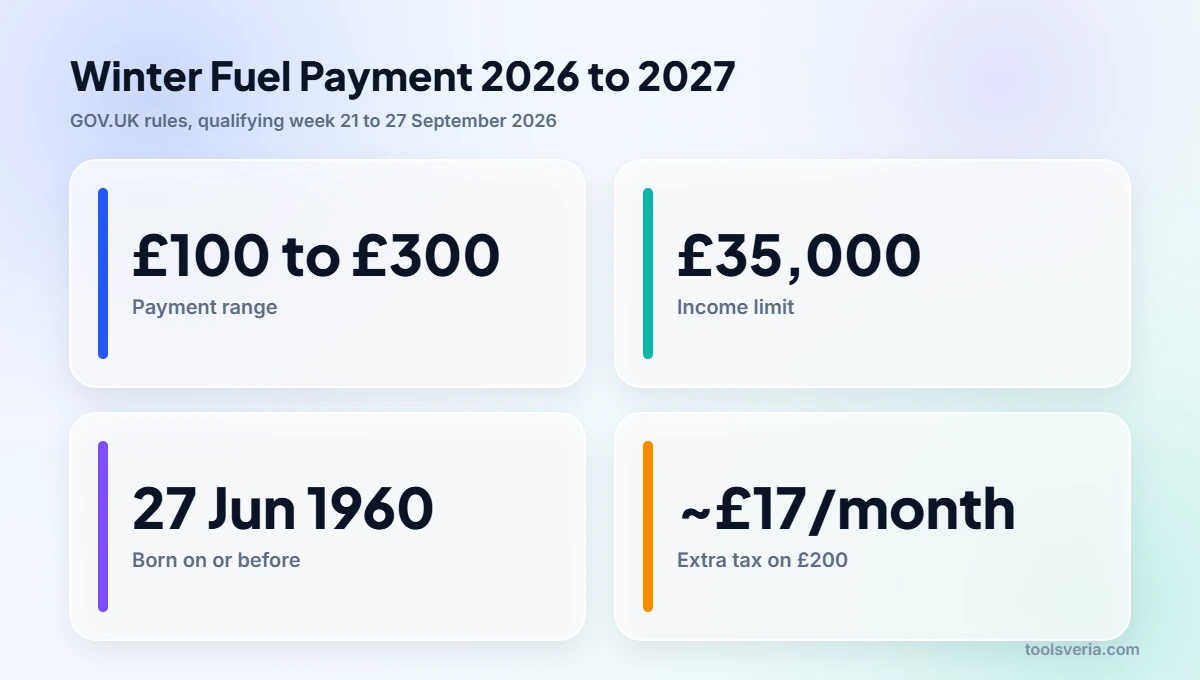
Quick answer: For winter 2026 to 2027, GOV.UK says HMRC takes back your whole Winter Fuel Payment, between £100 and £300, if your own total income for the 2026/27 tax year is over £35,000. At £35,000 or less you keep it. Your partner’s income is ignored, there is no taper, and Pension Credit claimants are exempt.
In This Guide
What is the Winter Fuel Payment 35000 rule?
The £35,000 rule means that any pensioner whose own total income for the tax year is more than £35,000 must repay the full Winter Fuel Payment through the tax system. The rule in plain words: add up your taxable income from 6 April 2026 to 5 April 2027, and if the total is over £35,000, the charge equals every pound of the payment you received.
There is no taper. Someone on £35,001 repays exactly as much as someone on £90,000, which is why the people most affected are those sitting a few hundred pounds over the line. The GOV.UK policy paper on the Winter Fuel Payments charge measures income as total income under section 23 of the Income Tax Act 2007 and exempts anyone on Pension Credit, Universal Credit, income based Jobseeker’s Allowance, income related ESA or Income Support.
Each person is tested alone. In a couple, one partner can keep the payment while the other repays it, and a high earning spouse never pulls the other over the limit.
How much is the Winter Fuel Payment for 2026 to 2027?
The Winter Fuel Payment for winter 2026 to 2027 is between £100 and £300, depending on your age and who you live with during the qualifying week of 21 to 27 September 2026. You must have been born on or before 27 June 1960, and the higher rate applies to anyone born before 28 September 1946.
| Your situation in the qualifying week | Born 28 Sep 1946 to 27 Jun 1960 | Born before 28 Sep 1946 |
|---|---|---|
| Live alone, or no one else at home qualifies | £200 | £300 |
| Live with someone born 28 Sep 1946 to 27 Jun 1960 | £100 | £200 |
| Live with someone born before 28 Sep 1946 | £100 | £150 |
| Live in a care home, no qualifying benefits | £100 | £150 |
Joint claims for Pension Credit and similar benefits have their own rows in the GOV.UK table of Winter Fuel Payment amounts, and a letter confirming your amount arrives in October or November. Most people are paid in November or December 2026. Scotland is not covered: Social Security Scotland runs its own Pension Age Winter Heating Payment instead.
What income counts towards the £35,000 limit?
All of your own taxable income counts towards the £35,000 limit, including the State Pension, workplace and personal pensions, earnings, self employed profits, savings interest, dividends, net rental profit and trust income. ISA interest and dividends are tax free, so they stay out of the total.
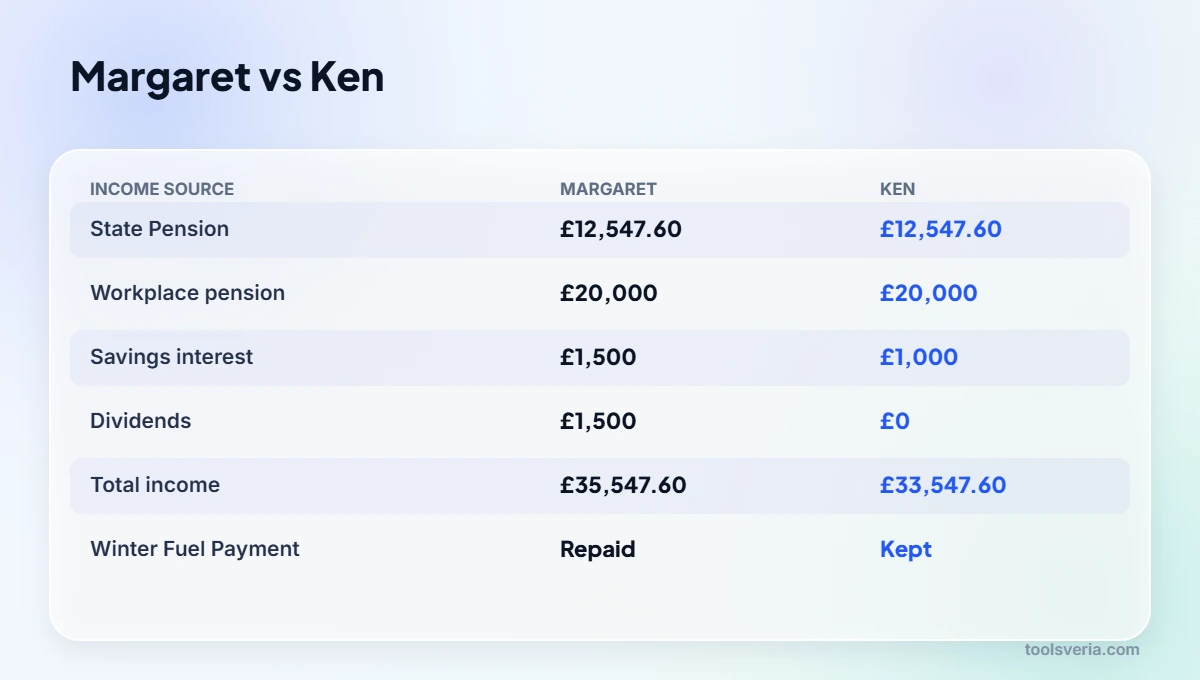
Margaret: £547.60 over the line
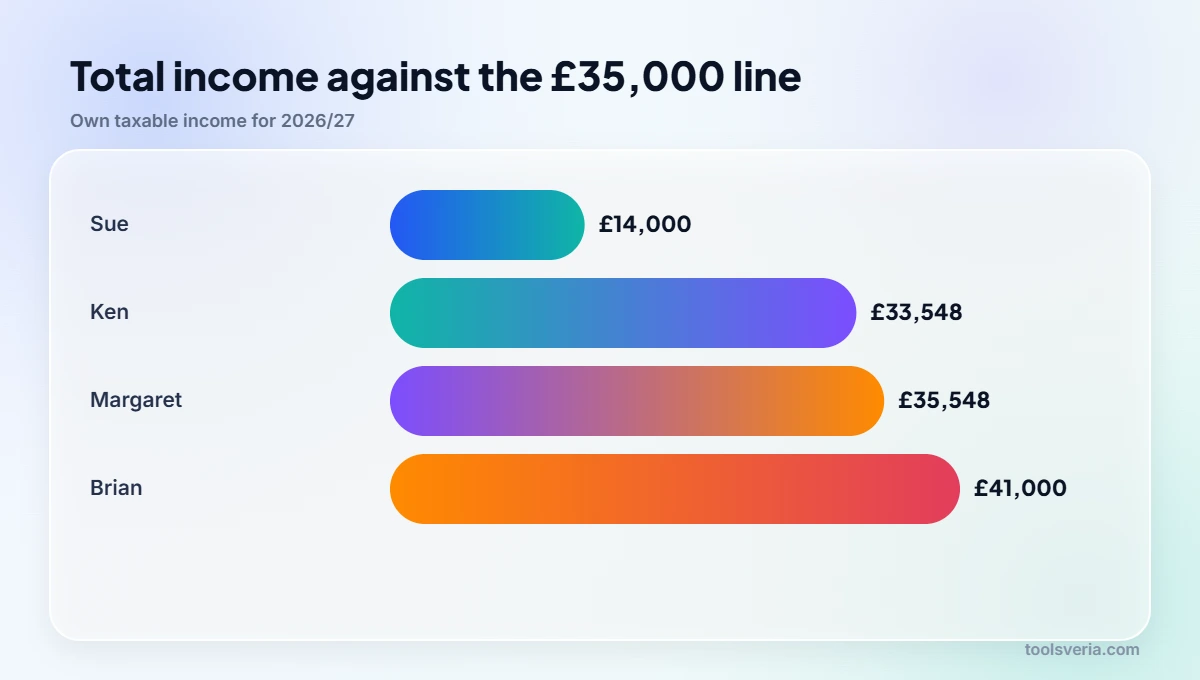
Margaret was born in 1955 and lives alone, so she receives £200. The full new State Pension of £241.30 a week gives her £12,547.60 a year, her workplace pension adds £20,000, a fixed rate bond pays £1,500 of interest and her shares pay £1,500 of dividends. Her total is £35,547.60, so HMRC recovers all £200.
Ken: £1,452.40 under the line
Ken has the same two pensions but only £1,000 of savings interest and no shares outside an ISA, giving £33,547.60. He keeps his £200 even though he still pays Income Tax on his pensions. Running both sets of figures through the savings interest calculator shows how a higher bond rate next year could push Ken’s interest, and his total, closer to £35,000.
A useful rule of thumb follows from these numbers. With the full new State Pension, you have roughly £22,452 of other taxable income before you reach £35,000. Joint savings and jointly owned property count only at your share, so a couple splitting £3,000 of joint interest each add £1,500.
Two traps catch people near the line. The test covers the whole tax year, so the taxable part of a pension withdrawal taken in March 2027 counts in full. And because the measure is total income, not the adjusted net income used for the Child Benefit charge, do not assume that Gift Aid or extra pension contributions will pull you back under £35,000 without checking with HMRC or an adviser.
How does HMRC take back the Winter Fuel Payment?
HMRC usually takes back the Winter Fuel Payment by changing your tax code, so a little more tax comes out of your pension each month, or by adding it to your bill if you file a Self Assessment return. For a typical £200 payment, GOV.UK puts the extra tax at about £17 a month.
The timing for this winter depends on your position last year. The GOV.UK page for incomes over £35,000 says that if HMRC is already collecting your 2025 payment, your tax code changes in January 2027 to start collecting the 2026 payment, then changes again in April 2027 to finish it and begin collecting the 2027 payment in advance.
Margaret’s April 2027 code therefore covers part of two winters, so her monthly deduction may look higher than £17 for a while. Checking the new code against her pension slip with the tax code calculator is the quickest way to see that the extra tax matches the payment and nothing more.
| Pensioner | Total 2026/27 income | Payment | Kept or repaid |
|---|---|---|---|
| Margaret, lives alone | £35,547.60 | £200 | Repaid in full |
| Ken, lives alone | £33,547.60 | £200 | Kept |
| Brian, lives with Sue | £41,000 | £100 | Repaid in full |
| Sue, lives with Brian | £14,000 | £100 | Kept |
| Graham, on Pension Credit | Any | £200 | Kept (exempt) |
Can I still opt out of the Winter Fuel Payment?
The opt out deadline for winter 2026 to 2027 was 11:59pm on 20 September 2026, so anyone over £35,000 who missed it will receive the payment and repay it through tax. Nothing is lost by that route apart from the paperwork, because the charge never exceeds the payment.
If you expect to stay over the limit, opting out before next year’s deadline saves a tax code change. Anyone with shares outside an ISA can model next year’s income with the dividend tax calculator before deciding. Pensioners close to the line, like Ken, are usually better off leaving the payment in place and checking their income each spring, because a quiet year for interest or dividends could leave them keeping it.
Key points
- HMRC recovers the whole Winter Fuel Payment if your own total income for 2026/27 is over £35,000.
- The payment for winter 2026 to 2027 is between £100 and £300, for people born on or before 27 June 1960.
- Your partner’s income is not added to yours, and there is no taper above £35,000.
- Pension Credit, Universal Credit, income based JSA, income related ESA and Income Support claimants keep the payment.
- For a £200 payment, the extra tax collected through a tax code is about £17 a month.
Winter Fuel Payment £35,000 Rule Terms Explained
These definitions explain the income test and exemptions behind the Winter Fuel Payment £35,000 rule, helping you judge whether HMRC will recover your payment.
- Winter Fuel Payment
- An annual tax free payment from the government to help people over State Pension age with heating costs. The amount depends on age and household during a qualifying week, and in winter 2026 to 2027 it ranges from £100 to £300.
- Winter Fuel Payments charge
- The tax mechanism HMRC uses to take back the payment from people whose income exceeds the limit. It is collected as extra Income Tax, so the recovery happens through the tax system rather than by repaying DWP directly.
- Total income
- The income measure defined in section 23 of the Income Tax Act 2007, adding up taxable pensions, earnings, savings interest, dividends and rents before the Personal Allowance. It is this total, not take-home income, that is compared with £35,000.
- Cliff edge threshold
- A limit where crossing by a single pound removes the whole benefit rather than reducing it gradually. Because the £35,000 test has no taper, people just above the line lose as much as those far above it.
- Qualifying week
- The week in September used to decide entitlement and amount, which for this winter runs from 21 to 27 September 2026. Age, address and who lives with you during that week fix the payment rate.
- Means-tested benefit exemption
- The rule that people receiving Pension Credit or certain other income related benefits keep the payment whatever their total income. These claimants are outside the charge because their entitlement already depends on low income.
Frequently Asked Questions
My income is exactly £35,000. Do I keep the payment?
Yes, an income of exactly £35,000 keeps the payment, because HMRC only recovers it when total income is more than £35,000. Just £1 over means the whole £100 to £300 is taken back.
My husband earns £50,000 and I have £15,000. Do I lose mine too?
No, each person is tested on their own income only. On £15,000 you keep your payment, while your husband’s payment is recovered from him because his £50,000 is over the £35,000 limit.
I have £4,000 of interest from a cash ISA. Does it count?
No, interest earned inside a cash ISA is tax free and is not part of taxable total income. Interest from an ordinary savings account or bond does count, so £4,000 earned outside an ISA would be added in full.
I live in Glasgow. Does the £35,000 rule apply to me?
Not to the Winter Fuel Payment, because people living in Scotland cannot get it. Scottish pensioners may get the Pension Age Winter Heating Payment from Social Security Scotland instead, which has its own rules.
Margaret now knows her £547.60 overshoot costs her the full £200, and Ken knows how much headroom he has before next winter. Add up your own income sources in the calculator to see which side of £35,000 you sit on. Figures checked October 2026.