Find the yield on a share and the income it could pay you each year.
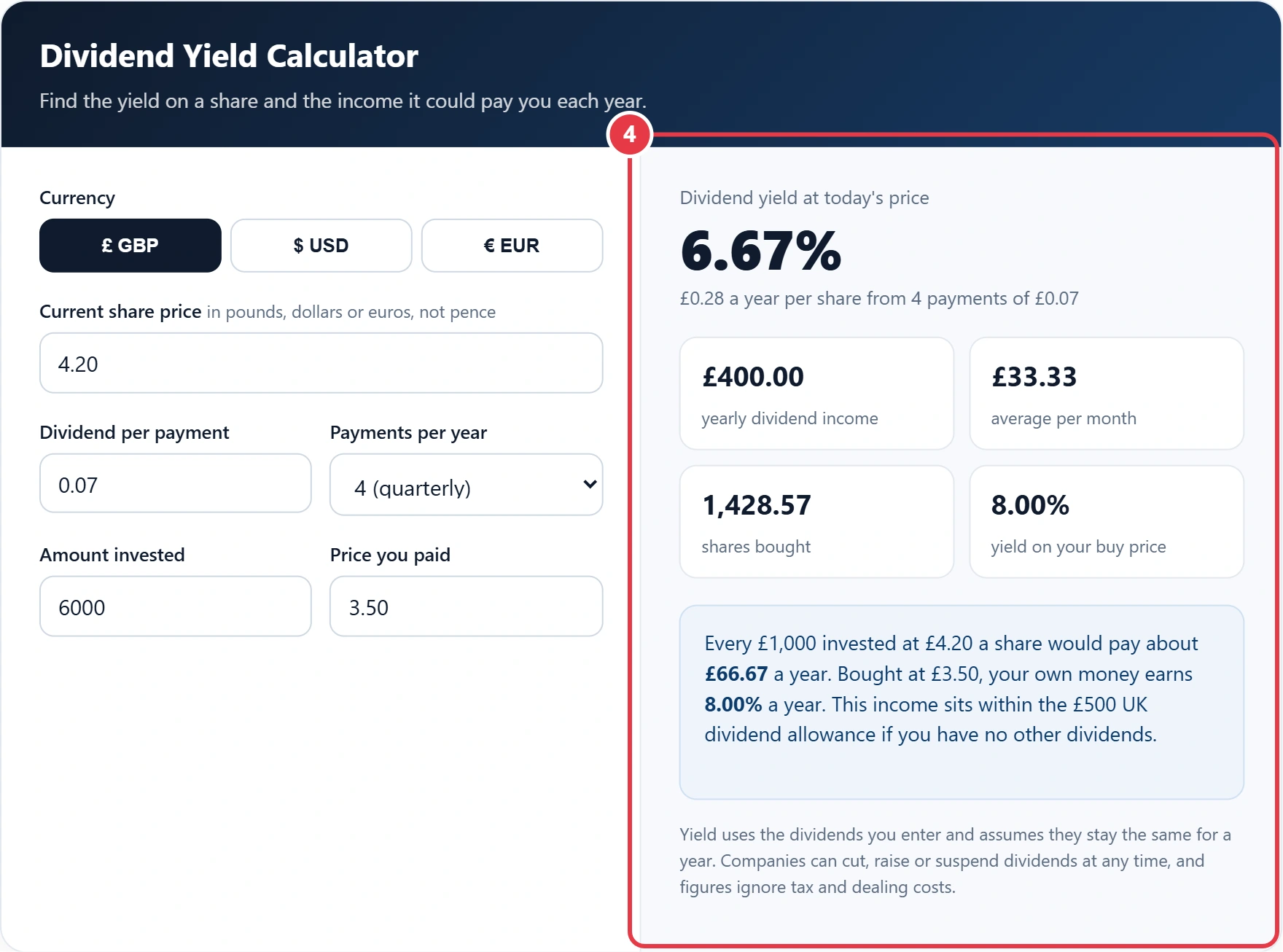
Yield uses the dividends you enter and assumes they stay the same for a year. Companies can cut, raise or suspend dividends at any time, and figures ignore tax and dealing costs.
A share that pays 7p four times a year sounds modest until you set it against the price you pay. This dividend yield calculator turns the payouts and the share price into a yield, then shows the cash your holding could produce, with a reminder of the £500 UK dividend allowance when you work in pounds. It also gives your yield on cost, which tells long term holders how hard their original money is now working.
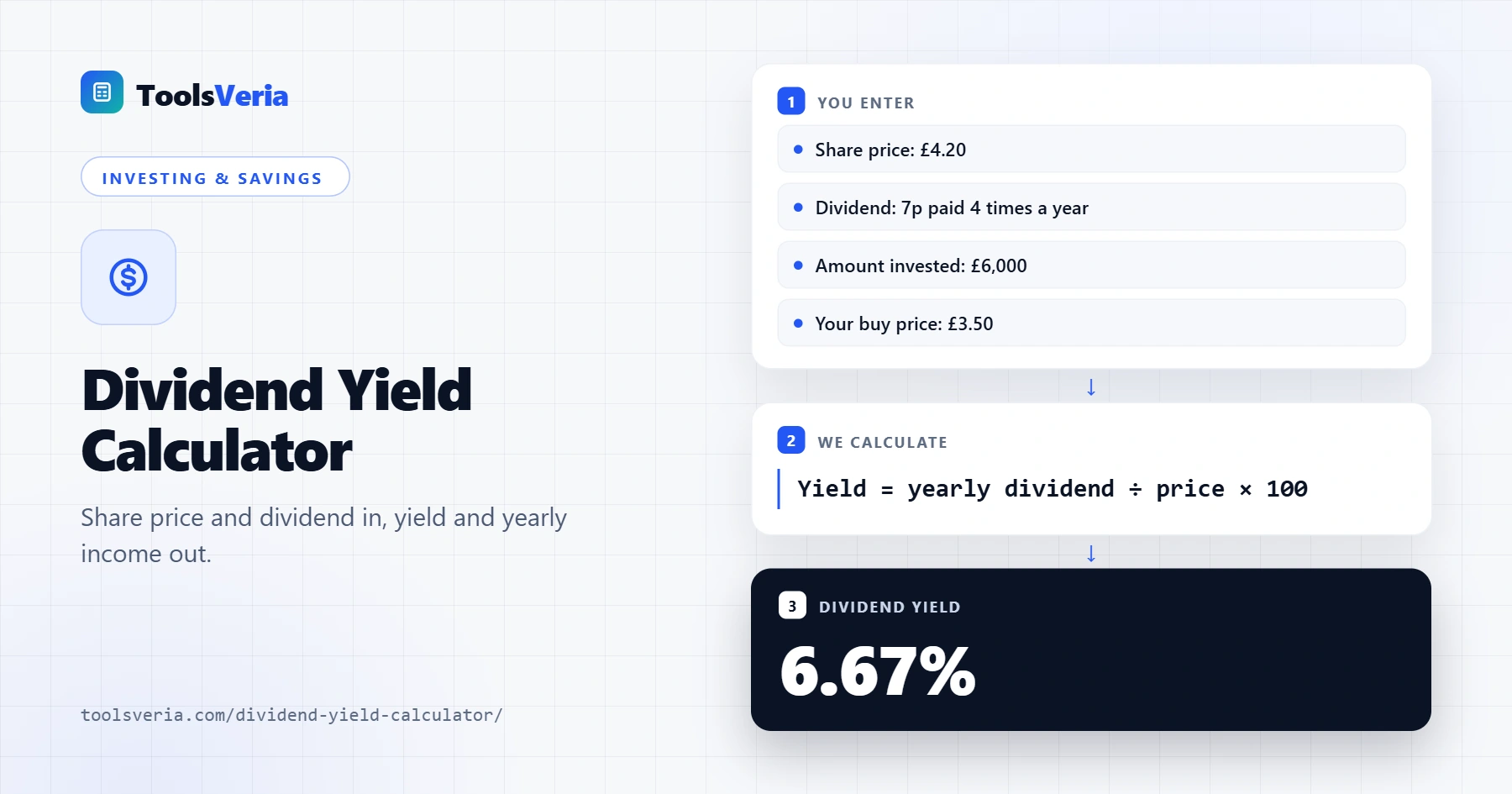
Quick answer: A dividend yield calculator divides the yearly dividend per share by the share price and multiplies by 100. A share priced at £4.20 that pays 7p every quarter has a yearly dividend of 28p, giving a yield of 6.67%. Because price sits underneath the fraction, the yield rises when the share price falls.
In This Guide
What Is Dividend Yield?
Dividend yield is the cash a company hands to shareholders over a year, shown as a percentage of what one share costs today. It lets you compare a bank, a utility and a tobacco firm on the same footing, even though their share prices and payout amounts look nothing alike.
The sum is yearly dividend per share ÷ share price × 100. Take Priya, who has £6,000 to put into a utility share priced at £4.20 that pays 7p every quarter. The yearly dividend is 28p, so the yield is 0.28 ÷ 4.20 × 100 = 6.67%. Her £6,000 buys about 1,428 shares, which would pay roughly £400 a year if the dividend holds. Because price sits underneath the fraction, the yield rises when the share falls, even if the company pays out exactly the same.
How to Use the Dividend Yield Calculator
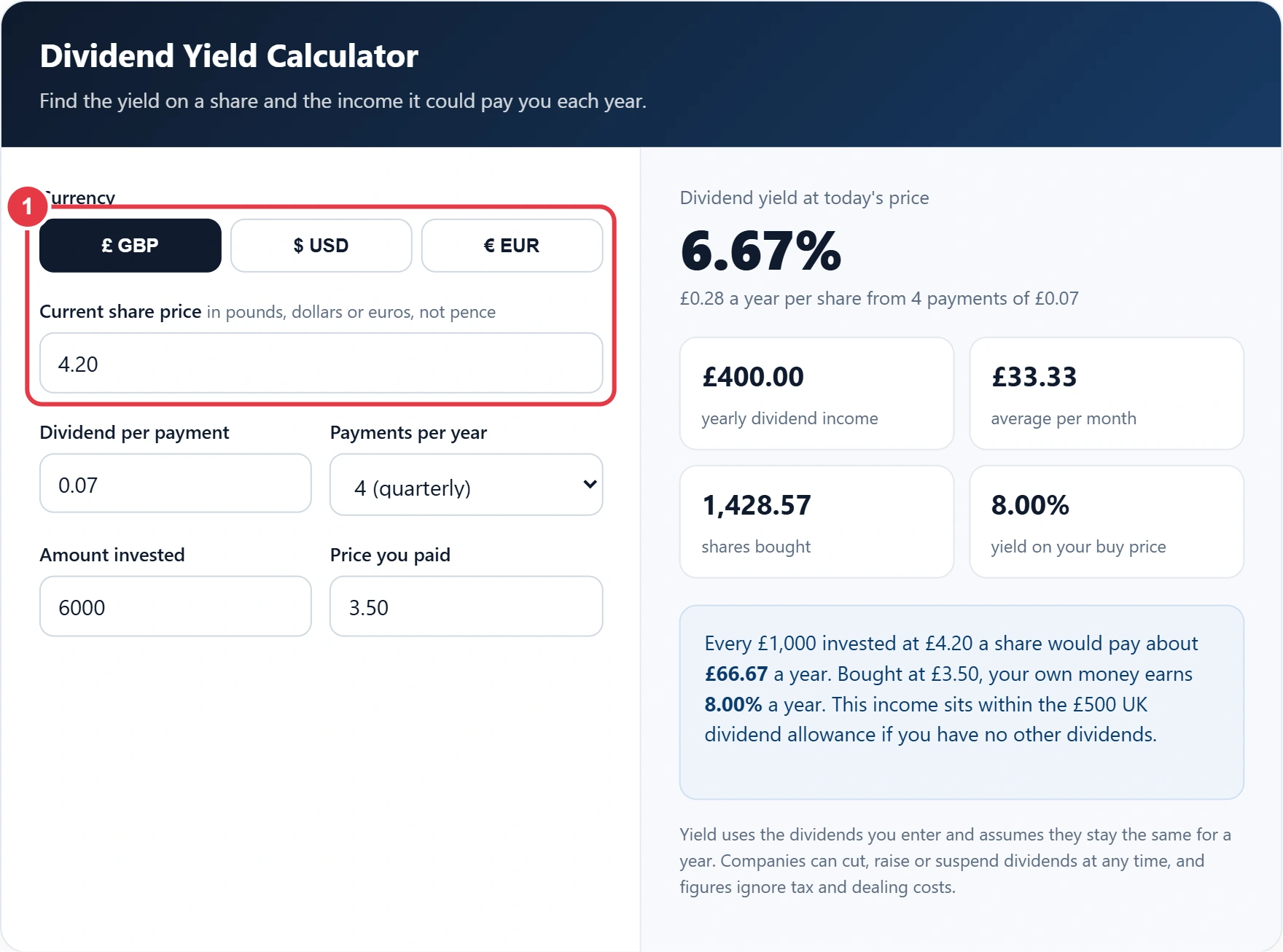
Step 1: Pick a Currency and Enter the Share Price
Choose pounds, dollars or euros, then type the current price of one share. London prices are often quoted in pence, so a share shown as 420p goes in as 4.20.
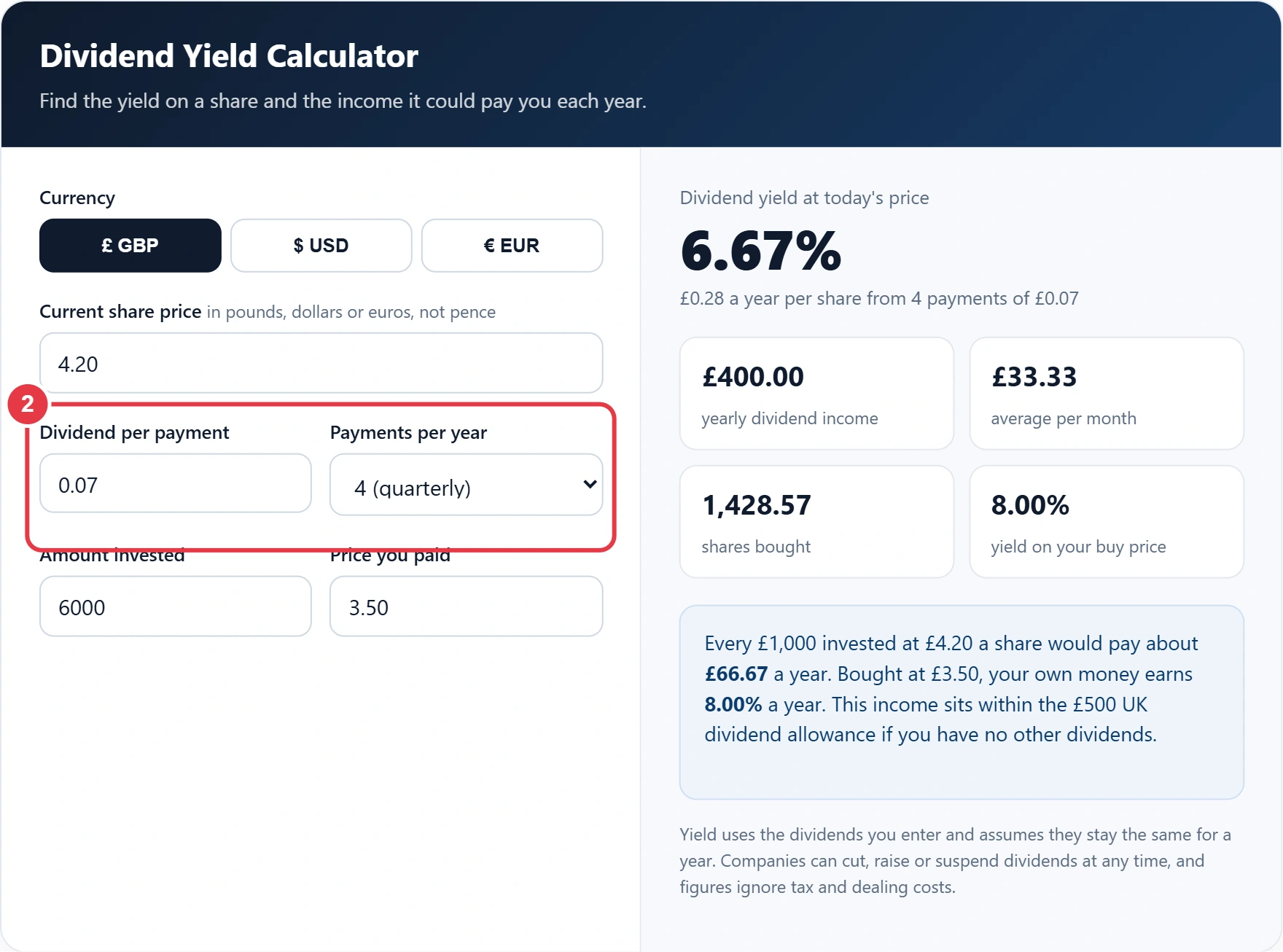
Step 2: Add the Dividend and How Often It Is Paid
Enter one payment per share and select how many arrive each year. Most FTSE companies pay twice, many US firms pay quarterly and some investment trusts pay monthly. If a company paid a one off special dividend, leave it out so the yield reflects what is likely to repeat.
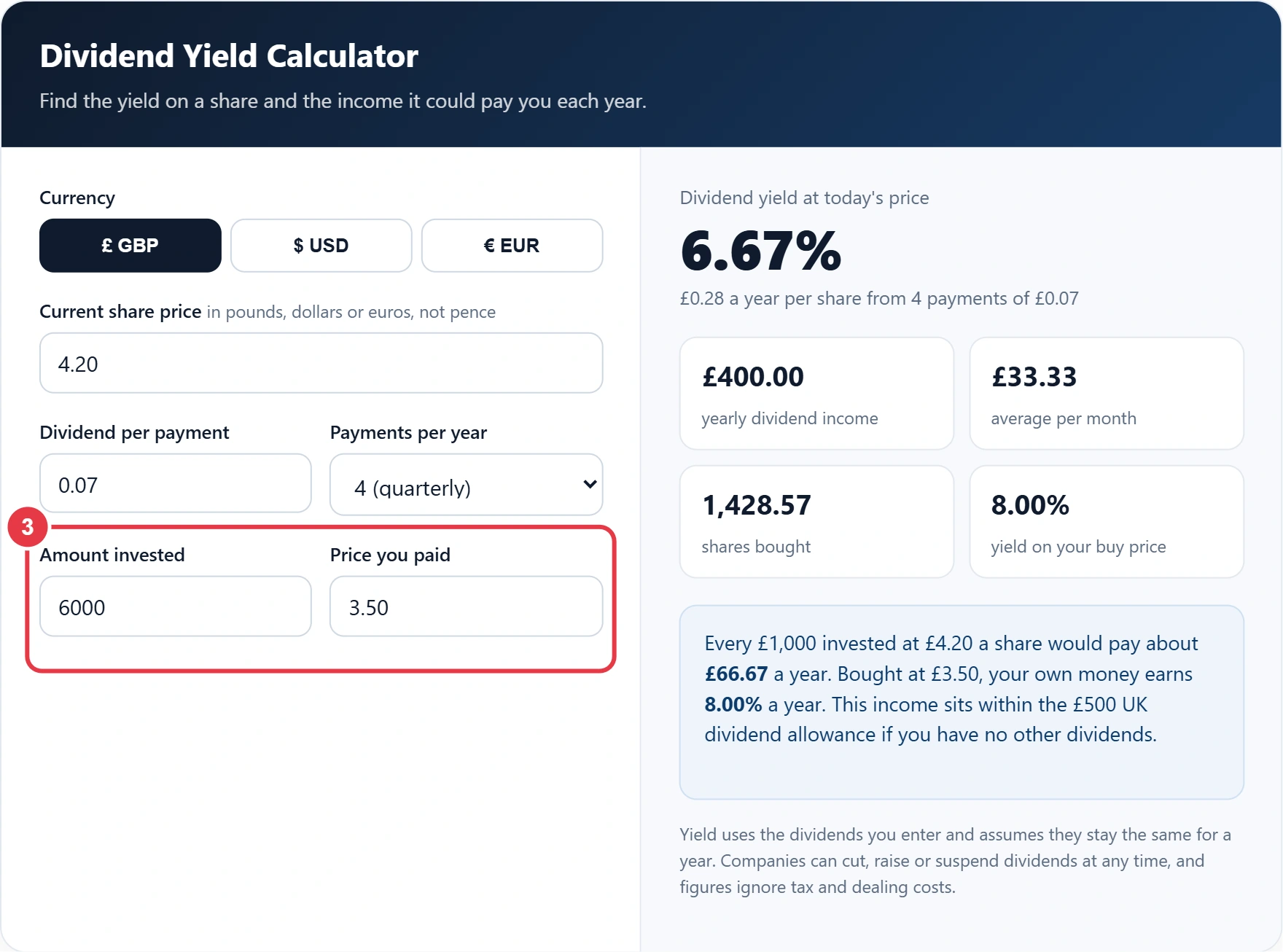
Step 3: Enter Your Investment and Buy Price
The amount invested gives you a yearly and monthly income figure. The price you paid works out your yield on cost: if Priya had bought at £3.50, the same 28p would be an 8% return on her original stake. To see what happens if those dividends are reinvested for years, the compound interest calculator projects the growth from a starting sum and a yearly rate.
Step 4: Read Your Results
The panel shows the yield, the yearly dividend per share, your income and your yield on cost. If the income is above £500 and the shares sit outside an ISA, the dividend tax calculator shows how much of it goes to HMRC at your tax band.
Reading a Yield Sensibly
| Share price | Yearly dividend | Yield | Income on £10,000 |
|---|---|---|---|
| £2.50 | 10p | 4.00% | £400 |
| £4.20 | 28p | 6.67% | £667 |
| £12.00 | 36p | 3.00% | £300 |
| £1.60 | 18p | 11.25% | £1,125 |
The last row is the one to treat with care. A double digit yield usually means the price has dropped because investors doubt the payout will last, so check whether profits cover the dividend before you buy. The MoneyHelper beginner's guide to investing is a useful reminder that income from shares is never guaranteed, and that spreading money across several holdings lowers the damage from any single cut.
Dividend Yield Calculator Terms You Should Know
These definitions explain the share income ideas behind the dividend yield calculator, helping you compare payouts fairly and spot yields that may not last.
- Dividend per share
- The total cash a company pays out for each ordinary share over a set period, usually a year. Adding every interim and final payment gives the annual figure used as the top line of the yield calculation.
- Trailing yield
- A yield based on dividends actually paid over the past twelve months, divided by today's price. It reflects real payouts but can be out of date if the company has since announced a cut or a rise.
- Ex-dividend date
- The date from which a share trades without the right to its next declared dividend. Buyers on or after it do not receive that payment, and the share price often falls by roughly the dividend amount.
- Payout ratio
- The proportion of a company's earnings paid out as dividends. A very high ratio leaves little profit to reinvest or absorb a downturn, which can make the dividend more vulnerable to being reduced.
- Yield trap
- A share whose unusually high yield reflects a falling price rather than a generous, secure payout. The market is often signalling doubt about future dividends, so the headline yield may disappear if the payment is cut.
- Special dividend
- A one off payment made outside a company's regular dividend pattern, often after an asset sale or an exceptional year. It is usually excluded from yield figures because it is not expected to repeat.
</>Embed this calculator on your website
Add the free Dividend Yield Calculator to your own site or blog. Copy the code below and paste it into an HTML block. It resizes itself and works on phones.
How we checked this tool: the Tools Veria Editorial Team built this tool by hand, checked it against the official rules or published standards where they apply, and tested it against worked examples. Results are estimates for planning, not personal financial or tax advice. Read our editorial policy and disclaimer, or report an error.
Frequently Asked Questions
What is a good dividend yield for a UK share?
Many large UK companies yield somewhere between 3% and 6%. A yield well above that can signal a high risk of the dividend being cut rather than a bargain.
Should I use the last dividend or the forecast dividend?
The last 12 months of payments give a trailing yield based on facts. A forecast gives a forward yield, which is useful but depends on the company delivering it.
Why did the dividend yield go up when the share price fell?
The yield divides the dividend by the price. If the price falls and the dividend stays the same, the yield rises automatically.
What is yield on cost?
It is the yearly dividend divided by the price you originally paid. It shows how the income on your own money has grown as the company raised its payout.
Are dividends in an ISA taxed?
No. Dividends from shares held in a stocks and shares ISA are free of UK tax and do not use up your £500 dividend allowance.
Do I enter the share price in pence or pounds?
Enter it in pounds. A share listed at 420p should be typed as 4.20, and a 7p dividend as 0.07.