Compare two fund charges and see what the difference costs you over time.
Use the expense ratio, or the OCF (ongoing charges figure) shown on UK fund factsheets. The platform fee applies to both funds.
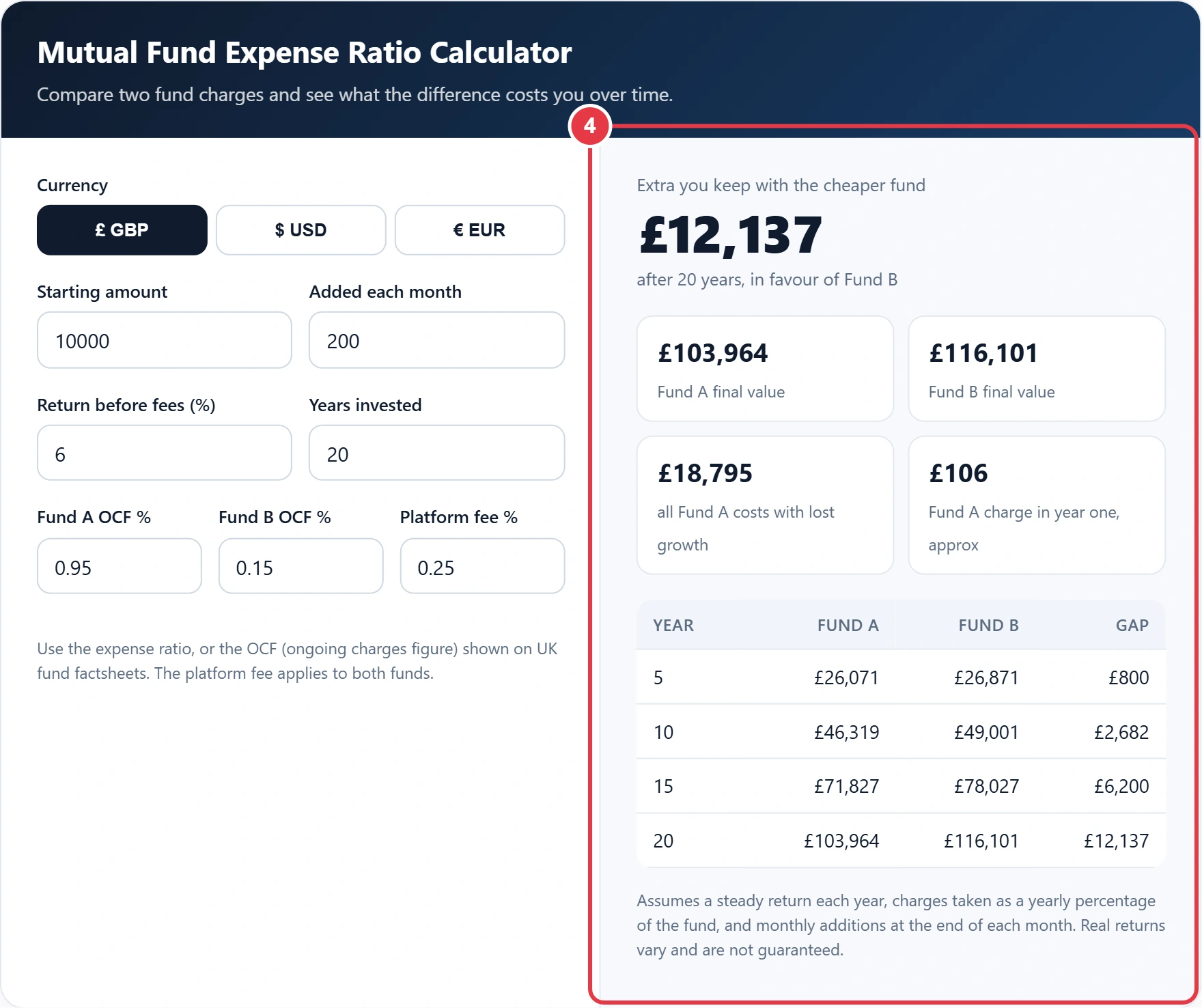
| Year | Fund A | Fund B | Gap |
|---|
Assumes a steady return each year, charges taken as a yearly percentage of the fund, and monthly additions at the end of each month. Real returns vary and are not guaranteed.
A fund charge of 0.95% looks tiny on a factsheet, yet over twenty years it can quietly swallow a five figure sum. This mutual fund expense ratio calculator puts two funds side by side and shows how much each charge takes from your pot. In the UK the same figure is called the OCF, or ongoing charges figure, and you can enter whichever your provider shows.
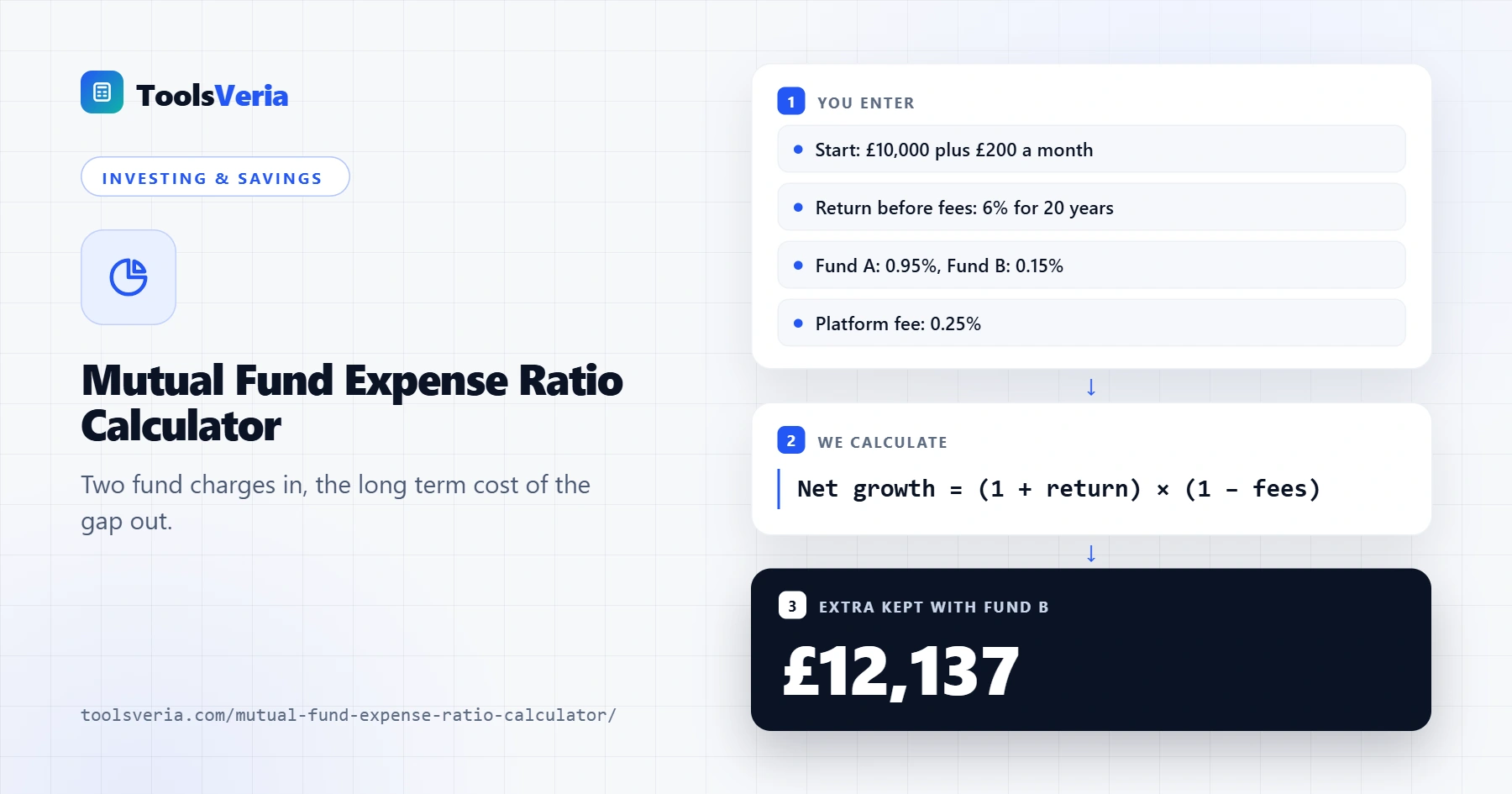
Quick answer: A mutual fund expense ratio calculator grows your money each year by (1 + return) × (1 − total charges). Starting with £10,000 and adding £200 a month for 20 years at 6%, with a 0.25% platform fee, a 0.95% fund ends at about £103,960 and a 0.15% tracker at about £116,100.
In This Guide
What Is an Expense Ratio or OCF?
An expense ratio is the yearly cost of running a fund, taken as a percentage of the money you have in it. You never see a bill: the charge comes out of the fund's value bit by bit, so your returns are simply lower. UK funds publish this as the OCF on their key information document, while US funds use the term expense ratio.
The calculator grows your money each year by (1 + return) × (1 − total charges), adding your monthly payments as it goes. Take Daniel, who starts with £10,000 and adds £200 a month for 20 years, assuming 6% a year before fees and a 0.25% platform fee. In an active fund charging 0.95%, he ends with about £103,960. In a tracker charging 0.15% he ends with about £116,100, so the cheaper fund leaves him roughly £12,140 better off from the same savings and the same market.
How to Use the Mutual Fund Expense Ratio Calculator
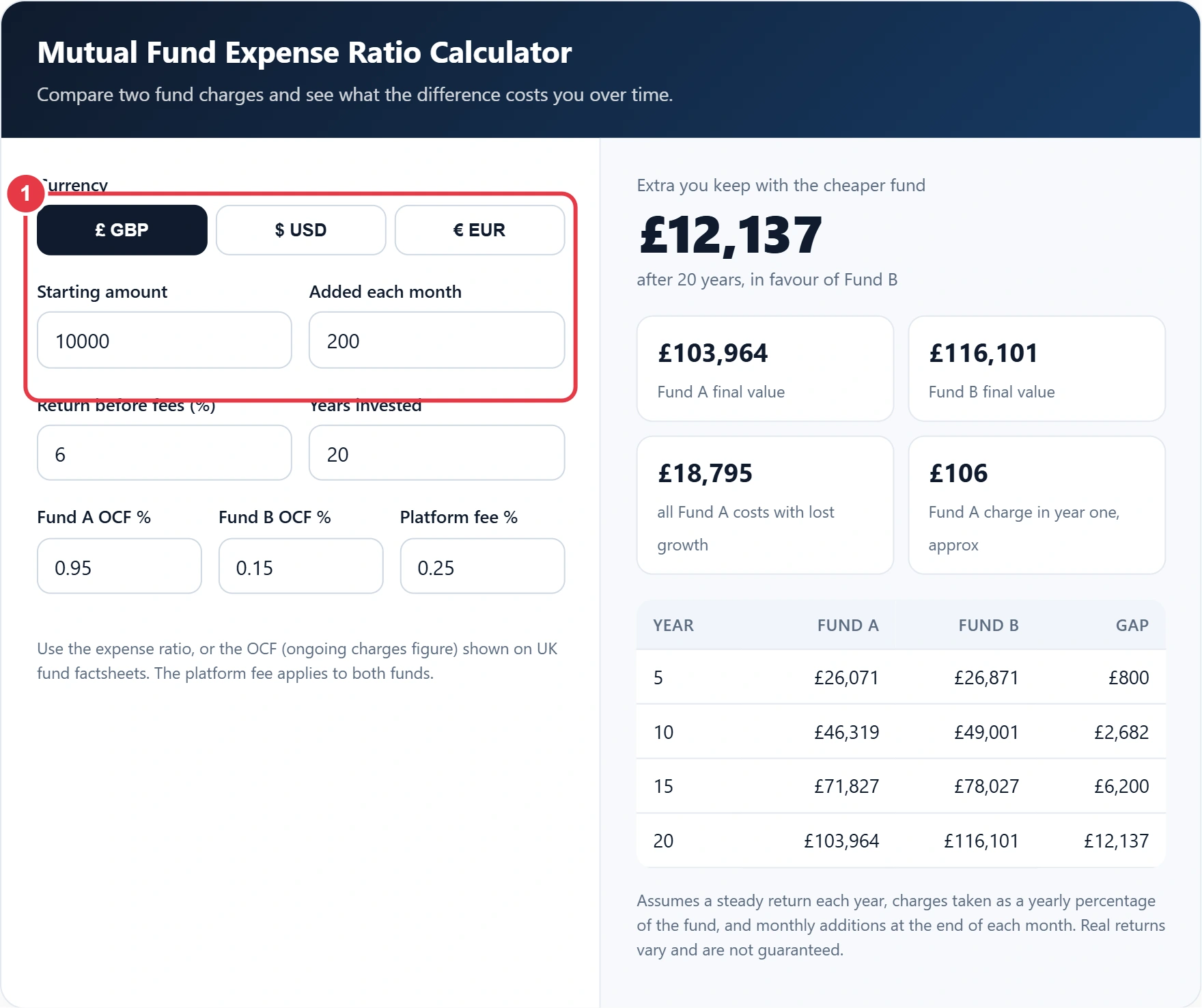
Step 1: Enter What You Invest
Choose a currency, then type your starting lump sum and how much you plan to add each month. Leave the monthly figure at zero if you are investing a single sum.
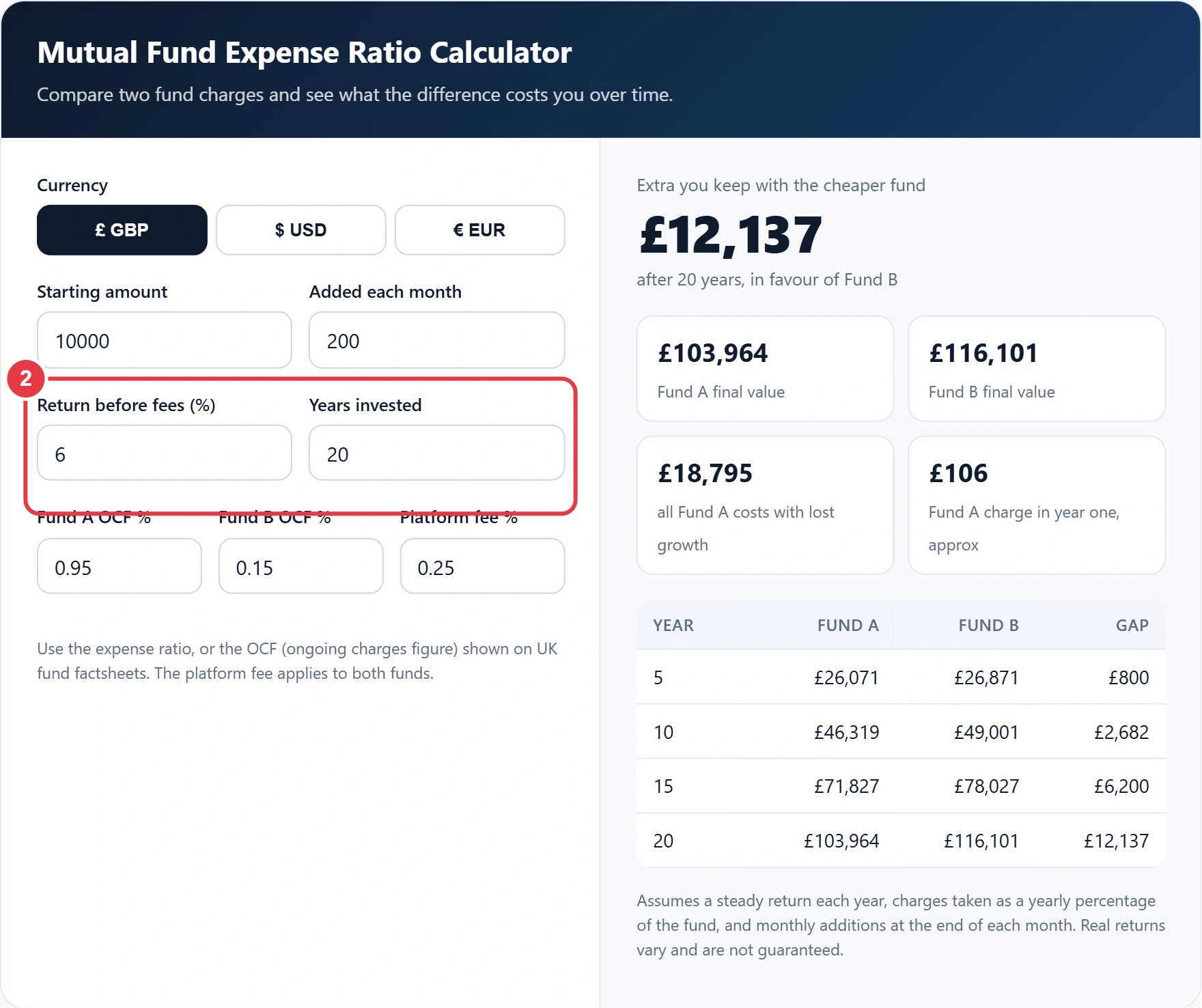
Step 2: Set the Return and Time Frame
Pick a yearly return before charges and the number of years. Use a cautious figure, as markets rise and fall. Running the same numbers through the inflation calculator afterwards shows what the final pot might be worth in today's money.
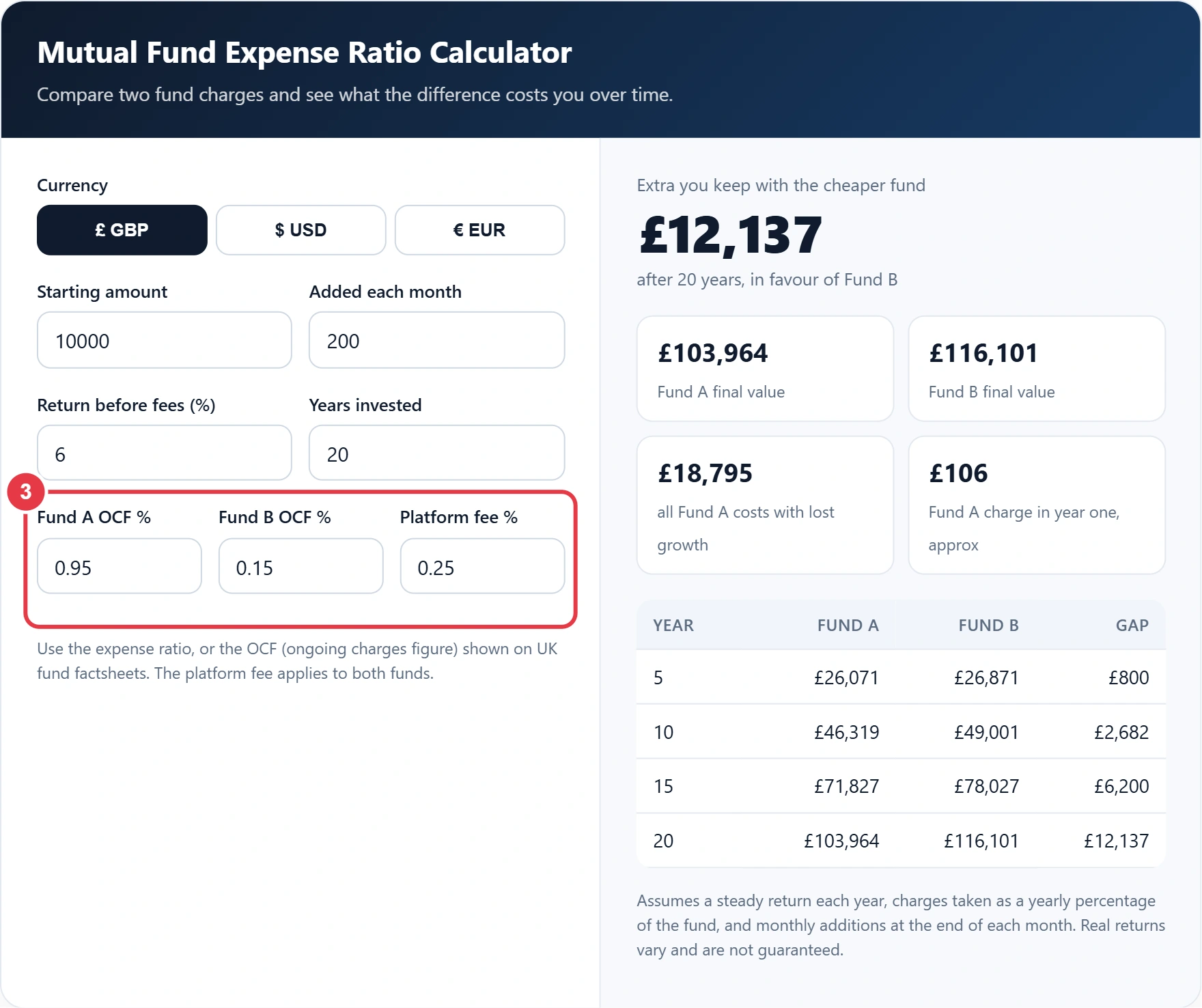
Step 3: Enter the Fund Charges
Type the OCF or expense ratio for each fund, plus any platform or adviser fee charged as a percentage. Most providers show the charge on the fund's factsheet, and an overview of expense ratios explains which running costs it covers and which it leaves out, such as dealing costs inside the fund.
Step 4: Compare the Results
The headline shows the extra you keep with the cheaper fund. Below it are both final values, the total Fund A charges cost you including the growth they would have earned, and a table showing how the gap widens over time.
Why Small Charges Add Up
Charges compound just like returns do, only in the wrong direction. Every pound taken in fees is a pound that can no longer grow, which is why the gap in the table speeds up in later years. The compound interest calculator shows the same effect from the growth side if you want to test a single rate.
- A higher charge is only worth paying if the fund consistently beats a cheaper alternative by more than the extra cost.
- Check the full cost, including platform fees and any adviser charge, not just the OCF.
- Index trackers often charge well under 0.25%, while many actively managed funds charge 0.75% or more.
Before you switch funds or platforms, the MoneyHelper guide to investing is worth a read, as it explains how fees reduce returns and why your attitude to risk matters as much as cost.
Key Mutual Fund Expense Ratio Terms Explained
These investing terms explain what the mutual fund expense ratio calculator measures, helping you compare fund charges and understand how small percentages shape long term returns.
- Expense ratio
- The share of a fund's assets used each year to cover its running costs, such as management, administration and custody. It is deducted from the fund's value rather than billed, so investors see it only as a slightly lower return.
- Ongoing charges figure
- The UK and European name for a fund's yearly running costs expressed as a percentage, published in its key investor documents. It covers most recurring costs but excludes trading costs incurred when the fund buys and sells holdings.
- Platform fee
- A charge made by an investment platform or wrapper provider for holding your funds, usually a percentage of the account value or a flat fee. It applies on top of fund charges, so both must be counted when comparing total costs.
- Index fund
- A fund that aims to match the performance of a market index by holding its constituents, rather than picking investments. Because it needs little research or trading, it typically charges much less than an actively managed fund.
- Active management
- An approach in which a fund manager selects investments with the aim of beating a benchmark. Higher research and dealing costs mean higher charges, which only pay off if the fund outperforms by more than the extra cost.
- Fee drag
- The cumulative reduction in an investment's value caused by charges compounding over time. Each pound removed in fees also loses all the growth it would have earned, so the gap between cheap and expensive funds widens every year.
</>Embed this calculator on your website
Add the free Fund Fees Calculator (OCF) to your own site or blog. Copy the code below and paste it into an HTML block. It resizes itself and works on phones.
How we checked this tool: the Tools Veria Editorial Team built this tool by hand, checked it against the official rules or published standards where they apply, and tested it against worked examples. Results are estimates for planning, not personal financial or tax advice. Read our editorial policy and disclaimer, or report an error.
Frequently Asked Questions
Is the OCF the same as the expense ratio?
They measure the same thing: the yearly cost of running a fund as a percentage of your money. UK funds call it the ongoing charges figure, and US funds call it the expense ratio.
Does the OCF include all fund costs?
No. It covers management and running costs but not the fund's own trading costs, and it excludes platform fees. Check the transaction costs on the fund's documents too.
How is a 1% fund charge taken?
It is deducted from the fund's value a little at a time, usually daily. You will not see a separate bill, just a lower fund price.
What is a typical OCF for an index tracker?
Many global and UK index trackers charge between 0.05% and 0.25% a year. Active funds commonly charge 0.6% to 1% or more.
Should I always choose the fund with the lowest charge?
Not always, but a higher charge needs to be earned back through better performance after costs. Over long periods, few expensive funds manage that consistently.
Why does the gap grow faster in later years?
Charges are a percentage of a pot that keeps growing, and every pound taken also loses its future growth. The effect compounds over time.