Marcus has managed a warehouse team for twelve years, and last week his employer confirmed his role is going. He is 45, earns £820 a week before tax, and wants to know the minimum he is owed. Statutory redundancy pay 2026 rules give a precise answer, but three details shape it: his age in each year of service, the number of full years he has worked and a weekly cap that trims his real pay.
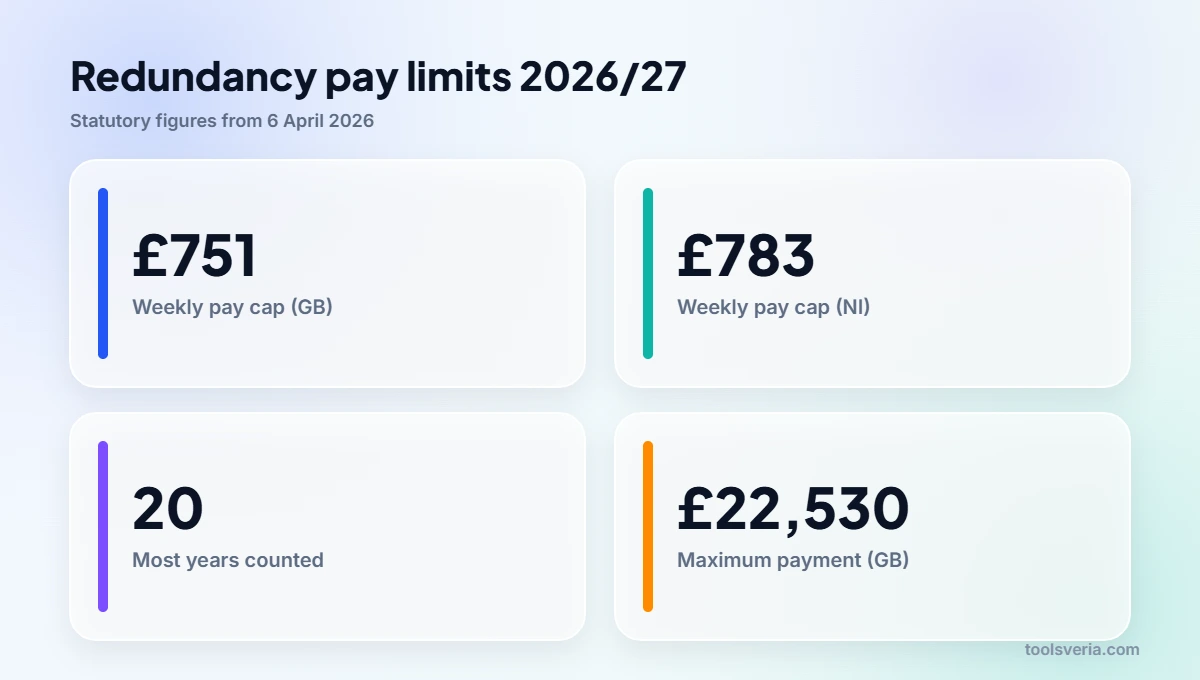
Quick answer: Statutory redundancy pay 2026 rules give 0.5, 1 or 1.5 weeks of pay for each full year of service, depending on your age in that year, once you have two years of service. Weekly pay is capped at £751 in Great Britain and £783 in Northern Ireland, and only 20 years count, so the GB maximum is £22,530.
We will follow Marcus and three colleagues with very different circumstances, using the figures that apply to redundancies from 6 April 2026. Each example is worked through so that you can repeat the steps with your own dates and wages.
In This Guide
How Long Must You Work to Get Statutory Redundancy Pay?
An employee must have at least two years of continuous service with the employer, and with less than that the statutory figure is nil however much they earn. Before any sums are done, an employee must have at least two years of continuous service with the employer. Priti, an analyst aged 38, joined the same company as Marcus one year and eleven months before her redundancy date. However much she earns, her statutory figure is nil, although her contract might still promise something extra.
Service is measured up to the date employment actually ends, so a few weeks can be decisive. If you are close to the line, count the exact gap between your start date and your leaving date with our days between dates calculator rather than relying on memory. The GOV.UK guidance on redundancy pay sets out the qualifying rules and is worth reading alongside your contract.
Age bands turn years into weeks
Under statutory redundancy pay 2026 rules, each full year of service earns a set number of weeks of pay, and the multiplier depends on how old you were during that particular year:
- Years when you were under 22: half a week’s pay each.
- Years when you were 22 to 40: one week’s pay each.
- Years when you were 41 or older: one and a half weeks’ pay each.
You count backwards from the redundancy date, and only the most recent 20 years are used. Part years are dropped entirely, so eleven years and ten months counts as eleven. This backwards counting is why older employees with long service gain the most: their latest years fall in the highest band.
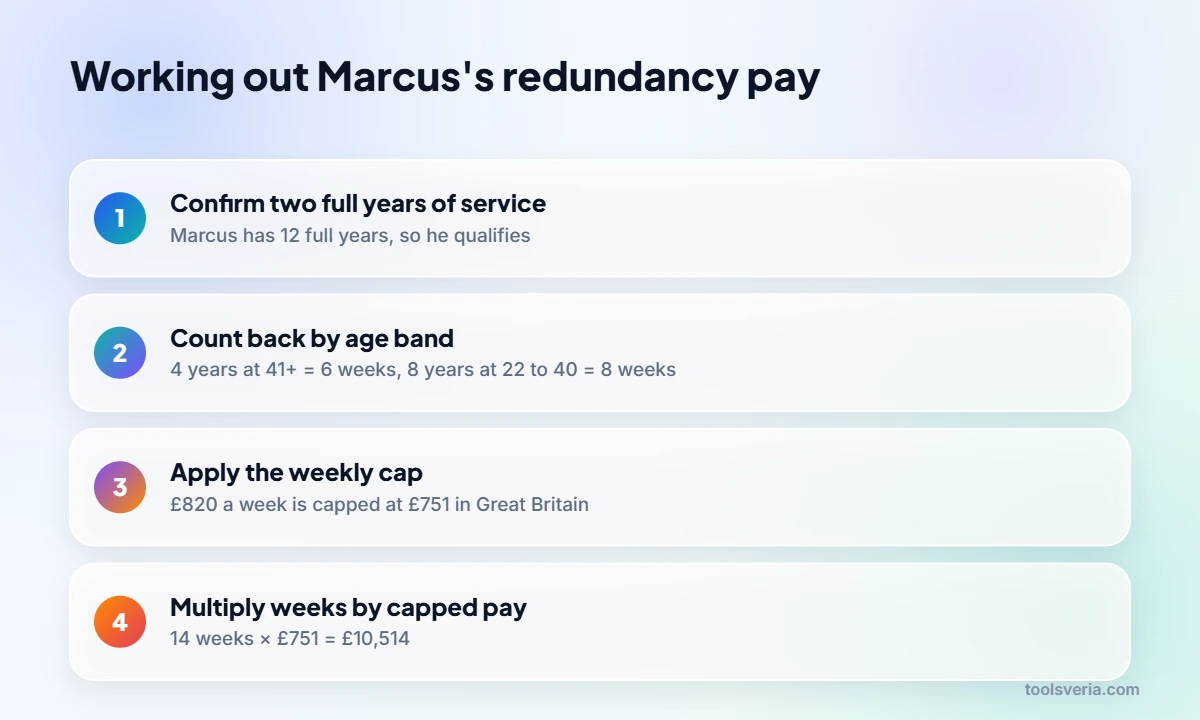
Marcus is 45 with twelve full years. Working back, his four most recent years were spent at 41 or over, earning 1.5 weeks each, a total of 6. The eight years before that sat in the 22 to 40 band, adding 8 more. His entitlement is therefore 14 weeks of pay.
What Is the Weekly Pay Cap for Statutory Redundancy Pay?
A week’s pay cannot exceed £751 in England, Scotland and Wales for redundancies from 6 April 2026, and in Northern Ireland the cap is higher, at £783. A week’s pay for this purpose is your gross weekly wage, but it cannot exceed £751 in England, Scotland and Wales for redundancies from 6 April 2026. In Northern Ireland the cap is higher, at £783. Anyone earning more is treated as if they earned exactly the cap.
Marcus earns £820, so his week is capped at £751. Fourteen weeks at £751 gives him £10,514. If he worked for the same firm’s Belfast depot, the figure would be 14 × £783, or £10,962. The difference of £448 comes purely from where the job is based.
Hourly paid staff often ask what counts as their normal week. Where hours are fixed, it is simply contracted hours at the usual rate. If your pay varies, an average over recent weeks is used, and our hourly to annual salary calculator helps you turn an hourly rate into a weekly figure before entering it.
Four colleagues, four results
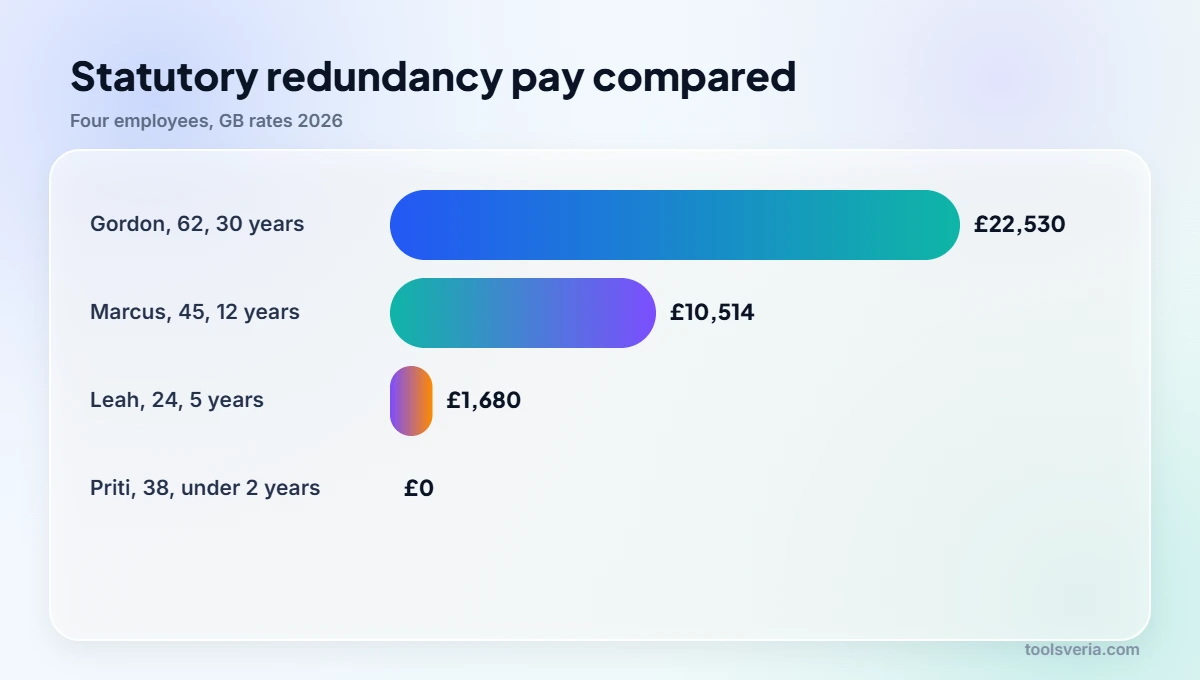
Leah is 24 and joined at 19 on £480 a week. Counting back over her five years, the two most recent were at age 22 or 23, giving 2 weeks. The three earlier years were before 22, giving 1.5 weeks. Her 3.5 weeks at £480 come to £1,680, with no cap applied because she earns below £751.
Gordon is 62 and has worked there for 30 years on £900 a week. Only 20 years count, all of them at 41 or older, so he earns 30 weeks. At the £751 cap that produces £22,530, the highest statutory payment possible in Great Britain.
| Employee | Age | Full years | Weekly pay used | Weeks | Statutory pay (GB) |
|---|---|---|---|---|---|
| Priti | 38 | 1 | Not relevant | 0 | £0 |
| Leah | 24 | 5 | £480 | 3.5 | £1,680 |
| Marcus | 45 | 12 | £751 (capped from £820) | 14 | £10,514 |
| Gordon | 62 | 30 (20 counted) | £751 (capped from £900) | 30 | £22,530 |
Gordon’s example shows the ceiling working twice. Ten of his thirty years are ignored, and £149 of his weekly wage falls outside the calculation. Long serving, well paid staff often find that a contractual or enhanced scheme matters far more to them than the statutory floor.
Is Statutory Redundancy Pay Taxable?
Statutory redundancy pay figures are usually free of income tax up to £30,000 when combined with other qualifying termination payments. Statutory redundancy pay 2026 figures are usually free of income tax up to £30,000 when combined with other qualifying termination payments, so Marcus, Leah and Gordon should all receive their statutory sums without deductions. That is not true of everything in a final payslip. Normal wages up to the leaving date, pay for untaken holiday and contractual notice pay are taxed in the usual way.
Notice is a separate entitlement from the redundancy sum. By law, someone with two or more years of service gets at least one week of notice for each full year, up to a ceiling of twelve weeks, and a contract can offer more. Marcus therefore has at least twelve weeks of notice to be worked or paid, on top of his £10,514. Leah, with five years, is due at least five.
Unused holiday can add a useful sum. Marcus has seven days left this leave year, and our holiday pay calculator estimates what those days are worth at his normal rate. Before agreeing any figures, run your numbers through the official GOV.UK redundancy pay calculator as a cross check against what your employer quotes.
Key points
- You need two full years of continuous service to qualify at all.
- Each full year earns 0.5, 1 or 1.5 weeks of pay depending on your age in that year.
- Weekly pay is capped at £751 in Great Britain and £783 in Northern Ireland.
- A maximum of 20 years counts, so the GB ceiling is £22,530.
Frequently Asked Questions
I turn 41 next month. Should I ask to leave after my birthday?
Possibly. Your most recent year would move into the 1.5 week band, adding half a week’s pay, worth up to £375.50 at the GB cap. Whether your employer can agree a later date is a separate question.
I have 7 years and 11 months of service. Is that rounded up to 8?
No. Only complete years count, so you are treated as having seven. If you are 30 and earn £600 a week, that gives £4,200 rather than £4,800.
I earn £1,200 a week. Why does my figure look so low?
The statutory sum uses no more than £751 a week in Great Britain, so £449 of your weekly wage is left out. Check your contract for an enhanced scheme based on actual pay.
I work in Northern Ireland. Do the age bands change?
The bands and the 20 year limit work in the same way, but the weekly cap is £783. Marcus’s 14 weeks would be worth £10,962 there.
Marcus now knows his statutory floor is £10,514, plus wages, notice and holiday pay due separately. Gather your start date, date of birth and gross weekly pay, run the numbers before your consultation meeting, and you will be able to question any figure that does not add up.