Kieran’s manager has just told him his salary is going from £28,500 to £30,210. Is that generous or stingy? Knowing how to calculate percentage increase turns a vague feeling into a figure he can compare with inflation, with colleagues and with offers elsewhere. The arithmetic takes under a minute once the pattern is clear.
Quick answer: Here is how to calculate percentage increase: subtract the old value from the new value, divide the change by the old value, then multiply by 100. A salary rising from £28,500 to £30,210 is a change of £1,710, and £1,710 ÷ £28,500 × 100 gives a rise of exactly 6%.
The same three steps handle a broadband price rise, a cheaper car insurance renewal and the original price hiding inside a figure that already includes VAT. Each one is worked through below with real pounds and pence, followed by the mistakes that trip people up most often.
In This Guide
How Do You Calculate Percentage Increase in Three Steps?
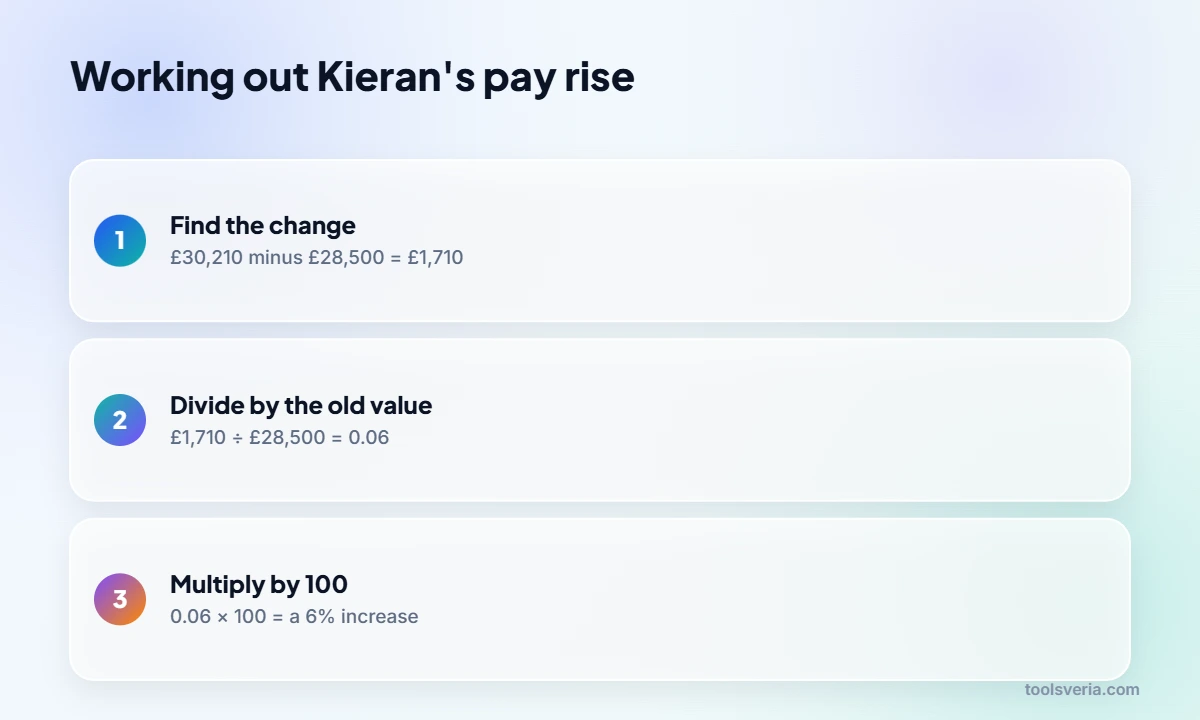
Divide the change by the starting figure, not the new one, then multiply by 100, so Kieran’s £1,710 rise on £28,500 is exactly 6%. Start with the change itself. Kieran’s new salary minus his old one is £30,210 less £28,500, which leaves £1,710. Next, divide that change by the starting figure, not the new one: £1,710 divided by £28,500 equals 0.06. Finally, multiply by 100 to express it as a percentage. His rise is exactly 6%.
- Step one: new value minus old value gives the change.
- Step two: divide the change by the old value.
- Step three: multiply by 100.
The order matters. Dividing by the new salary instead would give about 5.66%, understating his rise. Whenever you see two different answers for the same change, the culprit is almost always a different starting point, which mathematicians call the reference value in their treatment of relative change.
Once you know how to calculate percentage increase, running the process backwards is just as useful. If Kieran wants to know what a 6% rise on £28,500 would be before it happens, he multiplies £28,500 by 1.06 and gets £30,210 straight away.
A percentage on its own only tells half the story, so Kieran sets it against rising prices. Comparing the ONS consumer prices index averages for 2024 and 2025 shows prices rising by roughly 3.4%, which means his 6% rise leaves him around 2.5% better off in real terms, rather than the full 6% the headline suggests.
Spreadsheet users who know how to calculate percentage increase can do the same in a single cell. With the old salary in A2 and the new one in B2, typing =(B2-A2)/A2 and formatting the cell as a percentage returns 6.00%. Copy that cell down a column and you can check a whole team’s pay changes, or a year of monthly bills, in one go.
How Do You Calculate a Percentage Decrease?
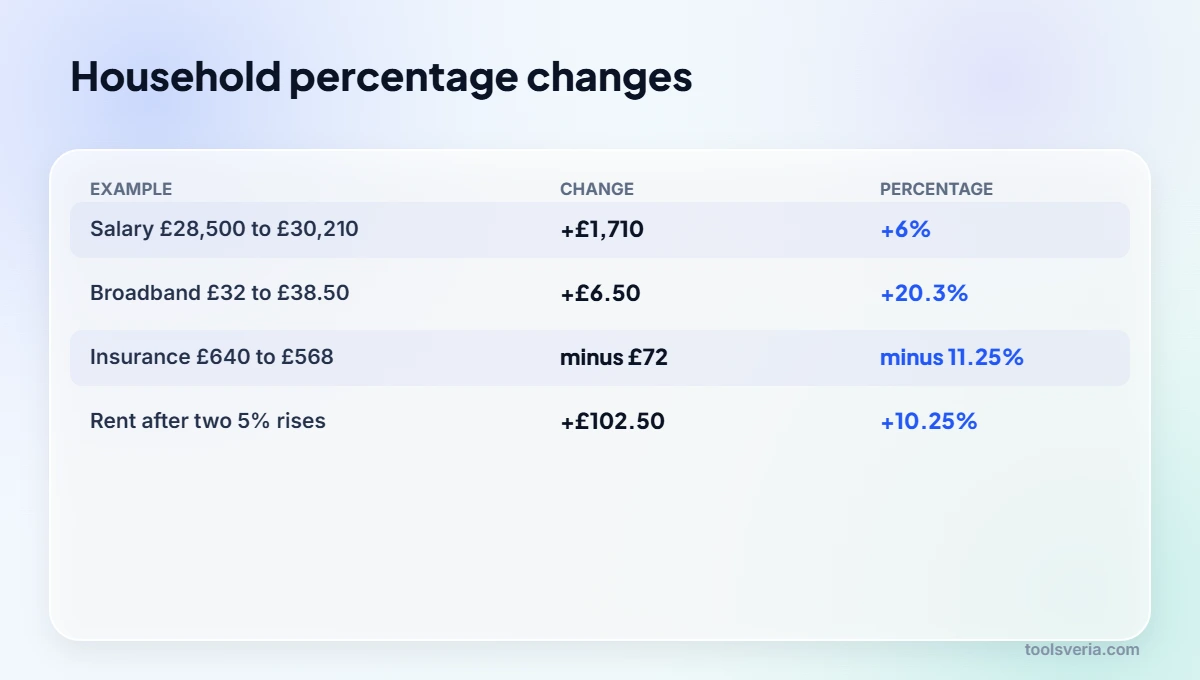
Divide the change by the old figure and multiply by 100, so a premium falling from £640 to £568 is a fall of 11.25%. Sophie’s car insurance renewal arrived at £568, down from £640 last year. The change is £568 minus £640, which is minus £72. Divide by the old premium: minus £72 over £640 is minus 0.1125. Multiply by 100 and her premium has fallen by 11.25%.
A negative result simply means a decrease. Most people drop the minus sign and say “down 11.25%”, which is perfectly clear. Shops use the same sum in reverse when they advertise a sale, and our discount calculator shows the new price and saving for any percentage off.
Her broadband went the other way, rising from £32 to £38.50 a month. That change of £6.50 over £32 comes to 20.3125%, or roughly 20.3%. Seeing the two side by side helps Sophie decide where to spend time hunting for a better deal: the broadband rise costs her £78 more over a year, while the insurance saving is £72.
| Example | Old value | New value | Change | Percentage change |
|---|---|---|---|---|
| Kieran’s salary | £28,500 | £30,210 | +£1,710 | +6% |
| Sophie’s broadband | £32.00 | £38.50 | +£6.50 | +20.3% |
| Sophie’s insurance | £640 | £568 | minus £72 | minus 11.25% |
| Concert ticket resale | £15 | £45 | +£30 | +200% |
| Rent after two 5% rises | £1,000 | £1,102.50 | +£102.50 | +10.25% |
How Do You Find the Original Price Before an Increase?
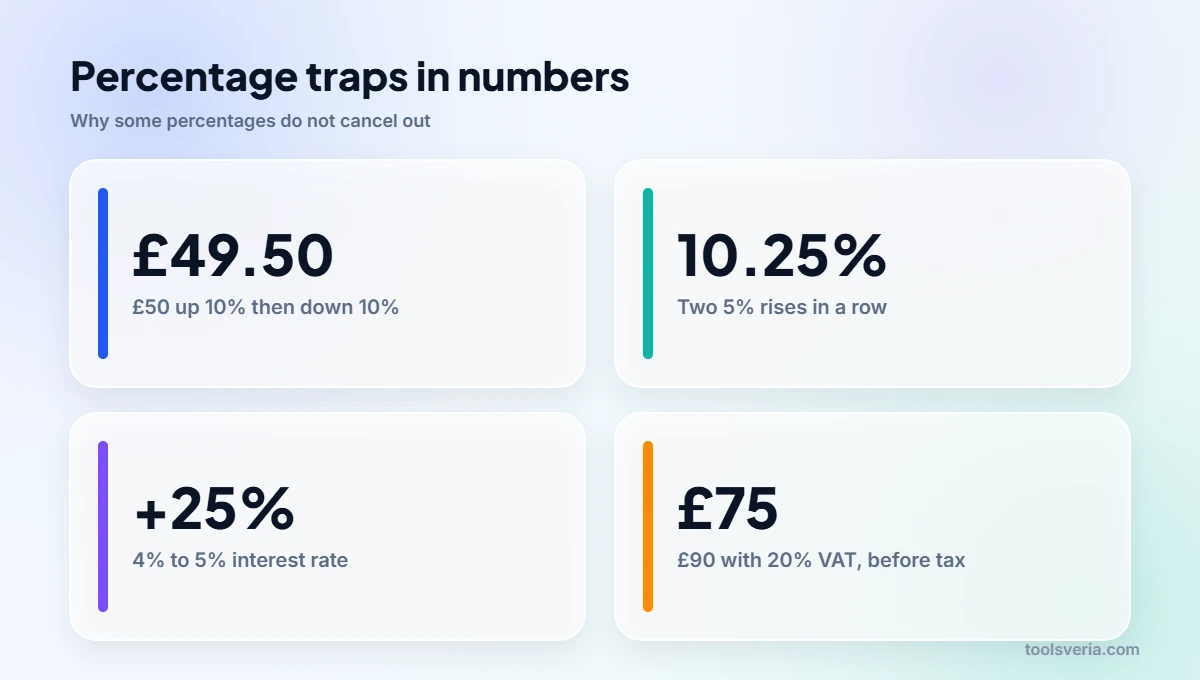
Divide by 1.2 rather than taking 20% off, because a £90 price including VAT at 20% represents 120% of the original, so the pre VAT price is £75. Sometimes you know the price after a rise and want the price before it. Oliver bought a garden bench for £90 including VAT at 20% and wants the figure before tax. Taking 20% off £90 gives £72, which is wrong. The correct move is to divide by 1.2, because £90 represents 120% of the original. The pre VAT price is £75.
The same reasoning works for any rise. If a monthly gym fee now stands at £46 after a 15% increase, dividing £46 by 1.15 reveals the old fee of £40. For VAT in particular, our reverse VAT calculator strips the tax out of a gross price instantly, which is handy when checking receipts for expense claims.
Three traps that catch almost everyone
Up 10% then down 10% is not a wash
A £50 jacket marked up by 10% becomes £55. Knock 10% off £55 and you reach £49.50, not £50. The second percentage applies to a larger number, so the fall is bigger in pounds than the rise. The net effect is a 1% drop.
Repeated rises compound
Rent of £1,000 a month rising by 5% two years running ends at £1,102.50, a total increase of 10.25%, not 10%. Each rise builds on the previous one, which is why long run price changes always look bigger than the yearly figures added together.
Percentage points are not percentages
If a mortgage rate moves from 4% to 5%, it has gone up by one percentage point, yet the rate itself has risen by 25%. News reports mix these up regularly. The explanation of percentage points covers the distinction, and it matters whenever rates rather than prices are being compared.
Increase, difference and markup: picking the right tool
A percentage increase always has a direction, from an old value to a new one. When two figures have no natural before and after, such as quotes from two different builders, a percentage difference is fairer because it measures the gap against their average. Our percentage difference calculator handles that case.
Small business owners meet a third variation. Adding a percentage to cost to set a selling price is a markup, and it is easy to confuse with profit margin, which is measured against the selling price instead. If you price products, the markup calculator keeps those two ideas apart.
Key points
- Subtract old from new, divide by the old value, then multiply by 100.
- A negative answer is a decrease: £640 to £568 is down 11.25%.
- To undo a rise, divide by one plus the rate: £90 ÷ 1.2 = £75.
- Successive percentages compound, so two 5% rises make 10.25%.
Frequently Asked Questions
My hourly rate went from £12.50 to £13.40. What rise is that?
The change is 90p. Divide 0.90 by 12.50 to get 0.072, so your rate rose by 7.2%.
Can a price go up by more than 100%?
Yes. A £15 ticket resold at £45 has risen by £30, which is 200% of the original. A fall, though, can never be more than 100%, since that would take the price below zero.
My bill dropped 20% then rose 20%. Am I back where I started?
No. A £100 bill falls to £80, then rises to £96. You end up 4% lower than the original figure.
Should I divide by the old or new figure when comparing two years?
Always the earlier year. Kieran’s rise is 6% measured from £28,500, but would look like 5.66% if you mistakenly used £30,210.
Kieran now knows his 6% rise in context, Sophie knows which bill to tackle first and Oliver has his pre VAT price for the garden bench. Keep the three steps in mind, check which number is the starting point, and percentage questions stop feeling like guesswork.