Project display ad income from your traffic and the page RPM in your own AdSense reports.
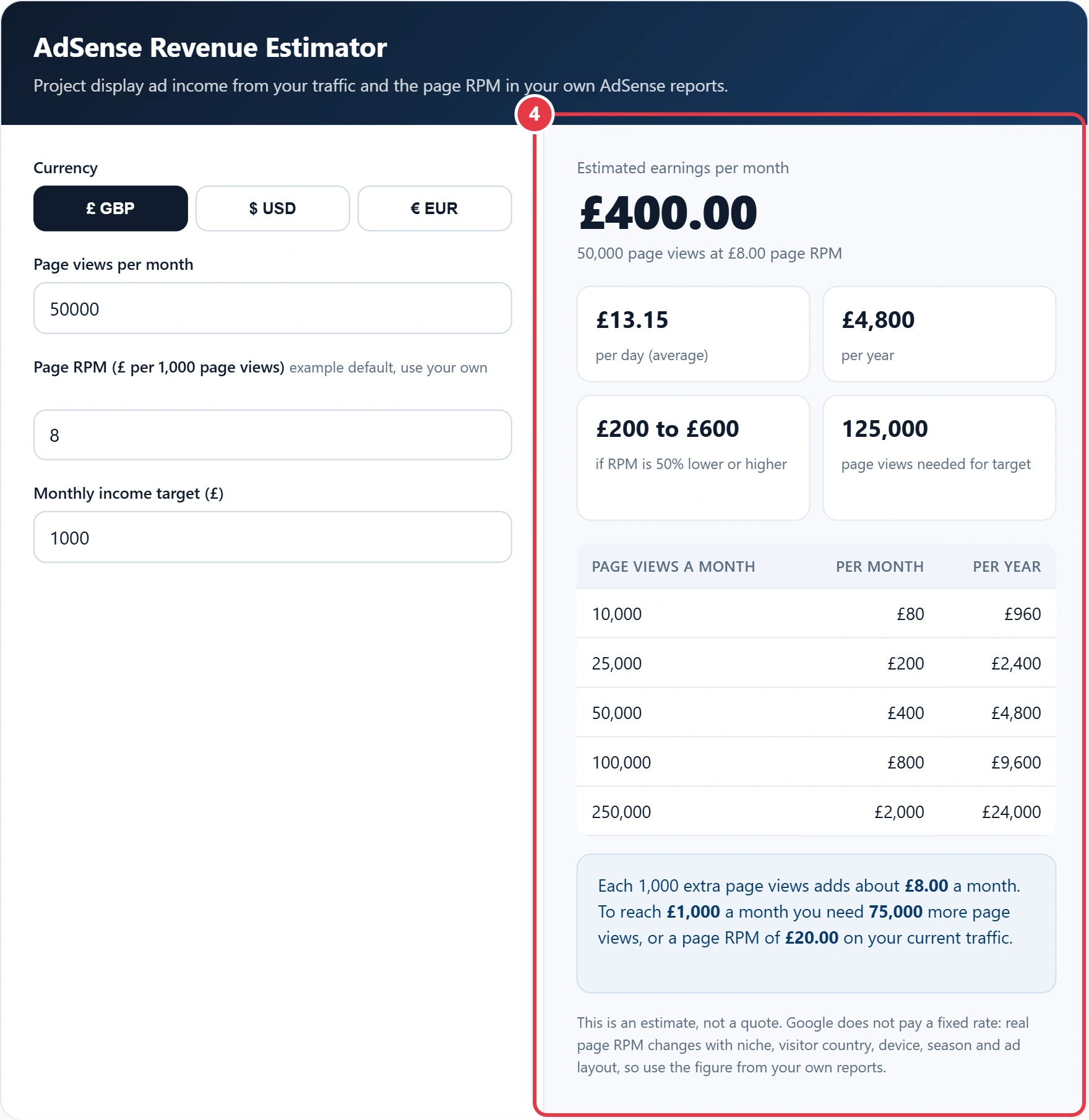
| Page views a month | Per month | Per year |
|---|
This is an estimate, not a quote. Google does not pay a fixed rate: real page RPM changes with niche, visitor country, device, season and ad layout, so use the figure from your own reports.
This AdSense revenue estimator helps bloggers and website owners project display ad income from monthly page views and the page RPM shown in their own AdSense account. Google's own AdSense help page on RPM uses exactly this per thousand approach, so once you plug in your real RPM the estimate is grounded in your site's history rather than someone else's averages.
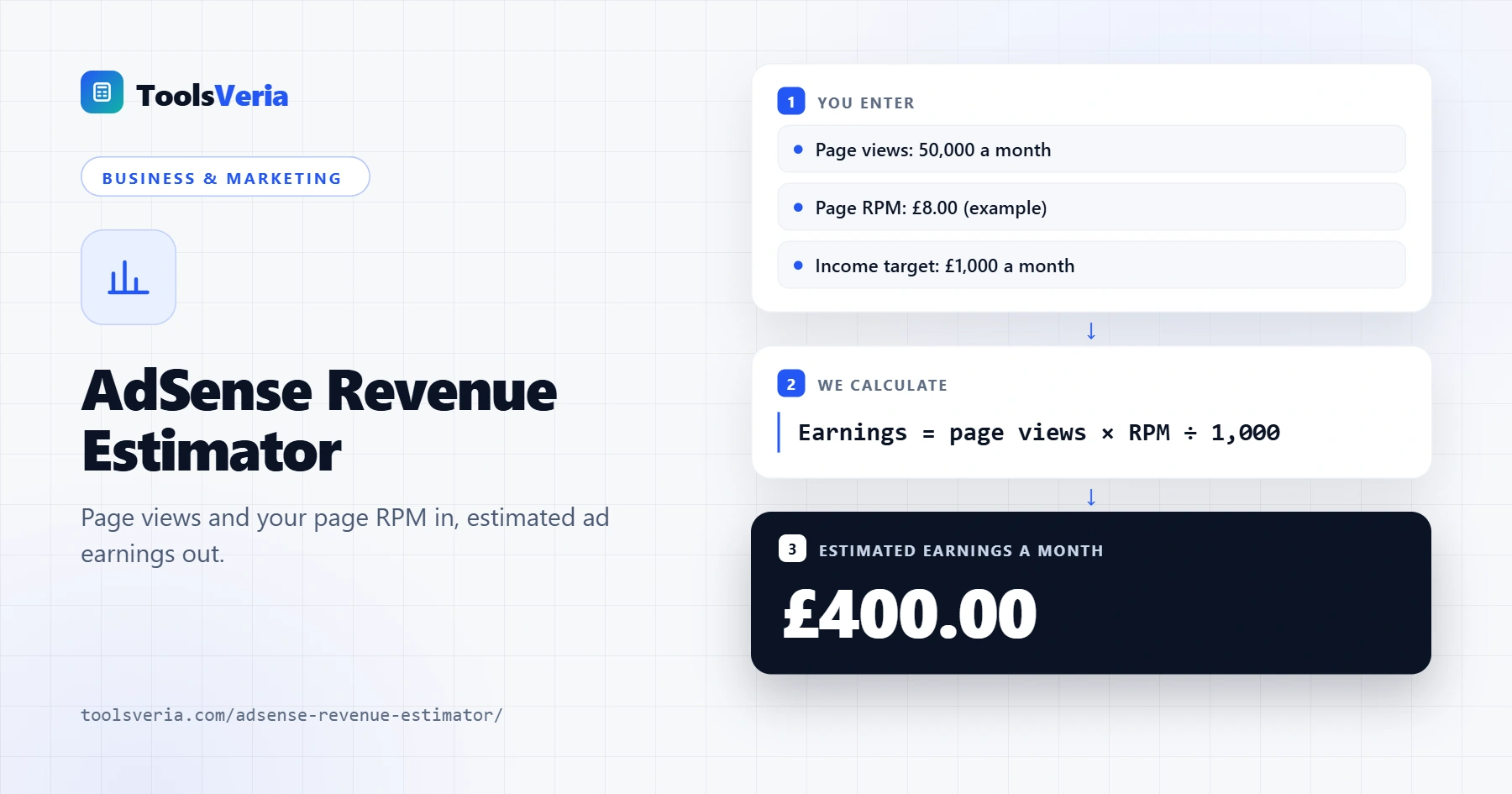
Quick answer: An AdSense revenue estimator multiplies page views by page RPM and divides by 1,000. For example, 50,000 monthly page views at an £8.00 RPM gives about £400 a month, £13.15 a day and £4,800 a year, while reaching £1,000 a month at that RPM needs 125,000 page views.
In This Guide
What Is an AdSense Revenue Estimate?
An AdSense revenue estimate is a projection of ad earnings made by multiplying page views by page RPM, the estimated earnings per 1,000 page views. RPM already blends ad clicks, impressions and advertiser bids into one number, which is why it is more useful for forecasting than CPC or CTR on their own.
The formula is estimated earnings = page views × page RPM ÷ 1,000. Fifty thousand page views at an £8.00 RPM gives 50 × £8.00, or £400 a month. The £8.00 default is only an example: there is no fixed rate, and real RPM can be several times higher or lower depending on niche, audience country, device mix and season.
How to Use the AdSense Revenue Estimator
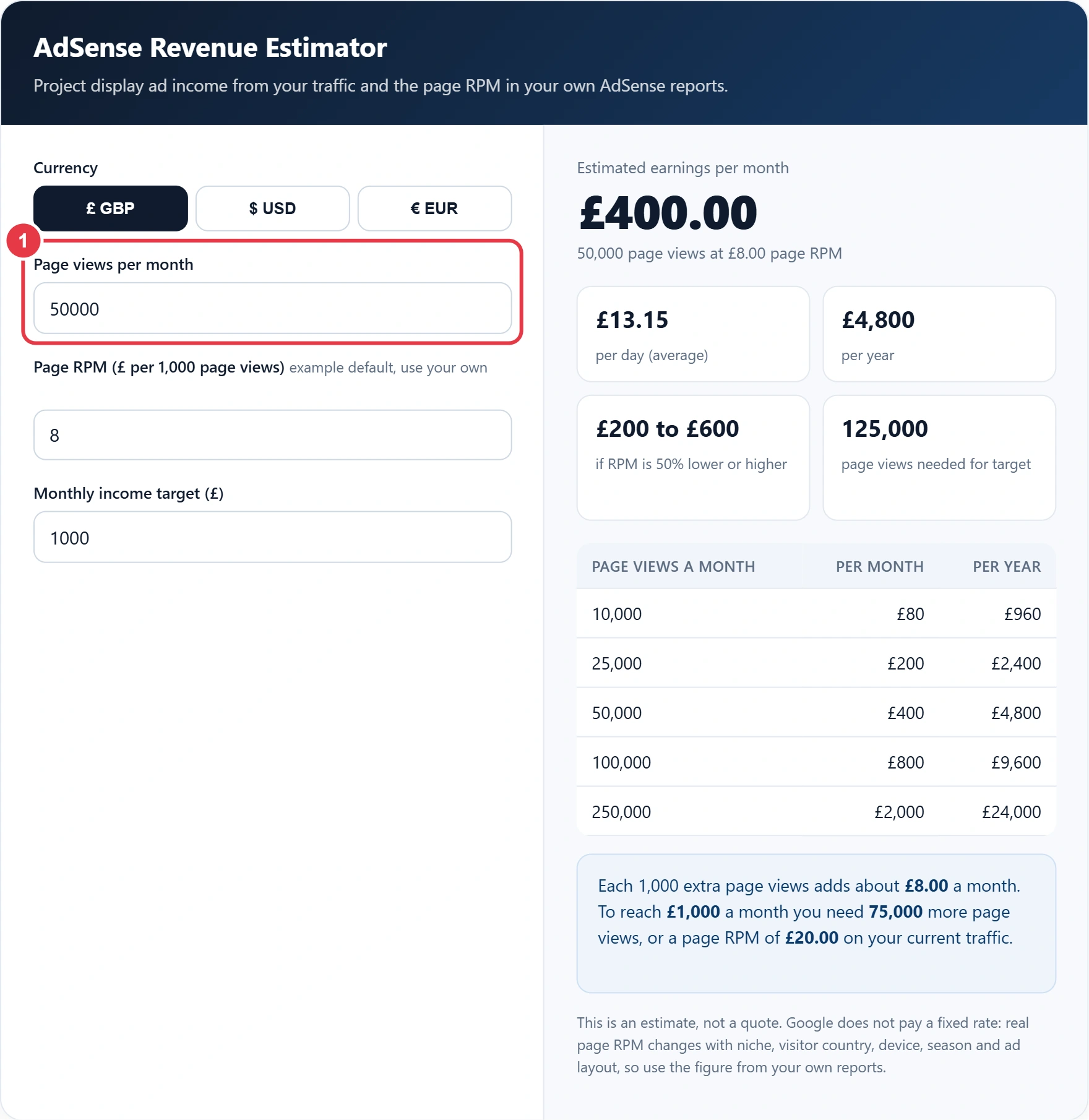
Step 1: Enter Monthly Page Views
Pick your currency and enter page views for a typical month. Use your analytics or AdSense page view count, not sessions, because one session often includes several pages.
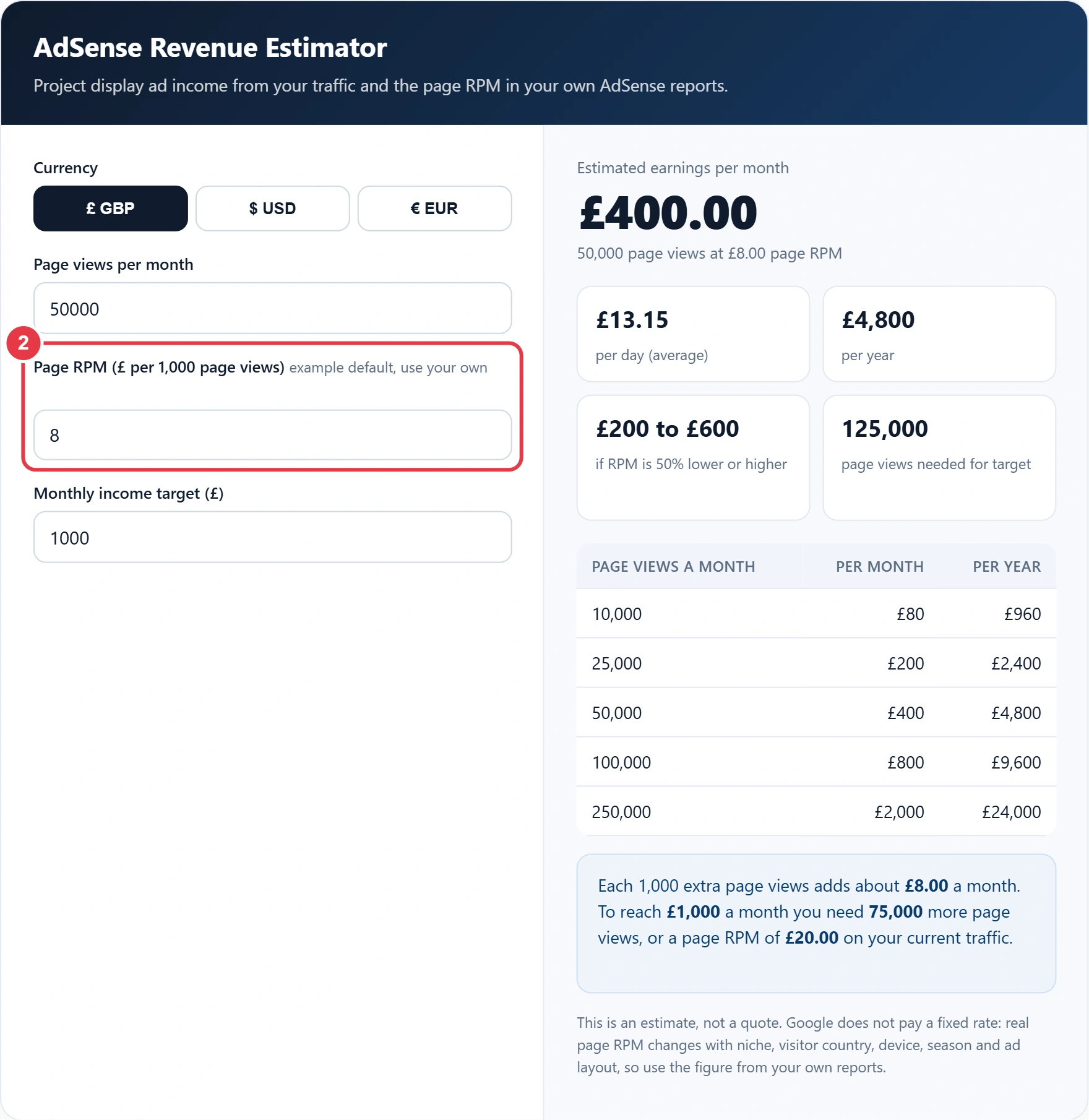
Step 2: Enter Your Page RPM
Replace the example with your page RPM averaged over the last 90 days. If you are comparing with direct ad deals priced on impressions, the CPM calculator converts those offers into the same per thousand basis so you can see which pays more.
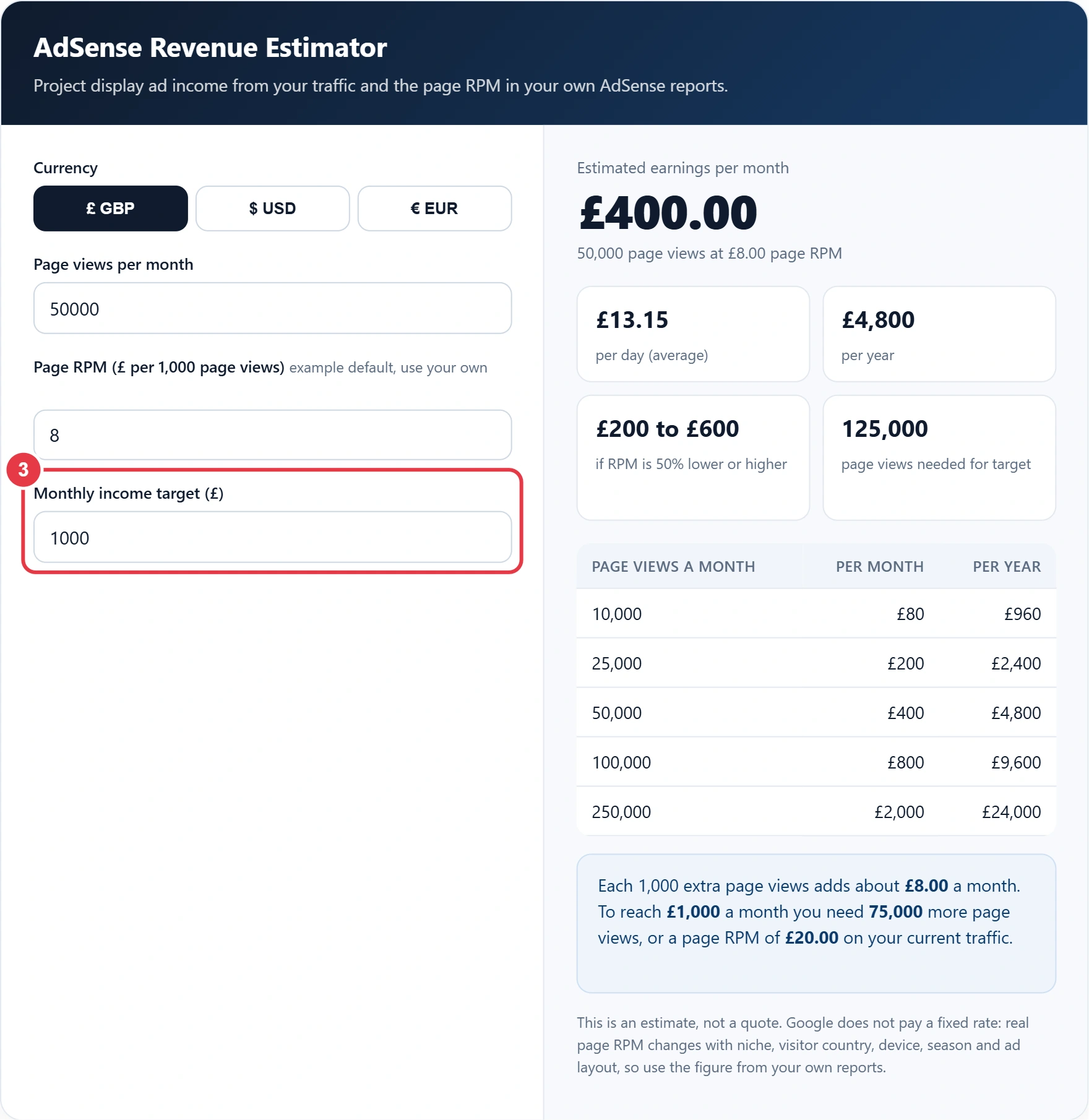
Step 3: Set an Income Target
Enter the monthly figure you are aiming for. The estimator works out the page views needed at your RPM and the RPM needed at your current traffic.
Step 4: Read Your Estimate
You get monthly, daily and yearly estimates, a range for RPM 50% lower or higher, and a table at five traffic levels. Treat the range as the honest answer, since RPM moves from month to month.
How Much Does AdSense Pay per 1,000 Page Views?
AdSense pays whatever your page RPM is, and that figure is unique to your site, so the only reliable answer comes from your own reports. Take Megan, who runs a UK baking blog with 50,000 page views a month and an RPM of £8.00. She earns about £400 a month, £13.15 a day and £4,800 a year.
| Megan's scenario | Working | Per month |
|---|---|---|
| Today | 50,000 × £8.00 ÷ 1,000 | £400 |
| If RPM fell to £5.50 | 50,000 × £5.50 ÷ 1,000 | £275 |
| If RPM rose to £12.00 | 50,000 × £12.00 ÷ 1,000 | £600 |
| £1,000 target at £8.00 | 125,000 × £8.00 ÷ 1,000 | £1,000 |
To hit £1,000 a month Megan needs 125,000 page views, or an RPM of £20.00 on today's traffic. Her RPM is already her share, because the AdSense revenue share is taken before earnings are reported. Growing the audience is usually the steadier route, and the percentage increase calculator shows how much faster her traffic must grow each month to get there.
AdSense Revenue Estimator Terms Explained
These terms explain the metrics behind the AdSense revenue estimator, so you can read your own reports and turn traffic into a realistic income forecast.
- Page RPM
- Estimated earnings for every 1,000 page views, calculated by dividing earnings by page views and multiplying by 1,000. It already blends clicks, impressions and bids, so it is the single best input for forecasting a site's display income.
- Page view
- One load of a page by a visitor, counted each time the page is displayed. It differs from a session, which may include several pages, so using sessions instead would understate the base your RPM is applied to.
- Cost per click (CPC)
- The amount an advertiser pays when someone clicks an ad, part of which reaches the publisher. CPC varies sharply by topic and audience country, which is a major reason RPM differs so much between niches.
- Click-through rate (CTR)
- The percentage of ad impressions that receive a click. Layout, ad placement and content type all affect it, and together with CPC it shapes the RPM a publisher eventually sees in reports.
- Cost per mille (CPM)
- A pricing model in which an advertiser pays for every thousand ad impressions rather than for clicks. It is useful for comparing direct ad deals with AdSense, because both can be expressed on the same per thousand basis.
- Revenue share
- The split of advertising income between Google and the publisher. Reported AdSense earnings are already the publisher's portion, so no further deduction should be applied to an estimate built on your own RPM.
</>Embed this calculator on your website
Add the free AdSense Revenue Estimator to your own site or blog. Copy the code below and paste it into an HTML block. It resizes itself and works on phones.
How we checked this tool: the Tools Veria Editorial Team built this tool by hand, checked it against the official rules or published standards where they apply, and tested it against worked examples. Results are estimates for planning, not personal financial or tax advice. Read our editorial policy and disclaimer, or report an error.
Frequently Asked Questions
How do I calculate AdSense earnings?
Multiply monthly page views by your page RPM and divide by 1,000. For example, 50,000 page views at an £8.00 RPM gives estimated earnings of £400 a month, or about £4,800 a year.
What is page RPM in AdSense?
Page RPM is estimated earnings per 1,000 page views. Google calculates it as estimated earnings divided by page views, multiplied by 1,000, and shows it in the AdSense reports for your site.
Does Google pay a fixed amount per 1,000 views?
No. Google does not pay a fixed rate. Your RPM depends on advertiser demand for your topic, where visitors are, the devices they use, the time of year and how your ads are placed.
How many page views do I need to earn £1,000 a month?
Multiply £1,000 by 1,000 and divide by your page RPM. At an £8.00 RPM you need 125,000 page views a month, while at £4.00 you would need 250,000 page views for the same income.
Why is my AdSense RPM lower than other sites?
Topics with costly ad auctions, such as finance or insurance, attract higher bids than entertainment or recipes. Visitor country, mobile share, ad layout and ad blockers also pull RPM up or down.
Is the RPM in AdSense before or after Google's share?
Page RPM in your AdSense reports reflects your estimated earnings, so Google's revenue share has already been taken. Enter that RPM directly without deducting anything further.