Enter your cash, monthly revenue and costs to see how long the money lasts.
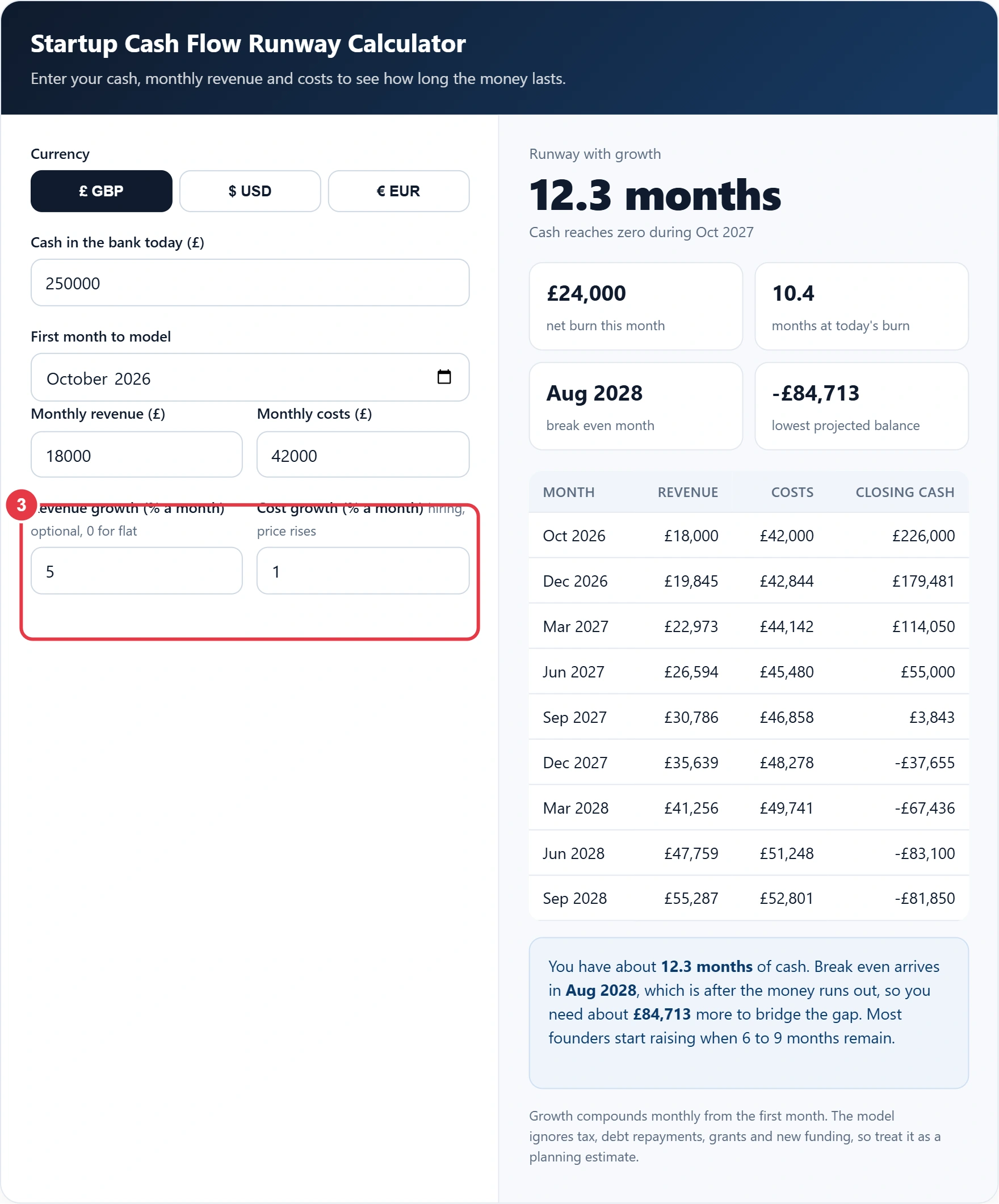
| Month | Revenue | Costs | Closing cash |
|---|
Growth compounds monthly from the first month. The model ignores tax, debt repayments, grants and new funding, so treat it as a planning estimate.
This startup cash flow runway calculator shows founders and small business owners how many months their cash will last, using monthly revenue, monthly costs and optional growth rates. Investors and the British Business Bank both expect you to know this number, so the tool also gives the exact month the balance hits zero and when revenue overtakes costs.
Quick answer: A startup runway calculator divides cash in the bank by net monthly burn, which is monthly costs minus monthly revenue. A company with £250,000 and a £24,000 net burn has 10.4 months. Aim for at least 12 to 18 months of runway after a funding round, and start raising again when 6 to 9 months remain.

In This Guide
What Is Cash Runway?
Cash runway is the number of months a business can keep operating before its bank balance reaches zero, assuming no new funding. The basic formula is cash in the bank ÷ net monthly burn, where net burn is monthly costs minus monthly revenue. A company with £250,000 and a £24,000 net burn has 10.4 months.
That flat figure is often wrong for a young company, because revenue and costs rarely sit still. This startup runway calculator projects every month separately, growing revenue and costs by your chosen percentage, and deducts each month's shortfall from the balance until it runs out. The result can be much longer or shorter than the simple division.
How to Use the Startup Runway Calculator for Cash Flow
Step 1: Enter Your Cash and Start Month
Choose £, $ or €, then type the cash you can actually spend today. Leave out money you have promised to a supplier or must hold for VAT and corporation tax, then pick the first month you want to model.

Step 2: Add Monthly Revenue and Costs
Use cash received, not invoiced sales, and include salaries, rent, software, contractors and marketing in costs. If you are unsure how much of each sale you keep, the profit margin calculator separates gross margin from revenue before you fill these boxes in.

Step 3: Set Growth Rates
Enter the monthly growth you realistically expect. Set both to 0 in the startup runway calculator for a flat view. A planned hire adds to costs, so a small cost growth rate of 1% to 3% stops the model from flattering you.
Step 4: Read Your Runway
The headline shows runway with growth, followed by the month cash runs out, today's net burn, the flat runway, the break even month and the lowest balance. The table tracks closing cash every quarter for two years.

How Many Months of Runway Should a Startup Have?
Aim for at least 12 to 18 months of runway after a funding round, and start raising again when 6 to 9 months remain, because a round typically takes several months to close. Below 6 months, cutting burn usually matters more than chasing growth.
Take Maya, who runs a Bristol software startup with £250,000 in the bank, £18,000 monthly revenue and £42,000 monthly costs. The flat figure says 10.4 months. With revenue growing 5% a month and costs 1%, the balance lasts 12.3 months, yet break even only arrives in month 23, so she needs a bridge round or deeper cuts.
Founders without investors can price a term loan with the loan calculator, then search the GOV.UK business finance support finder for grants and start up loans, before deciding how much extra runway is worth paying for.
| Cash | Net burn a month | Flat runway |
|---|---|---|
| £100,000 | £8,000 | 12.5 months |
| £250,000 | £24,000 | 10.4 months |
| £500,000 | £35,000 | 14.3 months |
| £1,000,000 | £60,000 | 16.7 months |
Startup Cash Flow Runway Terms Explained
These terms explain the cash and growth measures behind the startup cash flow runway calculator so founders can plan fundraising and spending decisions earlier.
- Burn rate
- The speed at which a company uses up its cash reserves, usually stated per month. Gross burn counts all outgoings, while net burn subtracts incoming revenue, and runway is always calculated from the net figure.
- Cash runway
- The length of time a business can keep operating before its money runs out, assuming nothing changes and no new funding arrives. Founders watch it closely because raising investment usually takes several months from first meeting to cash in the bank.
- Break-even point
- The moment when monthly revenue matches monthly costs, so the business stops consuming cash. Once it is reached, runway becomes effectively unlimited unless costs climb again or revenue falls back below spending.
- Cash flow forecast
- A month by month projection of money expected in and out of a business, showing the closing balance for each period. Unlike a profit and loss account, it follows when payments actually move rather than when sales are invoiced.
- Compound monthly growth
- Growth applied to each month's figure on top of the previous month's increase, so a steady percentage produces accelerating absolute gains. Small differences in the assumed rates can therefore change the projected runway considerably.
- Venture capital
- Equity funding provided by specialist investors to young, high growth companies in exchange for shares. Investors examine burn and runway closely, and a funding round usually aims to carry the company well past its next set of milestones.
</>Embed this calculator on your website
Add the free Startup Runway Calculator to your own site or blog. Copy the code below and paste it into an HTML block. It resizes itself and works on phones.
How we checked this tool: the Tools Veria Editorial Team built this tool by hand, checked it against the official rules or published standards where they apply, and tested it against worked examples. Results are estimates for planning, not personal financial or tax advice. Read our editorial policy and disclaimer, or report an error.
Frequently Asked Questions
What is the difference between gross burn and net burn?
Gross burn is your total monthly spending, while net burn is spending minus revenue. A startup spending £42,000 a month with £18,000 of revenue has a gross burn of £42,000 and a net burn of £24,000. Runway uses net burn.
How do I calculate runway in months?
Divide the cash you can spend by your net monthly burn. For example, £250,000 ÷ £24,000 gives 10.4 months. If revenue or costs are changing, project each month separately, as this calculator does.
Should I include unpaid invoices in my cash balance?
No. Count only money already in the bank and free to spend. Unpaid invoices can be late or go unpaid, so add them as revenue in the month you realistically expect to receive the cash.
What revenue growth rate should I use?
Use your average month on month growth from the last six months of actual cash receipts. If you have little history, run the calculator at 0% and again at a cautious 3% to see the range.
When should a startup start fundraising?
Start when you have roughly 6 to 9 months of runway left. Raising usually takes three to six months, and talking to investors with under three months of cash weakens your negotiating position.
Does the runway calculator include tax?
No. It ignores corporation tax, VAT payments and loan repayments. Add regular VAT and loan payments to monthly costs, and exclude cash held back for tax from your starting balance.