Pick an activity, add your weight and time, and see what a session and a week of it burns.
| Same time at your weight | kcal |
|---|
Estimates for healthy adults using the standard MET formula. Real burn varies with fitness, body composition, terrain and effort. This is not medical advice: speak to your GP before starting a new exercise plan if you have a health condition.
This calories burned calculator estimates the energy an adult uses during exercise or everyday activity, from body weight, activity and time. It runs on the MET values in the 2024 Adult Compendium of Physical Activities, the research list that sports scientists use, and it accepts kilograms, stone or pounds. You also get net calories, kilojoules and a weekly total checked against NHS activity guidance.
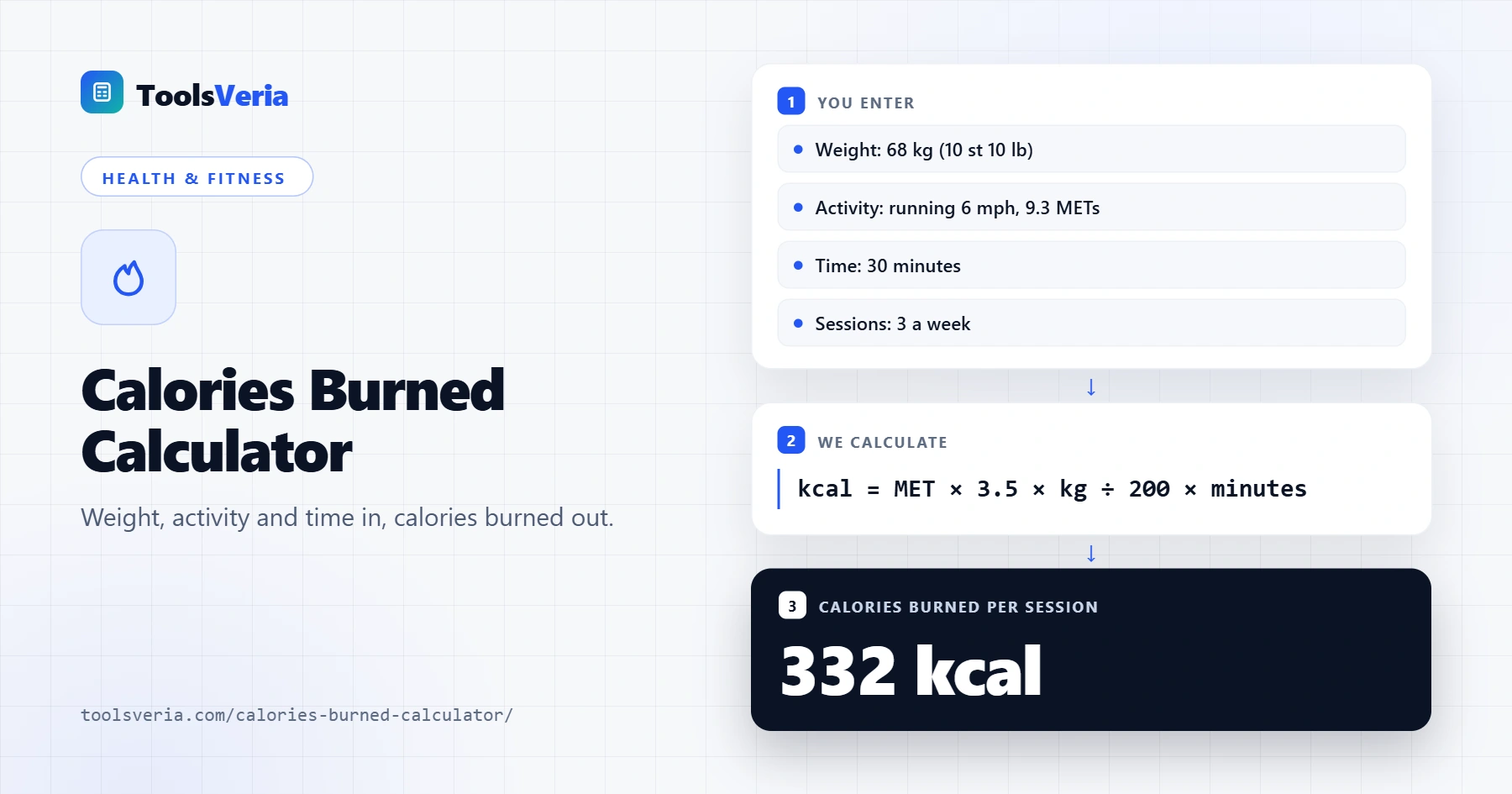
Quick answer: calories burned = MET × 3.5 × body weight in kg ÷ 200 × minutes. A 68 kg person running at 6 mph (9.3 METs) for 30 minutes burns about 332 kcal. Use the calories burned calculator above to swap in your own weight, activity and session length.
In This Guide
What Is a Calories Burned Calculator?
A calories burned calculator is a tool that converts an activity's intensity, your weight and the time you spend into an estimate of energy used, in kilocalories (kcal). Intensity is expressed in METs, short for metabolic equivalents. One MET is the energy you use sitting quietly, defined as 3.5 millilitres of oxygen per kilogram of body weight per minute. An activity rated 9.3 METs makes you work 9.3 times harder than sitting still.
In plain words, the formula multiplies the MET value by 3.5 and by your weight in kilograms, divides by 200 to turn oxygen into kcal per minute, then multiplies by the minutes you were active. Heavier bodies move more mass, so the same run burns more for a 90 kg person than for a 60 kg person. Because one MET works out at roughly 1 kcal per kilogram per hour, a quick mental check is MET × weight × hours.
How to Use the Calories Burned Calculator
Step 1: Enter Your Body Weight
Choose kg, stone and pounds, or pounds only. Switching units carries your weight across, so 68 kg becomes 10 st 10 lb, and the kg to stone converter is there if you want the exact conversion for other figures. Use your weight on the day, in light clothing, rather than a target weight.

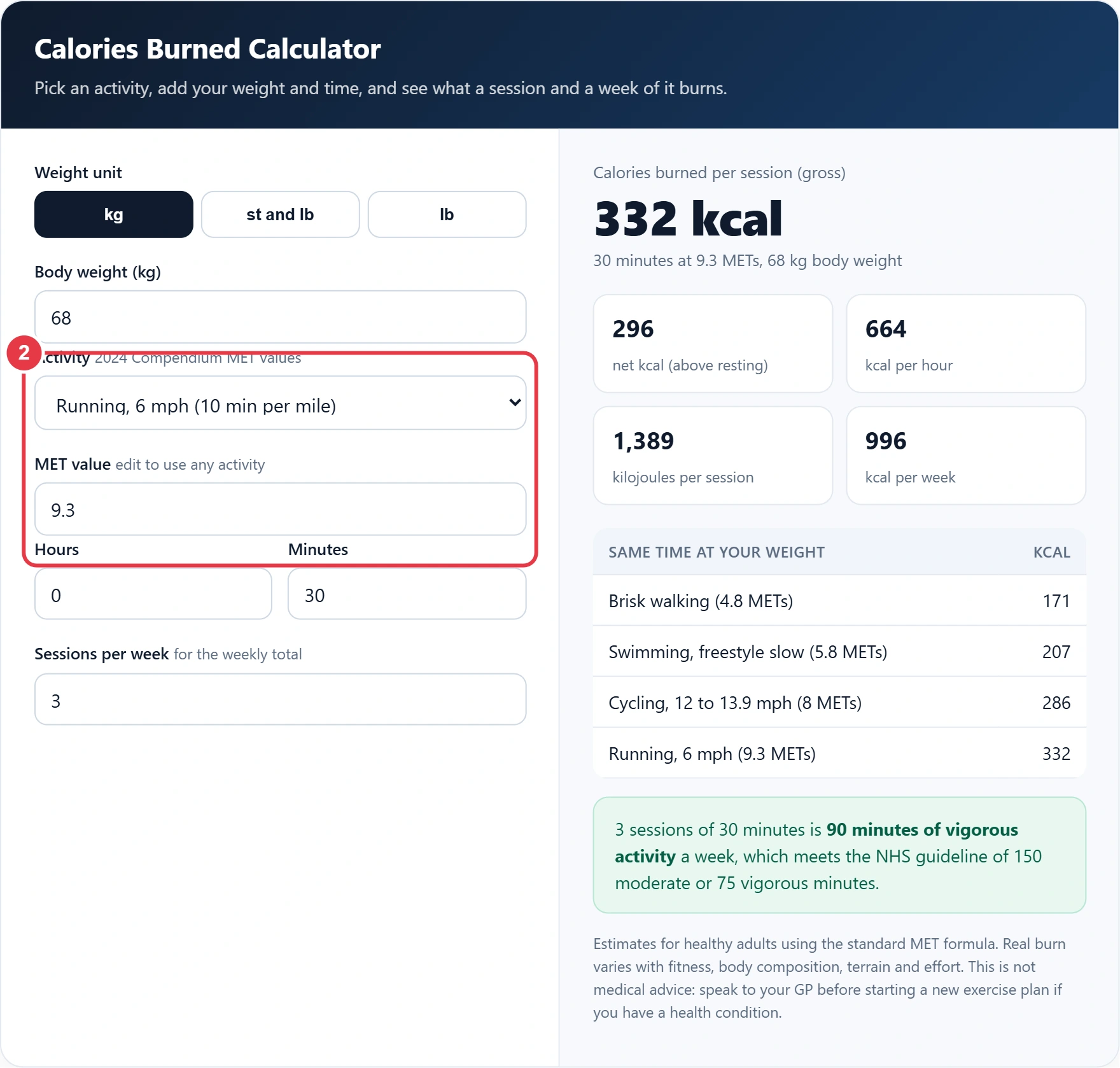
Step 2: Choose the Activity
Pick from 14 common activities. The MET box fills in automatically, and you can overwrite it with any value from the Compendium, for example 6.8 for singles tennis or 3.0 for vacuuming. Running is listed by speed because pace changes the burn far more than most people expect.
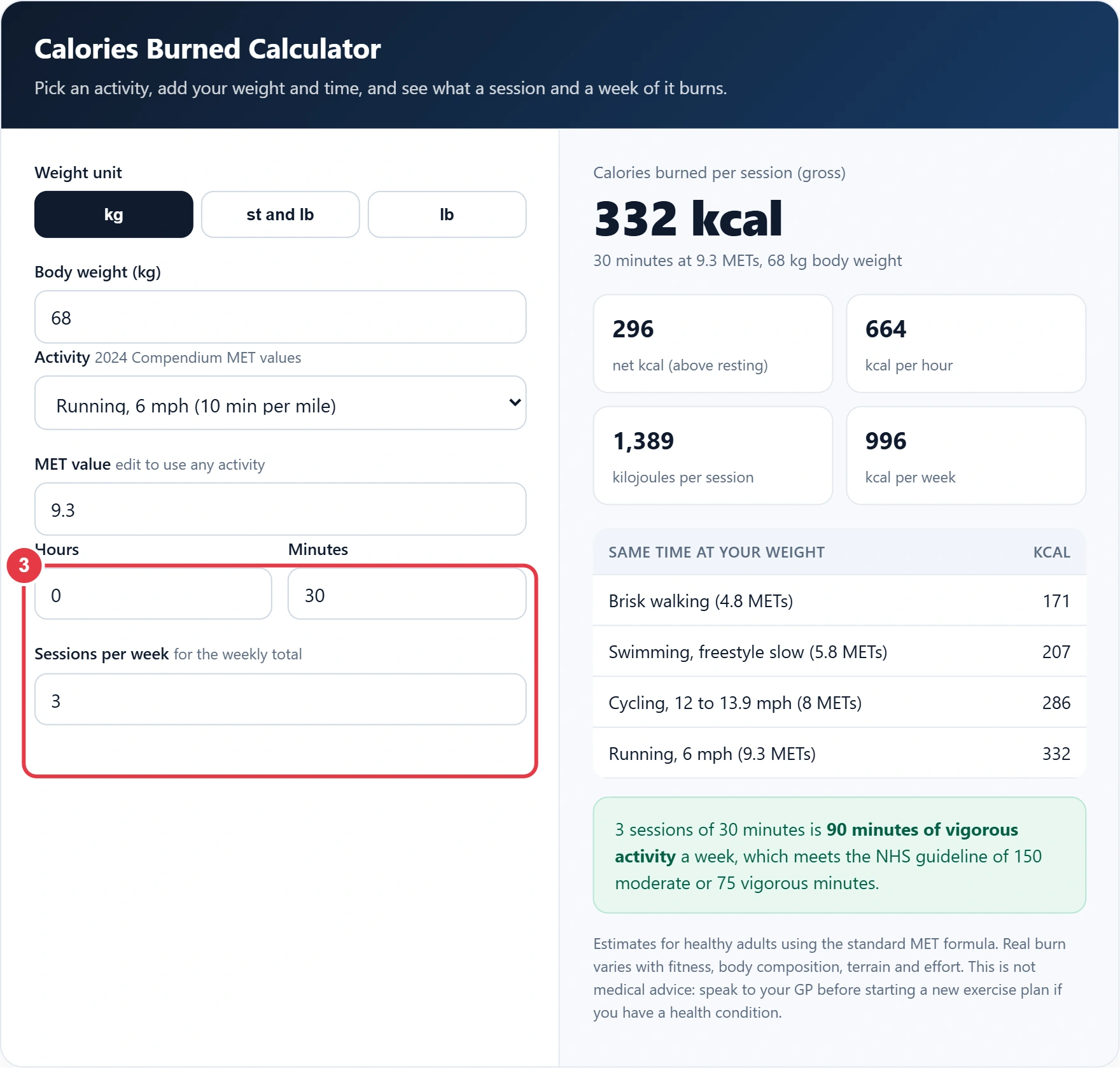
Step 3: Add Time and Sessions
Enter hours and minutes of actual activity, leaving out rests between sets or the drive to the pool. If you only know start and finish times, the time duration calculator works out the minutes for you before you type them here. Then set how many sessions you do in a typical week.
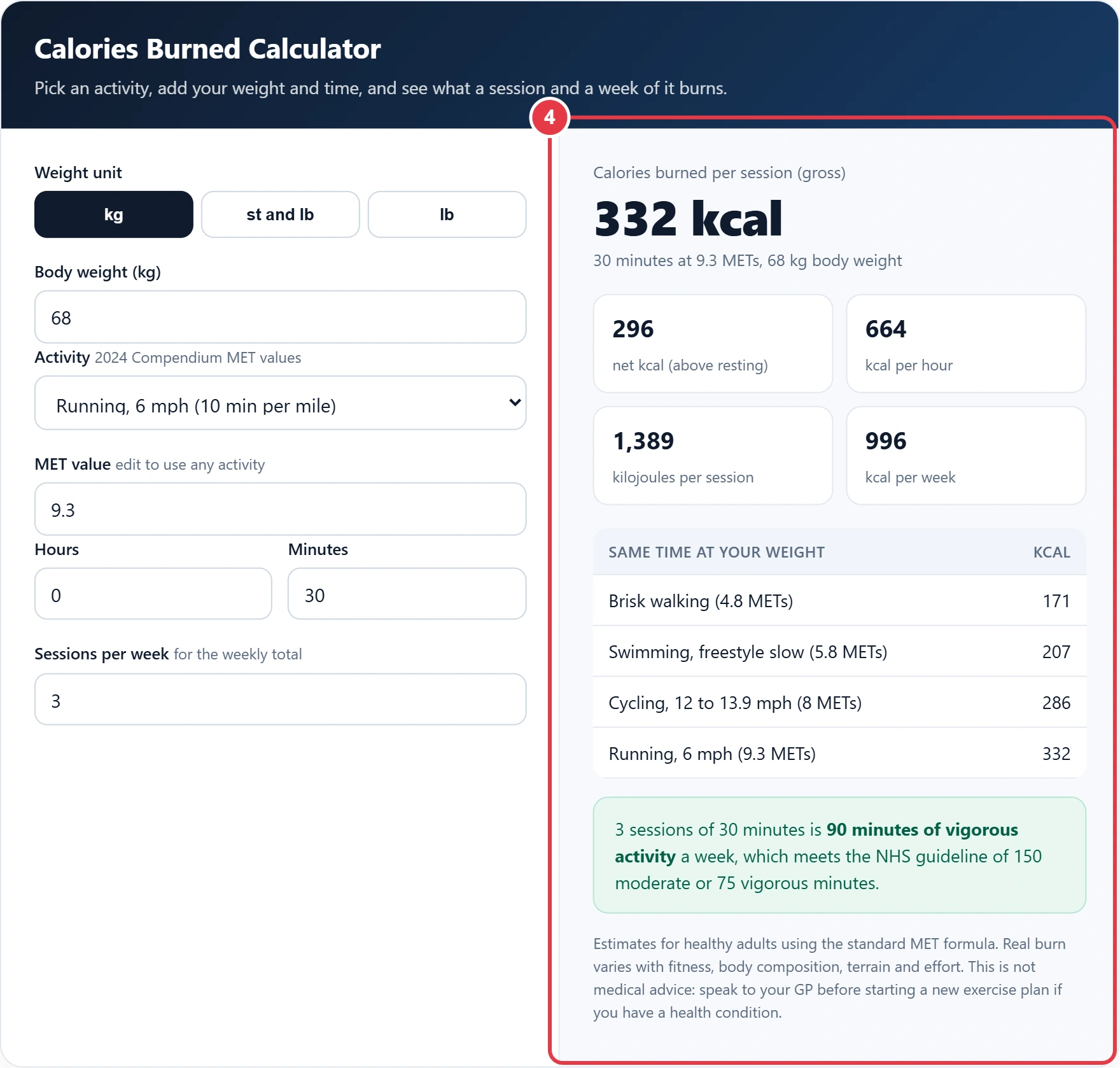
Step 4: Read Your Results
The large figure is gross calories for one session. Below it you see net calories, kcal per hour, kilojoules and the weekly total. The table compares four other activities over the same time at your weight, and the coloured box tells you whether your weekly minutes meet NHS guidance for adults.
How Many Calories Do You Burn Running for 30 Minutes?
A 70 kg adult burns about 342 kcal in 30 minutes of running at 6 mph, which is a 10 minute mile. At 5 mph the same person burns about 312 kcal, and at 8 mph about 441 kcal, because the MET value climbs from 8.5 to 12.0.
Take Hannah, who weighs 10 st 10 lb (68 kg) and runs three 30 minute sessions a week at 6 mph. Her sum is 9.3 × 3.5 × 68 ÷ 200 × 30 = 332 kcal per run. Over a week that is 996 kcal, or about 4,167 kJ. Her 90 vigorous minutes also clear the NHS target of 75 vigorous minutes. If she walked briskly for the same 30 minutes instead, she would burn about 171 kcal, roughly half.
Calories Burned by Activity and Body Weight
The table shows gross kcal for 30 minutes, worked out with the same formula as the tool. Use it to compare activities quickly, then enter your own numbers above for a closer figure.
| Activity (30 minutes) | METs | 60 kg | 75 kg | 90 kg |
|---|---|---|---|---|
| Yoga, Hatha | 2.3 | 72 | 91 | 109 |
| Weight training | 3.5 | 110 | 138 | 165 |
| Walking, moderate pace | 3.8 | 120 | 150 | 180 |
| Walking, brisk | 4.8 | 151 | 189 | 227 |
| Rowing machine, moderate | 5.0 | 158 | 197 | 236 |
| Swimming, freestyle slow | 5.8 | 183 | 228 | 274 |
| Football, casual | 7.0 | 221 | 276 | 331 |
| Cycling, 12 to 13.9 mph | 8.0 | 252 | 315 | 378 |
| Running, 6 mph | 9.3 | 293 | 366 | 439 |
| Running, 8 mph | 12.0 | 378 | 473 | 567 |
Calories Burned per Mile: Walking vs Running
Per minute, running burns roughly twice as much as walking. Per mile, the gap is much smaller, because walking takes longer to cover the same ground. For Hannah at 68 kg, one mile at 6 mph takes 10 minutes and burns about 111 kcal. A brisk walk at 3.7 mph takes about 16 minutes for that mile and burns about 93 kcal, and a 3 mph stroll takes 20 minutes and burns about 90 kcal.
So if your goal is a weekly distance, walking gets you most of the energy use of running, with less impact on your joints. If your goal is to fit the most activity into a 30 minute lunch break, running or cycling wins. Enter both options into the calories burned calculator with your real times to see the difference for your own weight.
Gross vs Net Calories and Why Your Watch Disagrees
Gross calories include the energy your body would have used anyway in that time. Net calories take away that resting share, which is one MET, so a 9.3 MET run counts as 8.3 METs of extra work. For Hannah, the 332 kcal gross run is 296 kcal net. Net is the fairer figure if you are comparing exercise with food, because you would have burned the other 36 kcal sitting on the sofa.
Fitness watches often show a different number because they use heart rate, and their makers do not publish exactly how they convert it. Wrist readings can be thrown off by fit, tattoos and cold skin. A MET estimate is consistent and transparent, but it assumes average efficiency: a trained runner uses less energy at a given pace than a beginner, and hills, wind and heat push the real figure up. Treat any single number, from a watch or from this page, as a sensible guide rather than an exact count.
How to Get a More Accurate Estimate
- Count only moving time. A 60 minute gym visit often holds 35 to 40 minutes of actual work.
- Pick the speed you really held, not the one you aimed for. Your watch's average pace is a good guide.
- For hills, rough trails or a heavy rucksack, choose a higher MET value from the Compendium, such as 6.0 for cross country hiking instead of 4.8 for brisk walking.
- Update your weight every few weeks if it changes, because the result scales directly with it.
Using the Results Safely
- Results are estimates for healthy adults and are not medical advice.
- Use calories burned as one input alongside how you feel, sleep and recover, not as a target to chase every day.
- Build up time and intensity gradually, especially if you are returning to exercise after a break.
- Speak to your GP before starting a new plan if you are pregnant, have a heart, lung or joint condition, or take regular medication.
Calories are only part of the picture. For overall health, adults aged 19 to 64 are asked by the NHS physical activity guidelines to do at least 150 minutes of moderate or 75 minutes of vigorous activity a week, plus strength work on two days. The calories burned calculator flags activities of 3 to 5.9 METs as moderate and 6 METs or more as vigorous, so you can see which sessions count.
Key Calories Burned Terms Explained
These definitions explain the exercise science behind the calories burned calculator, helping you interpret METs, gross and net figures and weekly totals.
- Metabolic equivalent of task
- A measure of exercise intensity expressed as a multiple of resting energy use. Sitting quietly equals one MET, so an activity rated at eight METs demands roughly eight times the energy of rest for the same body weight.
- Compendium of Physical Activities
- A research reference that assigns standard MET values to hundreds of everyday, occupational and sporting activities. Scientists maintain it so energy estimates in studies and calculators rest on a shared, evidence based set of intensity figures.
- Gross calories
- The total energy used during an activity, including the energy your body would have spent anyway at rest over the same period. Most fitness trackers and gym machines report this figure rather than the extra energy alone.
- Net calories
- The energy used during exercise above what you would have burned resting for the same time. It is the fairer number to use when deciding how much extra food a workout actually allows within a weight goal.
- Kilojoule
- The metric unit of energy used alongside the kilocalorie on UK food labels. One kilocalorie equals about 4.184 kilojoules, so a session burning 300 kcal corresponds to roughly 1,255 kJ of energy expenditure.
- Oxygen uptake
- The volume of oxygen the body consumes to produce energy, usually measured in millilitres per kilogram per minute. Because each litre of oxygen used releases a fairly constant amount of energy, it underpins how MET values convert into calories.
</>Embed this calculator on your website
Add the free Calories Burned Calculator to your own site or blog. Copy the code below and paste it into an HTML block. It resizes itself and works on phones.
How we checked this tool: the Tools Veria Editorial Team built this tool by hand, checked it against the official rules or published standards where they apply, and tested it against worked examples. Results are estimates for planning, not personal financial or tax advice. Read our editorial policy and disclaimer, or report an error.
Frequently Asked Questions
How accurate is a calories burned calculator?
A MET based calories burned calculator gives a fair average for a healthy adult, but it cannot see your fitness, terrain or exact effort. Your real burn may be noticeably higher or lower, so use it for comparisons and trends rather than precise counting.
Is walking or running better for burning calories?
Running burns more per minute: a 70 kg adult uses about 342 kcal in 30 minutes at 6 mph against about 176 kcal walking briskly. Over the same distance the gap is smaller, because walking takes longer.
Should I use gross or net calories?
Use net calories when comparing exercise with food, because it removes the 1 MET you would burn at rest anyway. For a 68 kg person running 30 minutes at 6 mph that is 296 kcal net versus 332 kcal gross.
How many calories does a 10,000 step walk burn?
About 10,000 steps is roughly 5 miles, which takes around 90 minutes at a moderate 3.3 mph. For a 70 kg adult at 3.8 METs that is about 420 kcal gross, depending on pace and stride length.
Why do heavier people burn more calories doing the same exercise?
Moving more body mass takes more energy, and the formula scales directly with weight. At 9.3 METs for 30 minutes, a 60 kg runner burns about 293 kcal while a 90 kg runner burns about 439 kcal.
How many kilojoules are in a kilocalorie?
One kilocalorie equals 4.184 kilojoules. UK food labels show both, so the calculator gives kJ too: a 332 kcal run is about 1,389 kJ, which makes it easy to compare with the energy figure on a label.