250 ml cups, US cups and imperial cups to US or UK fluid ounces, and back.
Fractions work too: 3/4, 1 1/2 or ½.
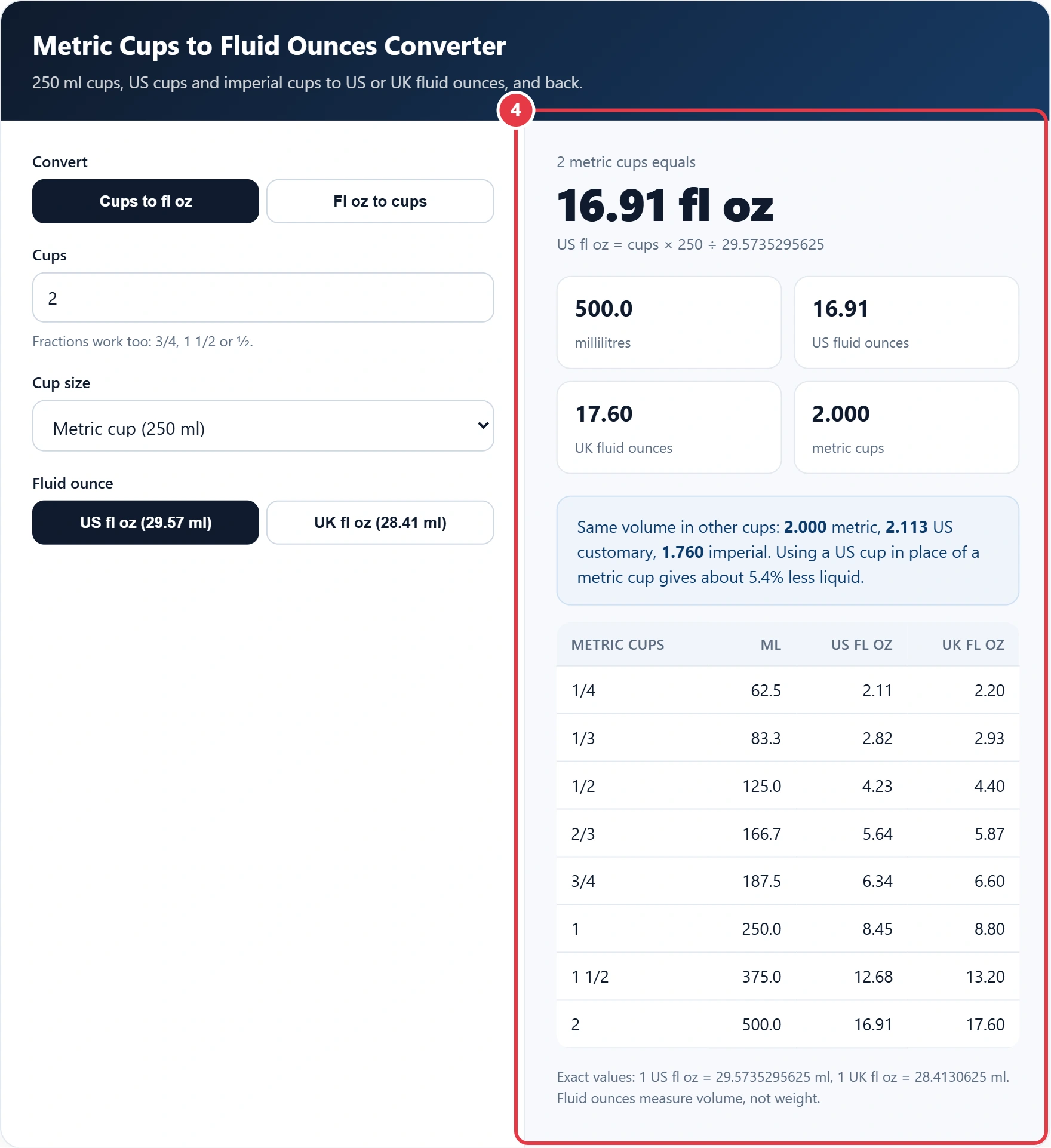
| Metric cups | ml | US fl oz | UK fl oz |
|---|
Exact values: 1 US fl oz = 29.5735295625 ml, 1 UK fl oz = 28.4130625 ml. Fluid ounces measure volume, not weight.
This metric cups to fluid ounces converter turns 250 ml cups into US or UK fluid ounces for home cooks, bakers and anyone working from an Australian, New Zealand, Canadian or modern British recipe with an American or older British jug. It also handles the US customary, US legal, imperial and Japanese cup sizes, so you can see exactly how much the different cups disagree. Values checked October 2026.
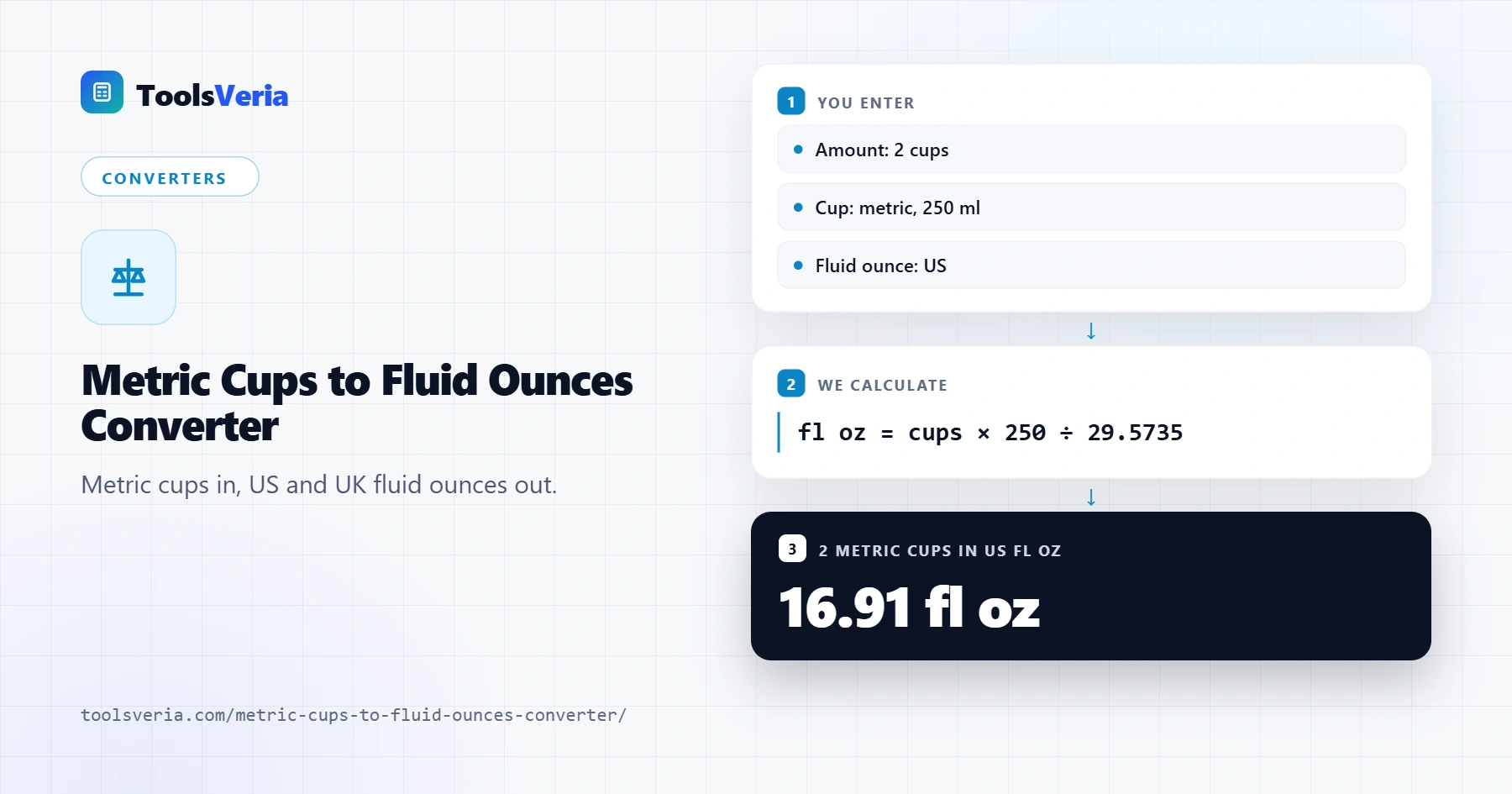
Quick answer: one metric cup is 250 ml, which is 8.45 US fluid ounces or 8.80 UK fluid ounces. Divide the millilitres by 29.5735 for US fl oz or by 28.4131 for UK fl oz. With this metric cups to fluid ounces converter, 2 metric cups come out at 16.91 US fl oz.
In This Guide
What Is a Metric Cup in Fluid Ounces?
A metric cup is a cooking measure of exactly 250 millilitres, which equals 8.4535 US fluid ounces or 8.7988 UK fluid ounces. It is the standard cup in Australia, New Zealand, Canada and South Africa, and most current UK cookbooks that list cups mean this one.
The formula in words: fluid ounces = cups × millilitres per cup ÷ millilitres per fluid ounce. The two fluid ounces are fixed exactly. NIST gives the US fluid ounce as 29.5735295625 ml (one 128th of a US gallon), and the UK fluid ounce is 28.4130625 ml (one 160th of an imperial gallon). So 1 metric cup = 250 ÷ 29.5735295625 = 8.4535 US fl oz.
How to Use the Metric Cups to Fluid Ounces Converter
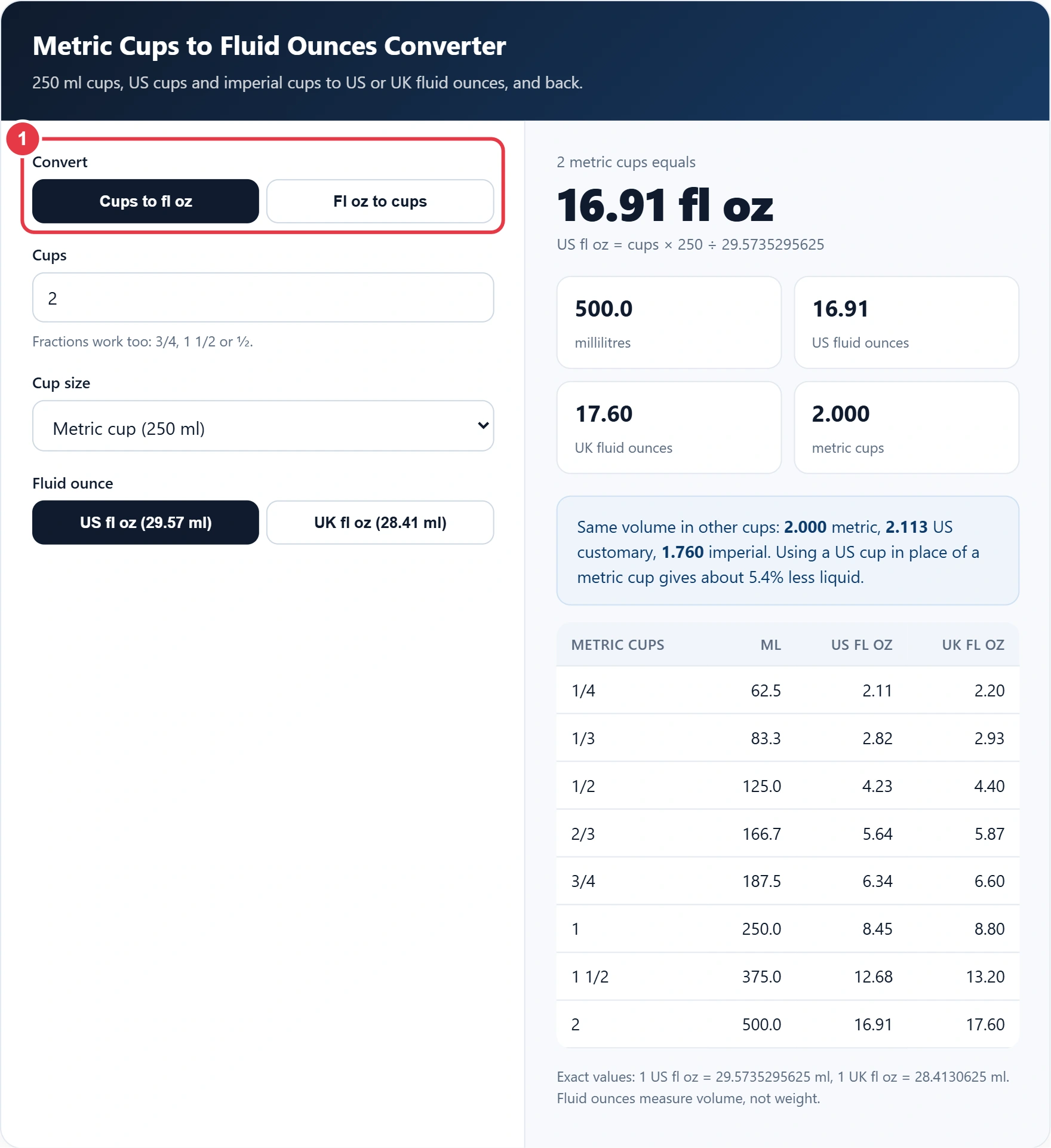
Step 1: Choose the Direction
Select Cups to fl oz when a recipe gives cups and your jug is marked in ounces. Select Fl oz to cups when a recipe lists fluid ounces and you only have a set of cup measures.
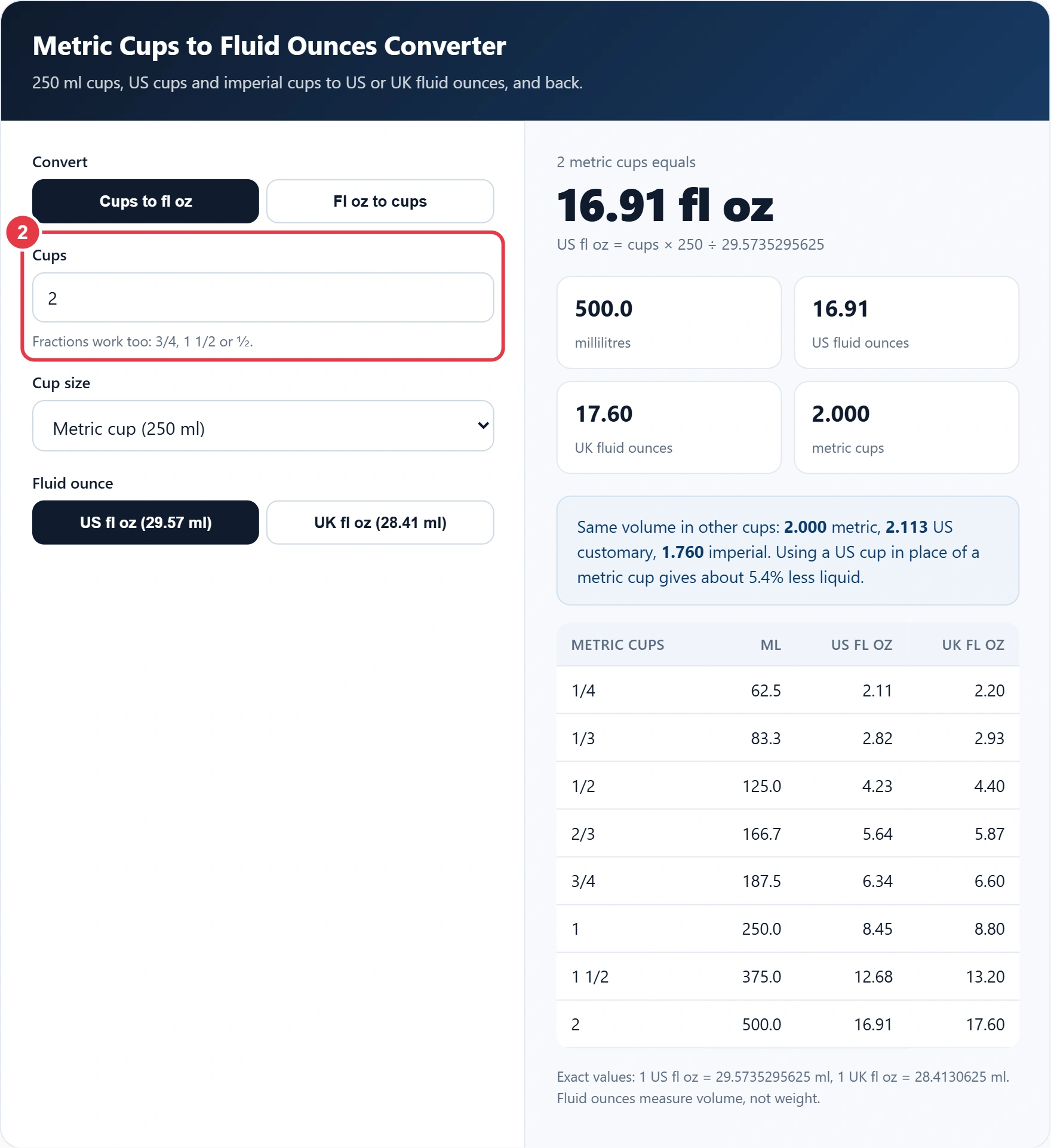
Step 2: Enter the Amount
Type the amount as a decimal or exactly as the recipe writes it: 3/4, 1 1/2 and ½ all work. The result updates as you type, so you can scale a recipe up or down without a separate calculation.
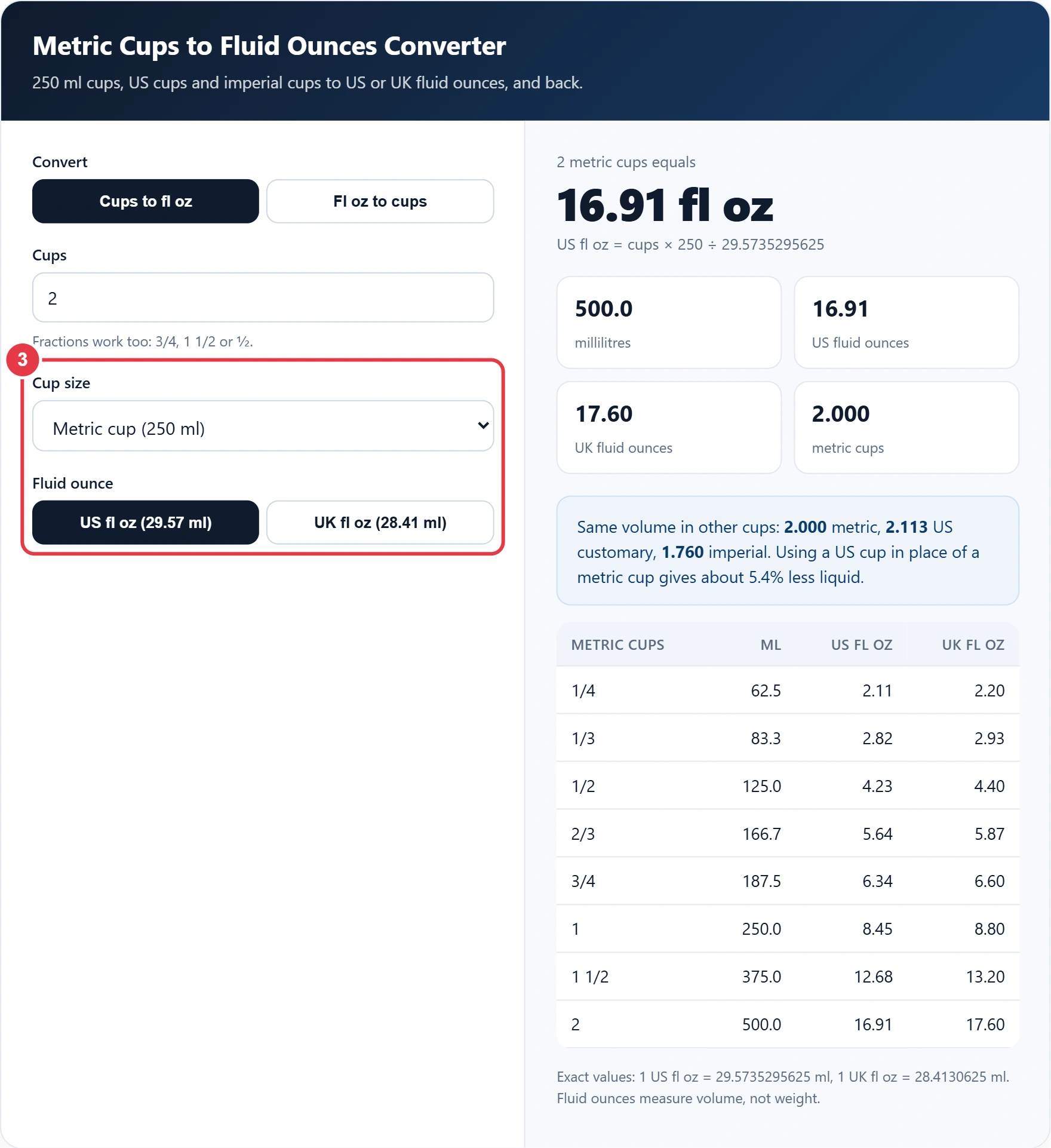
Step 3: Pick the Cup and Fluid Ounce
In the metric cups to fluid ounces converter, leave Metric cup selected for recipes from Australia, New Zealand, Canada or a modern UK book. Choose US customary for American recipes, US legal for nutrition labels, or Imperial for old British recipes. Then choose US fl oz for an American jug or UK fl oz for a British one.
Step 4: Read the Results
The metric cups to fluid ounces converter shows the answer in large type, the formula, the volume in millilitres and both fluid ounces. The blue box gives the same volume in the other cup sizes, and the table lists common fractions from a quarter cup to two cups.
How Many Fluid Ounces Are in a Cup?
It depends on the cup: a metric cup is 8.45 US fl oz, a US customary cup is exactly 8 US fl oz and an imperial cup is exactly 10 UK fl oz. Five cup standards are still in use, and this table compares them.
| Cup | Millilitres | US fl oz | UK fl oz | Where it is used |
|---|---|---|---|---|
| Metric cup | 250 | 8.45 | 8.80 | Australia, NZ, Canada, South Africa, modern UK |
| US customary cup | 236.59 | 8.00 | 8.33 | US recipes and measuring cups |
| US legal cup | 240 | 8.12 | 8.45 | US nutrition labels |
| Imperial cup | 284.13 | 9.61 | 10.00 | Older British recipes |
| Japanese cup | 200 | 6.76 | 7.04 | Japan (rice cups are smaller still) |
The US legal cup of 240 ml comes from the FDA's nutrition labelling rules, which round serving sizes to tidy metric numbers. You will see it on food packaging but rarely in a recipe.
Metric Cups to Fluid Ounces Chart
| Metric cups | Millilitres | US fl oz | UK fl oz |
|---|---|---|---|
| 1/4 | 62.5 | 2.11 | 2.20 |
| 1/3 | 83.3 | 2.82 | 2.93 |
| 1/2 | 125 | 4.23 | 4.40 |
| 2/3 | 166.7 | 5.64 | 5.87 |
| 3/4 | 187.5 | 6.34 | 6.60 |
| 1 | 250 | 8.45 | 8.80 |
| 1 1/2 | 375 | 12.68 | 13.20 |
| 2 | 500 | 16.91 | 17.60 |
| 4 | 1,000 | 33.81 | 35.20 |
Is 250 ml the Same as 8 Fluid Ounces?
No. 250 ml is 8.45 US fluid ounces, and 8 US fluid ounces is 236.59 ml, so a metric cup holds about 5.7% more than a US cup. Many websites round them together, which is harmless for soup but noticeable in baking.
Worked example: Mia in Bristol is baking an Australian banana bread that needs 1 1/2 metric cups of milk, or 375 ml. Her American measuring jug is marked in US fluid ounces, so she enters 1 1/2 and picks US fl oz: she needs 12.68 US fl oz, not the 12 she would pour if she treated each cup as 8 ounces. Her grandmother's British jug shows UK fluid ounces, and the same 375 ml reads 13.20 UK fl oz on it. Pouring 12 ounces would leave the batter about 20 ml short, enough to make a loaf noticeably drier.
For larger volumes such as punch, stock or a home brew, the liter to gallon converter takes over from cups and ounces, showing US and UK gallons side by side so the same mix up does not happen at scale.
How Do I Convert Fluid Ounces to Metric Cups?
Multiply the fluid ounces by 29.5735 (US) or 28.4131 (UK) to get millilitres, then divide by 250. In the metric cups to fluid ounces converter, choose Fl oz to cups and the tool does both steps at once.
Say an American smoothie recipe calls for 12 US fl oz of orange juice. That is 12 × 29.5735 = 354.9 ml, or 1.42 metric cups, so fill one metric cup and a little under half of a second. A 330 ml can holds 11.16 US fl oz or 1.32 metric cups, and a 568 ml British pint is exactly 20 UK fl oz or 2.27 metric cups. If a recipe gives ounces without saying which kind, assume US for American sources and UK for older British cookbooks and jugs.
Are Fluid Ounces the Same as Ounces in Weight?
No. A fluid ounce measures volume and an ounce measures weight, and they only match for water and liquids of similar density. A US fluid ounce of water weighs about 1.04 ounces, while a cup of flour weighs far less than a cup of honey.
That is why dry ingredients are best weighed rather than poured into cups. The cups to grams converter uses typical densities for flour, sugar, butter, oats and more, so a recipe written in cups becomes one you can follow on kitchen scales. Once the batter is mixed, the gas mark to Celsius converter sorts out oven temperatures written for a different country.
The UK and US fluid ounces have been different since 1824, when Britain defined its imperial gallon. If you want the full story of how the fluid ounce split into two sizes, it explains why a US fluid ounce is about 4% larger even though a US pint is smaller than a British one.
Metric Cups and Fluid Ounces Terms Explained
These measuring terms help you tell cup standards apart, so the metric cups to fluid ounces converter gives results that match your recipe and your jug.
- Metric cup
- A kitchen measure fixed at a round 250 millilitres, used in recipes from Australia, New Zealand, Canada, South Africa and most modern British cookbooks. Measuring cup sets sold in those countries are calibrated to it.
- US customary cup
- The cup used in American recipes and measuring sets, defined as half a US pint, or exactly eight US fluid ounces. It is slightly smaller than a metric cup, a gap that matters most in baking where ratios are tight.
- US legal cup
- A rounded cup of 240 millilitres that the US Food and Drug Administration uses for serving sizes on nutrition labels. It simplifies label arithmetic in metric units but rarely appears in recipes or on measuring equipment.
- US fluid ounce
- The American unit of liquid volume equal to one 128th of a US gallon. It is slightly larger than its British counterpart, so the same jug marking in ounces holds a little more liquid in an American recipe.
- Imperial fluid ounce
- The British unit of liquid volume equal to one 160th of an imperial gallon, or one twentieth of an imperial pint. It appears in older UK recipes and on some jugs alongside millilitre markings.
- Volume versus weight
- Fluid ounces measure the space a liquid occupies, while ordinary ounces measure mass. They only line up for water and similar liquids, so ingredients such as flour, sugar or honey need weighing rather than converting by volume.
</>Embed this calculator on your website
Add the free Metric Cups to Fluid Ounces Converter to your own site or blog. Copy the code below and paste it into an HTML block. It resizes itself and works on phones.
How we checked this tool: the Tools Veria Editorial Team built this tool by hand, checked it against the official rules or published standards where they apply, and tested it against worked examples. Results are estimates for planning, not personal financial or tax advice. Read our editorial policy and disclaimer, or report an error.
Frequently Asked Questions
How many fluid ounces are in a metric cup?
A metric cup holds 250 ml, which is 8.45 US fluid ounces or 8.80 UK fluid ounces. Divide 250 by 29.5735 for US fl oz or by 28.4131 for UK fl oz.
Is a metric cup bigger than a US cup?
Yes. A metric cup is 250 ml and a US customary cup is 236.59 ml, so the metric cup holds 13.4 ml, or about 5.7%, more. For most savoury cooking the difference does not matter, but it can affect baking.
How many metric cups are in 8 fluid ounces?
8 US fluid ounces is 236.59 ml, which is 0.946 metric cups. 8 UK fluid ounces is 227.30 ml, which is 0.909 metric cups. Neither is exactly one metric cup.
What cup size do Australian recipes use?
Australian recipes use the metric cup of 250 ml, which is 8.45 US fl oz. Note that an Australian tablespoon is 20 ml, larger than the 15 ml tablespoon used in the UK and roughly 14.8 ml in the US.
How many fluid ounces is half a metric cup?
Half a metric cup is 125 ml, which equals 4.23 US fluid ounces or 4.40 UK fluid ounces. A quarter cup is 62.5 ml, or 2.11 US fl oz.
Does a UK cup equal 8 fluid ounces?
Modern UK recipes that use cups mean the 250 ml metric cup, which is 8.80 UK fl oz. Older British recipes may mean the imperial cup of 284 ml, which is exactly 10 UK fluid ounces.