Sin, cos, tan and their reciprocals, inverse angles and right triangle sides, with the working shown.
Values are rounded to the decimal places you choose. Exact surd forms appear for multiples of 30 and 45 degrees.
This trigonometry calculator gives students, tradespeople and engineers the sine, cosine and tangent of any angle, turns a ratio back into an angle, and solves right angled triangles from two known values. It shows every line of working, uses the same standard definitions of the trigonometric functions taught in GCSE, A level and university courses, and gives exact surd answers for the special angles, so you can check homework as well as get a number.
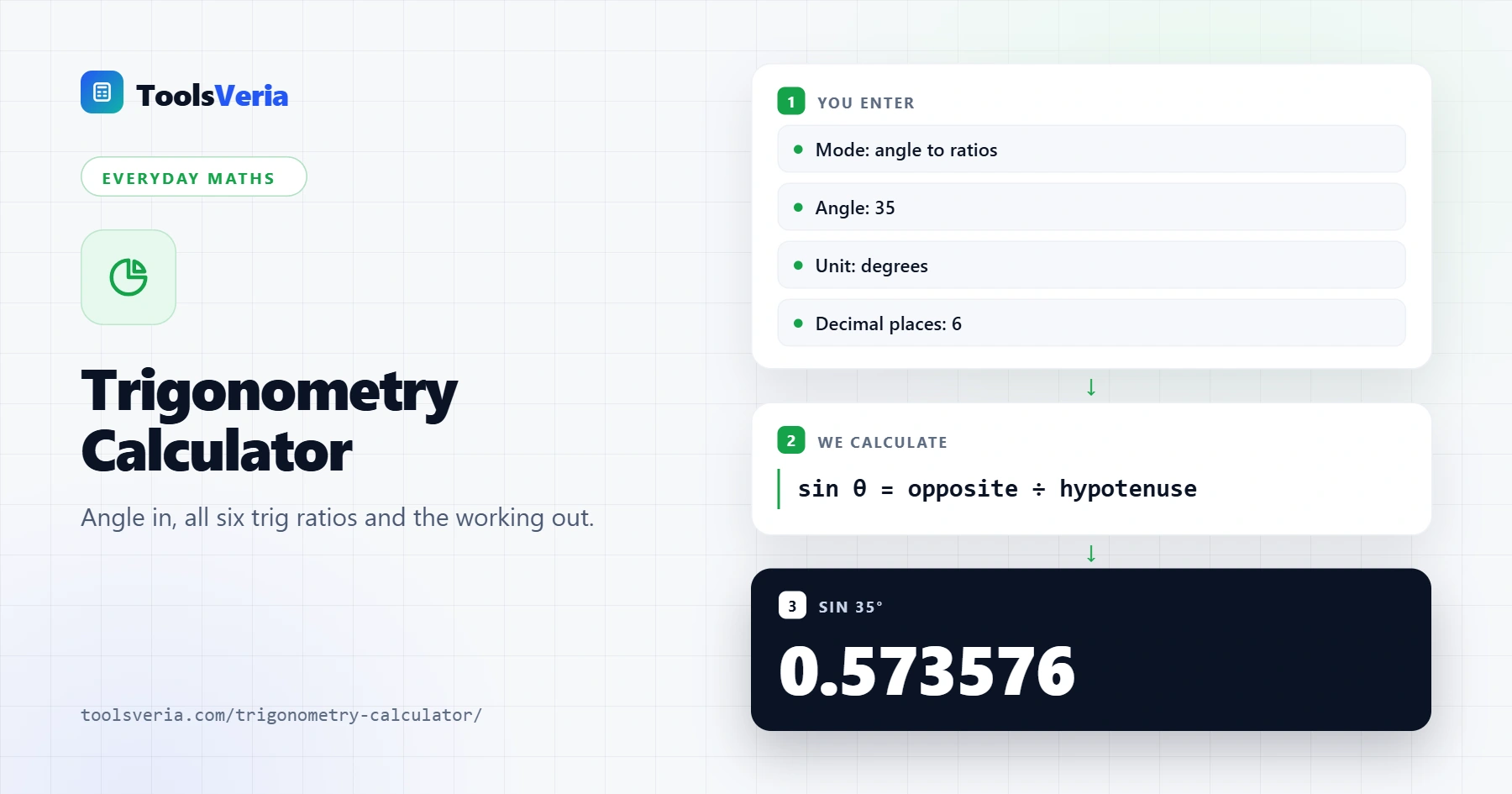
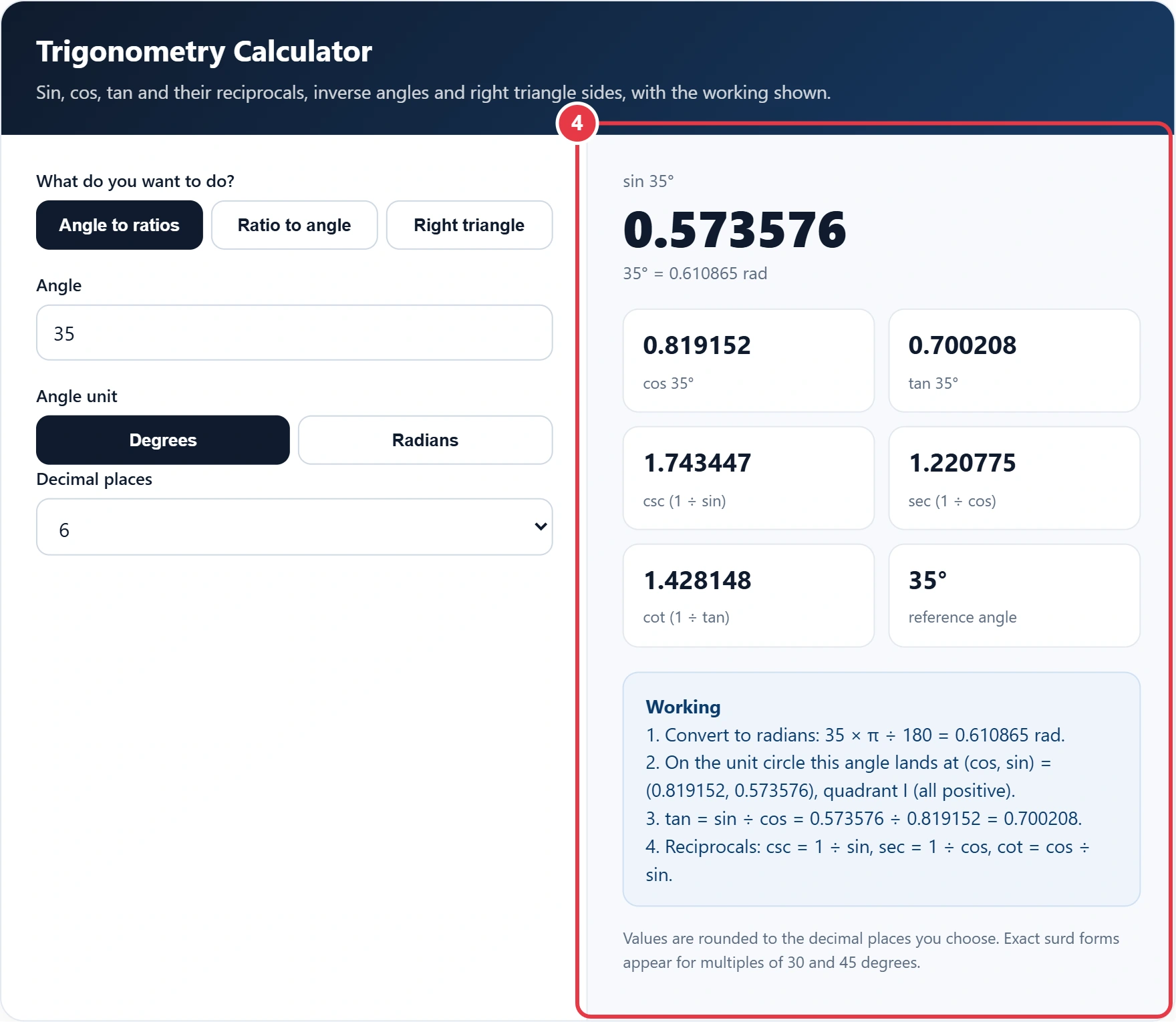
Quick answer: in a right angled triangle, sin = opposite ÷ hypotenuse, cos = adjacent ÷ hypotenuse and tan = opposite ÷ adjacent (SOH CAH TOA). For 35 degrees, the trigonometry calculator returns sin 0.573576, cos 0.819152 and tan 0.700208. Use arcsin, arccos or arctan to go from a ratio back to the angle.
In This Guide
What Is a Trigonometry Calculator?
A trigonometry calculator is a tool that links angles to side ratios: it finds sin, cos, tan and their reciprocals for an angle, finds the angle for a known ratio, and works out missing sides of a right triangle. It replaces the tables of values that people once looked up in printed books.
The formulas in plain words: the sine of an angle is the side opposite it divided by the hypotenuse, the cosine is the side next to it divided by the hypotenuse, and the tangent is the opposite side divided by the adjacent side. The three reciprocal functions flip those fractions: cosecant is 1 ÷ sin, secant is 1 ÷ cos and cotangent is 1 ÷ tan. For angles beyond 90 degrees the calculator uses the unit circle, where cos is the x coordinate and sin is the y coordinate of a point one unit from the centre, which is why some answers come out negative.
How to Use the Trigonometry Calculator
Step 1: Choose What You Want to Find
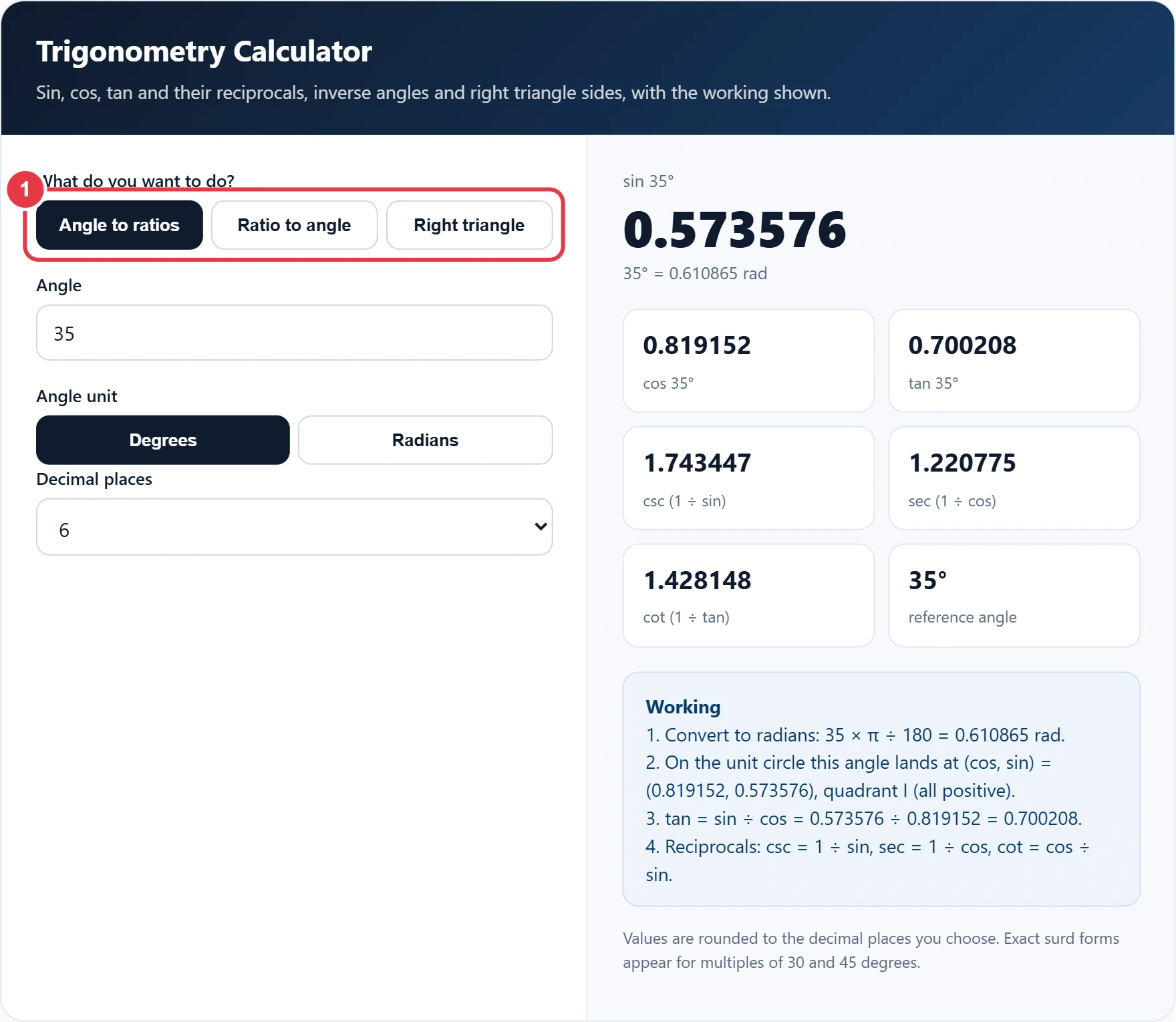
Pick Angle to ratios to get all six functions of an angle, Ratio to angle to run arcsin, arccos or arctan, or Right triangle to find missing sides and angles from any two known values, such as a hypotenuse and one angle.
Step 2: Enter the Angle and Its Unit
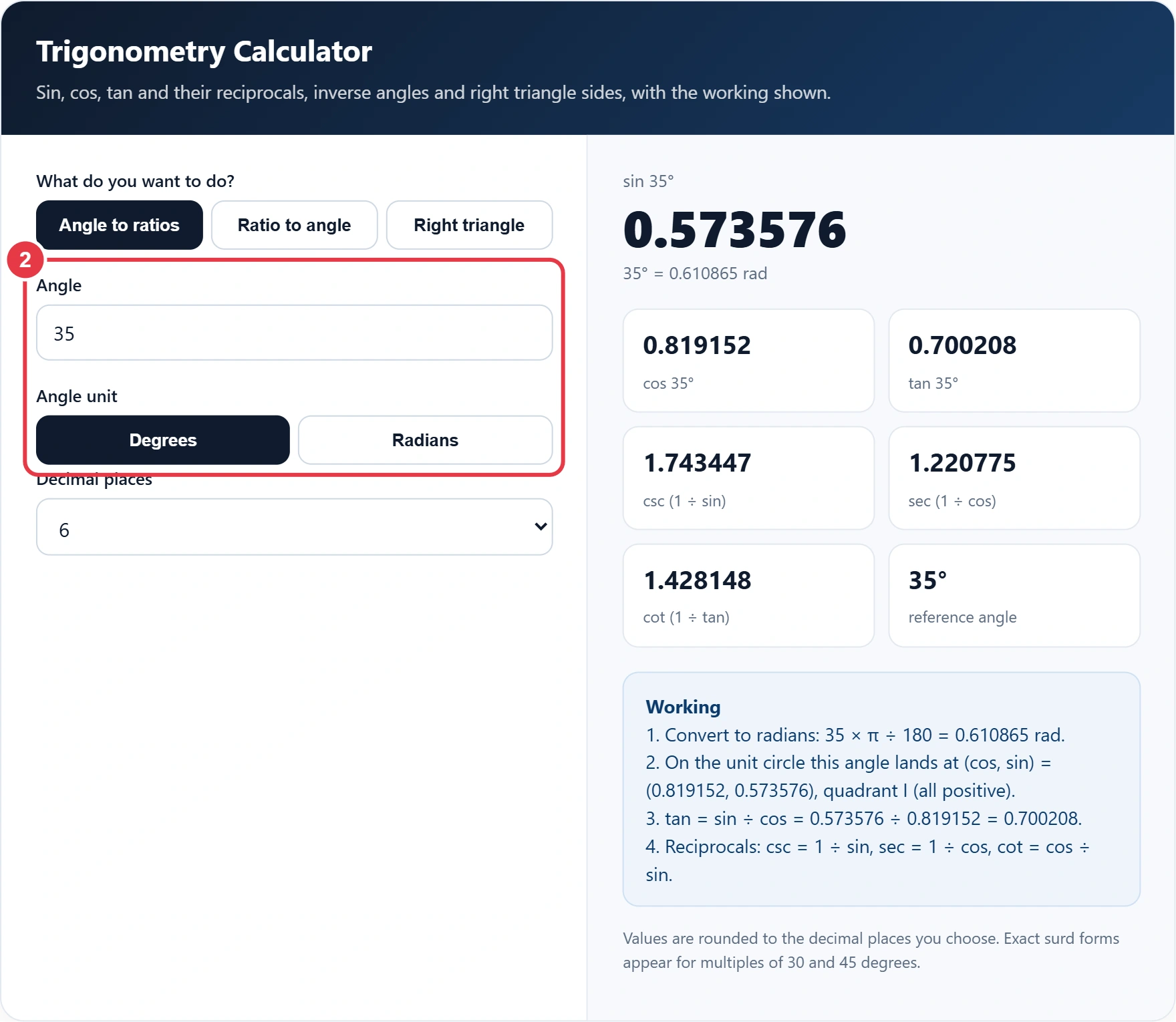
Type the angle and tell the calculator whether it is in degrees or radians. Negative angles and angles above 360 degrees are fine: 390 degrees gives the same answers as 30 degrees, and the working tells you which quadrant the angle falls in.
Step 3: Set the Decimal Places
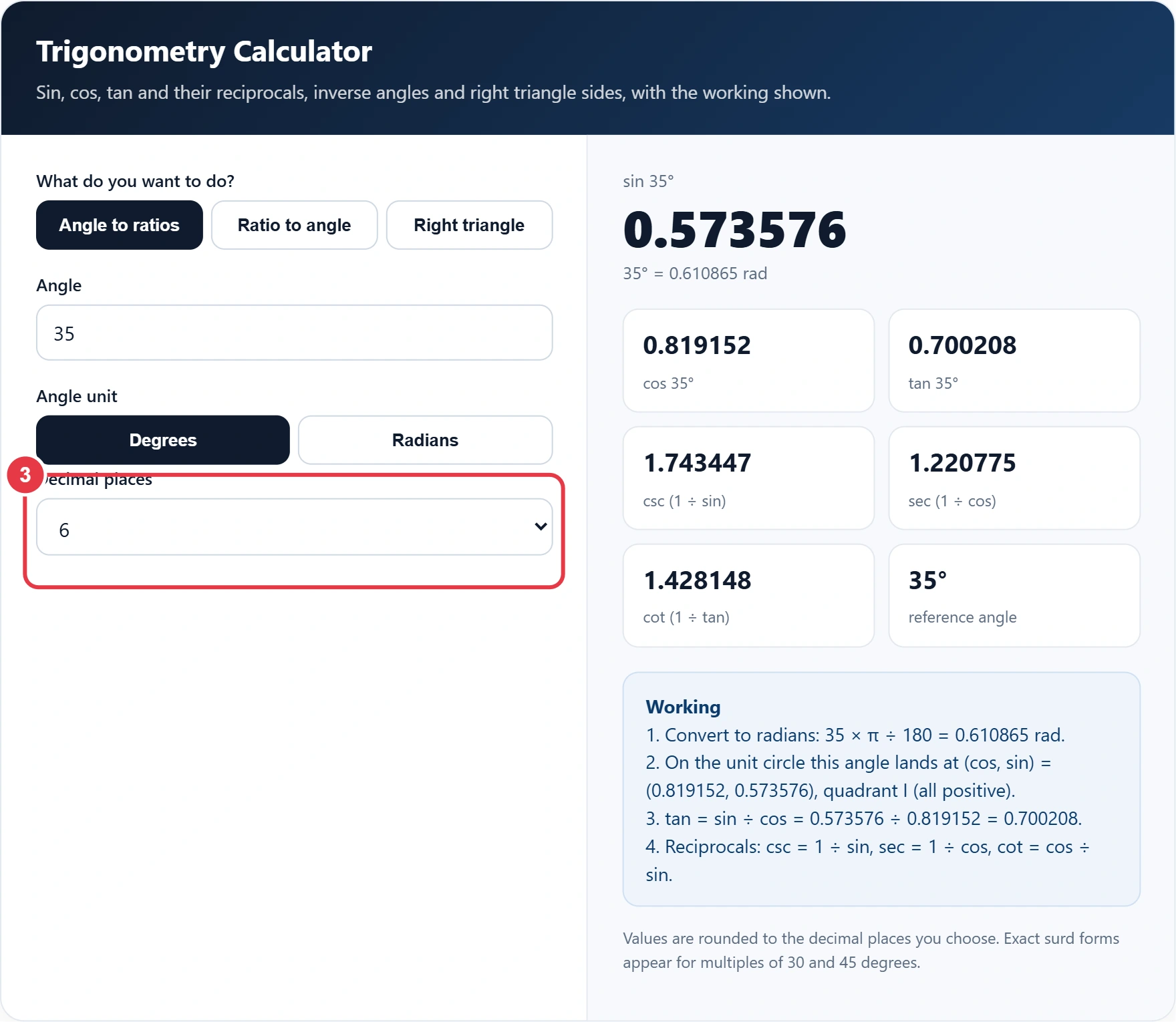
Choose 4 decimal places for most school questions, or 8 to 10 when you need to carry values into a longer engineering or physics calculation without rounding errors creeping in.
Step 4: Read the Results and Working
The large figure is the sine, with cos, tan, csc, sec, cot and the reference angle underneath. The working box shows the radian conversion, the point on the unit circle and, for multiples of 30 and 45 degrees, the exact values such as √3/2.
How Do You Find a Missing Side With Trigonometry?
Multiply or divide the side you know by sin, cos or tan of the angle you know: opposite = hypotenuse × sin A, adjacent = hypotenuse × cos A, and opposite = adjacent × tan A. Pick the function that uses the side you have and the side you want, which is exactly what SOH CAH TOA is for.
Worked example: Dan in Leeds leans a 5 metre ladder against a wall at 75 degrees to the ground, close to the 1 in 4 angle the Health and Safety Executive recommends. The ladder is the hypotenuse. Height reached = 5 × sin 75° = 5 × 0.965926 = 4.83 metres. Distance of the foot from the wall = 5 × cos 75° = 1.29 metres. Pick Right triangle, enter c = 5 and A = 75, and the calculator shows both sides, angle B of 15 degrees, and a Pythagoras check: 4.829629² + 1.294095² = 25.
Going the other way, Amira is fitting a lean to roof with a horizontal run of 2.4 metres and a rise of 1.0 metre. The pitch is arctan(1.0 ÷ 2.4) = 22.62 degrees and the rafter is √(2.4² + 1.0²) = 2.6 metres, so she can check the pitch against the minimum the tile maker allows.
What Are the Exact Values of Sin, Cos and Tan?
The exact values come from two triangles: half of a square (45, 45, 90) and half of an equilateral triangle (30, 60, 90). Exams often ask for these without a calculator, so they are worth learning.
| Angle | Radians | sin | cos | tan |
|---|---|---|---|---|
| 0° | 0 | 0 | 1 | 0 |
| 30° | π/6 | 1/2 | √3/2 | √3/3 |
| 45° | π/4 | √2/2 | √2/2 | 1 |
| 60° | π/3 | √3/2 | 1/2 | √3 |
| 90° | π/2 | 1 | 0 | undefined |
For angles in other quadrants, use the reference angle and the sign rule many UK students learn as CAST: in quadrant I all functions are positive, in II only sine, in III only tangent, and in IV only cosine. So sin 150° = 1/2 and cos 150° = minus √3/2.
Should I Use Degrees or Radians?
Use degrees for measured angles in building, navigation and most geometry questions, and radians for calculus, physics formulas and programming. One radian is about 57.2958 degrees, and a full turn of 360 degrees is 2π radians. Most programming languages expect radians, as the JavaScript Math.sin reference explains, so a value typed in degrees gives a wrong answer unless you convert it first.
The most common slip on a handheld trigonometry calculator is leaving it in the wrong mode. A quick test: sin 30 should be 0.5. If you see minus 0.988, the calculator is reading 30 as radians.
Why Do Some Trig Values Come Out as Undefined?
A value is undefined when the formula would divide by zero: tan 90° = sin ÷ cos = 1 ÷ 0, so it has no value, and the same applies to sec 90°, csc 0° and cot 0°. Near those angles the numbers grow without limit, which is why the tangent graph has vertical asymptotes every 180 degrees.
- sin⁻¹ means arcsin, the inverse function, not 1 ÷ sin. The reciprocal is cosecant.
- arcsin and arccos only accept values from minus 1 to 1, because no side can be longer than the hypotenuse.
- Inverse functions return one principal angle. The calculator lists the second answer between 0 and 360 degrees as well.
- The hypotenuse is always the longest side and sits opposite the right angle.
When a problem is about proportions rather than angles, the ratio calculator simplifies and scales side ratios, and the fraction to decimal converter turns exact answers such as 3/8 into decimals. Formulas checked October 2026.
Key Trigonometry Calculator Terms Explained
These definitions explain the functions, units and triangle parts used by the trigonometry calculator, helping you follow its working and check homework or engineering answers.
- Sine
- A trigonometric function that relates an angle to the ratio of the side opposite it and the longest side of a right angled triangle. On the unit circle it equals the vertical coordinate, so it is negative for angles below the horizontal axis.
- Cosine
- A trigonometric function that compares the side beside an angle with the hypotenuse. On the unit circle it gives the horizontal coordinate of a point, which is why its value turns negative in the second and third quadrants.
- Tangent
- A trigonometric function equal to sine divided by cosine, or opposite over adjacent in a right triangle. It measures the slope of the angle's line, and it is undefined where cosine is zero, such as at 90 degrees.
- Hypotenuse
- The longest side of a right angled triangle, lying opposite the right angle. It appears in the definitions of sine and cosine, and Pythagoras' theorem links its square to the sum of the squares of the other two sides.
- Radian
- The SI unit of angle, defined by an arc whose length equals the circle's radius. A full turn is 2π radians, equal to 360 degrees, so calculators must know which unit an angle uses before evaluating a function.
- Inverse trigonometric functions
- Arcsin, arccos and arctan reverse the ordinary functions, returning the angle that produces a given ratio. Their outputs are restricted to principal ranges so that each ratio gives a single answer rather than infinitely many angles.
</>Embed this calculator on your website
Add the free Trigonometry Calculator to your own site or blog. Copy the code below and paste it into an HTML block. It resizes itself and works on phones.
How we checked this tool: the Tools Veria Editorial Team built this tool by hand, checked it against the official rules or published standards where they apply, and tested it against worked examples. Results are estimates for planning, not personal financial or tax advice. Read our editorial policy and disclaimer, or report an error.
Frequently Asked Questions
What does SOH CAH TOA mean?
It is a memory aid for the three main ratios: Sine = Opposite ÷ Hypotenuse, Cosine = Adjacent ÷ Hypotenuse, and Tangent = Opposite ÷ Adjacent. Pick the one that links the side you know to the side you want.
What is sin 30 degrees?
Sin 30 degrees is exactly 1/2, or 0.5. It comes from half of an equilateral triangle, where the side opposite the 30 degree angle is half the length of the hypotenuse.
How do I find an angle from two sides?
Divide the two sides and apply the matching inverse function: arcsin(opposite ÷ hypotenuse), arccos(adjacent ÷ hypotenuse) or arctan(opposite ÷ adjacent). For sides 3 and 4, arctan(3 ÷ 4) gives 36.87 degrees.
Why is tan 90 degrees undefined?
Tan is sin divided by cos, and cos 90 degrees is 0. Dividing 1 by 0 has no answer, so tan 90 degrees is undefined, and the tangent graph shoots off to infinity on either side of 90.
Can trigonometry be used on triangles without a right angle?
Yes. Use the sine rule, a ÷ sin A = b ÷ sin B, or the cosine rule, c² = a² + b² minus 2ab cos C. This calculator covers right triangles; split other shapes into right triangles where you can.
How do I convert degrees to radians?
Multiply the degrees by π and divide by 180. For example, 35 degrees × π ÷ 180 = 0.610865 radians. To go back, multiply radians by 180 and divide by π, so 1 radian is 57.2958 degrees.