Estimate your Reemployment Assistance weekly benefit, eligibility and total from your base period wages.
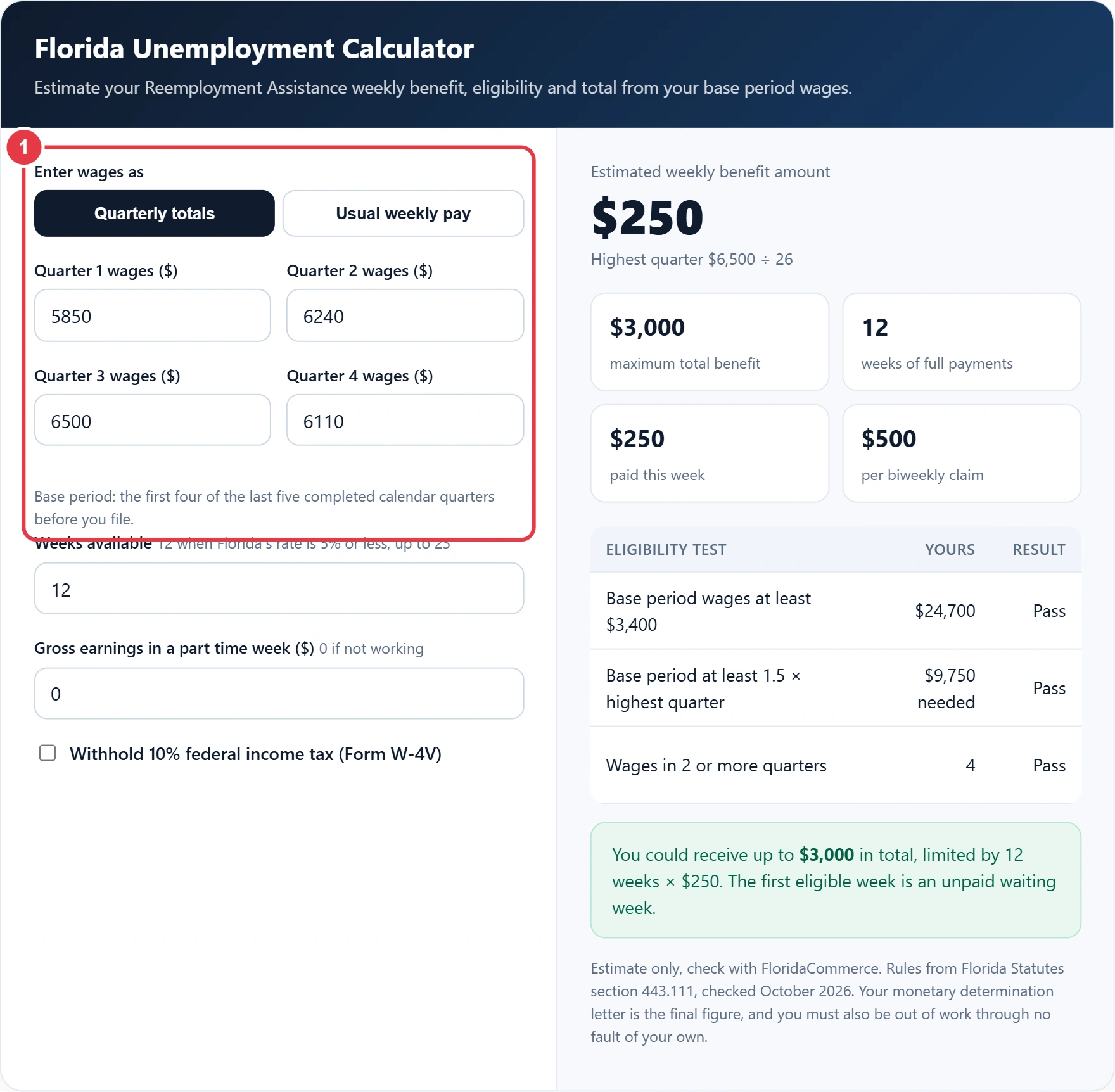
Base period: the first four of the last five completed calendar quarters before you file.
| Eligibility test | Yours | Result |
|---|
Estimate only, check with FloridaCommerce. Rules from Florida Statutes section 443.111, checked October 2026. Your monetary determination letter is the final figure, and you must also be out of work through no fault of your own.
This Florida unemployment calculator estimates the Reemployment Assistance a laid off Florida worker can expect for a claim filed in 2026: the weekly benefit amount, whether the wages pass the state's eligibility tests, the most you can be paid in total and what reaches you in a week of part time work. It follows the formula in Florida Statutes section 443.111, which FloridaCommerce (formerly the Department of Economic Opportunity) applies to every claim.
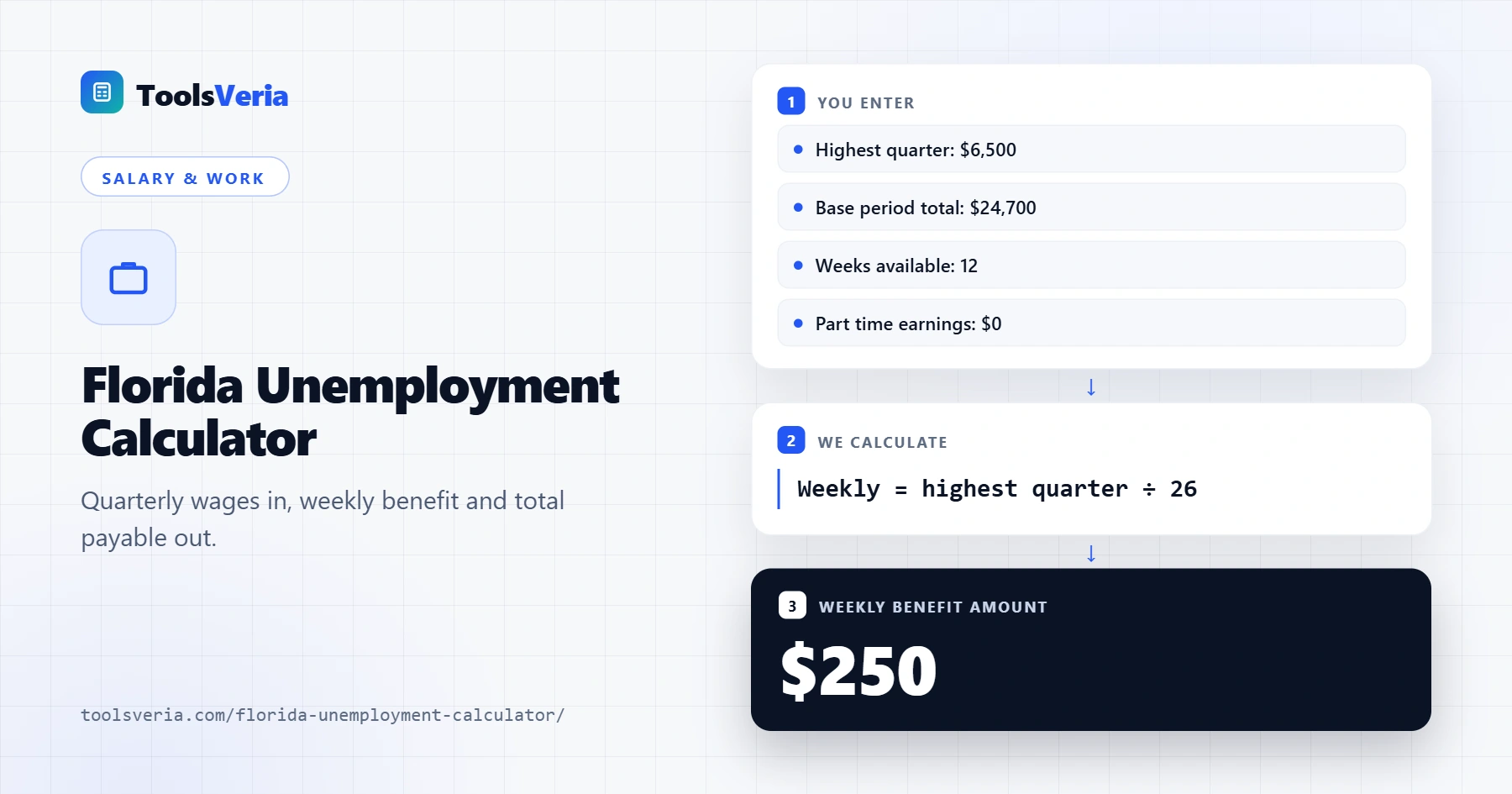
Quick answer: Florida pays one twenty sixth of your highest quarter's wages, rounded down to the dollar, between $32 and $275 a week. A $6,500 best quarter gives $250 a week. This Florida unemployment calculator also caps the total at 25% of base period wages, $6,325 or weekly amount × weeks.
In This Guide
What Is the Florida Unemployment Calculator?
The Florida unemployment calculator is a tool that turns your recent earnings into an estimate of Reemployment Assistance, the name Florida uses for unemployment insurance. In plain words: take the quarter of your base period in which you earned the most, divide it by 26 and round down, then keep the result between $32 and $275. Your maximum total is the lowest of three numbers: 25% of all base period wages, $6,325, or the weekly amount multiplied by the weeks available.
The base period is the first four of the last five completed calendar quarters before you file. If you file in October 2026, the last completed quarter is July to September 2026, which is skipped, so the base period runs from July 2025 to June 2026. Earnings that the state does not yet have on file, such as the most recent quarter, do not count towards the standard calculation.
How to Use the Florida Unemployment Calculator
Step 1: Enter Your Base Period Wages
Type your gross wages for each of the four base period quarters. Payslips or your final W-2 make this easy: add up three months at a time. If you were paid the same every week, switch to usual weekly pay and the tool multiplies it by 13 weeks for each quarter.
Step 2: Set the Weeks Available
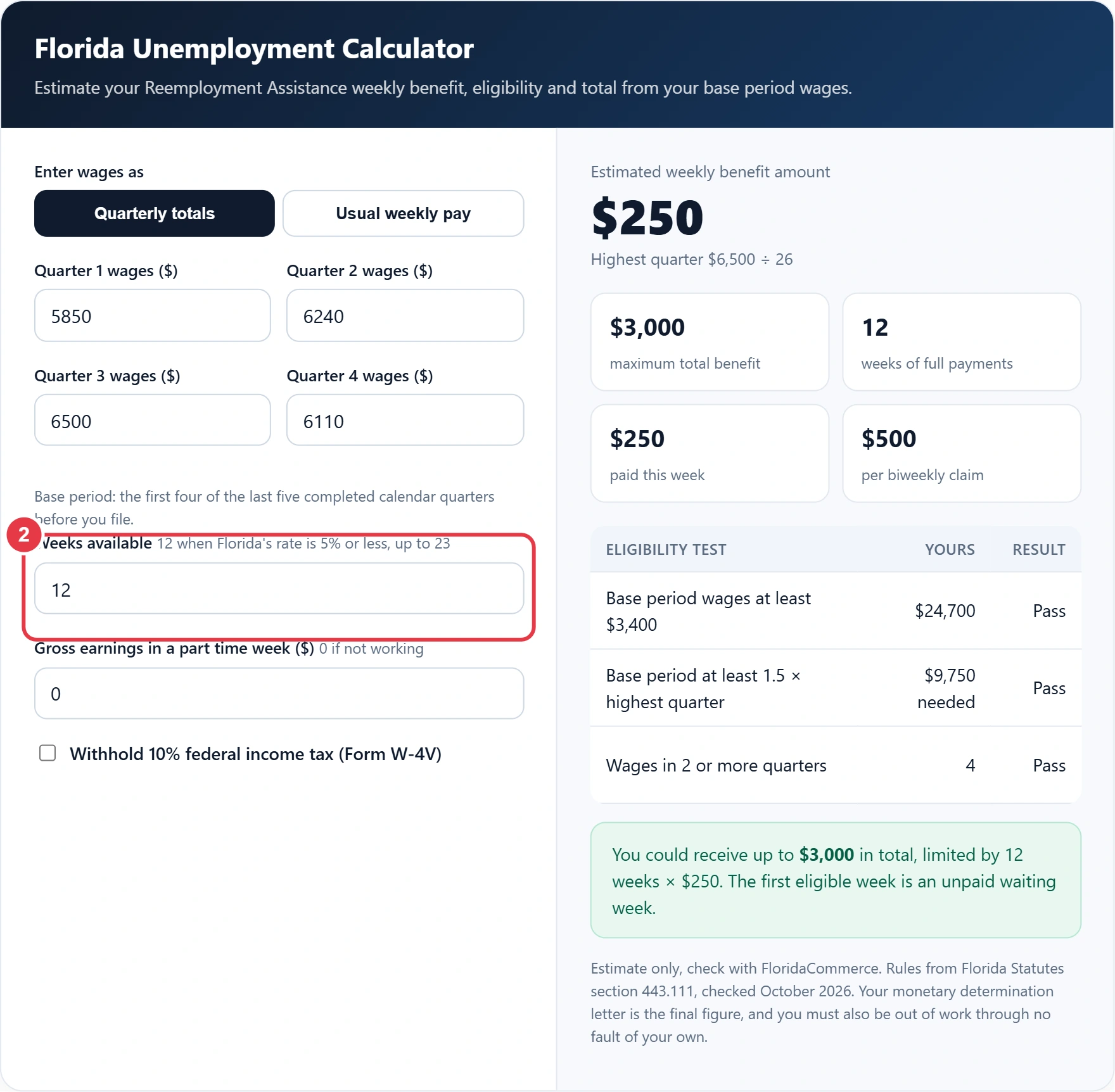
Leave this at 12 unless FloridaCommerce tells you otherwise. The number of weeks is fixed each year from Florida's average unemployment rate for the third quarter of the previous year, and it only rises above 12 when that rate passes 5%.
Step 3: Add Part Time Earnings and Tax
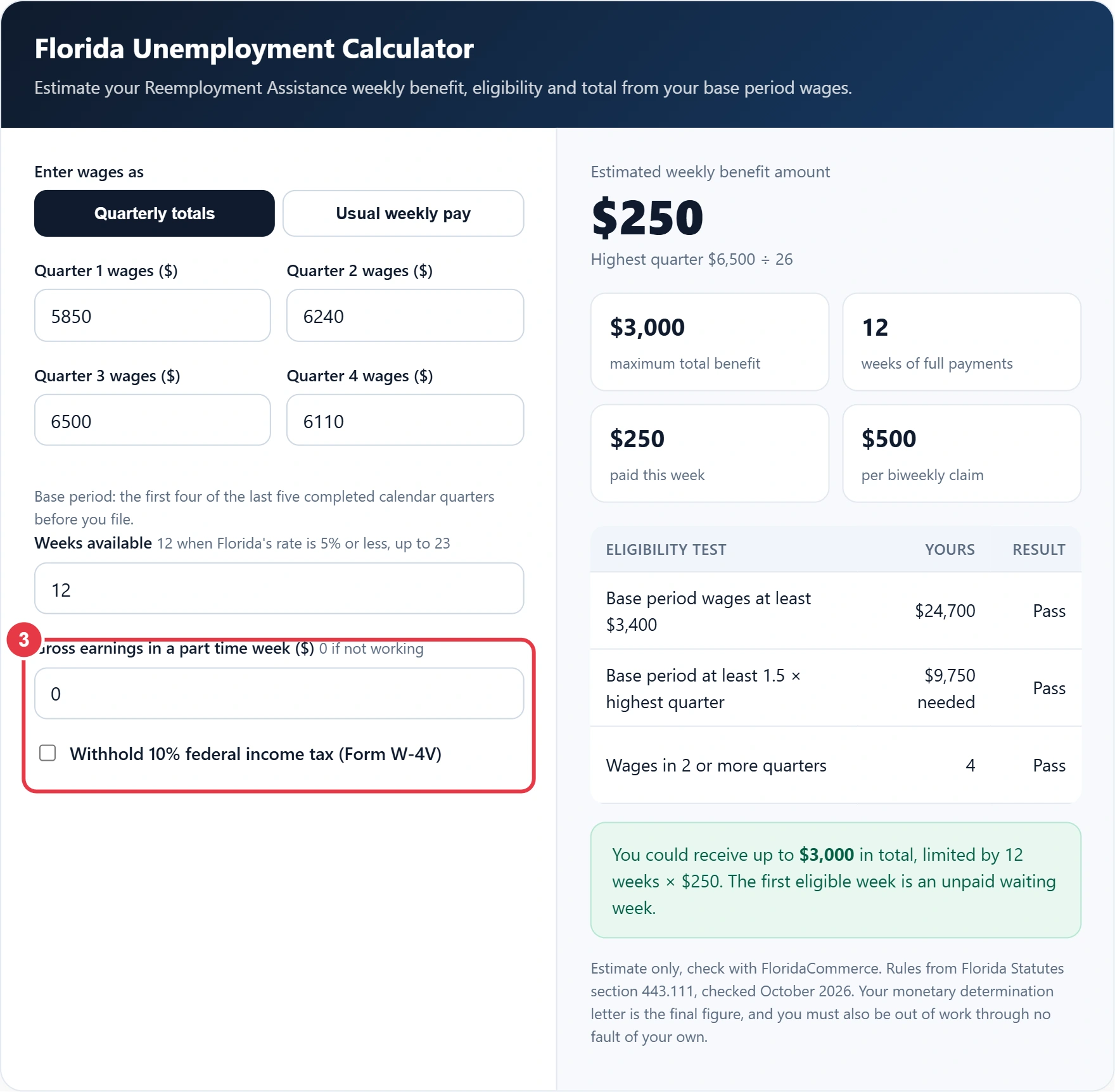
If you work some hours while claiming, enter that week's gross earnings to see the reduced payment. A shift worker can total the hours with the time card calculator first, then enter the pay here. Tick the withholding box if you asked for 10% federal income tax to be held back from each payment.
Step 4: Read Your Results
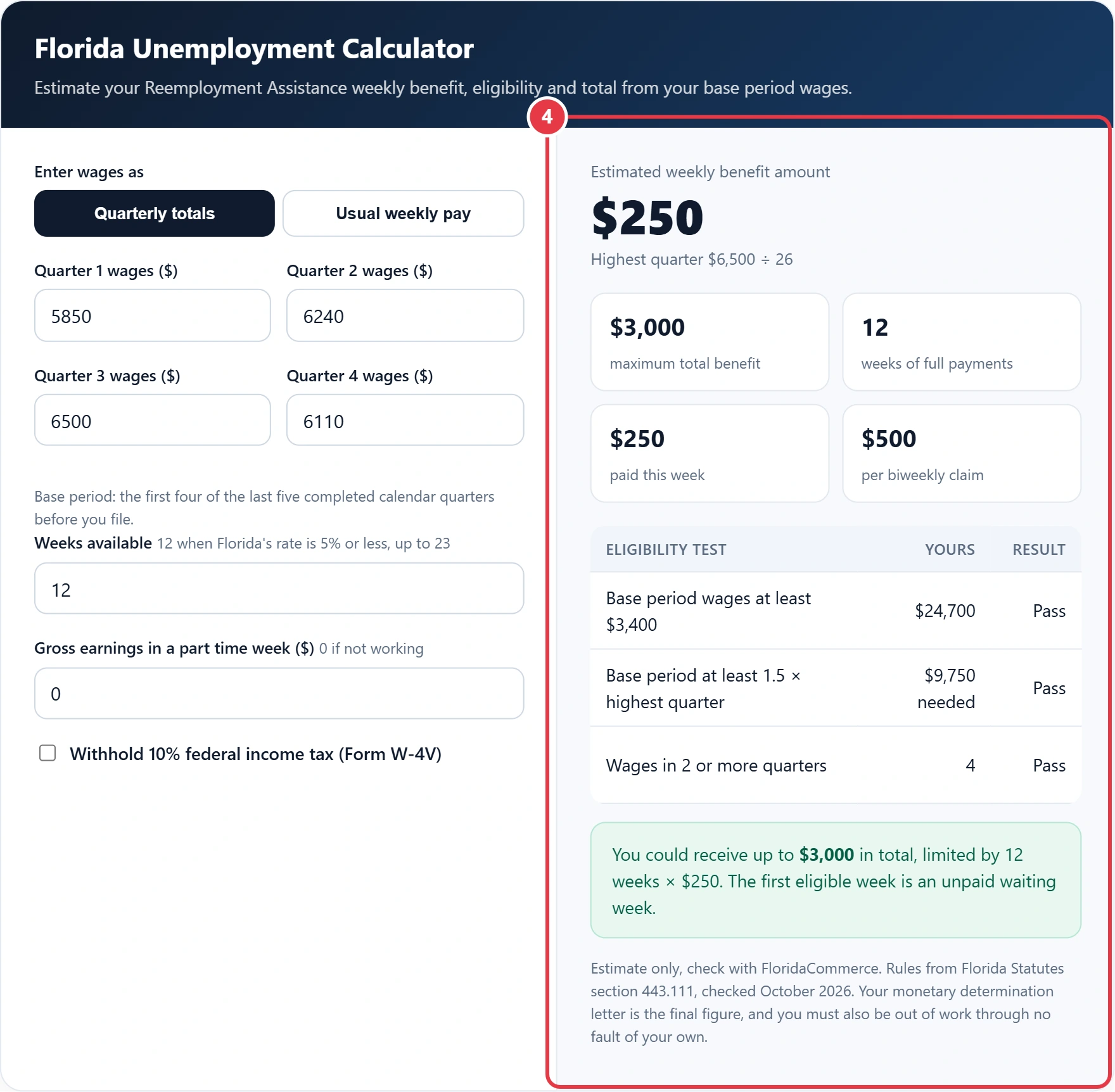
The headline is your estimated weekly benefit amount. Below it are the maximum total, how many full weeks that pays for, the amount for the week you entered and the payment for a biweekly claim. The table runs the three monetary eligibility tests and shows exactly where your wages fall short if one fails.
How Much Unemployment Will I Get in Florida?
You will get your highest quarter's wages divided by 26, rounded down to a whole dollar and capped at $275 a week. Worked example: Marcus, a warehouse picker in Tampa, earned $5,850, $6,240, $6,500 and $6,110 in his base period quarters, $24,700 in all. His weekly benefit is $6,500 ÷ 26 = $250. His total is the lowest of $6,175 (25% of $24,700), $6,325 and 12 × $250 = $3,000, so he can receive up to $3,000. With 10% federal withholding, each full week pays $225, or $450 per biweekly claim.
| Highest quarter wages | Weekly benefit | Total over 12 weeks | Base period needed (1.5 × quarter) |
|---|---|---|---|
| $2,600 | $100 | $1,200 | $3,900 |
| $3,900 | $150 | $1,800 | $5,850 |
| $5,200 | $200 | $2,400 | $7,800 |
| $6,500 | $250 | $3,000 | $9,750 |
| $7,150 or more | $275 (maximum) | $3,300 | $10,725 |
The 12 week totals assume base period wages of at least four times the weekly benefit × 12, so the 25% cap does not bite. Someone earning a steady $1,000 a week reaches the $275 ceiling well before the end of the scale, which is why Florida replaces a smaller share of higher wages than most states.
How Many Weeks of Unemployment Can You Get in Florida?
Most claims filed in 2026 can be paid for up to 12 weeks, the minimum Florida allows. The weeks rise by one for each half point that Florida's average unemployment rate for July to September of the previous year sits above 5%, up to 23 weeks at 10.5% or more.
| Florida average unemployment rate | Weeks available | Most at $275 a week |
|---|---|---|
| 5% or less | 12 | $3,300 |
| 6% | 14 | $3,850 |
| 7% | 16 | $4,400 |
| 8.5% | 19 | $5,225 |
| 10.5% or more | 23 | $6,325 |
Can You Work Part Time and Still Get Florida Unemployment?
Yes, as long as your earnings for the week are less than your benefit plus the disregard. Florida ignores earnings up to 8 times the federal minimum wage of $7.25, which is $58, and takes every dollar above that off your weekly benefit. If Marcus earns $150 in a week, $92 is deducted and he is paid $158. Report gross earnings, before tax, and the Florida unemployment calculator applies the same rule.
Who Qualifies for Reemployment Assistance in Florida?
You qualify on wages if your base period total is at least $3,400, at least 1.5 times your highest quarter, and earned in two or more quarters. You must also have lost work through no fault of your own, be able and available to work, contact at least five employers a week (three in some smaller counties), and claim every two weeks. The first week you are eligible is an unpaid waiting week.
Why Might Your Monetary Determination Differ?
Your official figure arrives in a Notice of Monetary Determination, and it can differ from the Florida unemployment calculator for four common reasons. First, an employer may have reported wages late or in a different quarter, so a bonus paid on 2 January lands in the next quarter. Second, wages from a federal job, military service or another state are handled separately and may need a combined claim. Third, pay from self employment or gig apps usually is not insured work, so it does not count. Fourth, the state only uses wages it holds on file when you apply.
If a quarter looks wrong, gather payslips or a W-2 and ask for a reconsideration quickly, because deadlines are short. Florida generally gives 20 days to appeal a determination, and the date is printed on the notice. Keep claiming every two weeks while you wait, since weeks you do not claim on time may not be paid later.
Is Florida Unemployment Taxable?
Florida has no state income tax, but the payments count as income for federal tax. The IRS guidance on unemployment compensation says you can ask for tax to be withheld on Form W-4V, where the rate is 10%, and you will get Form 1099-G after the year ends. Setting money aside matters because a $3,000 claim with nothing withheld can add a few hundred dollars to your tax bill in April.
Unemployment insurance in the United States is run by each state under a shared federal framework, which the overview of US unemployment benefits explains, and that is why Florida's $275 cap is among the lowest in the country. When you find work, the hourly to annual salary calculator helps compare a new offer against your old pay. Figures checked October 2026.
</>Embed this calculator on your website
Add the free Florida Unemployment Calculator to your own site or blog. Copy the code below and paste it into an HTML block. It resizes itself and works on phones.
How we checked this tool: the Tools Veria Editorial Team built this tool by hand, checked it against the official rules or published standards where they apply, and tested it against worked examples. Results are estimates for planning, not personal financial or tax advice. Read our editorial policy and disclaimer, or report an error.
Frequently Asked Questions
What is the maximum unemployment benefit in Florida in 2026?
The maximum weekly benefit in Florida is $275, and the minimum is $32. With 12 weeks available for most 2026 claims, the most anyone can receive is $3,300, and the absolute state limit is $6,325 when 23 weeks apply.
How is Florida unemployment calculated?
Florida divides the wages from the highest paid quarter of your base period by 26 and rounds down to the dollar. The result is kept between $32 and $275 a week. Someone earning $5,200 in their best quarter gets $200 a week.
How long does Florida unemployment last?
Florida unemployment lasts up to 12 weeks for claims filed in 2026 when the state's average unemployment rate is 5% or less. Each half point above 5% adds one week, to a maximum of 23 weeks at 10.5%.
How much do I need to earn to qualify for unemployment in Florida?
You need at least $3,400 of wages in your base period, spread over two or more quarters, and a base period total of at least 1.5 times your highest quarter. Someone with $4,000 in one quarter needs $6,000 in total.
How much can I earn while on unemployment in Florida?
You can earn up to $58 a week, which is 8 times the $7.25 federal minimum wage, without any reduction. Every dollar above $58 comes off your weekly benefit, so on a $250 benefit earnings of $308 or more stop that week's payment.
Does Florida have a waiting week for unemployment?
Yes. Florida has one unpaid waiting week, the first week in which you are otherwise eligible. No payment is made for it, so your first payment covers the second eligible week.