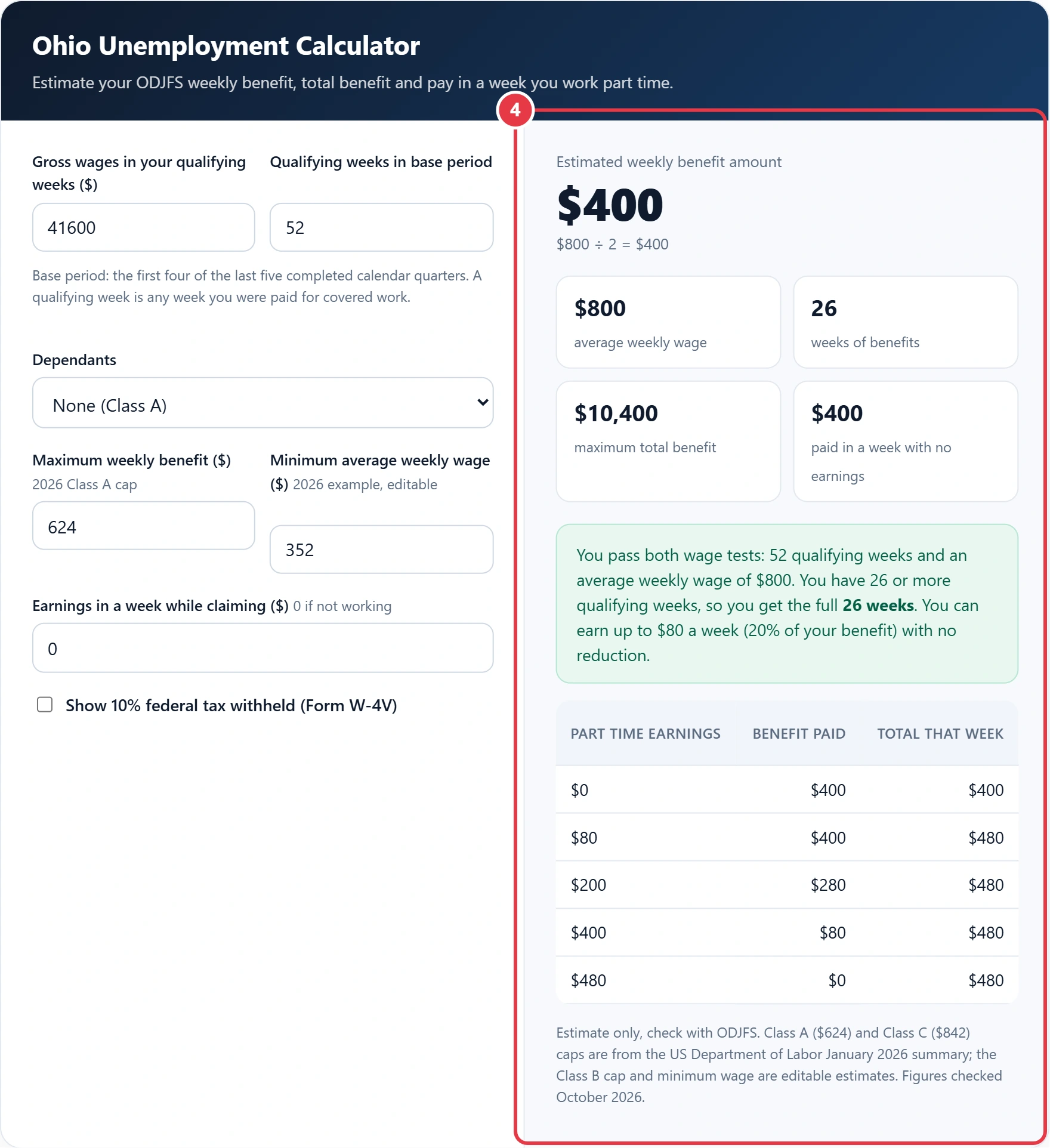
Estimate your ODJFS weekly benefit, total benefit and pay in a week you work part time.
Base period: the first four of the last five completed calendar quarters. A qualifying week is any week you were paid for covered work.
| Part time earnings | Benefit paid | Total that week |
|---|
Estimate only, check with ODJFS. Class A ($624) and Class C ($842) caps are from the US Department of Labor January 2026 summary; the Class B cap and minimum wage are editable estimates. Figures checked October 2026.
This Ohio unemployment calculator estimates the weekly unemployment benefit, total benefit and part time pay for people filing with the Ohio Department of Job and Family Services (ODJFS) in 2026, using Ohio's qualifying week formula and the dependency class caps of $624 to $842 a week. It runs both wage tests, sets your number of weeks from 20 to 26 and can show each payment after federal tax on unemployment is withheld, so you can plan a realistic budget. Figures checked October 2026.
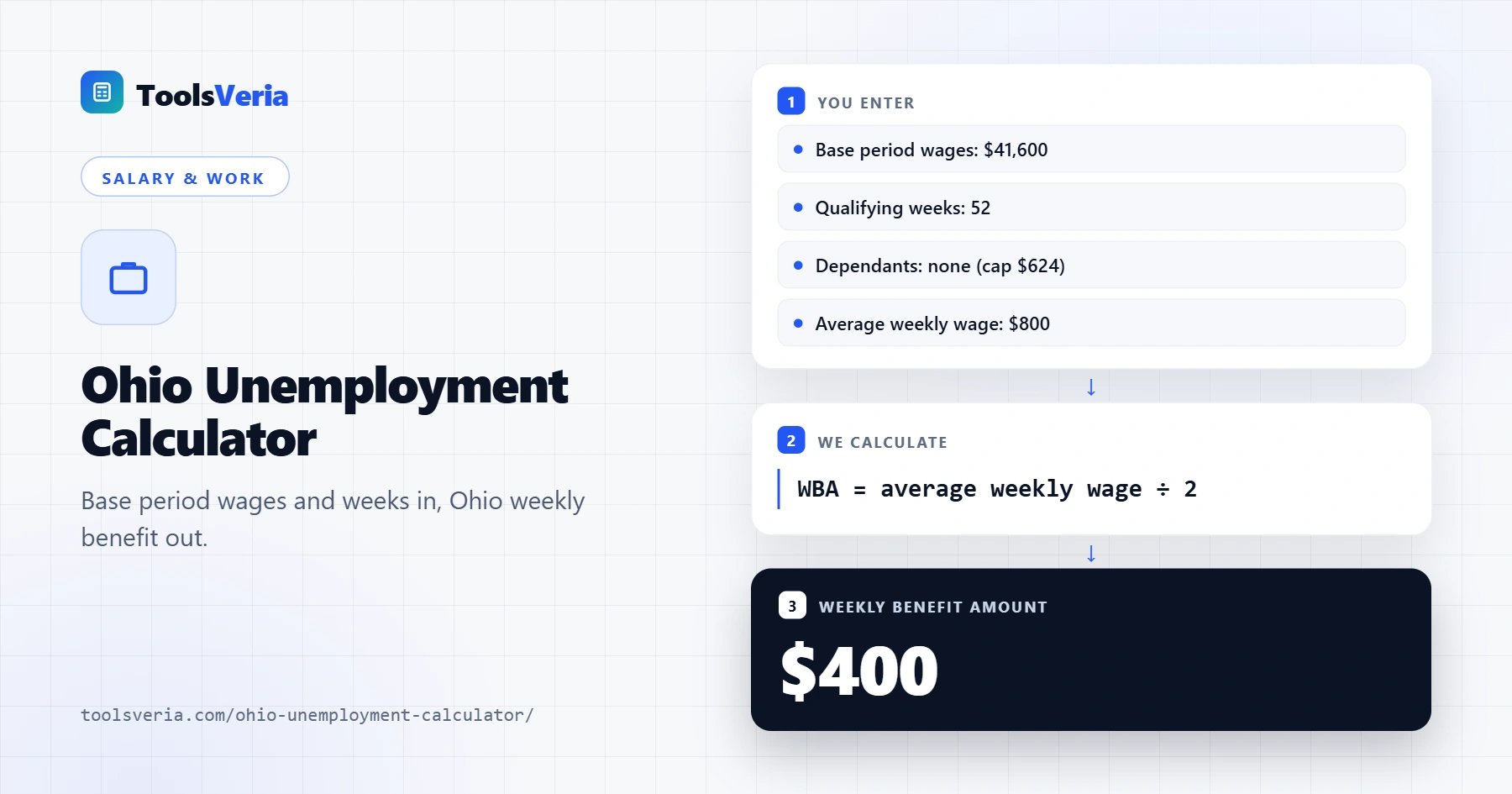
Quick answer: Ohio pays half your average weekly wage in the base period, rounded down to the dollar, up to $624 a week with no dependants or $842 with three or more. An Ohio unemployment calculator turns $41,600 over 52 qualifying weeks into an $800 average and a $400 weekly benefit for 26 weeks.
In This Guide
What Is an Ohio Unemployment Calculator?
An Ohio unemployment calculator is a tool that estimates the state unemployment insurance ODJFS could pay you, based on the weeks you worked and the wages you earned in your base period. Unlike most states, Ohio counts weeks rather than quarters: a qualifying week is any calendar week in which you earned or were paid wages from covered work.
The formula in plain words: add up your wages for all qualifying weeks, divide by the number of qualifying weeks to get your average weekly wage, and halve it, dropping any cents. That is your weekly benefit amount, capped by your dependency class. Your total benefit is the weekly amount times your qualifying weeks, with a minimum of 20 weeks and a maximum of 26.
How to Use the Ohio Unemployment Calculator
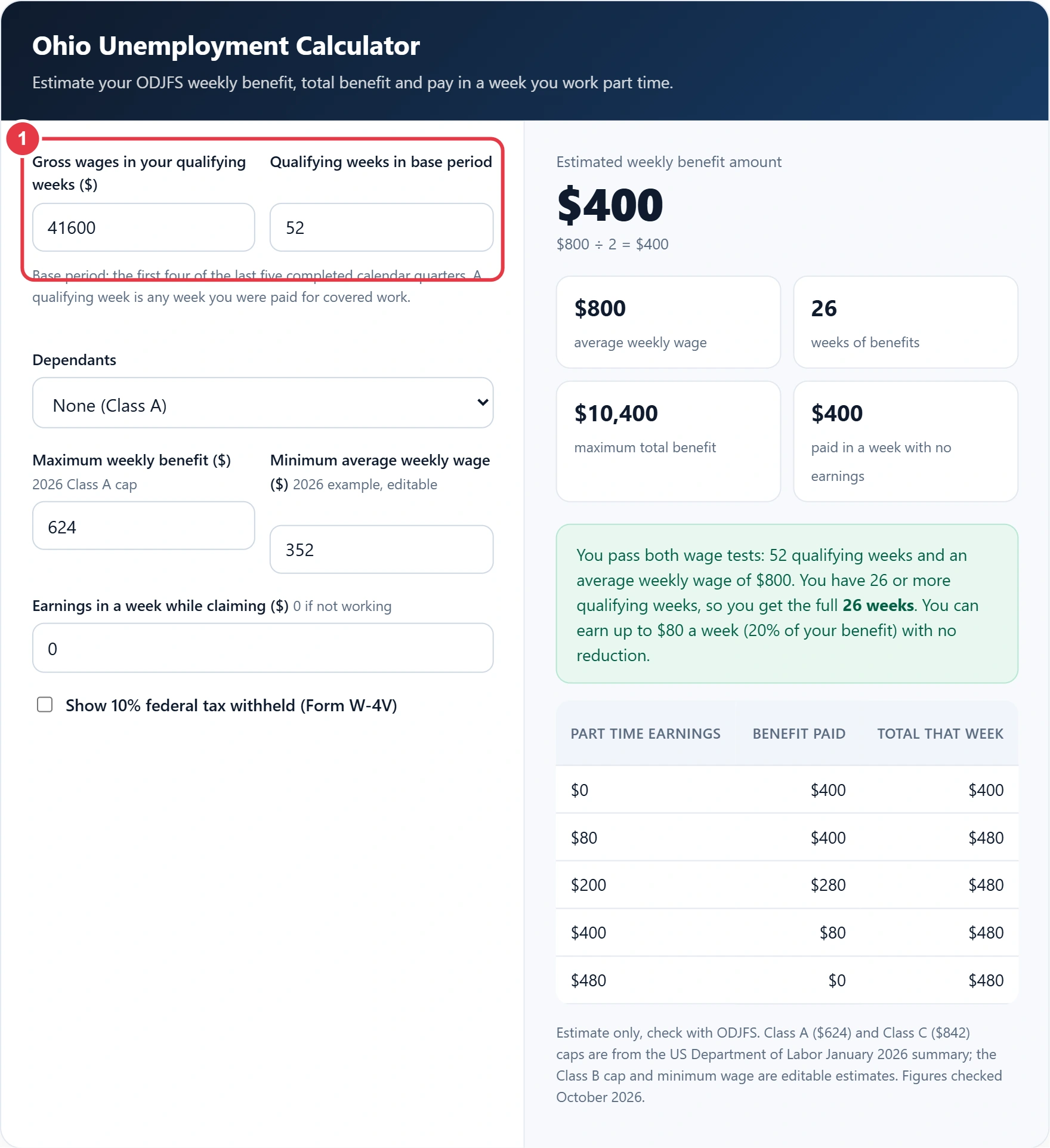
Step 1: Enter Wages and Qualifying Weeks
Your base period is the first four of the last five completed calendar quarters, so a claim filed in October 2026 looks at July 2025 to June 2026. Enter your gross pay for the weeks you worked in that time and the number of those weeks. If you only know your hourly rate, the hourly to annual salary calculator converts it into weekly and yearly pay.
Step 2: Choose Your Dependants
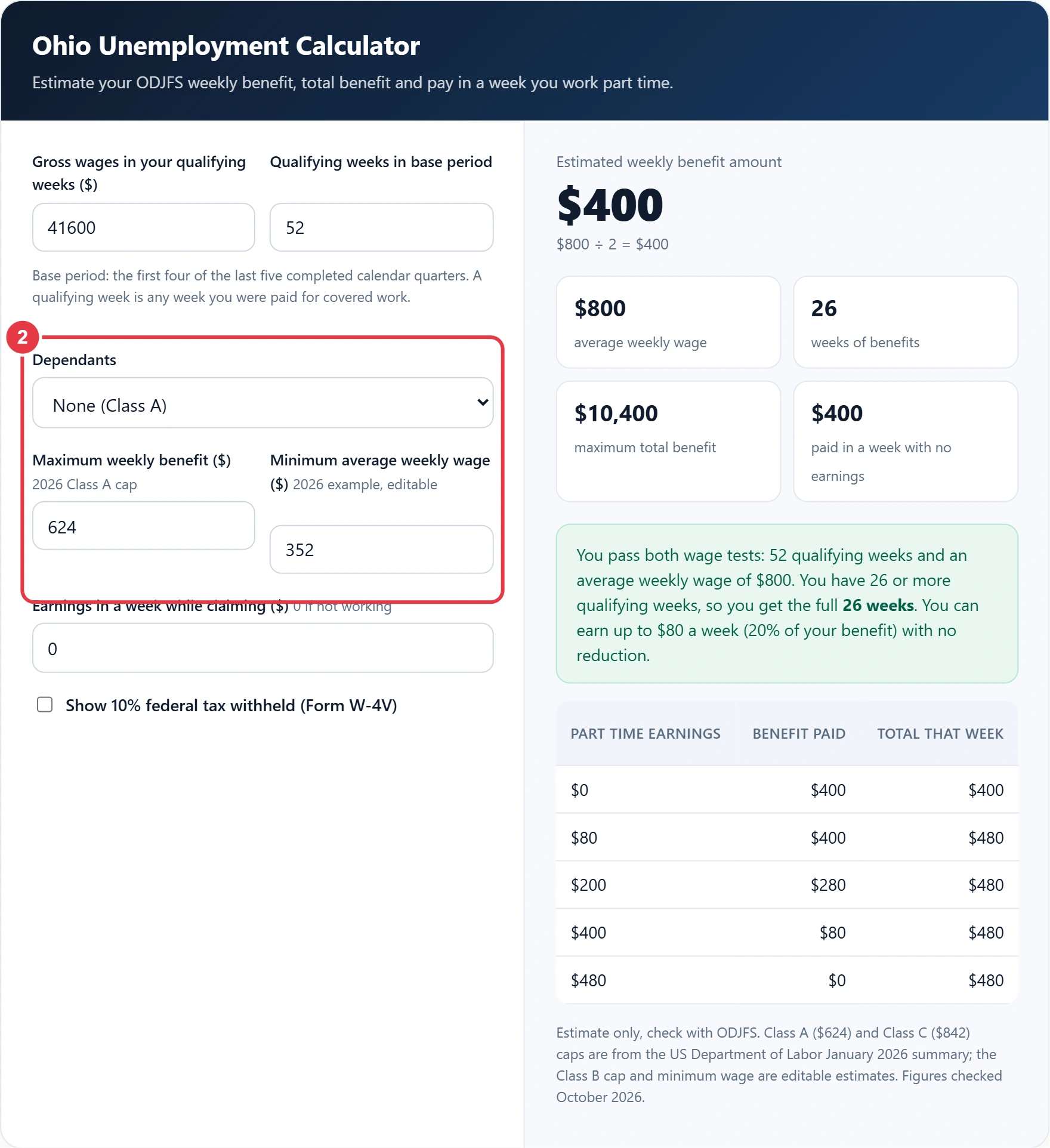
Pick your dependency class. A dependant is a child aged 17 or under, or a spouse living with you, for whom you provided more than half of their support in the 90 days before your claim. The cap fills in automatically and you can edit it, along with the minimum average weekly wage, if ODJFS publishes a different figure.
Step 3: Add Part Time Earnings and Tax
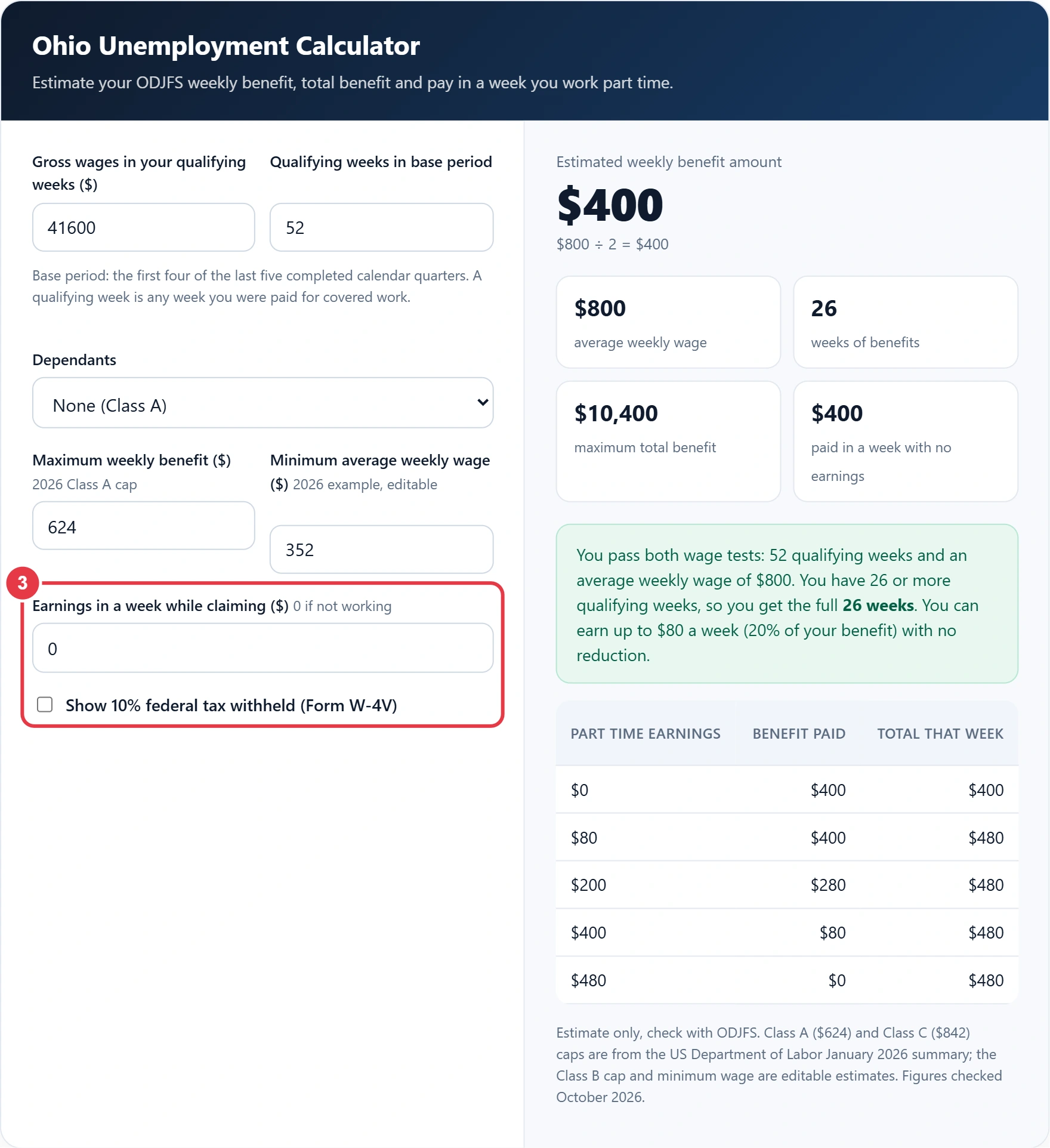
Enter any gross pay from part time work in a week you claim. Ohio ignores earnings up to 20% of your weekly benefit and deducts the rest dollar for dollar. Tick the box to see payments after 10% federal withholding.
Step 4: Read Your Result
The headline is your weekly benefit amount with the working shown underneath. The stats give your average weekly wage, how many weeks you can be paid, your maximum total and your pay in a week with the earnings you entered, and the table shows how part time pay changes your benefit.
How Much Unemployment Will I Get in Ohio?
You will get half your average weekly wage, up to $624 a week with no dependants and up to $842 with three or more, for 20 to 26 weeks. The most a single claimant with no dependants can receive on a regular claim in 2026 is $624 × 26 = $16,224.
| Average weekly wage | Class A (no dependants) | Class B (1 or 2) | Class C (3 or more) |
|---|---|---|---|
| $400 | $200 | $200 | $200 |
| $800 | $400 | $400 | $400 |
| $1,300 | $624 (cap) | $650 | $650 |
| $1,600 | $624 (cap) | about $756 (cap, estimate) | $800 |
| $2,000 | $624 (cap) | about $756 (cap, estimate) | $842 (cap) |
Worked example: Kayla, a machine operator in Toledo laid off in September 2026, worked 40 qualifying weeks in her base period and earned $56,000, an average weekly wage of $1,400. Half of that is $700. With no dependants she would be capped at $624, but she supports two children, which puts her in Class B, so she receives $700 a week. Because she has 26 or more qualifying weeks, she can be paid for 26 weeks, a maximum of $18,200.
How Many Weeks of Unemployment Can You Get in Ohio?
You get one week of benefits for each qualifying week in your base period, between 20 and 26 weeks. With 20 qualifying weeks you receive 20 weeks of payments, with 23 you receive 23, and 26 or more gives the full 26 weeks. Ohio also has one unpaid waiting week per benefit year. To count the weeks since your claim started, the days between dates calculator gives the exact number of days and weeks from your claim date.
Who Qualifies for Unemployment in Ohio?
You qualify on wages if you have at least 20 qualifying weeks in your base period and an average weekly wage of at least 27.5% of the statewide average weekly wage, about $352 in 2026 based on the $176 minimum weekly benefit. If your regular base period falls short, ODJFS can use an alternate base period of the last four completed quarters. You must also have lost work through no fault of your own and be able, available and actively looking for work each week. If you have worked in another state, the Georgia unemployment calculator shows how a state with a quarterly formula treats similar wages. If your wages were earned in more than one state, a combined wage claim can count them together, and the state you file in then applies its own rules to the total.
How Does Part Time Work Affect Ohio Unemployment?
Ohio lets you keep earnings up to 20% of your weekly benefit, and anything above that comes off your benefit dollar for dollar. With a $700 benefit, Kayla can earn $140 and still get $700. If she earns $200, ODJFS deducts $60 and pays $640, so her total that week is $840. Unemployment is taxable on your federal return, and the Form W-4V withholding request lets you have 10% taken from each payment. Ohio income tax may also apply, so check with the Ohio Department of Taxation if you are unsure.
</>Embed this calculator on your website
Add the free Ohio Unemployment Calculator to your own site or blog. Copy the code below and paste it into an HTML block. It resizes itself and works on phones.
How we checked this tool: the Tools Veria Editorial Team built this tool by hand, checked it against the official rules or published standards where they apply, and tested it against worked examples. Results are estimates for planning, not personal financial or tax advice. Read our editorial policy and disclaimer, or report an error.
Frequently Asked Questions
How is Ohio unemployment calculated?
ODJFS divides your wages in the base period by your number of qualifying weeks to get your average weekly wage, then pays half of it, rounded down to the dollar. An $800 average weekly wage gives a $400 weekly benefit, up to your dependency class cap.
What is the maximum unemployment benefit in Ohio for 2026?
The 2026 maximum is $624 a week with no dependants and $842 a week with three or more dependants, according to the US Department of Labor January 2026 summary. The one or two dependant cap sits between these, at about $756.
How many weeks of unemployment does Ohio pay?
Ohio pays between 20 and 26 weeks. You get one week for each qualifying week you worked in the base period, so 22 qualifying weeks gives 22 weeks of benefits and 26 or more gives the full 26 weeks.
How much can I earn while on unemployment in Ohio?
You can earn up to 20% of your weekly benefit with no reduction. Every dollar above that is deducted, so with a $400 benefit you can earn $80 freely, and earning $200 reduces your payment to $280.
Who counts as a dependant for Ohio unemployment?
A child aged 17 or under, or a spouse living with you, for whom you provided more than half of their support in the 90 days before your claim. A spouse's income must not exceed 25% of your average weekly wage.
Is Ohio unemployment taxable?
Yes. Unemployment benefits are taxable on your federal return, and you can ask for 10% to be withheld using Form W-4V. A $400 weekly benefit becomes $360 after that withholding. Ohio income tax may also apply to the payments.