Type the two numbers from a modern plate, a single year letter, or a whole registration to see exactly when it was issued.
| Identifier | From | To |
|---|
Dates follow the DVLA age identifier pattern. A plate shows the earliest the vehicle could be: a car can carry an older registration but never one that makes it look newer.
This number plate age identifier tells UK drivers, buyers and sellers exactly when a registration was issued: type the two numbers from a modern plate, a single prefix or suffix letter, or the whole registration, and it shows the first and last day of that issue period. It follows the DVLA format set out in leaflet INF104 on GOV.UK, then works out how old a car on that plate is today and when its first MOT falls due.
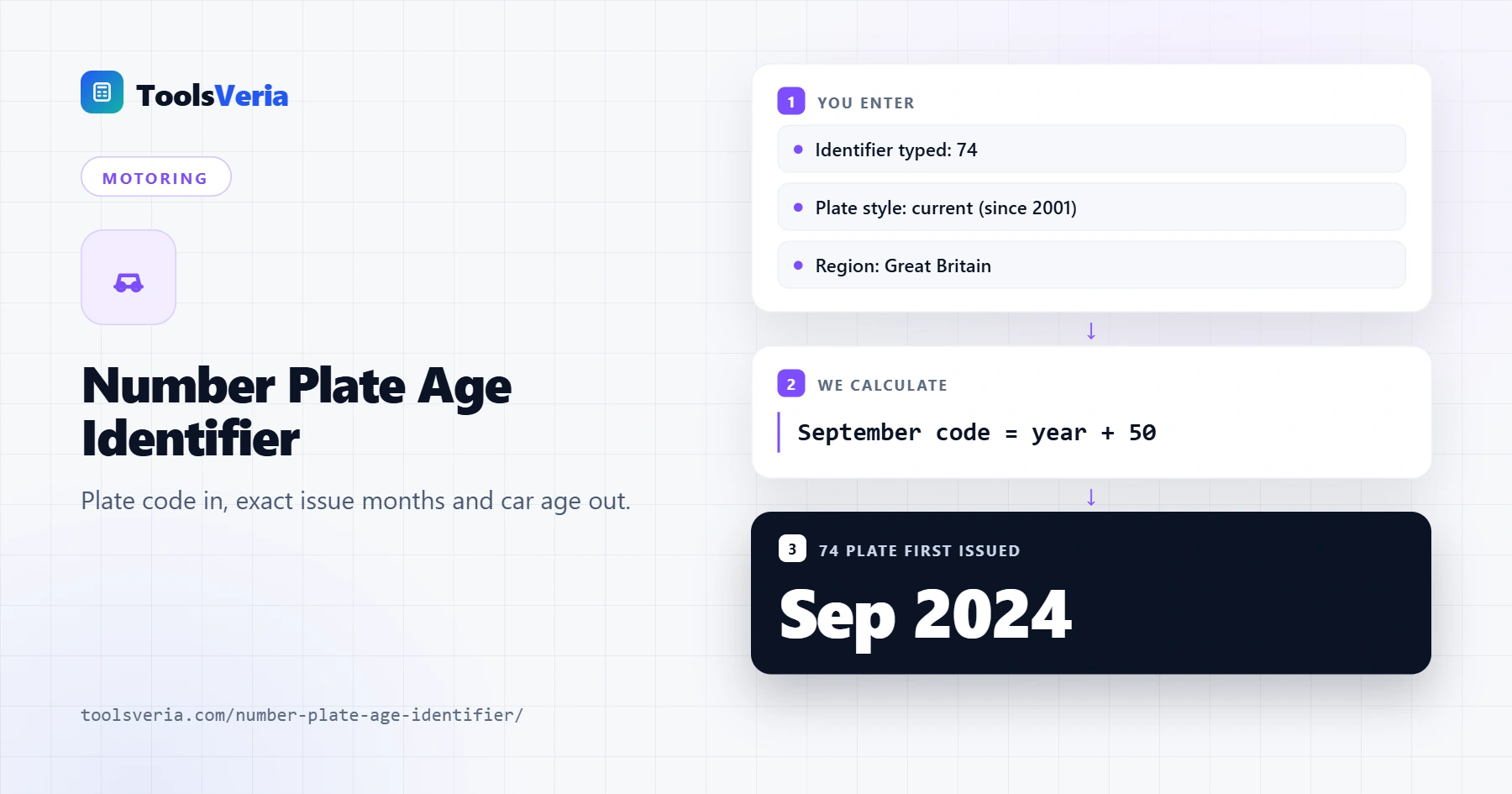
Quick answer: the two numbers on a UK plate give the issue date. March to August codes match the year, so 26 means March to August 2026. September to February codes add 50, so 76 means September 2026 to February 2027. The number plate age identifier also decodes the older prefix and suffix letters.
In This Guide
What Is a Number Plate Age Identifier?
An age identifier is the part of a UK registration that shows when the mark was first issued: two numbers on plates from September 2001, or one letter on older plates. The rule in plain words: for a plate issued from 1 March to 31 August, the code is the last two digits of the year; for a plate issued from 1 September to the end of February, the code is the year plus 50.
A current registration such as AB74 CDE has three parts. The first two letters are the local memory tag, the two numbers are the age identifier, and the last three letters are chosen at random. Before 2001, Great Britain used a single year letter: at the end of the registration from 1963 to 1983 (a suffix), then at the front from 1983 to 2001 (a prefix).
How to Use the Number Plate Age Identifier
Step 1: Type the Identifier or Registration
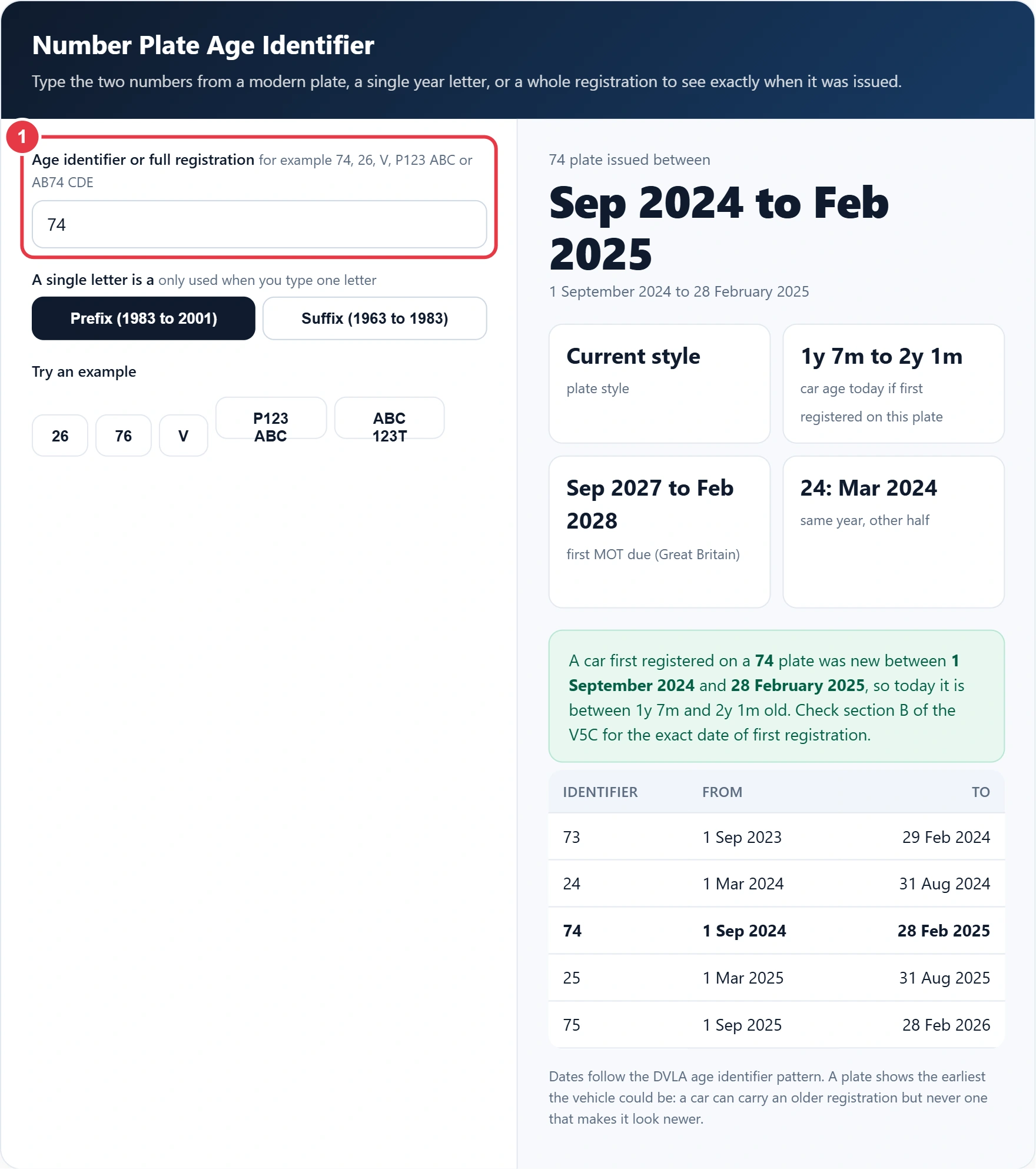
Enter just the code, such as 74, or the full registration with or without the space. The tool recognises current plates, prefix plates like P123 ABC and suffix plates like ABC 123T, and it tells you when a mark carries no date at all.
Step 2: Choose Prefix or Suffix for One Letter
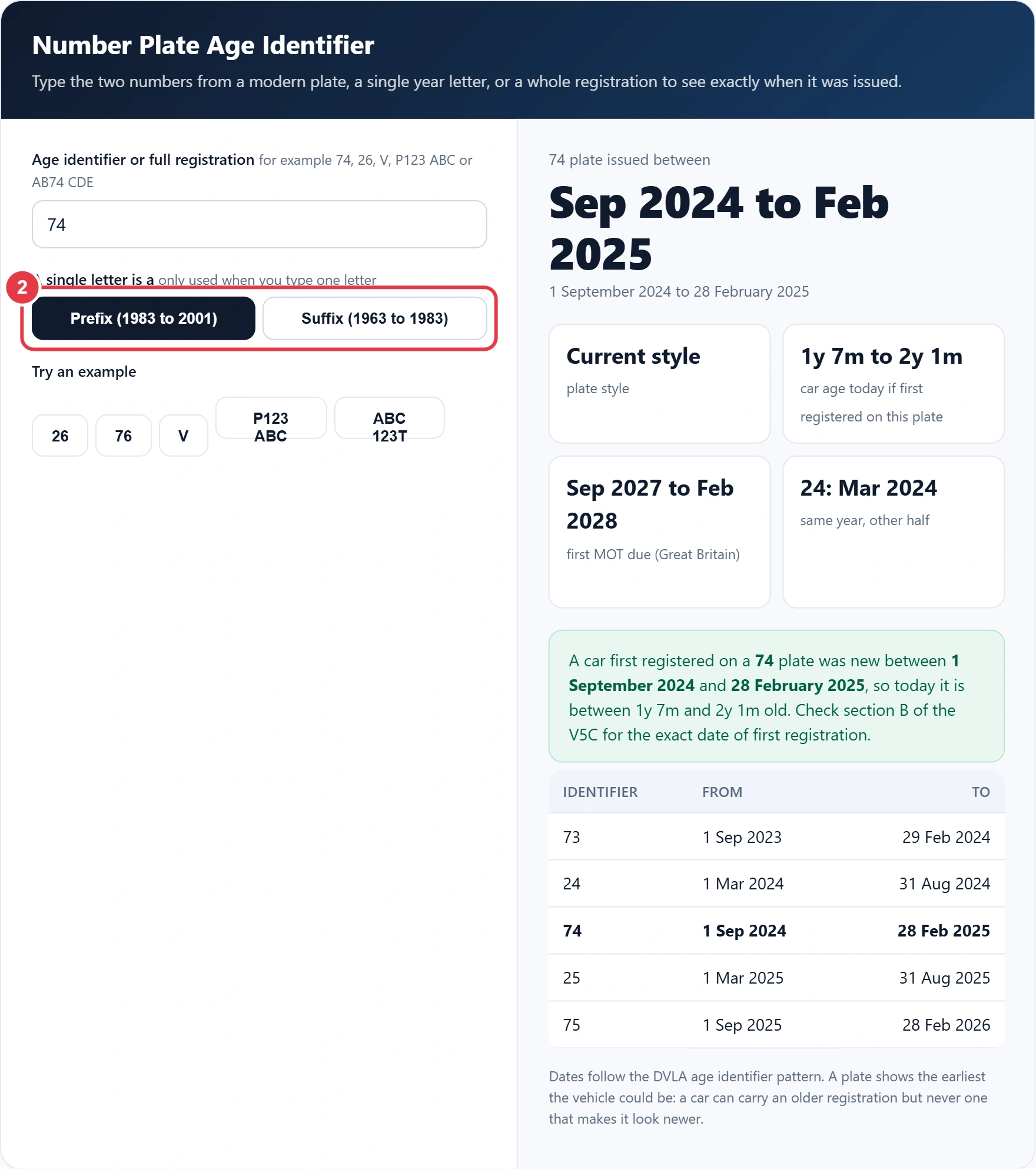
A single letter can mean two different years. V at the front of a plate means September 1999 to February 2000, while V at the end means August 1979 to July 1980. Pick the position you see on the car; a full registration sets this automatically.
Step 3: Try an Example
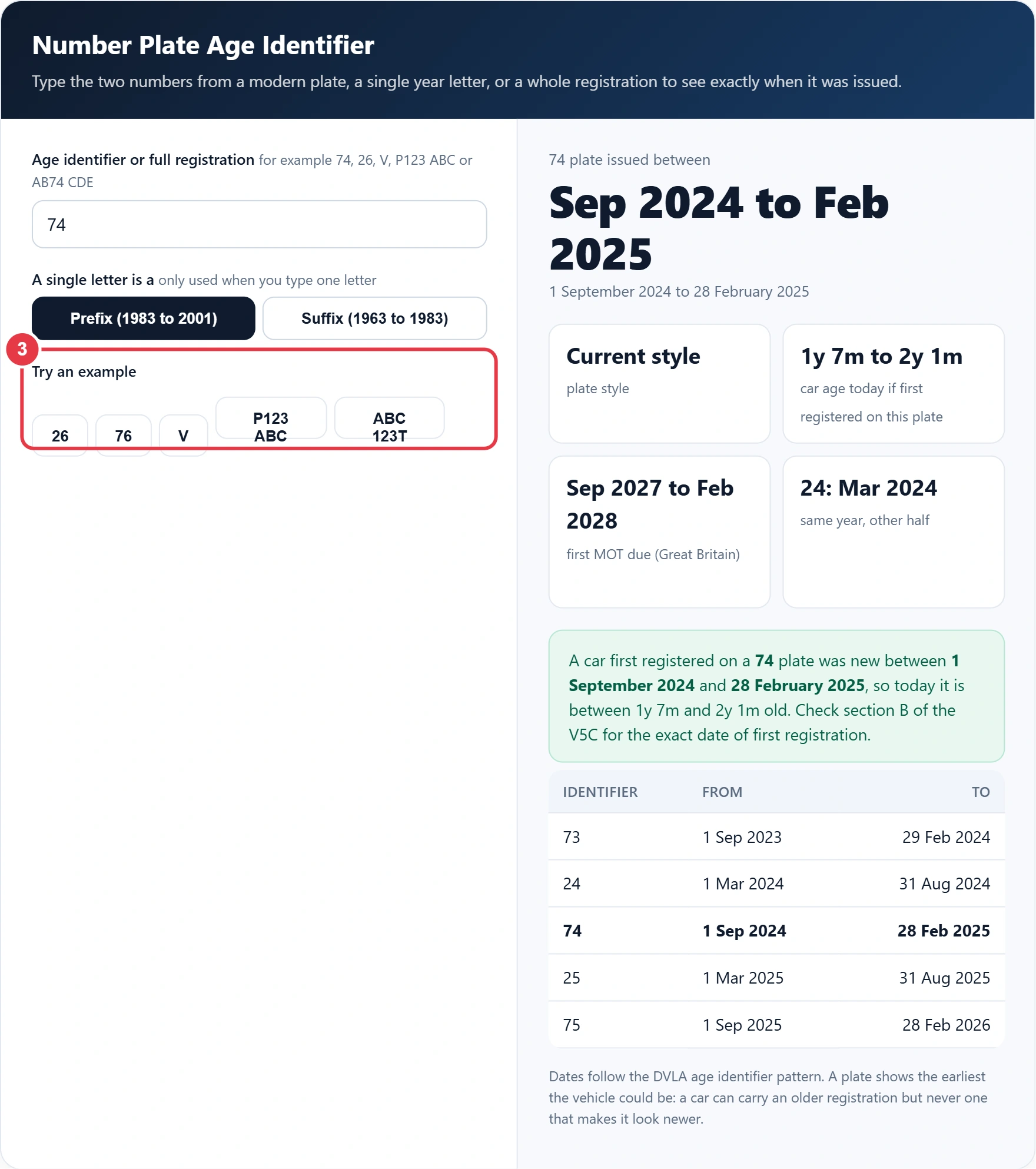
The example buttons in the number plate age identifier load common searches, including the new 76 plate and the 26 plate from earlier this year. They are a quick way to compare two cars on a forecourt, for example a 25 plate against a 75 plate of the same model.
Step 4: Read the Dates
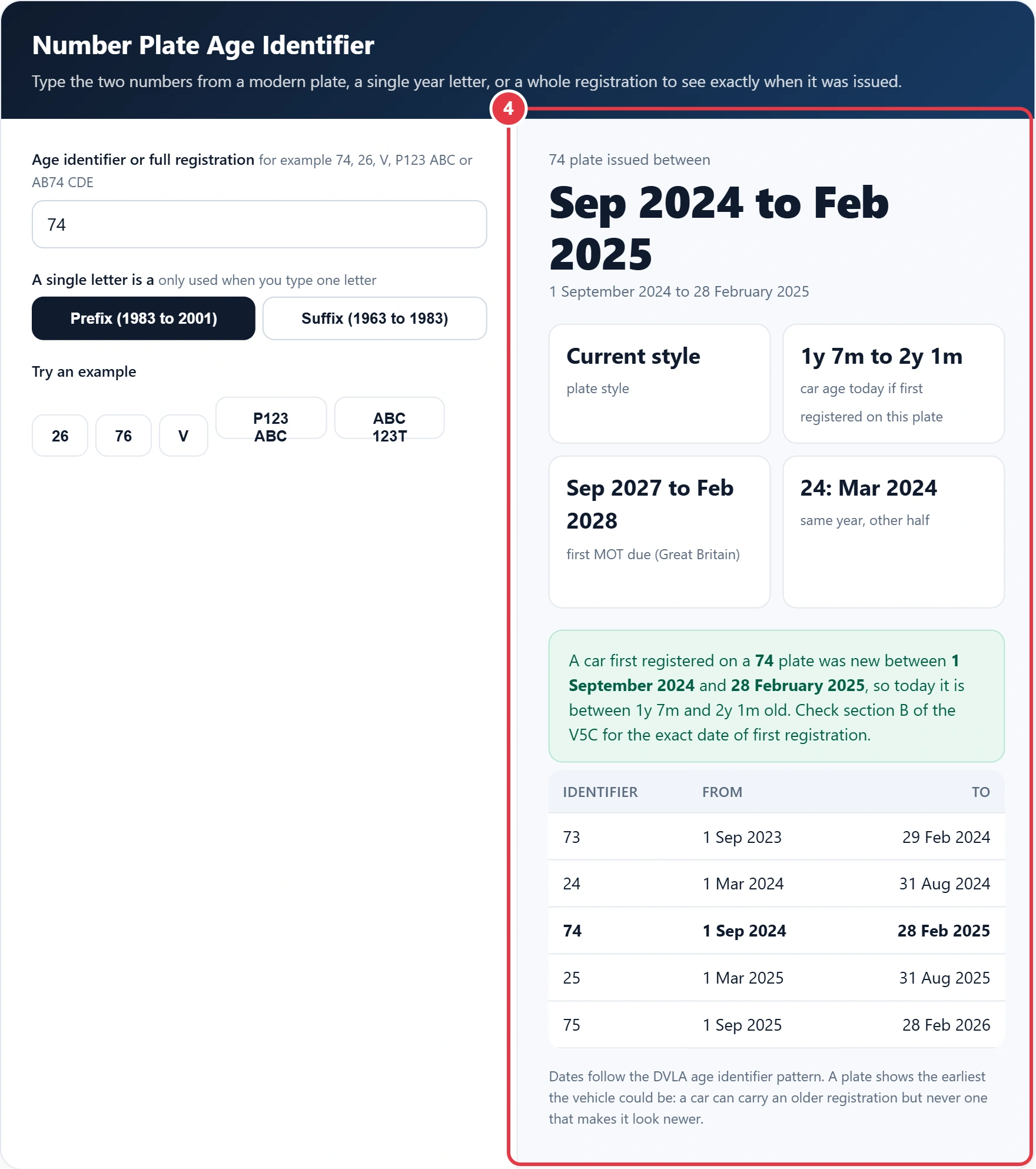
The large figure is the issue window, with exact start and end dates below. The tiles show the plate style, how old a car first registered on that plate is today, its first MOT window in Great Britain and the matching code from the other half of the same year. The table lists the neighbouring identifiers.
What Year Is My Number Plate?
Your number plate year is the year in its two numbers if the code is 50 or lower, and the code minus 50 if it is 51 or higher. Worked example: Priya in Leeds is offered a hatchback registered YD74 KPL. The number plate age identifier shows 74 was issued from 1 September 2024 to 28 February 2025, so the car is about 1 year 7 months to 2 years 1 month old in October 2026, and its first MOT is due between September 2027 and February 2028. The V5C pins down the exact day.
| Year | March to August code | September to February code |
|---|---|---|
| 2021 | 21 (Mar to Aug 2021) | 71 (Sep 2021 to Feb 2022) |
| 2022 | 22 | 72 |
| 2023 | 23 | 73 |
| 2024 | 24 | 74 (Sep 2024 to Feb 2025) |
| 2025 | 25 | 75 |
| 2026 | 26 (Mar to Aug 2026) | 76 (Sep 2026 to Feb 2027) |
| 2027 | 27 (from 1 March 2027) | 77 (from 1 September 2027) |
When Do New Number Plates Come Out?
New number plates come out twice a year, on 1 March and 1 September. The 76 plate began on 1 September 2026 and runs until 28 February 2027, when the 27 plate takes over. The pattern started with 51 in September 2001 and has enough codes to run to the 00 plate, issued from September 2050 to February 2051. The code 01 was never used, because the scheme began in September.
Because registrations peak in March and September, a car's first MOT often lands in those months three years later. The first MOT due date calculator turns the exact registration date into the test deadline and the earliest day you can book it.
How Do I Read Older Prefix and Suffix Plates?
On older plates the single year letter tells you the age: a letter at the end is a suffix from 1963 to 1983, and a letter at the start is a prefix from 1983 to 2001. Most letters ran from 1 August to 31 July, as the history of UK registration plates shows letter by letter. The prefix series sped up at the end, with S covering August 1998 to February 1999 and then T, V, W, X and Y lasting six months each. The letters I, O, Q, U and Z were never used as year letters.
| Letter | As a suffix (ABC 123 X) | As a prefix (X123 ABC) |
|---|---|---|
| A | Feb to Dec 1963 | Aug 1983 to Jul 1984 |
| E | Jan to Jul 1967 | Aug 1987 to Jul 1988 |
| P | Aug 1975 to Jul 1976 | Aug 1996 to Jul 1997 |
| S | Aug 1977 to Jul 1978 | Aug 1998 to Feb 1999 |
| V | Aug 1979 to Jul 1980 | Sep 1999 to Feb 2000 |
| Y | Aug 1982 to Jul 1983 | Mar 2001 to Aug 2001 |
Which Plates Do Not Show a Year?
Three kinds of plate do not show a year. Northern Ireland registrations, such as AXZ 1234, contain an I or a Z and are issued in sequence with no age code. Q plates go on vehicles whose age or identity cannot be confirmed, such as kit cars and some imports. Dateless marks with only letters and numbers were first issued before 1963 and are often moved to newer cars as cherished plates.
A private plate can make a car look older than it is, but DVLA rules never allow a registration that makes a car look newer. If the plate and the V5C disagree, the logbook wins. Before you buy, the VIN model year decoder gives a second check on the build year, and the tyre date codes add a third clue about how the car has been kept.
- Number plate year and value: two cars of the same model a few weeks apart can sit on different plates, such as 26 and 76, which affects resale price more than the real age gap.
- Selling a car: a refund of unused road tax is paid automatically when you tell DVLA, and the car tax refund calculator shows roughly how much to expect.
- Old classics: a car with a suffix or dateless plate may be eligible for historic vehicle tax status once it is old enough, so check the build date, not the plate.
Every date in this number plate age identifier comes from the DVLA format and the published year letter tables. Figures checked October 2026 against GOV.UK leaflet INF104 and the registration history table.
</>Embed this calculator on your website
Add the free Number Plate Age Identifier to your own site or blog. Copy the code below and paste it into an HTML block. It resizes itself and works on phones.
How we checked this tool: the Tools Veria Editorial Team built this tool by hand, checked it against the official rules or published standards where they apply, and tested it against worked examples. Results are estimates for planning, not personal financial or tax advice. Read our editorial policy and disclaimer, or report an error.
Frequently Asked Questions
What year is a 74 plate?
A 74 plate was issued from 1 September 2024 to 28 February 2025. September codes add 50 to the year, so 74 means the second half of 2024. A car first registered on a 74 plate is roughly 1 year 7 months to 2 years 1 month old in October 2026.
What is the new number plate for September 2026?
The new plate from 1 September 2026 is the 76 plate, and it runs until 28 February 2027. The next plate is the 27, which starts on 1 March 2027, followed by the 77 plate on 1 September 2027.
What year is a V reg car?
It depends on where the V sits. A V at the start of the registration means September 1999 to February 2000. A V at the end of the registration means August 1979 to July 1980. Enter the full registration and the tool picks the right one.
Can a car have a newer number plate than its age?
No. DVLA rules do not allow a registration that makes a vehicle look newer than it is. You can put an older or dateless private plate on a newer car, so a plate only shows the earliest a car could be, never the latest.
Why do Northern Ireland number plates not show the year?
Northern Ireland registrations use letters containing I or Z with up to four numbers, issued in sequence, and have no age identifier. To find the age of an NI registered car, use the date of first registration on the logbook.
When will UK number plates run out?
The current two number system can run until the 00 plate, which covers September 2050 to February 2051. DVLA's leaflet INF104 says the pattern will continue until all possible variations have been used, so a new format will be needed after that.