
Gemma runs the payroll for a café in Bristol, and every Friday her software asks for a tax week number before it will calculate anyone’s pay. A new starter’s P45 shows a different week, an employee queries an emergency tax code, and suddenly what tax week is it becomes the question holding up the whole pay run. The answer takes ten seconds once you know where the count starts.
HMRC numbers weeks and months from 6 April, not from 1 January, so the figures never match a normal calendar. Below is the counting method, the 2026/27 table with every PAYE deadline, and the week 53 rule that only affects a small group of employers this year.
Quick answer: On Thursday 22 October 2026 it is tax week 29 of the 2026/27 tax year, covering Monday 19 to Sunday 25 October, and tax month 7, which runs from 6 October to 5 November. HMRC counts tax weeks in 7 day blocks from 6 April, so week 1 is always 6 to 12 April.
In This Guide
How do you work out what tax week it is?
You work out the tax week by counting the days from 6 April up to and including your date, dividing by 7 and rounding up to the next whole number. The count always restarts on 6 April, the first day of the UK tax year, whatever day of the week that falls on.
Take 22 October 2026. April contributes 25 days from the 6th, then May 31, June 30, July 31, August 31, September 30 and October 22, which makes day 200 of the tax year. Divide 200 by 7 to get 28.6, and round up to tax week 29. HMRC’s National Insurance manual definition of tax weeks and months describes exactly this: successive 7 day periods beginning with 6 April.
Tax months are easier still. Each one runs from the 6th of a month to the 5th of the next, so any date from the 6th onwards belongs to the month that started that day, and dates from the 1st to the 5th still belong to the previous one. That is why 3 November 2026 is in tax month 7 while 6 November starts tax month 8.
| Tax week | Dates in 2026/27 | Tax month |
|---|---|---|
| 29 | Mon 19 Oct to Sun 25 Oct 2026 | 7 |
| 30 | Mon 26 Oct to Sun 1 Nov 2026 | 7 |
| 31 | Mon 2 Nov to Sun 8 Nov 2026 | 7 and 8 |
| 38 | Mon 21 Dec to Sun 27 Dec 2026 | 9 |
| 39 | Mon 28 Dec 2026 to Sun 3 Jan 2027 | 9 |
| 40 | Mon 4 Jan to Sun 10 Jan 2027 | 9 and 10 |
| 52 | Mon 29 Mar to Sun 4 Apr 2027 | 12 |
| 53 | Mon 5 Apr 2027 only | 12 |
Because 6 April 2026 was a Monday, every 2026/27 tax week runs Monday to Sunday, which makes this year unusually easy to read. In 2027/28 the year starts on a Tuesday, so each week will run Tuesday to Monday instead.

Does PAYE use the pay date or the work date?
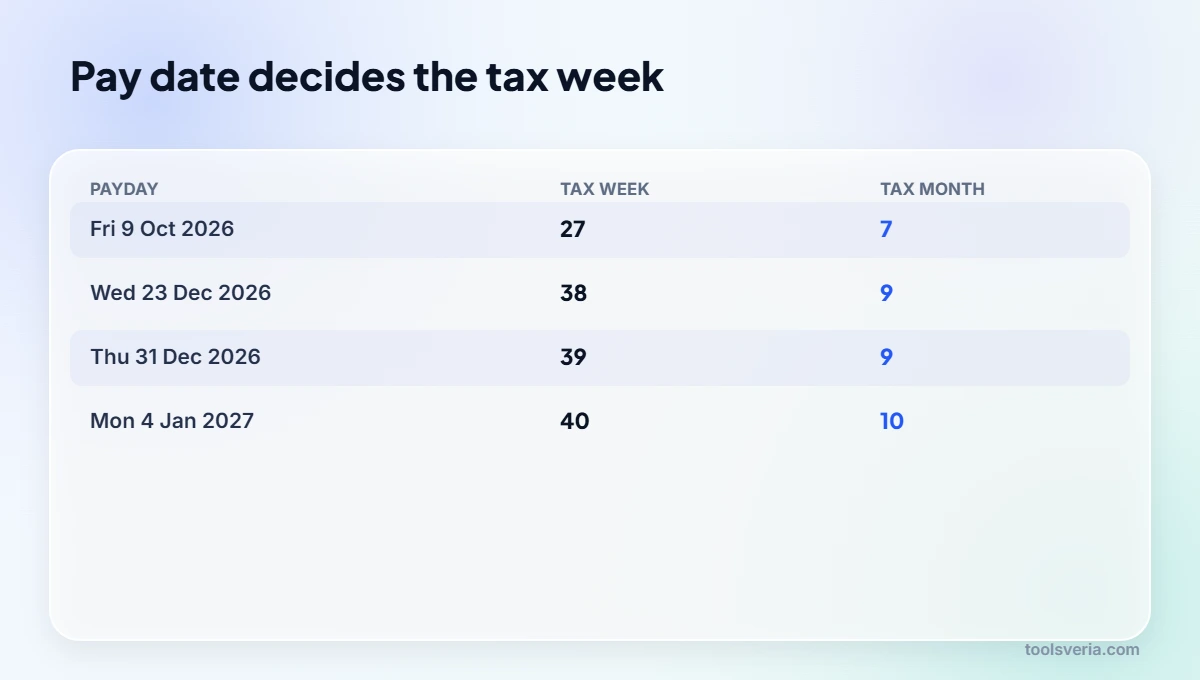
PAYE uses the date the employee is actually paid, not the dates the work was done, so the tax week on a payslip is the week containing the payday. Gemma pays a week in arrears: shifts worked from Monday 28 September to Sunday 4 October fall in tax week 26, but the wages are paid on Friday 9 October, so that pay run is reported in tax week 27 and tax month 7.
Christmas shows why this matters. Gemma’s normal Friday payday on 25 December 2026 moves to Wednesday 23 December, which is still in tax week 38, so nothing changes. The New Year payday on Friday 1 January 2027 moves to Thursday 31 December, which is still tax week 39. Counting the working days around the holidays with the UK working days calculator helps her plan the rota and the bank cut off together. Had she paid on Monday 4 January instead, the run would have moved into week 40 and the next tax month.
For fortnightly and four weekly payrolls, the reported week number is the last week of the pay period, so fortnightly runs normally show even numbers and four weekly runs show multiples of four. An employee checking a payslip can compare its period number with the tables here to confirm the payroll date is right.
When is PAYE due for each tax month in 2026/27?
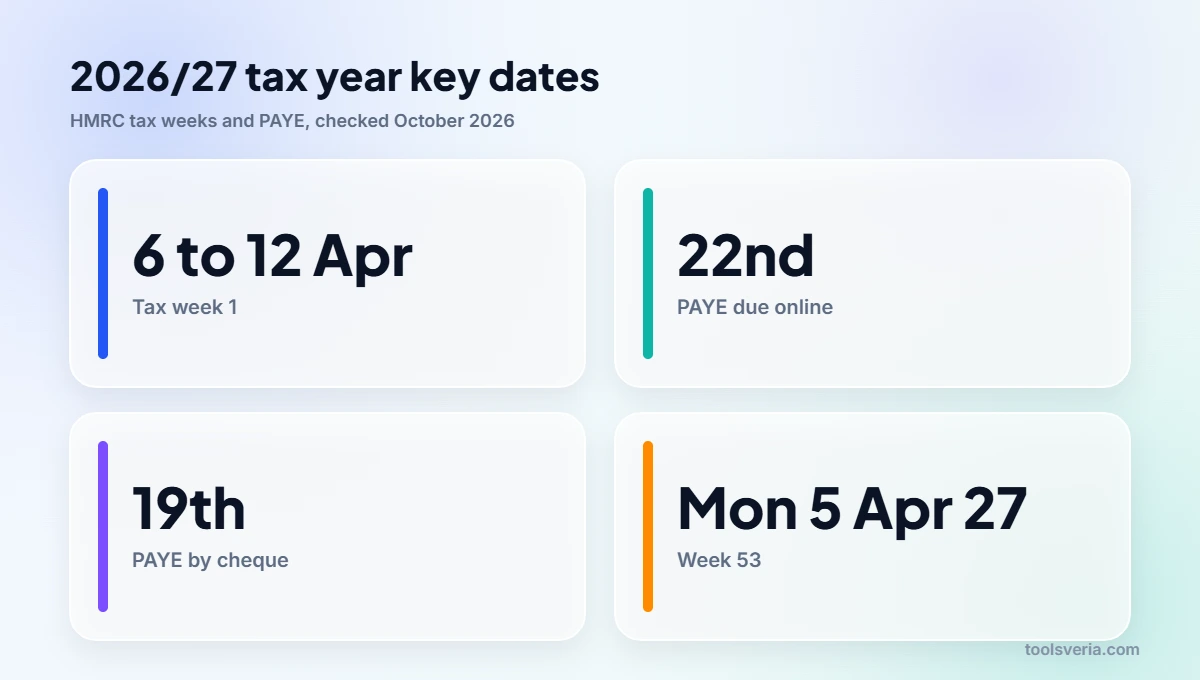
PAYE for each tax month is due by the 22nd of the following tax month if you pay electronically, or must reach HMRC by the 19th if you send a cheque. The GOV.UK guide to paying employers’ PAYE also sets 22 July, 22 October, 22 January and 22 April as the dates for employers allowed to pay quarterly.
| Tax month | Dates | Tax weeks | PAYE due online |
|---|---|---|---|
| 1 | 6 Apr to 5 May 2026 | 1 to 5 | Fri 22 May 2026 |
| 2 | 6 May to 5 Jun 2026 | 5 to 9 | Mon 22 Jun 2026 |
| 3 | 6 Jun to 5 Jul 2026 | 9 to 13 | Wed 22 Jul 2026 |
| 4 | 6 Jul to 5 Aug 2026 | 14 to 18 | Sat 22 Aug 2026 |
| 5 | 6 Aug to 5 Sep 2026 | 18 to 22 | Tue 22 Sep 2026 |
| 6 | 6 Sep to 5 Oct 2026 | 22 to 27 | Thu 22 Oct 2026 |
| 7 | 6 Oct to 5 Nov 2026 | 27 to 31 | Sun 22 Nov 2026 |
| 8 | 6 Nov to 5 Dec 2026 | 31 to 35 | Tue 22 Dec 2026 |
| 9 | 6 Dec 2026 to 5 Jan 2027 | 35 to 40 | Fri 22 Jan 2027 |
| 10 | 6 Jan to 5 Feb 2027 | 40 to 44 | Mon 22 Feb 2027 |
| 11 | 6 Feb to 5 Mar 2027 | 44 to 48 | Mon 22 Mar 2027 |
| 12 | 6 Mar to 5 Apr 2027 | 48 to 53 | Thu 22 Apr 2027 |
Today’s date matters here: PAYE for tax month 6 is due on Thursday 22 October 2026, the same day this guide was published. The month 7 deadline falls on Sunday 22 November, so Gemma schedules that payment for Friday 20 November to make sure it clears before the weekend.
Is there a tax week 53 in 2026/27?
Yes, tax week 53 in 2026/27 is the single day of Monday 5 April 2027, so only employers whose weekly payday is a Monday will have a 53rd weekly payday this tax year. A year of 365 days holds 52 full weeks plus one spare day, and that spare day becomes week 53.
Weekly payrolls are not the only ones affected, because other pay frequencies can gain an extra payday in the same way, and HMRC’s 2026 to 2027 employer further guide to PAYE calls it week 54 for a fortnightly payroll with 27 paydays and week 56 for a four weekly payroll with 14. Staff on a week 1 or month 1 basis code are simply treated as having another week 1 payment, and payroll software applies the special calculation for everyone else.
Owen runs a building firm that pays its labourers every Monday, so he will make 53 weekly payments in 2026/27 and should warn his accountant now. Gemma pays on Fridays, so her final payday of the year is 2 April 2027 in week 52 and she has no week 53 at all. If one of Owen’s Monday paydays includes leave, the holiday pay calculator checks that figure before the run. In 2027/28, which includes 29 February 2028, week 53 covers Tuesday 4 and Wednesday 5 April 2028, so Tuesday and Wednesday payrolls are the ones affected next year.
Key points
- The UK tax year runs from 6 April to 5 April, and tax week 1 is always 6 to 12 April.
- Thursday 22 October 2026 is in tax week 29 and tax month 7 of the 2026/27 tax year.
- To find the tax week, count the days since 6 April, divide by 7 and round up.
- PAYE is reported in the tax week of the payday, not the week the work was done.
- Electronic PAYE payments are due by the 22nd of the following tax month.
- Tax week 53 in 2026/27 is Monday 5 April 2027, affecting only Monday weekly paydays.
What Tax Week Is It: Key Payroll Terms Explained
These definitions explain the calendar and payroll rules that answer what tax week is it, helping you number each pay run correctly for HMRC.
- UK tax year
- The twelve month period HMRC uses for Income Tax and PAYE, running from 6 April to 5 April. Weeks and months are counted from its first day rather than from 1 January, so the numbers never align with the calendar year.
- Pay date rule
- The PAYE principle that earnings belong to the tax period containing the date they are paid, not the period when the work was done. Paying in arrears can therefore move wages into the following tax week.
- Paying in arrears
- Paying wages for a period after it has ended, such as paying on Friday for the previous week’s shifts. Employers who do this report each pay run under the week of the payday rather than the week worked.
- P45
- The form an employee receives when leaving a job, showing pay and tax to date and their tax code. A new employer uses its figures, including the leaving period, to continue the correct cumulative calculation.
- Week 1 or Month 1 basis
- A non-cumulative way of operating a tax code in which each payment is taxed on its own, ignoring earlier pay in the year. It is marked by W1 or M1 after the code and is common with emergency codes.
Frequently Asked Questions
I start a new job on 2 November 2026. Which tax week is that?
Monday 2 November 2026 is the first day of tax week 31, which runs to Sunday 8 November. It is still in tax month 7, because tax month 8 only begins on 6 November, so your first monthly payslip may show either month depending on the payday.
My payslip says week 1 next to my tax code. Is something wrong?
Not necessarily, because a week 1 or month 1 marker means your tax is worked out on each payday alone, without the running total from 6 April. It often appears after a job change, and checking the code with the tax code calculator shows what HMRC expects.
Which tax week is 1 April 2027?
Thursday 1 April 2027 is in tax week 52 of the 2026/27 tax year, which covers 29 March to 4 April 2027. Dates from 1 to 5 April always belong to the tax year that is ending, not the new one.
We pay monthly on the last Friday. Do we need to worry about week 53?
No, week 53 only affects weekly, fortnightly and four weekly payrolls. Monthly payrolls always have 12 tax months, so your last payday of 2026/27, Friday 26 March 2027, falls in tax month 12 as normal.
When a colleague asks “what tax week is it?”, Gemma now checks the payday, not the shift dates, and reads the PAYE deadline in the same glance. Enter any date into the calculator to see its tax week, tax month and payment due date for 2026/27 or any other year. Figures checked October 2026.