Count whole days outside the UK and test them against the naturalisation limits.
Formats: 2024-07-15 2024-08-12 or 15/07/2024 12/08/2024. Nothing you type leaves your browser.
| Trip | Days out | In period | Last 12 months |
|---|
Not immigration advice. Counts whole days only, as GOV.UK caseworker guidance says: the day you leave and the day you return are not absences. Check your own case on GOV.UK or with a regulated immigration adviser before you apply.
This British citizenship absence calculator counts the days you have spent outside the UK and checks them against the naturalisation limits, for people with ILR or settled status and for spouses of British citizens applying in 2026. It follows the counting rules in the Home Office naturalisation guidance on GOV.UK, works out your qualifying period and shows the earliest date your absences fit. It only counts days: it is not immigration advice. Figures checked October 2026.
Quick answer: On the standard route you can spend up to 450 days outside the UK in the 5 years before applying and no more than 90 days in the last 12 months. A British citizenship absence calculator counts only whole days abroad. If you are married to a British citizen, the limits are 270 days in 3 years and 90 days.
In This Guide
What Is the British Citizenship Absence Rule?
The absence rule is the residence requirement that limits how many days you were outside the UK during the qualifying period before you apply to naturalise. There are two tests and you need to pass both: a total for the whole period and a separate limit for the final 12 months.
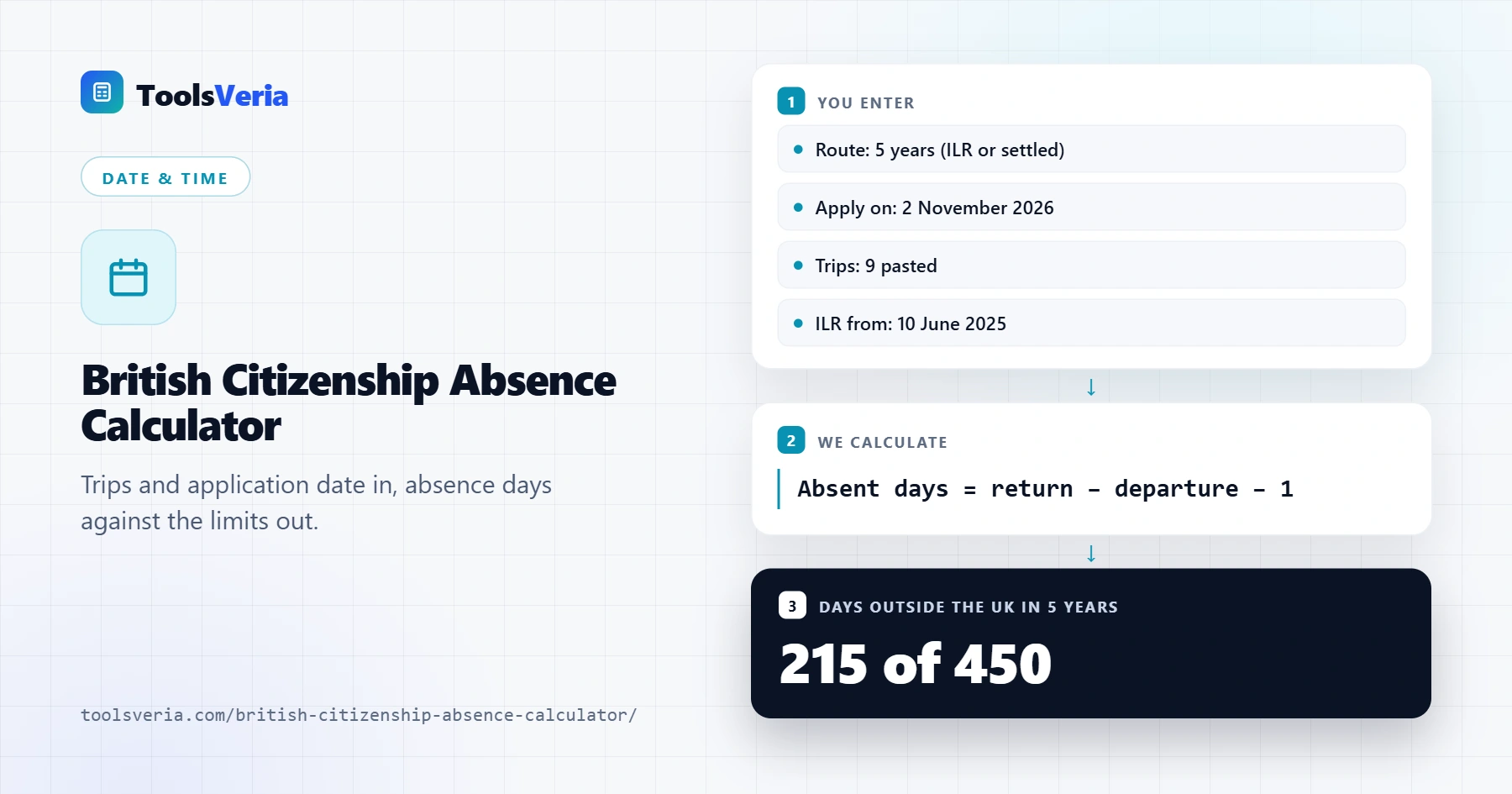
The formula in plain words: for each trip, days absent = return date minus departure date minus 1, because the day you leave and the day you come back both count as days in the UK. Add up the days that fall inside the qualifying period, then do the same for the last 12 months. The period starts the day after the date that is 5 years (or 3 years) before your application date.
How to Use the British Citizenship Absence Calculator
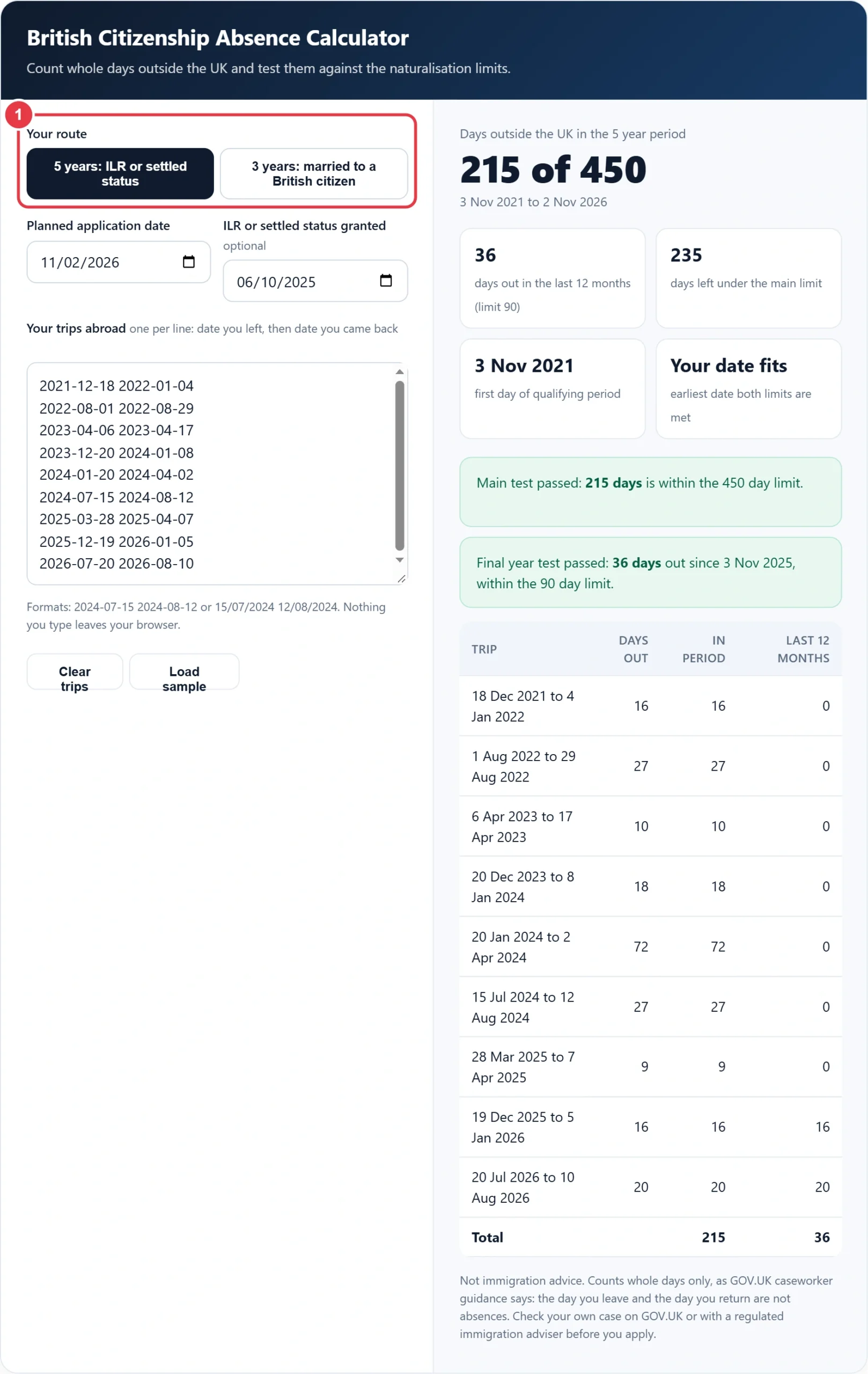
Step 1: Choose Your Route
Choose the 5 year route if you hold indefinite leave to remain, indefinite leave to enter or EU settled status and you are not married to a British citizen. Choose the 3 year route if you are married to, or in a civil partnership with, a British citizen.
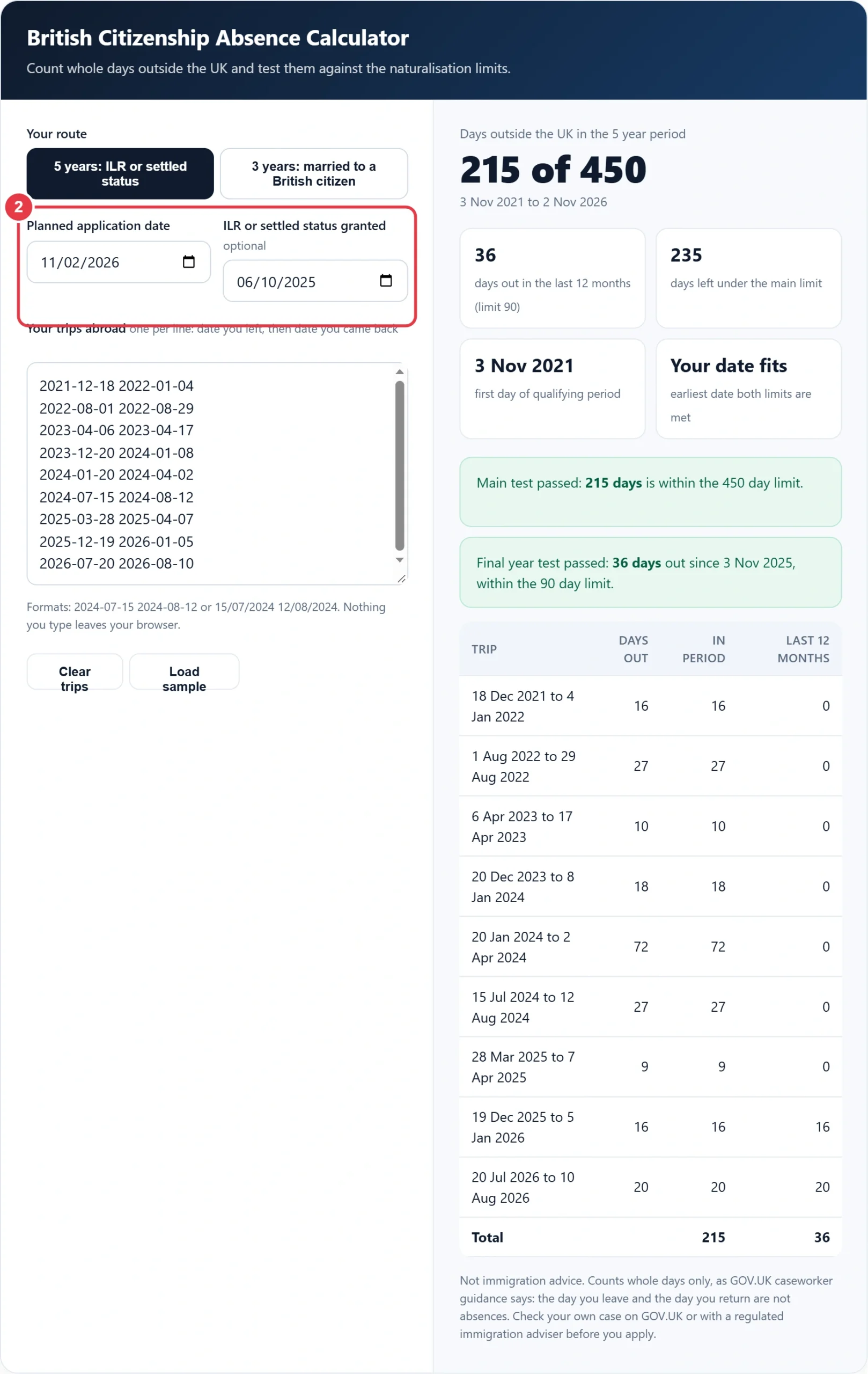
Step 2: Enter Your Dates
Enter the date you expect the Home Office to receive your application, since every window counts back from that day. Add the date your ILR or settled status was granted to check the 12 month wait that applies on the 5 year route.
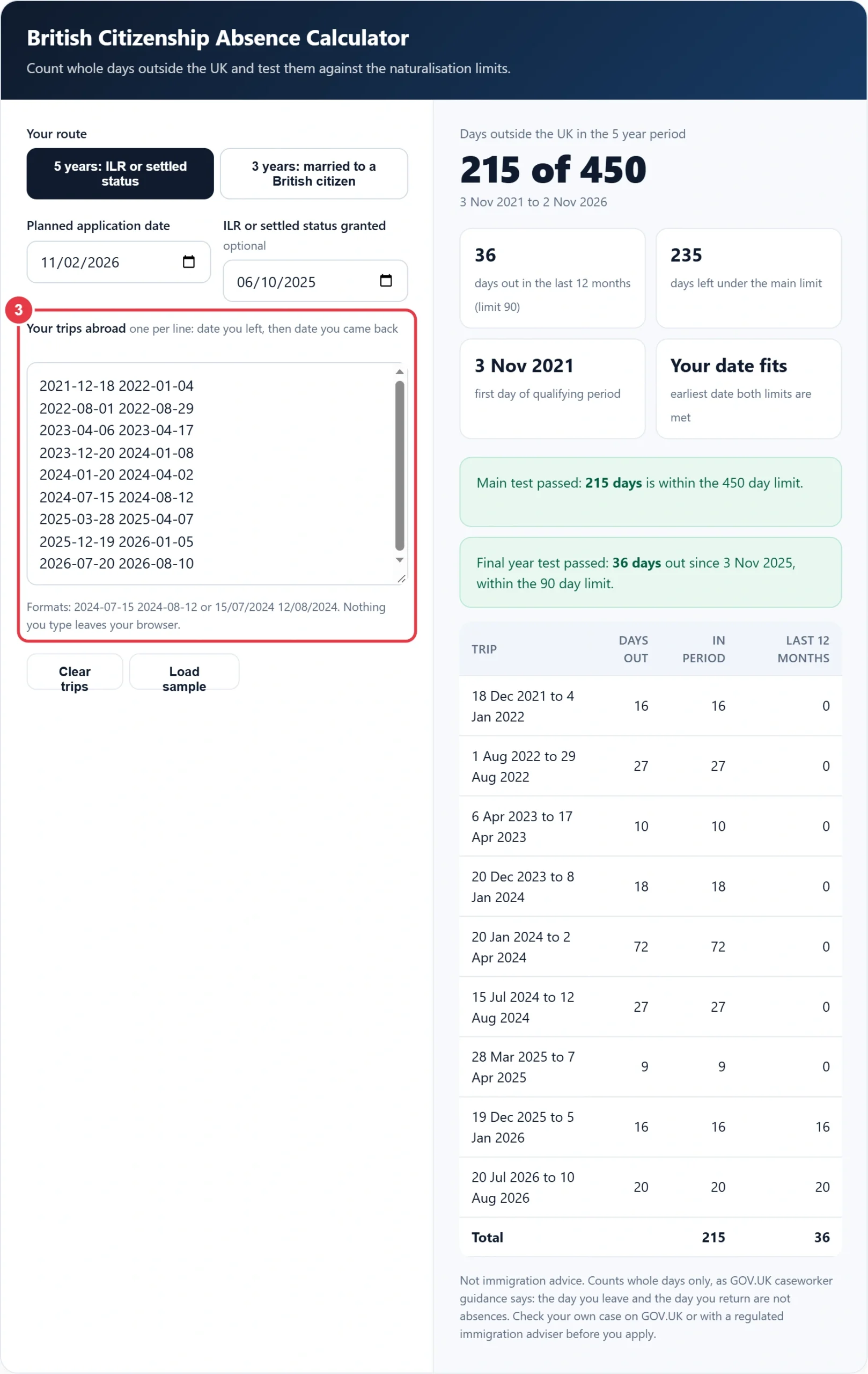
Step 3: Paste Your Trips
Type or paste one trip per line: the date you left the UK, then the date you came back. Passport stamps, airline emails and the dates you gave on earlier visa forms are good sources. Before you list a trip, the passport validity checker for Europe is worth a look if you are still travelling, because a short trip now adds days to every window.
Step 4: Read Your Results
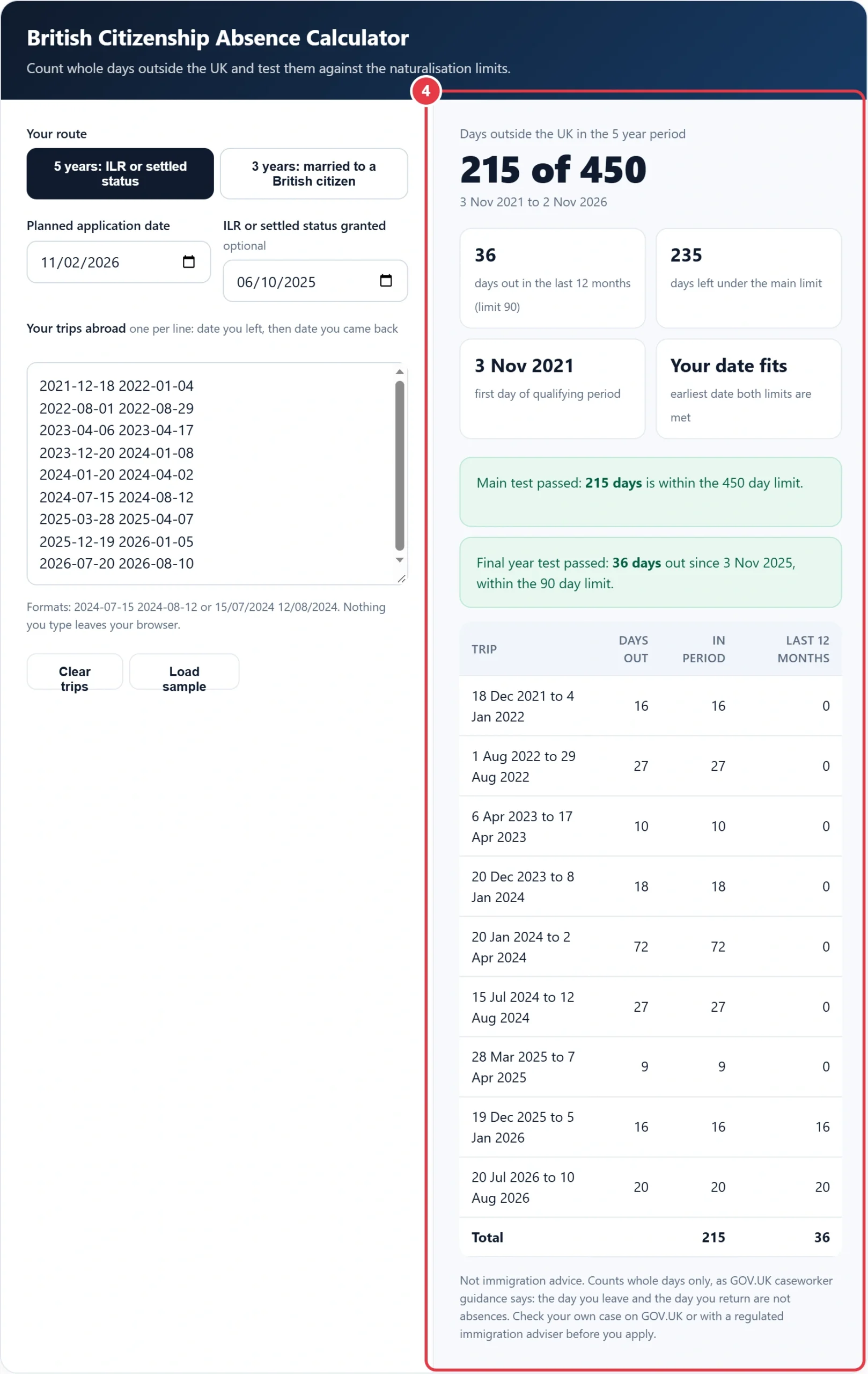
You see total days out against the 450 or 270 limit, days out in the last 12 months against 90, the first day of your qualifying period and the earliest date both limits are met. The table splits each trip into the days that fall inside each window, so you can match it to the absences section of your form.
How Many Days Can I Be Out of the UK for British Citizenship?
You can be out of the UK for up to 450 days in the 5 years before applying, and up to 90 days in the final 12 months, on the standard route. The GOV.UK citizenship eligibility page also says you must have been in the UK exactly 5 years before the Home Office receives your application.
| Test | 5 year route (ILR or settled) | 3 year route (spouse of a British citizen) |
|---|---|---|
| Qualifying period | 5 years | 3 years |
| Total absence limit | 450 days | 270 days |
| Last 12 months limit | 90 days | 90 days |
| Discretion normally used up to | 480 days | 300 days |
| Discretion possible with strong reasons | 480 to 900 days | 300 to 540 days |
| ILR or settled status held | 12 months before applying | On the date of application |
Worked example: Tomasz, a nurse in Bristol with settled status granted on 10 June 2025, plans to apply on 2 November 2026. His qualifying period runs from 3 November 2021. He lists nine trips, including 72 whole days abroad from 20 January to 2 April 2024 caring for his mother. The calculator counts 215 days out against the 450 limit and 36 days in the last 12 months against 90, and his settled status passes 12 months on 10 June 2026, so his planned date fits.
Do Departure and Arrival Days Count as Absences?
No, only whole days spent outside the UK count. The caseworker guidance gives the example of someone who leaves on 22 September and returns on 23 September: they are not treated as absent at all. A week in Spain from Saturday to the following Saturday therefore counts as 6 days, not 8. To check the gap between any two dates, the days between dates calculator gives the raw figure, and you subtract 1 for each trip.
What Happens If I Have Too Many Absences?
If you are 30 days or less over the limit, the guidance says caseworkers must normally use discretion as long as you meet every other requirement. Between 480 and 900 days on the 5 year route, discretion needs an established home, job, family and finances in the UK plus a specific reason, such as Crown service or a career that made travel unavoidable. Above 900 days it is described as highly unlikely. For the final year, up to 100 days is normally accepted, while 100 to 180 days needs strong ties.
Waiting is often the simplest fix: every day you wait moves the start of the window forward and old trips drop out, which is what the earliest date figure shows. The fee is £1,839, made up of the £1,709 application fee and the £130 ceremony fee, and it is not refunded if the application fails. Keep travel evidence, and if your case is borderline, check it with the GOV.UK guidance for spouses or the 5 year page, or with a regulated immigration adviser, before you pay.
</>Embed this calculator on your website
Add the free British Citizenship Absence Calculator to your own site or blog. Copy the code below and paste it into an HTML block. It resizes itself and works on phones.
How we checked this tool: the Tools Veria Editorial Team built this tool by hand, checked it against the official rules or published standards where they apply, and tested it against worked examples. Results are estimates for planning, not personal financial or tax advice. Read our editorial policy and disclaimer, or report an error.
Frequently Asked Questions
How many days can you be out of the UK for British citizenship?
Up to 450 days in the 5 years before you apply and no more than 90 days in the last 12 months. If you are married to a British citizen, the limits are 270 days in 3 years and still 90 days in the final 12 months.
How do I calculate my absence days for British citizenship?
For each trip, subtract the departure date from the return date and take off 1, since travel days count as days in the UK. A trip from 1 to 29 August is 27 days. Add up the days inside your qualifying period and the last 12 months.
When does the 5 year qualifying period start?
It starts the day after the date 5 years before the Home Office receives your application. For an application received on 2 November 2026, the period runs from 3 November 2021, and you should be in the UK on that first day.
Is the 90 day rule for citizenship strict?
Not completely. GOV.UK guidance says caseworkers normally use discretion for up to 100 days in the final 12 months if you meet every other requirement. Between 100 and 180 days you need strong ties, such as your home, family and job in the UK.
Can I apply for citizenship with 480 days of absence?
Possibly. Being 30 days or less over the 450 day limit, up to 480 days, is normally accepted under the guidance if all other requirements are met. Above 480 days you need strong UK links and a reason the Home Office accepts.
Do I need ILR for 12 months before applying for citizenship?
On the 5 year route, yes: you must have held ILR, indefinite leave to enter or settled status for 12 months. If you are married to a British citizen, you can apply as soon as you get ILR or settled status, subject to the 3 year residence test.