Regime forfettario for 2026: profitability coefficient, INPS, 5% or 15% flat tax and what you keep.
| Line | Amount |
|---|
Estimate. Coefficients from the Agenzia delle Entrate annex; INPS defaults from INPS circulars 8 and 14 of 2026 (€18,808 minimum income). Assumes INPS paid in the year equals this year's contributions. Real expenses are not deductible. Check with a commercialista.
This regime forfettario calculator is for freelancers, digital nomads and small traders who have, or plan to open, an Italian partita IVA under the flat rate scheme in 2026. It applies the official profitability coefficient for your activity, deducts INPS contributions and charges the 15% or 5% substitute tax, following the rules on taxation in Italy set out by the Agenzia delle Entrate, so you see your real take home pay in English. Figures checked October 2026.
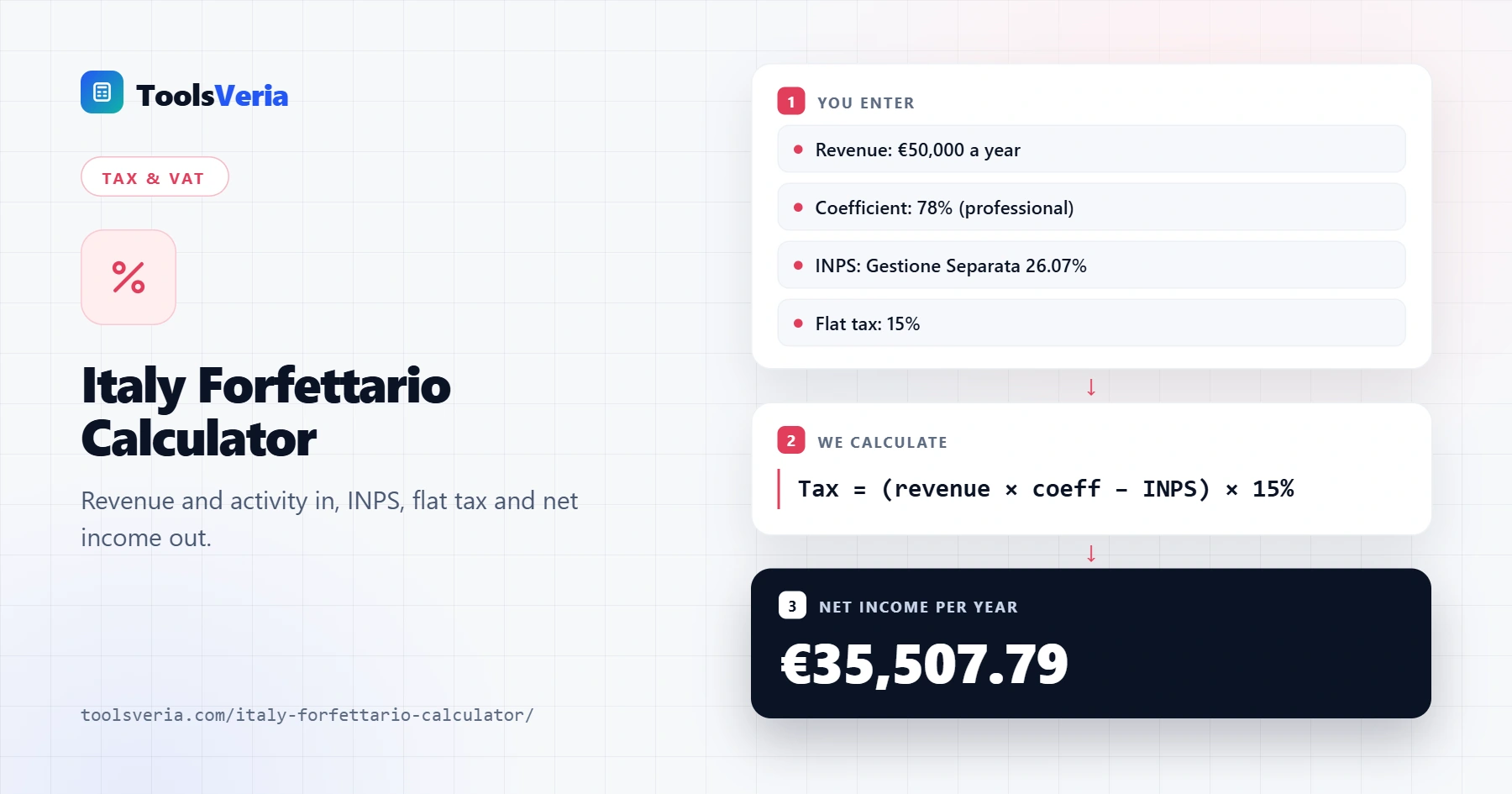
Quick answer: Under the forfettario you multiply revenue by your coefficient (40% to 86%), subtract INPS, and pay 15% tax on the rest, or 5% for your first five years. This regime forfettario calculator shows a consultant on €50,000 at 78% pays €10,167.30 INPS and €4,324.91 tax, keeping €35,507.79.
In This Guide
What Is the Regime Forfettario?
The regime forfettario is Italy's flat rate tax scheme for self employed people with revenue of up to €85,000 a year, replacing income tax and regional and municipal surcharges with one substitute tax. Instead of deducting real costs, you apply a profitability coefficient that the law sets for your ATECO activity code, which assumes a fixed share of revenue is profit. The Agenzia delle Entrate page on the scheme, updated 19 January 2026, confirms the €85,000 entry limit, the immediate exit above €100,000, the €20,000 cap on staff costs and the employment income limit of €35,000 for 2025 and 2026.
The formula in plain words: reddito forfettario = revenue collected × coefficient; taxable base = reddito minus INPS contributions paid; tax = taxable base × 15% (or 5%). Net income is revenue minus INPS minus tax, and any real expenses you have come out of that net figure, since they are never deductible.
How Much Tax Do You Pay Under the Regime Forfettario?
Most professionals on the forfettario pay about 29% of revenue in tax and INPS combined at the 15% rate, and about 23% at the 5% start-up rate. Take Oliver, a British marketing consultant who moved to Lecce and invoices €50,000 in 2026. His activity is professional, so the coefficient is 78% and his reddito is €39,000. With no professional fund of his own he pays the Gestione Separata at 26.07%, which is €10,167.30. His taxable base is €28,832.70, and 15% of it is €4,324.91. He keeps €35,507.79, or €2,958.98 a month. If he qualifies for the 5% start-up rate, tax falls to €1,441.64 and he keeps €38,391.06.
How to Use the Regime Forfettario Calculator
Step 1: Enter Revenue and Choose Your Activity
Enter the fees or sales you actually collect in the year, because the forfettario works on a cash basis. Then pick the group that contains your ATECO code; the list follows the nine groups in the official annex, with everyday labels added.

Step 2: Choose 15% or 5%
The 5% rate lasts for the first five years if you did no business, artistic or professional activity in the previous three years and the new activity is not simply a continuation of your old job. Everyone else pays 15%.

Step 3: Pick Your INPS Scheme
Professionals without their own pension fund use the Gestione Separata, a straight percentage with no minimum payment. Craftspeople and traders join the artigiani or commercianti scheme, which charges a fixed minimum even with no income, plus a percentage above €18,808. The rate fields are editable in case INPS revises them, and traders can tick the optional 35% reduction available to forfettari.

Step 4: Read Your Net Income
The headline is what you keep after INPS and tax, with the reddito, contributions, tax and monthly figure below. If you are comparing Italy with France, the France micro entrepreneur calculator runs the same revenue through the French scheme so you can see which country leaves you more.

Which Profitability Coefficient Applies to Me?
Your coefficient depends on the ATECO group of your activity code, from 40% for shops and restaurants to 86% for builders and estate agents. The table maps the official groups to common jobs and shows the reddito on €40,000 of revenue.
| Group (ATECO codes) | Coefficient | Typical jobs | Reddito on €40,000 |
|---|---|---|---|
| Professional, scientific, technical, health, education, finance (64 to 66, 69 to 75, 85, 86 to 88) | 78% | Consultant, designer, translator, tutor, physiotherapist | €31,200 |
| Other economic activities (incl. 58 to 63, 96) | 67% | Programmer, hairdresser, tailor, furniture maker | €26,800 |
| Construction and real estate (41 to 43, 68) | 86% | Builder, electrician, estate agent | €34,400 |
| Trade intermediaries (46.1) | 62% | Sales agent | €24,800 |
| Street trade, other goods (47.82 to 47.89) | 54% | Market stall, clothing | €21,600 |
| Retail, wholesale, food industry, accommodation and food service, street food (10 to 11, 45 to 47, 55 to 56) | 40% | Shop, e-commerce, B&B, café | €16,000 |
Software developers are often surprised to land in the 67% group rather than 78%, because ATECO division 62 sits under "other economic activities" in the annex. Check your code on your partita IVA certificate before relying on any figure.
How Much INPS Do Forfettari Pay in 2026?
Professionals in the Gestione Separata pay 26.07% of their reddito in 2026, while artigiani pay a fixed €4,521.36 and commercianti €4,611.64 on the first €18,808, then 24% or 24.48% above it, according to INPS circulars 8 and 14 of February 2026. Take Giulia, a hairdresser in Bologna registered as an artigiana with €40,000 of revenue. Her reddito at 67% is €26,800, her INPS is €4,521.36 plus 24% of €7,992, or €6,439.44, and her tax is €3,054.08, leaving €30,506.48. With the 35% reduction her INPS drops to €4,185.64 and she keeps €32,422.21, though a lower contribution also means a smaller pension.
| Revenue | INPS (26.07%) | Tax at 15% | Net at 15% | Net at 5% |
|---|---|---|---|---|
| €30,000 | €6,100.38 | €2,594.94 | €21,304.68 | €23,034.64 |
| €50,000 | €10,167.30 | €4,324.91 | €35,507.79 | €38,391.06 |
| €70,000 | €14,234.22 | €6,054.87 | €49,710.91 | €53,747.49 |
| €85,000 | €17,284.41 | €7,352.34 | €60,363.25 | €65,264.81 |
The table assumes a 78% coefficient and the Gestione Separata. Remember that the INPS you deduct is what you actually paid in the year, often the balance for the previous year plus advances, so year one and year two can differ from this steady state estimate.
Can Foreigners Use the Regime Forfettario?
Yes, Italian tax residents of any nationality can use it, and non residents can too if they live in the EU or EEA and earn at least 75% of their total income in Italy. Before you register, read the UK government guide to living in Italy for residency and healthcare steps. If you will later leave a salaried job in Italy, the Italy TFR calculator estimates the severance your employer owes when that job ends, which is useful when timing the switch to self employment.
Key Regime Forfettario Terms Explained
These terms explain the coefficients, contributions and tax rates behind the regime forfettario calculator, so you can follow how net income is reached.
- Regime forfettario
- Italy's flat rate scheme for self employed people with revenue up to €85,000 a year. It replaces income tax and regional and municipal surcharges with one substitute tax, and assumes profit from a fixed share of revenue.
- Profitability coefficient
- The percentage of revenue the law treats as taxable profit for a given type of activity, ranging from 40% to 86%. It stands in for real costs, which cannot be deducted under the scheme.
- ATECO code
- The Italian classification code for an economic activity, chosen when a business is registered. It decides which of the nine coefficient groups applies, so a professional and a retailer with equal revenue are taxed on different bases.
- Imposta sostitutiva
- The single substitute tax charged on the forfettario taxable base, at 15% as standard or 5% for a qualifying new business in its first five years. It is worked out after INPS contributions are deducted.
- Gestione Separata
- The INPS pension fund for self employed professionals who have no professional body fund of their own. Contributions are a percentage of the reddito, unlike the trader and craft schemes, which also carry a fixed yearly minimum.
- Partita IVA
- The Italian VAT number a self employed person must open to trade and invoice. Forfettario holders have one but do not charge VAT on their invoices, which keeps pricing simpler for private clients.
</>Embed this calculator on your website
Add the free Italy Forfettario Calculator to your own site or blog. Copy the code below and paste it into an HTML block. It resizes itself and works on phones.
How we checked this tool: the Tools Veria Editorial Team built this tool by hand, checked it against the official rules or published standards where they apply, and tested it against worked examples. Results are estimates for planning, not personal financial or tax advice. Read our editorial policy and disclaimer, or report an error.
Frequently Asked Questions
What is the regime forfettario limit in 2026?
The regime forfettario is open if your revenue was no more than €85,000 in the previous year. If revenue goes above €100,000 during the year, the regime ends at once and VAT applies to the sales that crossed the limit.
What is the forfettario tax rate?
The substitute tax is 15% of taxable income, or 5% for the first five years of a genuinely new activity. It replaces IRPEF and the regional and municipal surcharges on that business income.
How is taxable income calculated in the forfettario?
Multiply the revenue you collected by the profitability coefficient for your ATECO group, from 40% to 86%, then subtract the compulsory INPS contributions paid in the year. Real expenses are not deducted.
How much INPS does a forfettario freelancer pay?
A professional in the Gestione Separata pays 26.07% of the reddito forfettario in 2026. On €50,000 of revenue at a 78% coefficient that is €10,167.30, with no minimum if income is low.
Can I have a job and the forfettario at the same time?
Yes, if your employment income in the previous year was no more than €35,000, the limit for 2025 and 2026, and you do not mainly work for your current or recent employer.
What coefficient do software developers use?
Programmers with ATECO division 62 fall in the other economic activities group, so their coefficient is 67%, not 78%. On €60,000 of revenue that gives a reddito forfettario of €40,200.