Monthly payment, total interest, overpayments, rate rises and a year by year schedule in one place.
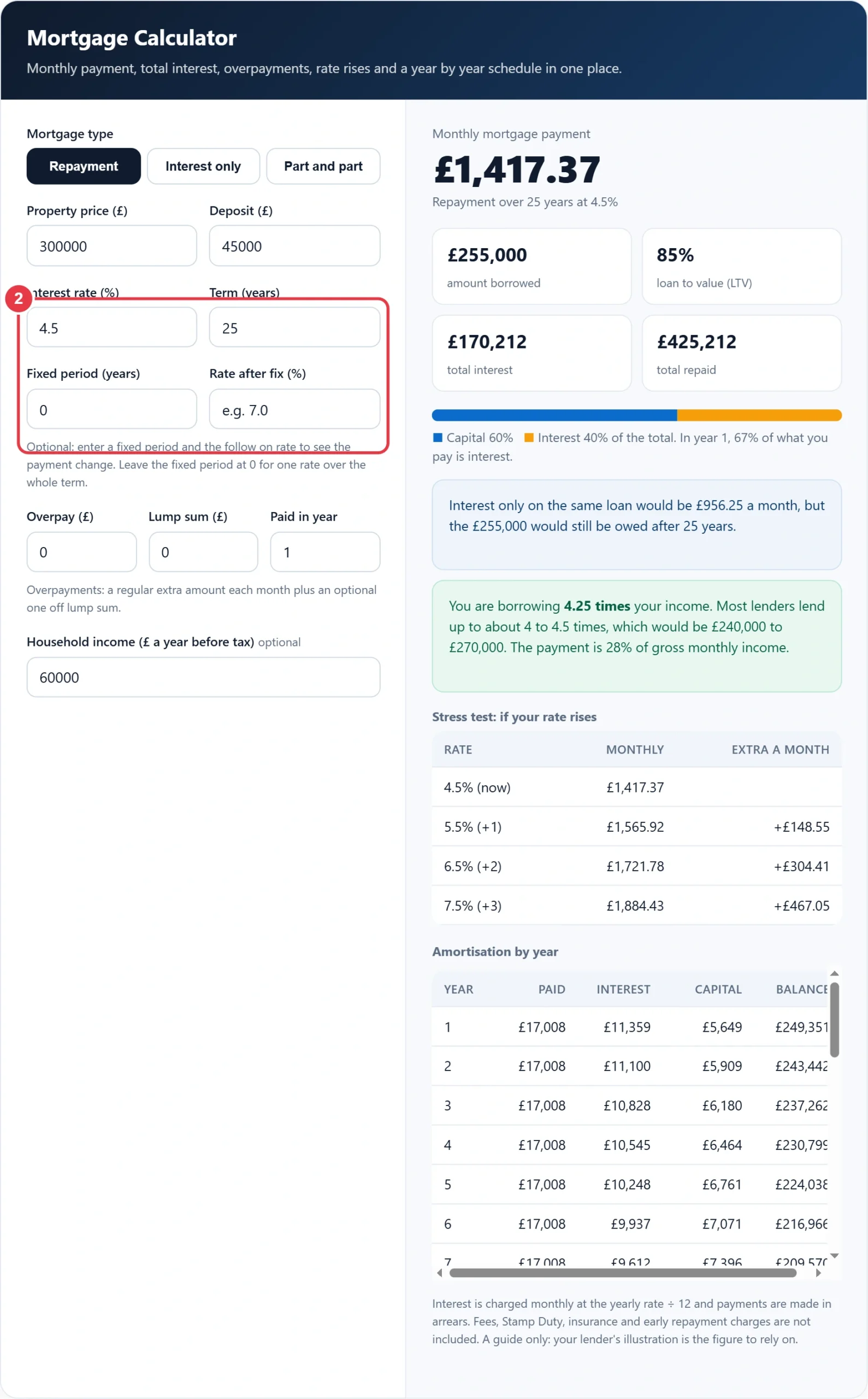
Optional: enter a fixed period and the follow on rate to see the payment change. Leave the fixed period at 0 for one rate over the whole term.
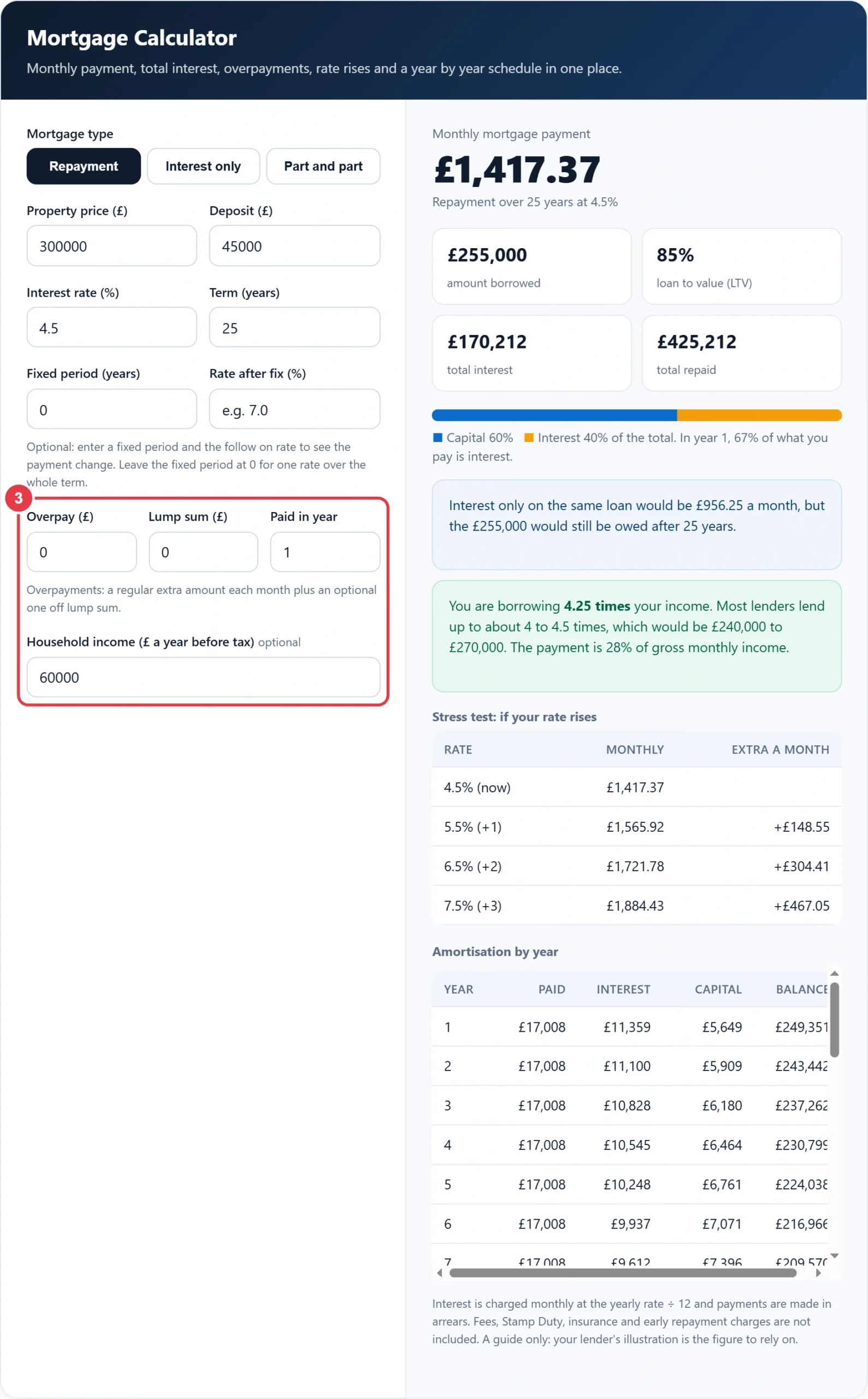
Overpayments: a regular extra amount each month plus an optional one off lump sum.
| Rate | Monthly | Extra a month |
|---|
| Year | Paid | Interest | Capital | Balance |
|---|
Interest is charged monthly at the yearly rate ÷ 12 and payments are made in arrears. Fees, Stamp Duty, insurance and early repayment charges are not included. A guide only: your lender's illustration is the figure to rely on.
This free mortgage calculator works out the monthly payment on a UK home loan in 2026 for first time buyers, home movers and anyone remortgaging, whether the loan is repayment, interest only or part and part. It uses the standard amortisation formula that lenders use for illustrations, then adds what most calculators leave out: total interest, loan to value, a rate change after your fixed deal, overpayments, a stress test and a year by year schedule. Figures checked October 2026.
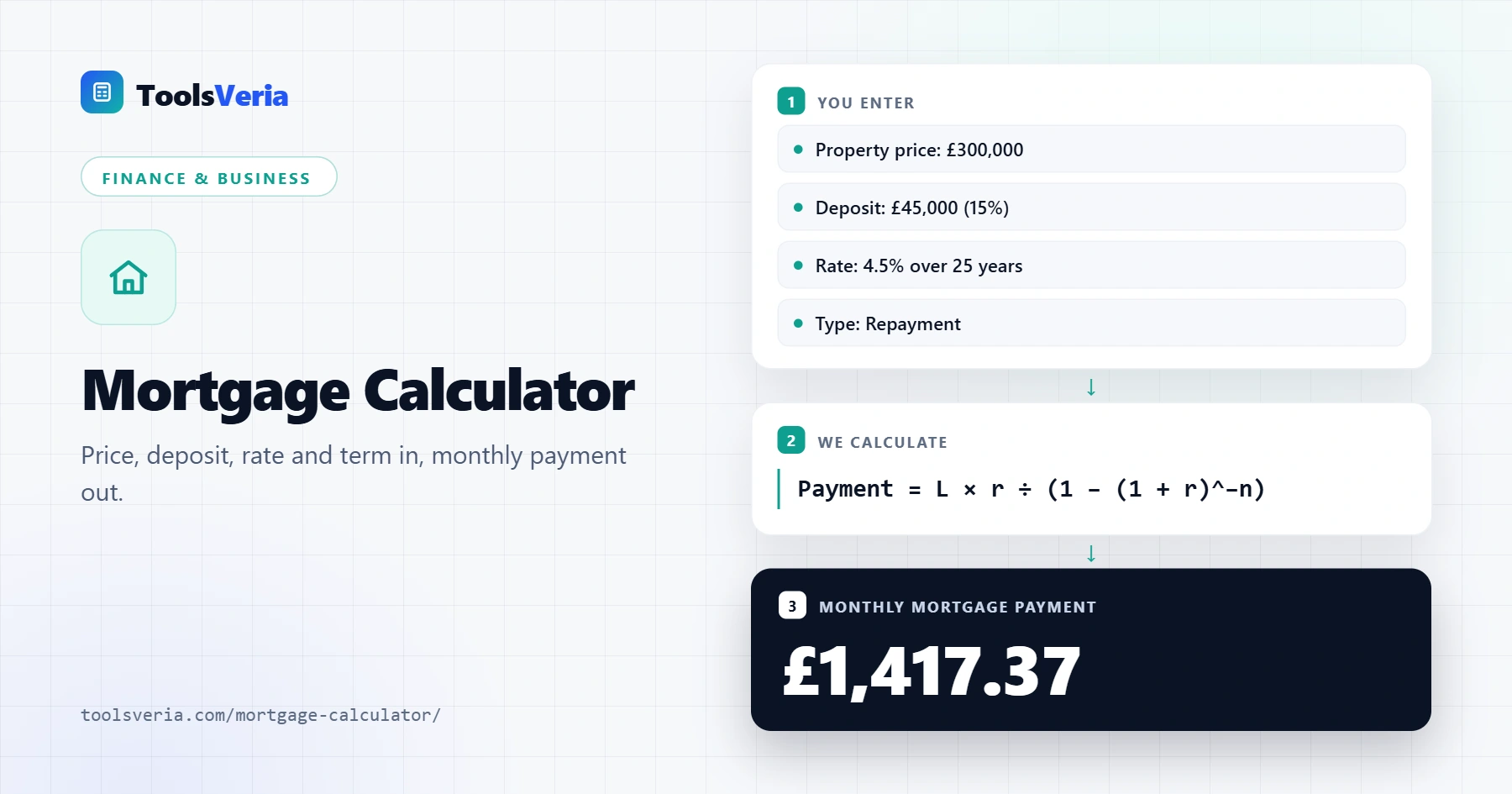
Quick answer: A mortgage calculator uses monthly payment = loan × r ÷ (1 − (1 + r) to the power of −n), where r is the yearly rate ÷ 12 and n is the number of monthly payments. Borrowing £255,000 at 4.5% over 25 years costs £1,417.37 a month and £170,212 in interest. Interest only would cost £956.25 a month.
In This Guide
What Is a Mortgage Calculator?
A mortgage calculator is a tool that turns a loan amount, interest rate and term into the fixed monthly payment needed to clear the debt, and shows how much of what you pay is interest. In plain words: take the monthly rate, multiply it by the loan, then divide by one minus the discount factor for the number of months. On an interest only mortgage the sum is simpler, because the payment is just the loan × the yearly rate ÷ 12.
Each repayment payment covers that month's interest first and the rest reduces the balance. Early on the balance is large, so most of the payment is interest; later the split reverses. That is why the yearly table shows capital growing every year while the payment stays the same.
How to Use the Mortgage Calculator
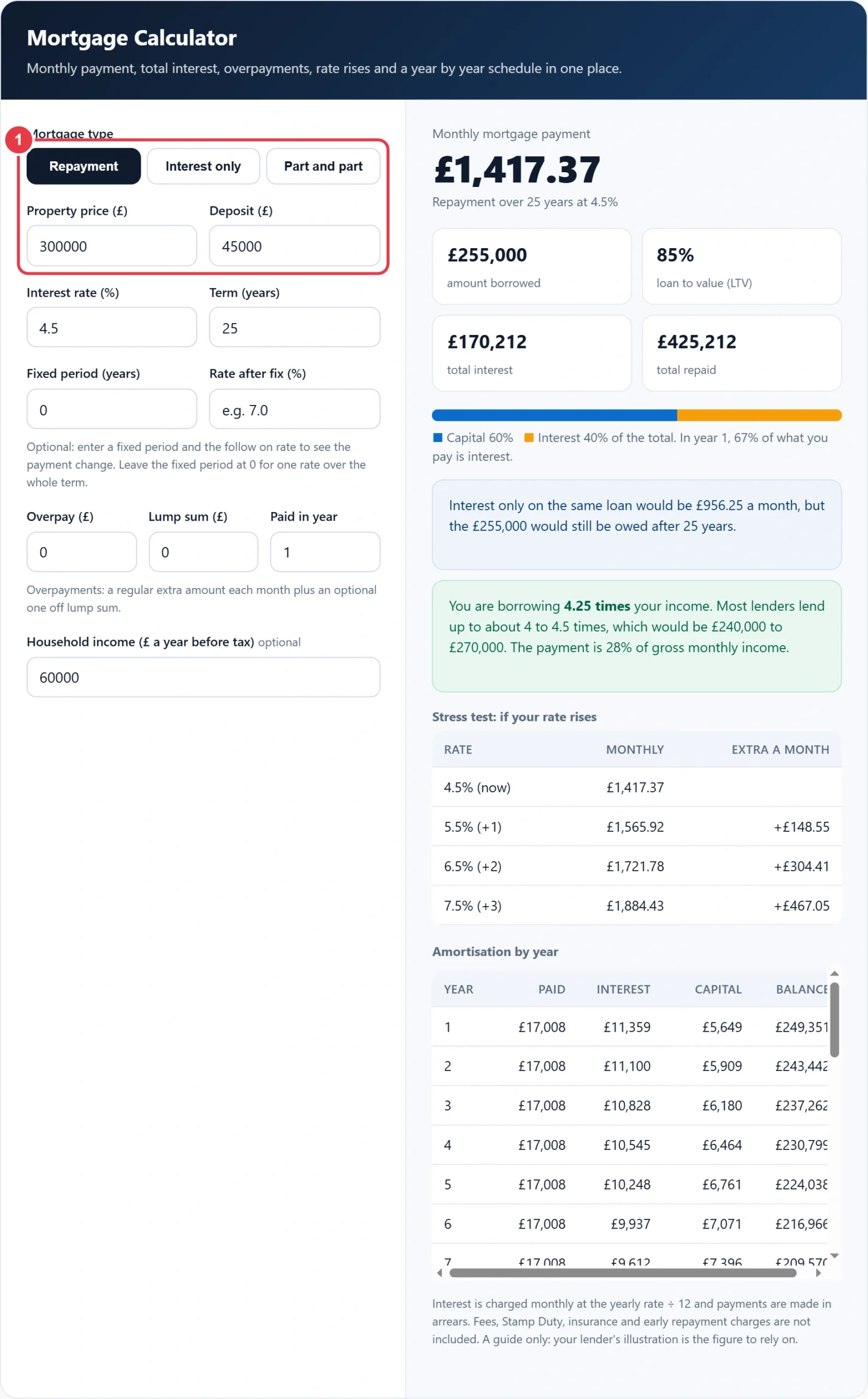
Step 1: Choose the Type, Price and Deposit
Pick repayment, interest only or part and part, then enter the property price and your deposit. The tool works out the amount borrowed and the loan to value. For part and part, enter how much of the loan is on interest only.
Step 2: Enter the Rate, Term and Any Rate Change
Type the rate from your mortgage offer and the term in years (up to 40). If you are on a two or five year fix, enter the fixed period and the rate you expect afterwards, such as your lender's standard variable rate, and the payment is recalculated on the balance left at that point.
Step 3: Add Overpayments and Income
Add a regular monthly overpayment, a one off lump sum and the year you pay it. Then enter your household income before tax to see your loan to income multiple. To compare the payment with what actually lands in your account, the UK salary calculator shows take home pay after tax and National Insurance.
Step 4: Read Your Results
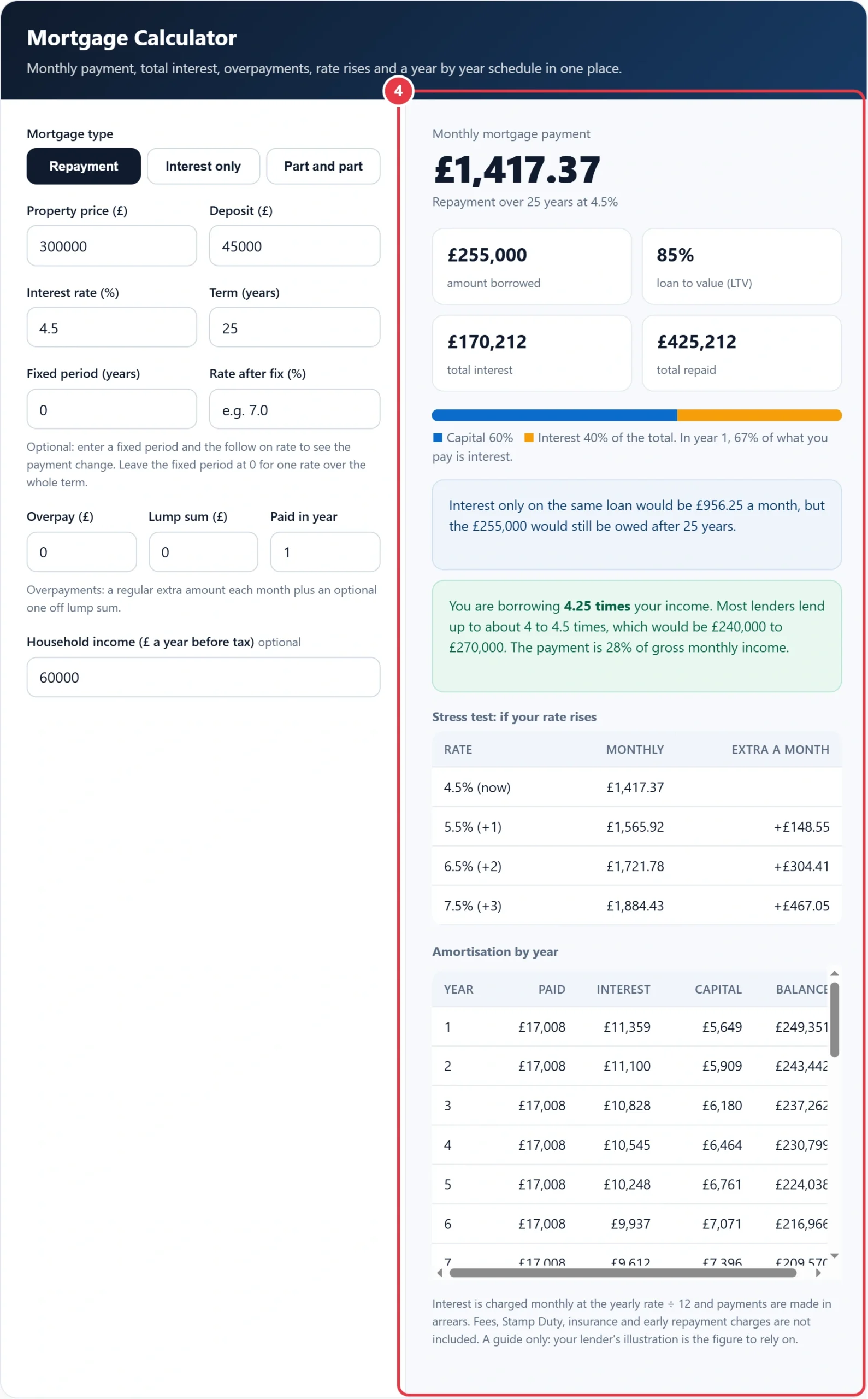
You see the monthly payment, amount borrowed, LTV, total interest and total repaid, a capital and interest bar, the stress test at rates up to 3 points higher, and the amortisation by year table. With overpayments entered, the table follows the overpaid plan.
How Is a Monthly Mortgage Payment Calculated?
A monthly mortgage payment is calculated as loan × r ÷ (1 − (1 + r)^−n), with r the yearly rate ÷ 12 and n the term in months. The formula sets one level payment that clears the loan exactly on the final month.
Worked example: Amira buys a £300,000 home with a £45,000 deposit, so she borrows £255,000 at 85% LTV. At 4.5% over 25 years, r is 0.00375 and n is 300, giving £1,417.37 a month. In year one she pays £17,008, of which £11,359 (67%) is interest and only £5,649 reduces the debt. Over the full term she repays £425,212, including £170,212 of interest. If her 4.5% rate is a five year fix and she then moves to 6.5%, the £224,038 still owed is spread over the remaining 20 years and the payment rises to £1,670.36.
How Rate and Term Change Your Mortgage Payment
The table shows monthly repayments on a £200,000 repayment mortgage, worked out with this mortgage calculator, plus the total interest at 4.5%.
| Term | 3.5% | 4.5% | 5.5% | Total interest at 4.5% |
|---|---|---|---|---|
| 20 years | £1,159.92 | £1,265.30 | £1,375.77 | £103,672 |
| 25 years | £1,001.25 | £1,111.66 | £1,228.17 | £133,499 |
| 30 years | £898.09 | £1,013.37 | £1,135.58 | £164,813 |
| 35 years | £826.58 | £946.51 | £1,074.03 | £197,536 |
Stretching a 25 year term to 35 years cuts the payment by £165.15 a month but adds £64,037 of interest. Each extra percentage point on the rate adds roughly £105 to £130 a month on this loan, which is why the stress test matters when a fixed deal ends.
Is a Repayment or Interest Only Mortgage Cheaper?
Interest only is cheaper each month but much dearer overall. On £255,000 at 4.5% over 25 years it costs £956.25 a month against £1,417.37 on repayment, yet you pay £286,875 in interest and still owe the full £255,000 at the end. Lenders only offer interest only with a credible plan to repay the capital, such as investments or the sale of another property, and usually ask for a larger deposit.
A part and part mortgage splits the loan: one part is repaid, the other is interest only. It lowers the payment while still clearing most of the debt, so choose that option above to see both parts in one result.
How Much Can I Borrow for a Mortgage?
Most UK lenders will lend about 4 to 4.5 times your gross household income, so a £60,000 income usually supports a mortgage of £240,000 to £270,000. The Bank of England limits loans at 4.5 times income or more to 15% of new mortgages across the market; since July 2025 individual lenders may go over that share as long as the market as a whole stays within it. Lenders also check your spending, debts and whether you could cope with a higher rate.
Your deposit matters as much as your income. Rates usually improve at the 90%, 85%, 75% and 60% loan to value ratio thresholds, so a slightly bigger deposit can cut the cost of the whole loan, and most buyers need at least 5%.
Budget too for lender fees, a survey, legal costs and Stamp Duty. The GOV.UK residential rates apply in England and Northern Ireland, and the stamp duty calculator also covers Scotland and Wales, so you can check the full cost of buying before you make an offer.
How Much Do Mortgage Overpayments Save?
Overpaying £200 a month on a £255,000, 25 year mortgage at 4.5% saves £38,640 in interest and clears the loan five years early. Many fixed deals allow overpayments of up to 10% of the balance each year without an early repayment charge, but the limit varies, so check your offer first. For a deeper look at regular and lump sum overpayments, the mortgage overpayment calculator compares reducing your term with reducing your payment, while this mortgage calculator shows the effect alongside the full schedule.
</>Embed this calculator on your website
Add the free Mortgage Calculator to your own site or blog. Copy the code below and paste it into an HTML block. It resizes itself and works on phones.
How we checked this tool: the Tools Veria Editorial Team built this tool by hand, checked it against the official rules or published standards where they apply, and tested it against worked examples. Results are estimates for planning, not personal financial or tax advice. Read our editorial policy and disclaimer, or report an error.
Frequently Asked Questions
How accurate is a mortgage calculator?
A mortgage calculator is accurate to within a few pounds when you enter the same loan, rate and term as your lender. Small differences come from how interest is charged, daily or monthly, and from fees added to the loan, so treat your lender's illustration as the final figure.
Does a mortgage calculator include stamp duty and fees?
No. This calculator covers the loan only. Stamp Duty, arrangement fees, valuation, survey, legal costs and insurance are extra. If you add a fee to the loan, increase the amount borrowed by the fee, because you will then pay interest on it for the whole term.
What happens when my fixed rate ends?
When a fixed rate ends you move to the lender's follow on rate, often a standard variable rate, unless you remortgage. Your payment is recalculated on the balance left over the remaining term. Enter the fixed period and the new rate above to see the change.
Is a shorter mortgage term better?
A shorter term means higher monthly payments but far less interest. On £200,000 at 4.5%, 20 years costs £1,265.30 a month and £103,672 in interest, while 35 years costs £946.51 a month but £197,536 in interest, almost twice as much.
What deposit do I need for a mortgage?
Most UK lenders need a deposit of at least 5% of the price, which is a 95% loan to value mortgage. A deposit of 10%, 15%, 25% or 40% usually unlocks lower rates, so every extra pound saved can reduce the monthly payment and the total interest.
How is mortgage interest worked out each month?
Interest each month is the outstanding balance × the yearly rate ÷ 12. On £255,000 at 4.5% the first month's interest is £956.25, so £461.12 of a £1,417.37 payment repays capital. As the balance falls, the interest share falls too.