The legal maximum deposit, holding deposit and rent in advance for a home in England.
For the whole tenancy, not per tenant. Applies to lets in England covered by the Tenant Fees Act 2019.
| Rent level | Weeks | Deposit cap |
|---|
Estimate only, check with GOV.UK guidance. Caps from the Tenant Fees Act 2019 and rent in advance limits from 1 May 2026, rounded down to the penny. Figures checked October 2026.
This 5 weeks rent deposit calculator shows tenants, landlords and letting agents in England the most that can legally be taken as a tenancy deposit in 2026, along with the holding deposit and rent in advance limits. Enter the rent in any frequency and it converts it the way the law requires, applies the 5 or 6 week cap and checks any deposit you have been quoted. Figures checked October 2026.
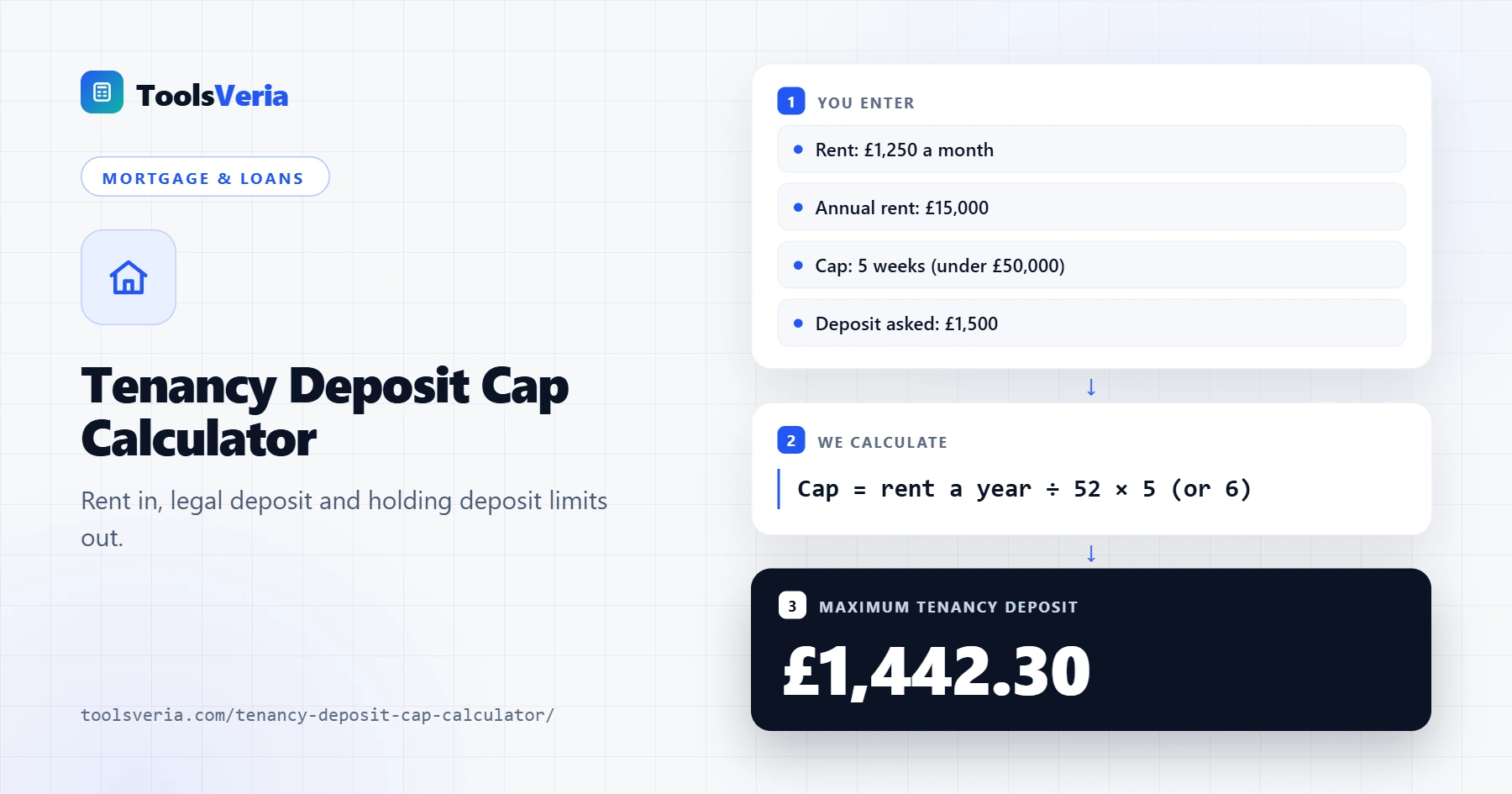
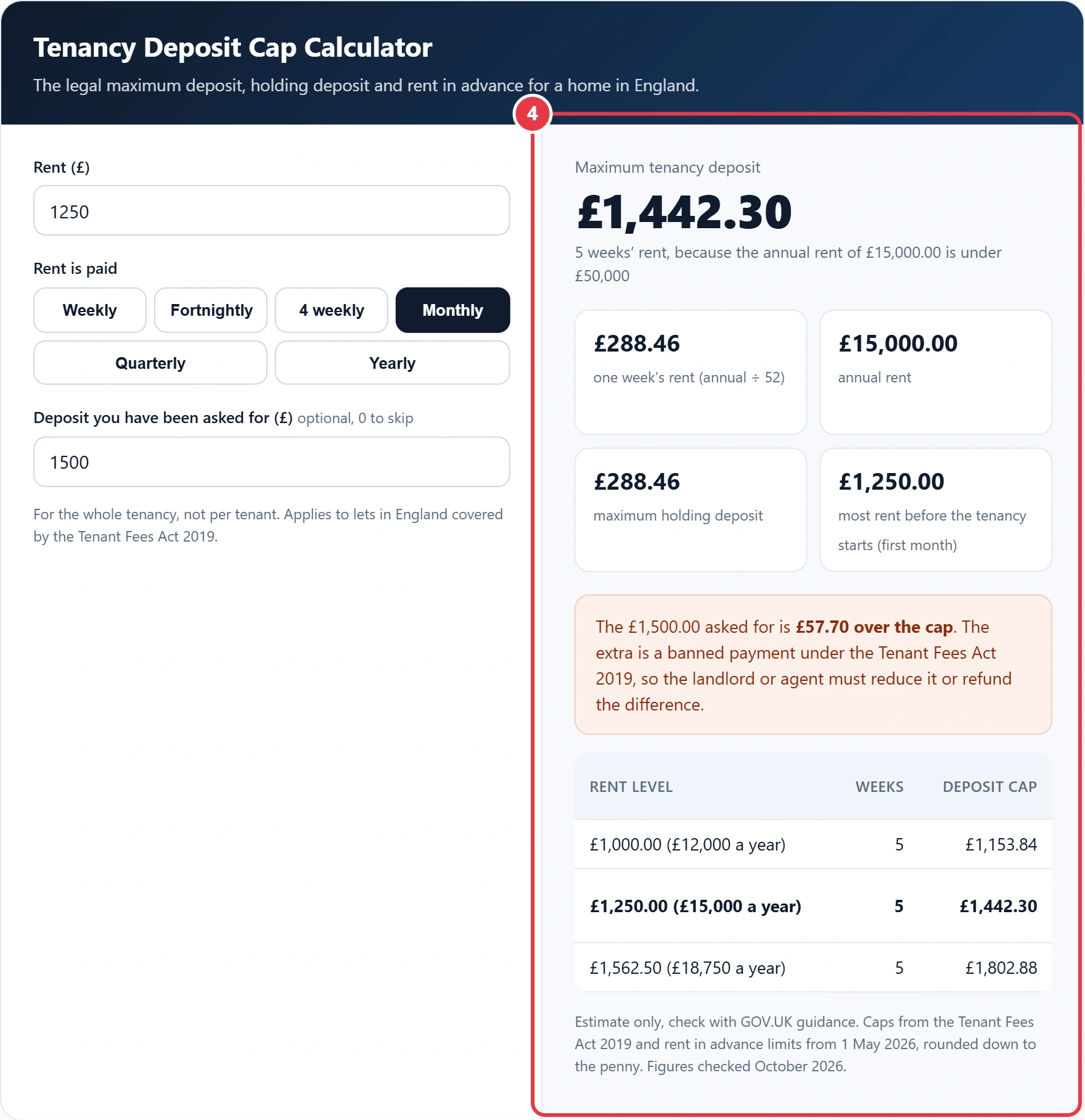
Quick answer: In England a tenancy deposit is capped at 5 weeks' rent when the annual rent is under £50,000, and 6 weeks' rent at £50,000 or more. One week's rent is the annual rent divided by 52, so £1,250 a month gives £15,000 ÷ 52 × 5 = £1,442.30 on this 5 weeks rent deposit calculator.
In This Guide
What Is the Tenancy Deposit Cap?
The tenancy deposit cap is the legal maximum refundable deposit a landlord or agent in England can ask for, set by the Tenant Fees Act 2019 and unchanged by the Renters' Rights Act. Anything above the cap is a prohibited payment, and the cap applies to the whole tenancy, so joint tenants share one deposit rather than each paying five weeks.
The formula in plain words: work out the rent for a full year, divide it by 52 to get one week's rent, then multiply by 5, or by 6 if the annual rent is £50,000 or more. The calculator rounds the result down to the penny, because rounding up by even a fraction would take the deposit over the limit. A holding deposit, paid to reserve a home while checks are done, is capped at one week's rent.
How to Use the 5 Weeks Rent Deposit Calculator
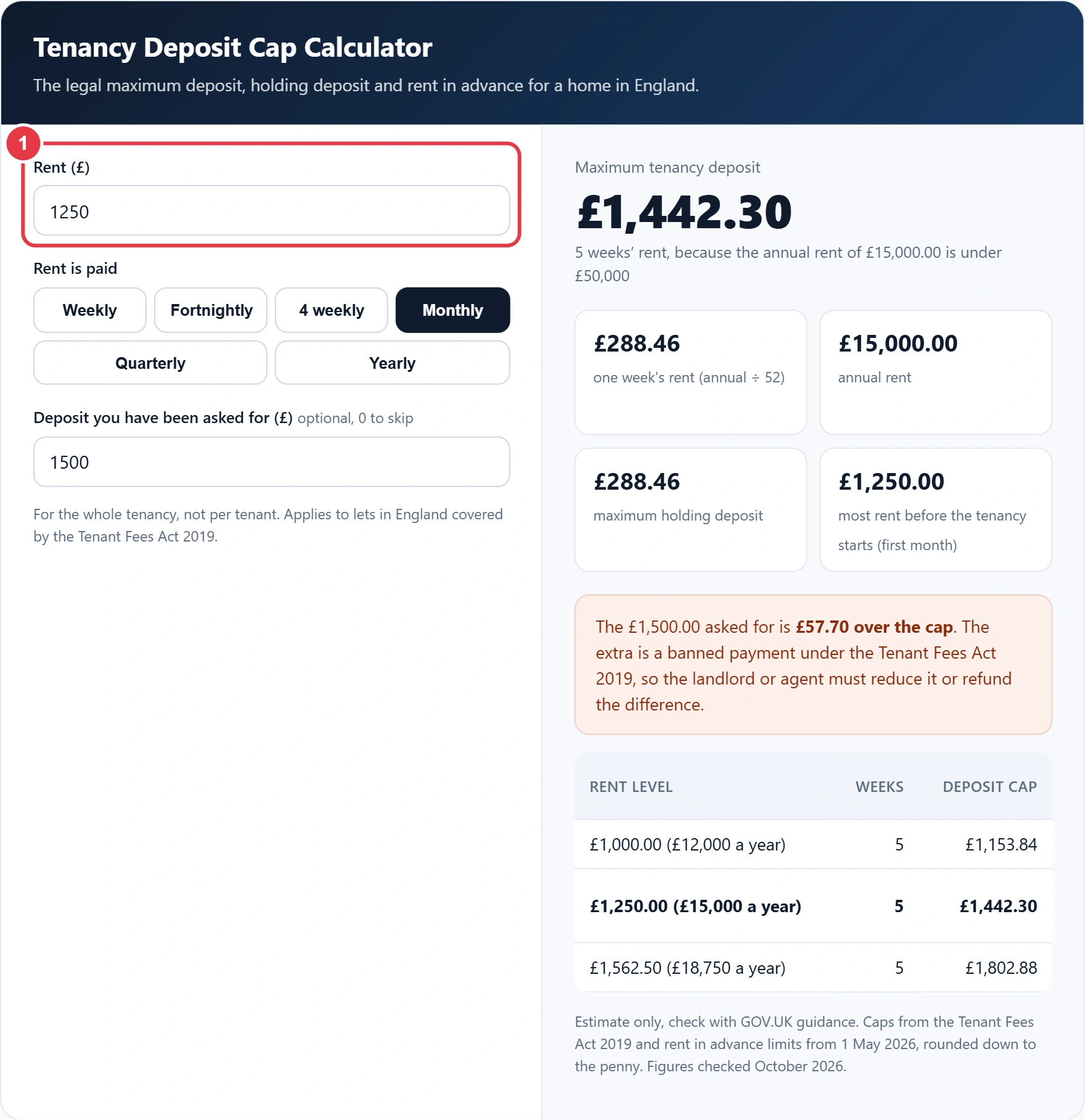
Step 1: Enter the Rent
Type the rent exactly as it appears in the advert or your tenancy agreement. Use the full rent for the property, not your own share, because the cap is worked out for the tenancy as a whole.
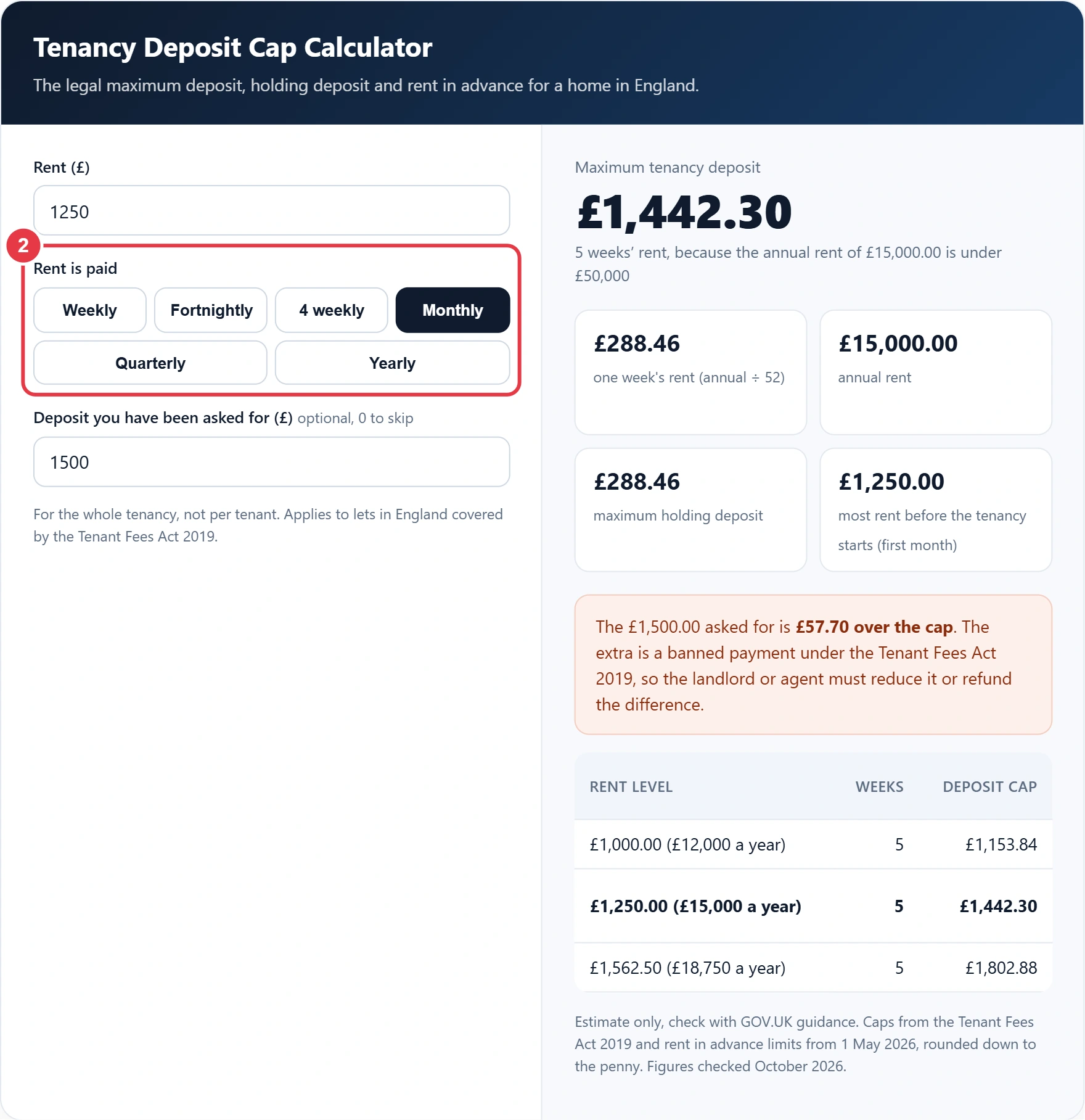
Step 2: Choose How Often Rent Is Paid
Pick weekly, fortnightly, 4 weekly, monthly, quarterly or yearly. This matters: £1,250 a month is £15,000 a year, but £1,250 every 4 weeks is £16,250 a year, which raises the cap to £1,562.50. Monthly rent is never simply multiplied by 4.33 or divided by 4.
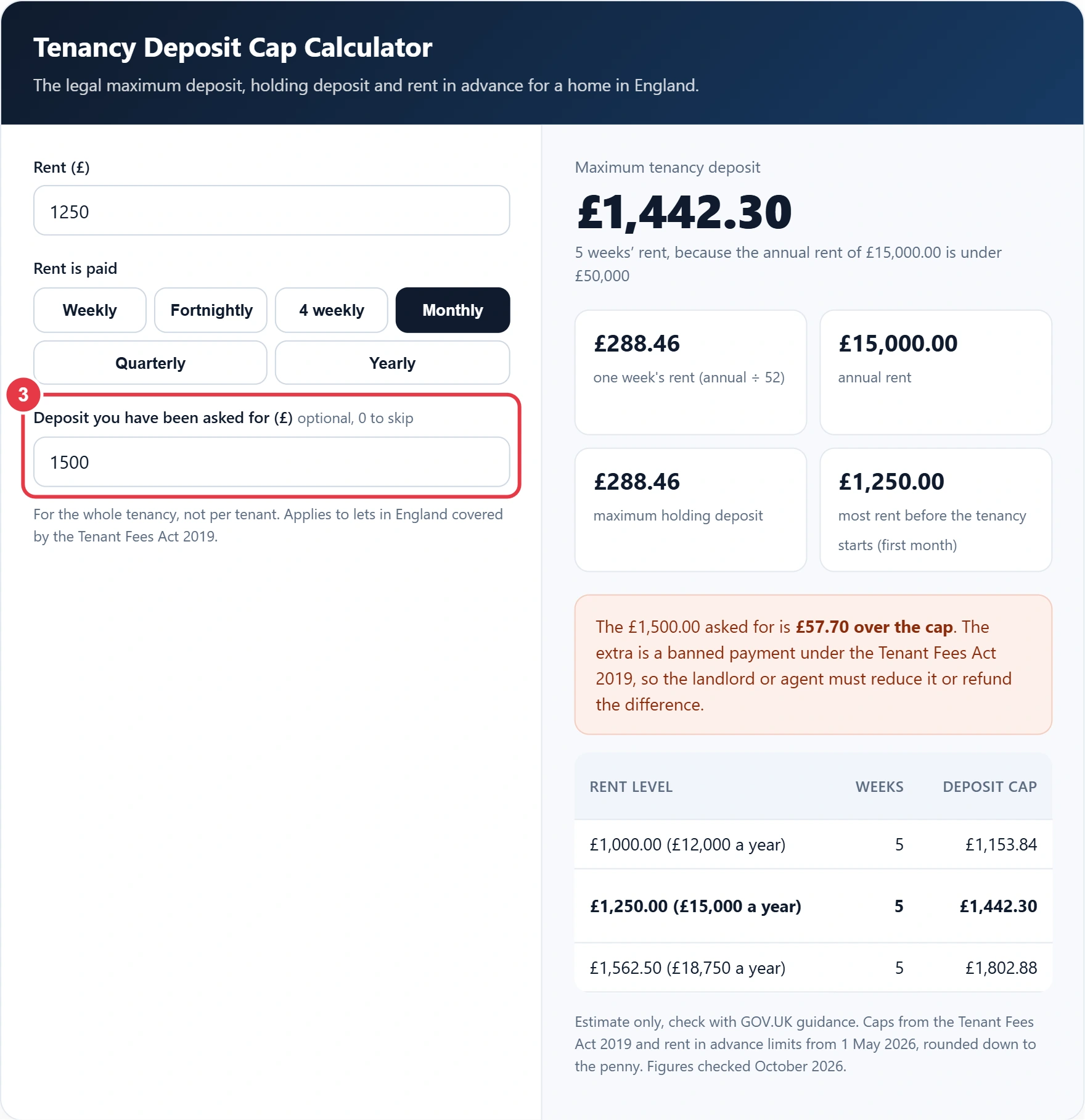
Step 3: Add the Deposit You Were Quoted
Enter the deposit the landlord or agent has asked for, or leave it at 0 if you just want the cap. The calculator tells you whether the quote is within the limit and, if not, exactly how much too high it is.
Step 4: Read Your Limits
The headline is the maximum tenancy deposit. The stats show one week's rent, the annual rent, the maximum holding deposit and the most rent you can be asked to pay before the tenancy starts. The table shows how the cap changes if the rent is 20% lower or 25% higher, which helps when you are negotiating.
How Much Deposit Can a Landlord Charge in England?
A landlord can charge up to 5 weeks' rent as a deposit when the yearly rent is below £50,000, which covers almost every home in England. The 6 week cap only starts at £50,000 a year, equal to about £4,166.67 a month.
| Monthly rent | Annual rent | One week's rent | Weeks | Maximum deposit |
|---|---|---|---|---|
| £800 | £9,600 | £184.61 | 5 | £923.07 |
| £1,000 | £12,000 | £230.76 | 5 | £1,153.84 |
| £1,250 | £15,000 | £288.46 | 5 | £1,442.30 |
| £1,500 | £18,000 | £346.15 | 5 | £1,730.76 |
| £2,000 | £24,000 | £461.53 | 5 | £2,307.69 |
| £3,000 | £36,000 | £692.30 | 5 | £3,461.53 |
| £4,500 | £54,000 | £1,038.46 | 6 | £6,230.76 |
Worked example: Chloe and Sam are moving into a two bedroom flat in Bristol at £1,250 a month, and the agent asks for a £1,500 deposit. The annual rent is £15,000, one week's rent is £288.46 and five weeks is £1,442.30. The quote is £57.70 over the cap, so the agent must cut the deposit to £1,442.30 or less. Their holding deposit can be no more than £288.46, and once they sign the agreement the most they can be asked to pay before moving in is the first month's rent of £1,250.
How Do You Calculate 5 Weeks' Rent?
Multiply the monthly rent by 12, divide by 52 and multiply by 5. This is not a rule of thumb: the wording of the Tenant Fees Act 2019, Schedule 1 defines one week's rent as the annual rent divided by 52, so the same method works for weekly or quarterly rent once you turn it into a yearly figure. A common mistake is to treat a month as four weeks, which overstates weekly rent by about 8% and pushes the deposit over the limit.
When Does the 6 Week Deposit Cap Apply?
The 6 week cap applies when the total rent for a year is £50,000 or more. At £4,500 a month the annual rent is £54,000, so the cap is £54,000 ÷ 52 × 6 = £6,230.76. At £4,166.66 a month the annual rent is £49,999.92, so the 5 week cap of £4,807.68 applies instead. Homes let for more than £100,000 a year generally fall outside assured tenancy rules, so take legal advice if your rent is that high.
How Much Rent in Advance Can a Landlord Ask For?
From 1 May 2026 a landlord cannot ask for any rent before the tenancy agreement is signed. After signing but before the tenancy begins, they can ask for the first month's rent if rent is monthly, or up to the first 28 days of rent otherwise. Large upfront payments of six or twelve months, once common for students and people with poor credit, can no longer be required for new assured tenancies in the private rented sector.
What Happens If a Landlord Takes Too Much Deposit?
Any amount over the cap is a prohibited payment that must be repaid. Ask the landlord or agent in writing for the excess first, and if they refuse, report it to Trading Standards at your local council, which enforces the Act. The deposit itself must be protected, and the GOV.UK guide to deposit protection schemes confirms it has to go into an approved scheme within 30 days of payment, so check the certificate you receive.
Keep a note of the date you paid, because the protection clock starts then and the days between dates calculator counts the days from paying a deposit to the 30 day protection deadline. If the rent is going up at renewal, the percentage increase calculator shows the rise in percentage terms, and a 5 weeks rent deposit calculator check on the new rent tells you whether a top up is allowed.
</>Embed this calculator on your website
Add the free Tenancy Deposit Cap Calculator to your own site or blog. Copy the code below and paste it into an HTML block. It resizes itself and works on phones.
How we checked this tool: the Tools Veria Editorial Team built this tool by hand, checked it against the official rules or published standards where they apply, and tested it against worked examples. Results are estimates for planning, not personal financial or tax advice. Read our editorial policy and disclaimer, or report an error.
Frequently Asked Questions
How do you calculate a 5 week deposit?
Multiply the monthly rent by 12, divide by 52, then multiply by 5. For £1,250 a month that is £15,000 ÷ 52 × 5 = £1,442.30. Round down to the penny so the deposit never goes over the legal cap.
Can a landlord charge 6 weeks deposit?
Only if the annual rent is £50,000 or more, which is about £4,166.67 a month. Below that, the Tenant Fees Act 2019 caps the deposit at 5 weeks' rent, and anything above the cap must be refunded to the tenant.
Is the deposit cap per tenant or per property?
The cap is per tenancy, not per person. Four sharers on a joint tenancy at £2,000 a month can be asked for £2,307.69 in total, not £2,307.69 each, so split the single capped amount between you.
How much can a holding deposit be?
A holding deposit can be no more than one week's rent, which is the annual rent divided by 52. On £1,250 a month that is £288.46. It is refundable and is normally put towards the first rent or the tenancy deposit.
Can a landlord ask for a pet deposit on top?
No. A separate pet deposit would be a prohibited payment. A landlord who accepts a pet can only take the normal tenancy deposit, which must still stay within the 5 or 6 week cap for the whole tenancy.
Does the deposit cap apply in Wales or Scotland?
No. The 5 and 6 week caps in this calculator come from the Tenant Fees Act 2019, which covers England only. Wales, Scotland and Northern Ireland have their own deposit rules, so check the official guidance for the nation where the home is.