Spell out any number, cheque amount or ordinal in British English.
Uses the short scale, where a billion is a thousand million, as UK government and media do. Cheque mode rounds to the nearest penny.
Need to write £1,250.75 on a cheque, spell out a figure in a contract or check how a big number is said aloud? This number to words converter writes any number in correct British English, including the "and" that UK readers expect, following the usual English numeral conventions for hyphens and large numbers. It also turns amounts into pounds and pence and creates ordinals such as twenty-first.
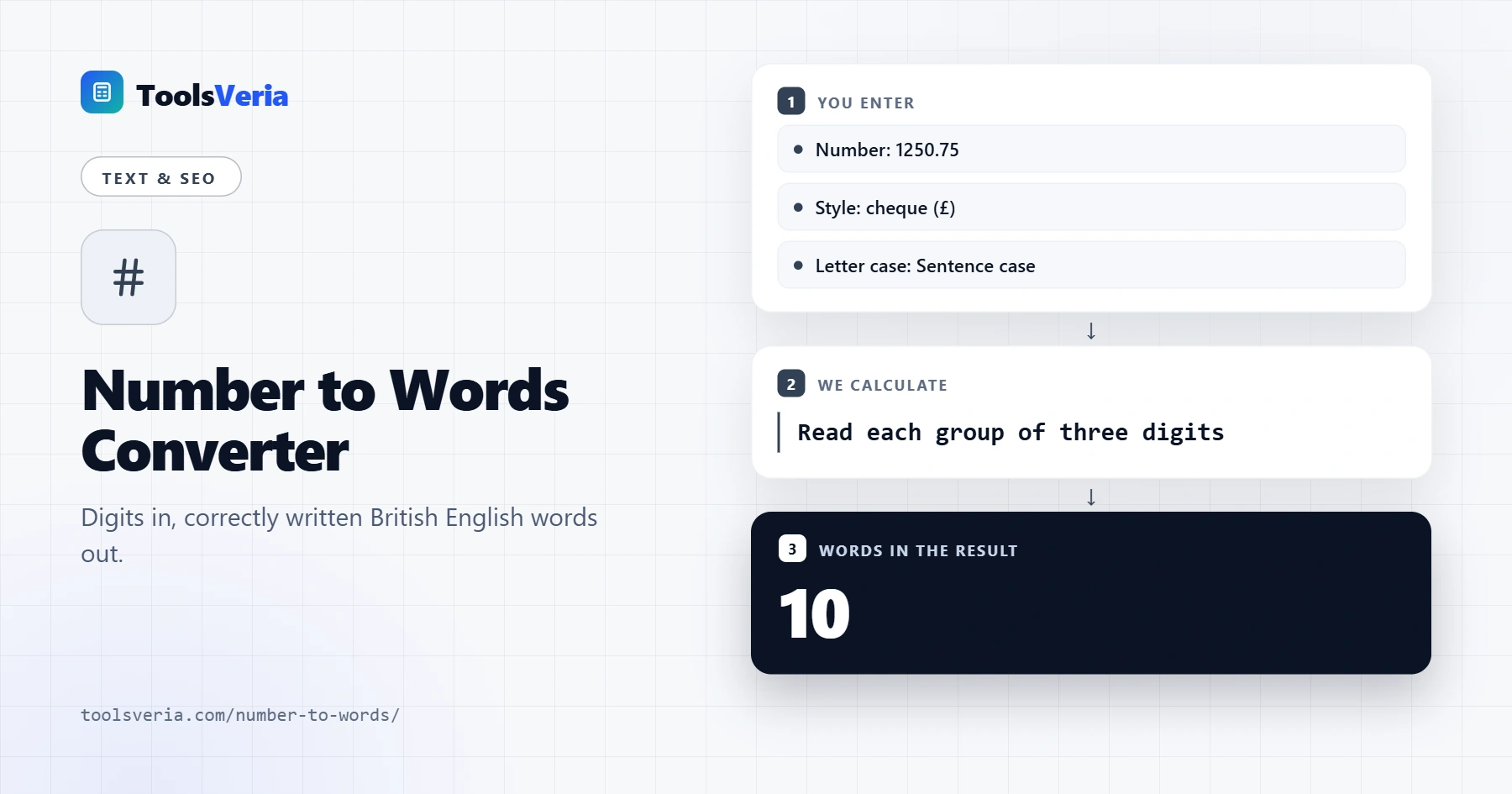
Quick answer: A number to words converter splits the digits into groups of three from the right and reads each group as hundreds, tens and units with its scale. In British English, "and" goes after the hundreds, as in three hundred and twelve, and numbers from 21 to 99 take a hyphen, as in forty-two.
In This Guide
What Is a Number to Words Converter?
A number to words converter reads the digits of a number and writes out how you would say it. Writing amounts in words is common on cheques, legal documents and invoices because words are much harder to alter than figures.
The method is simple. The number is split into groups of three digits from the right, and each group is read as hundreds, tens and units, then given its scale: thousand, million, billion and so on. In British English "and" goes after the hundreds (three hundred and twelve) and before a final group under 100 (two thousand and twenty-six). Numbers from 21 to 99 take a hyphen, as in forty-two, and digits after a decimal point are read one by one.
How Do You Use the Number to Words Converter?
Step 1: Enter Your Number
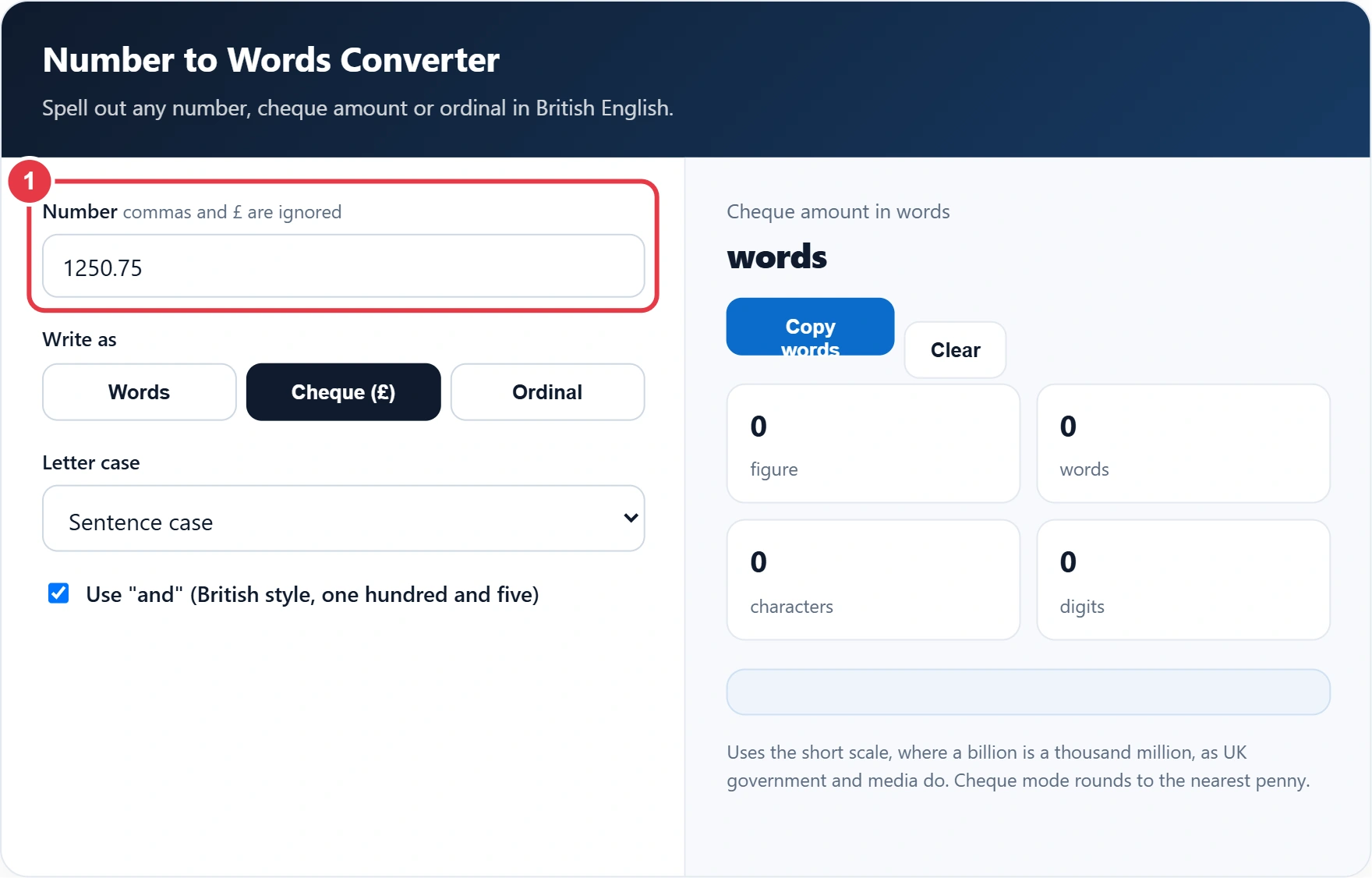
You type or paste a number, and commas, spaces and the £ sign are ignored, with up to 21 digits allowed before the decimal point. Type or paste a number. Commas, spaces and the £ sign are ignored, so 1,250.75 and £1250.75 both work. You can enter up to 21 digits before the decimal point.
Step 2: Choose a Style
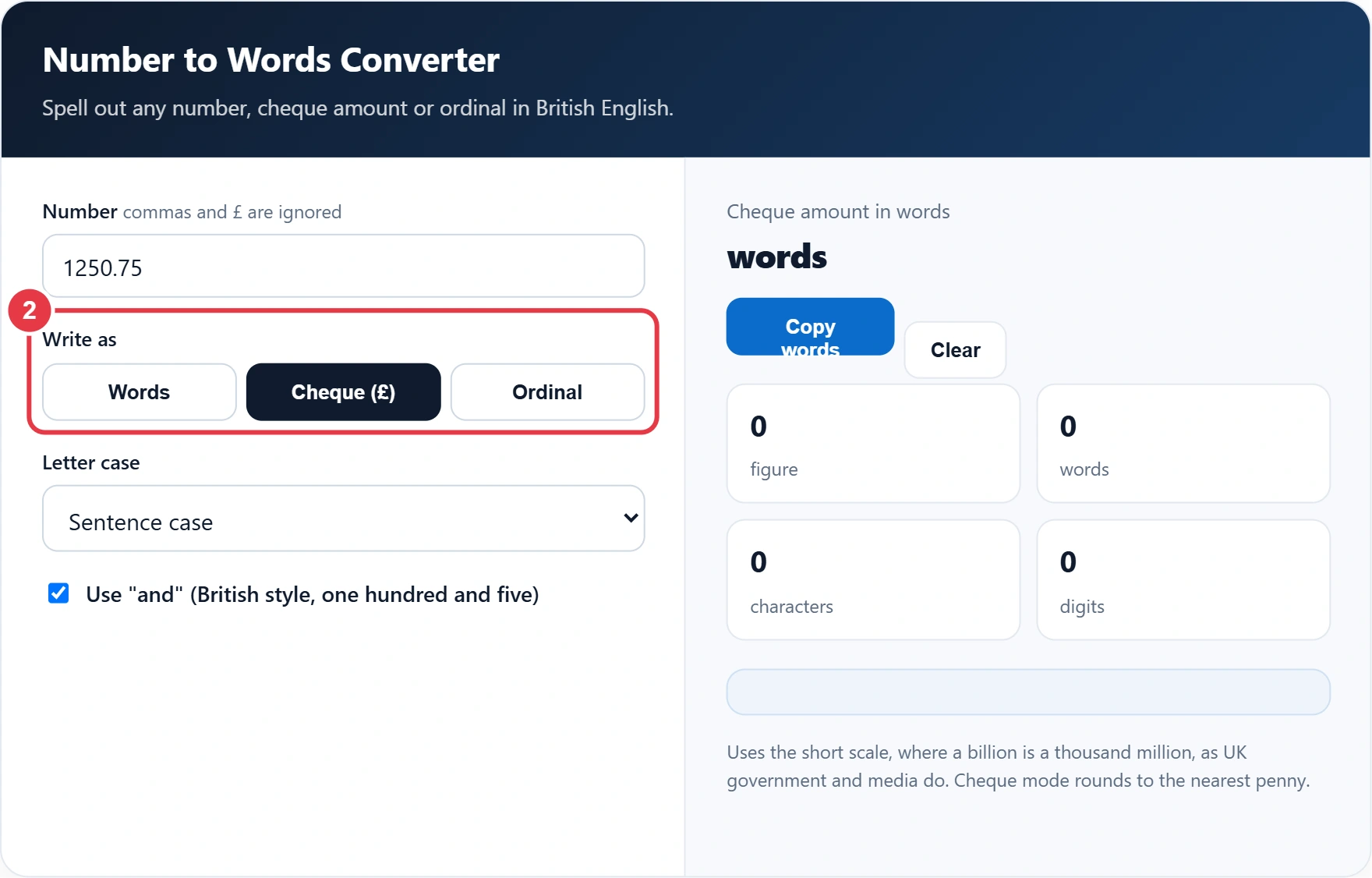
Pick Words for a plain number, Cheque (£) for pounds and pence, or Ordinal for positions such as first or one hundred and first. If you work with dates on monuments or clock faces, the Roman numeral converter handles the other classic way of writing numbers, and both tools update as you switch.
Step 3: Set Case and Style Options
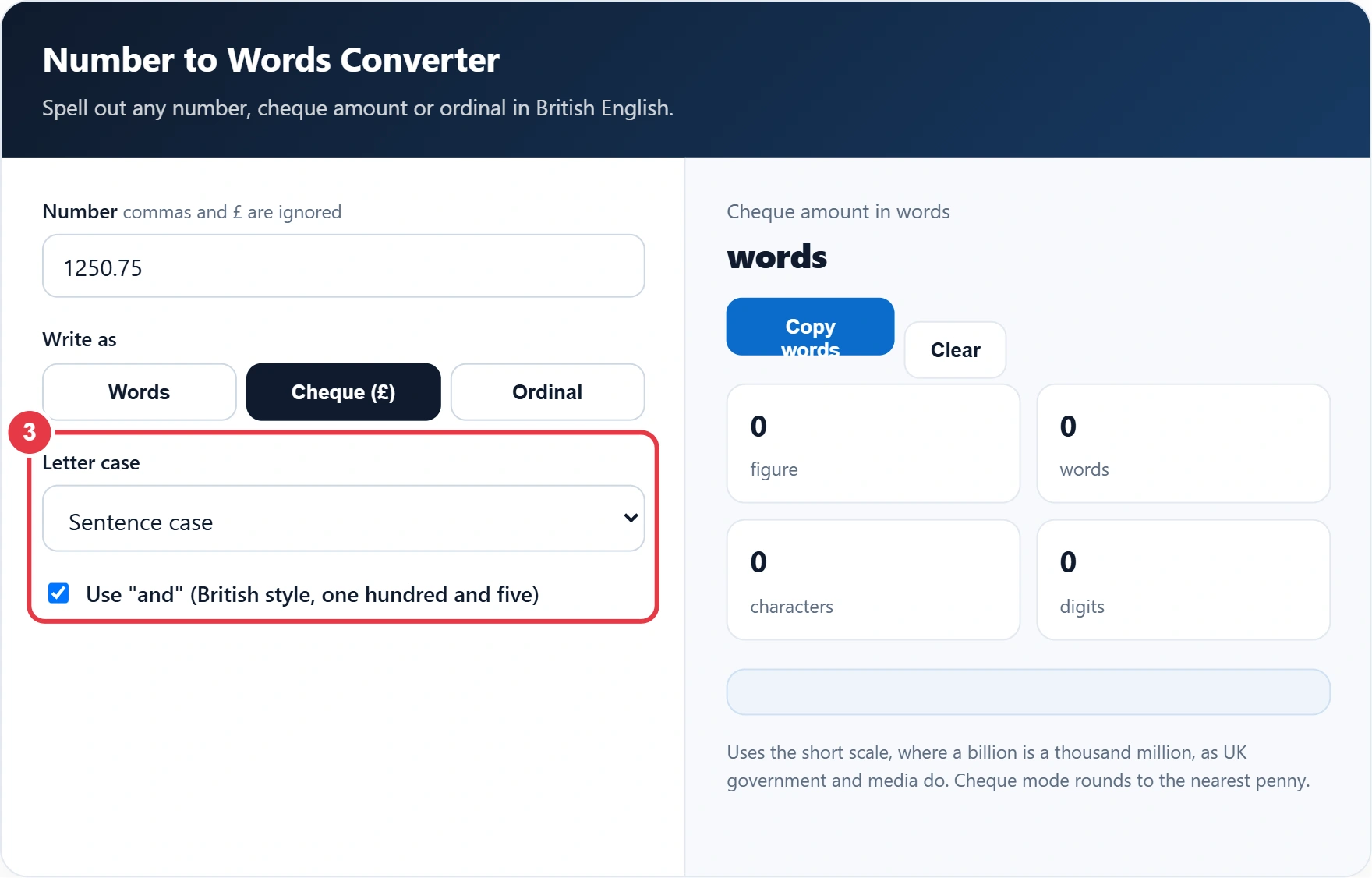
Choose Sentence case for cheques and documents, or another case to match your layout. Untick the "and" option if you need American style wording, such as one hundred five.
Step 4: Copy the Words
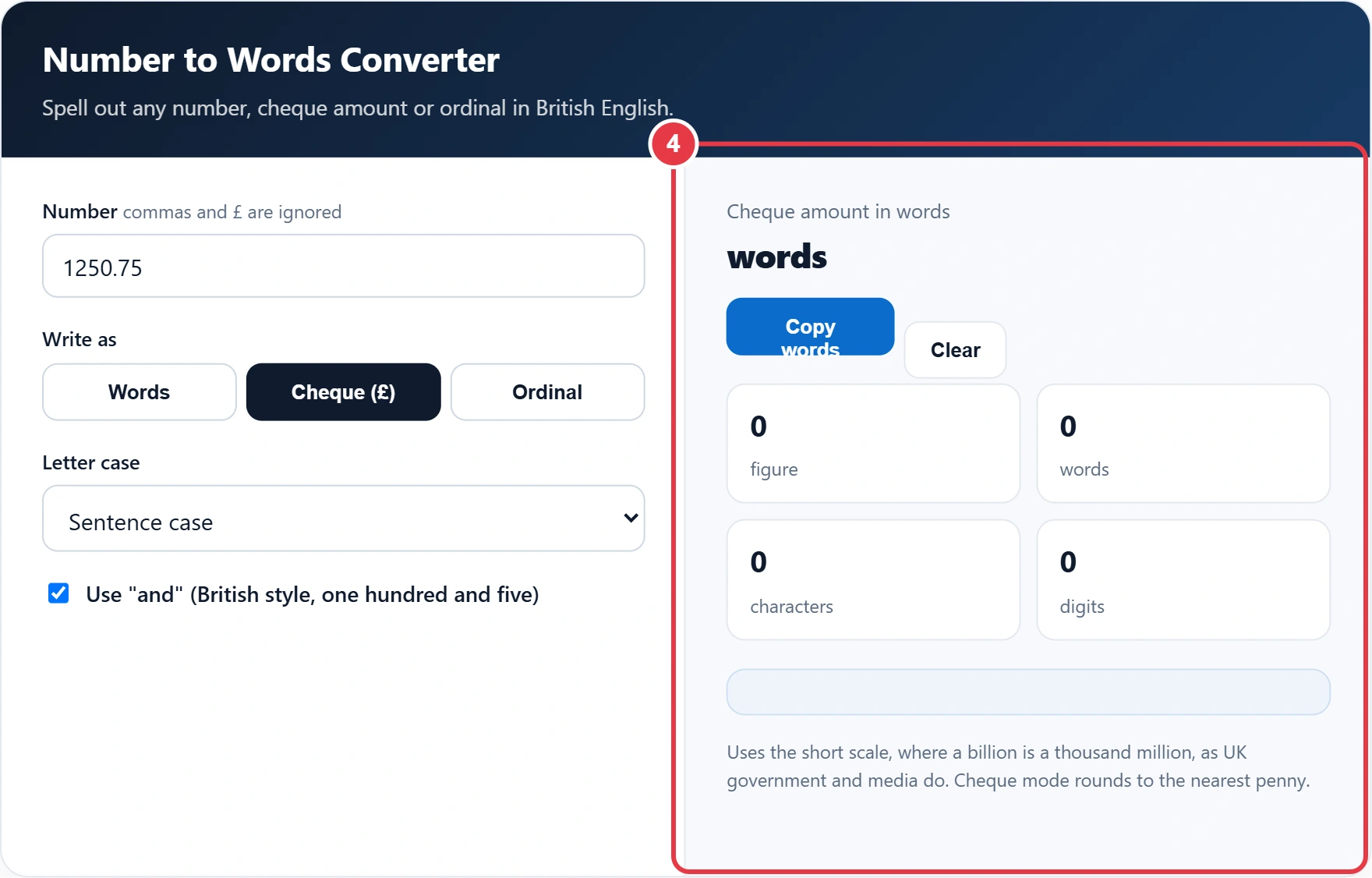
The words appear instantly, with the formatted figure, word count and character count below. When the amount comes from a bill that includes VAT, the reverse VAT calculator splits out the net price first, so the figure you spell out is right. Press Copy words to use the result.
How Do You Write Numbers in Words?
| Number | Style | In words |
|---|---|---|
| 101 | Words | One hundred and one |
| 2,026 | Words | Two thousand and twenty-six |
| 3,500,000 | Words | Three million five hundred thousand |
| £49.99 | Cheque | Forty-nine pounds and ninety-nine pence |
| £1,250.75 | Cheque | One thousand two hundred and fifty pounds and seventy-five pence |
| 21 | Ordinal | Twenty-first |
For example, 101 is written as one hundred and one, 2,026 as two thousand and twenty-six, and £49.99 on a cheque as forty-nine pounds and ninety-nine pence. Large numbers use the short scale, where one billion means a thousand million. The UK officially moved to this system in 1974, as explained in this guide to long and short scales, so older British texts may use billion to mean a million million.
</>Embed this calculator on your website
Add the free Number to Words Converter to your own site or blog. Copy the code below and paste it into an HTML block. It resizes itself and works on phones.
How we checked this tool: the Tools Veria Editorial Team built this tool by hand, checked it against the official rules or published standards where they apply, and tested it against worked examples. Results are estimates for planning, not personal financial or tax advice. Read our editorial policy and disclaimer, or report an error.
Frequently Asked Questions
How do you write 1,250.75 on a cheque?
Write One thousand two hundred and fifty pounds and seventy-five pence on the words line and £1,250.75 in the box. Draw a line through any unused space.
Do you put and in numbers in British English?
Yes. British English uses and after hundreds, as in one hundred and five, and before a final part under 100, as in two thousand and twenty-six.
When do you use a hyphen in numbers?
Use a hyphen in compound numbers from twenty-one to ninety-nine, such as forty-two or seventy-five, even inside larger numbers.
How do you write decimals in words?
Say the whole number, then point, then each digit separately. For example, 3.14 is three point one four.
How many zeros are in a billion?
A billion has nine zeros, 1,000,000,000, which is a thousand million. This is the short scale used in the UK today.
What is an ordinal number?
An ordinal number shows position or order, such as first, second or twenty-first, rather than quantity.