
Sofia is in her second year at a university in Ohio and has just received five grades for the autumn semester: two As, an A minus, a B plus and a B, across courses worth different numbers of credits. Her scholarship requires a 3.5. Knowing how to calculate GPA properly tells her whether she has kept it, and what she needs next term if she has not.
This guide is for students in the US system, students abroad applying to American universities, and parents trying to make sense of a transcript. It works through a full semester, a cumulative GPA, weighted high school grades, and a target grade calculation, then explains how GPA relates to UK degree classifications.
Quick answer: To calculate GPA, convert each letter grade to grade points on the 4.0 scale (A = 4.0, B = 3.0, C = 2.0), multiply each by the course credits, add the results, and divide by the total credits. For example, 53.3 quality points over 15 credits gives a GPA of 3.55.
In This Guide
What is a GPA and why do credits matter?
A grade point average, or GPA, is a single number summarising academic performance, calculated as a credit weighted average of grade points on a scale that normally runs from 0.0 to 4.0. The overview of academic grading in the United States shows how widely the scale is used, from high schools to graduate programmes.
Credits matter because a four credit science course takes more class time than a one credit activity, so its grade should count more. A simple average of grade points ignores that and can mislead. Sofia’s grades averaged without credits come to 3.6, but her true GPA is lower because her B plus fell in a heavier course. Our average calculator shows the difference between a plain mean and a weighted one.
Most US colleges use this common conversion from letter grades and percentages, though each school publishes its own version, so always check your handbook for the exact cut offs.
| Letter grade | Typical percentage | Grade points (unweighted) |
|---|---|---|
| A | 93 to 100 | 4.0 |
| A minus | 90 to 92 | 3.7 |
| B plus | 87 to 89 | 3.3 |
| B | 83 to 86 | 3.0 |
| B minus | 80 to 82 | 2.7 |
| C plus | 77 to 79 | 2.3 |
| C | 73 to 76 | 2.0 |
| C minus | 70 to 72 | 1.7 |
| D plus | 67 to 69 | 1.3 |
| D | 63 to 66 | 1.0 |
| D minus | 60 to 62 | 0.7 |
| F | Below 60 | 0.0 |

How to calculate GPA for one semester
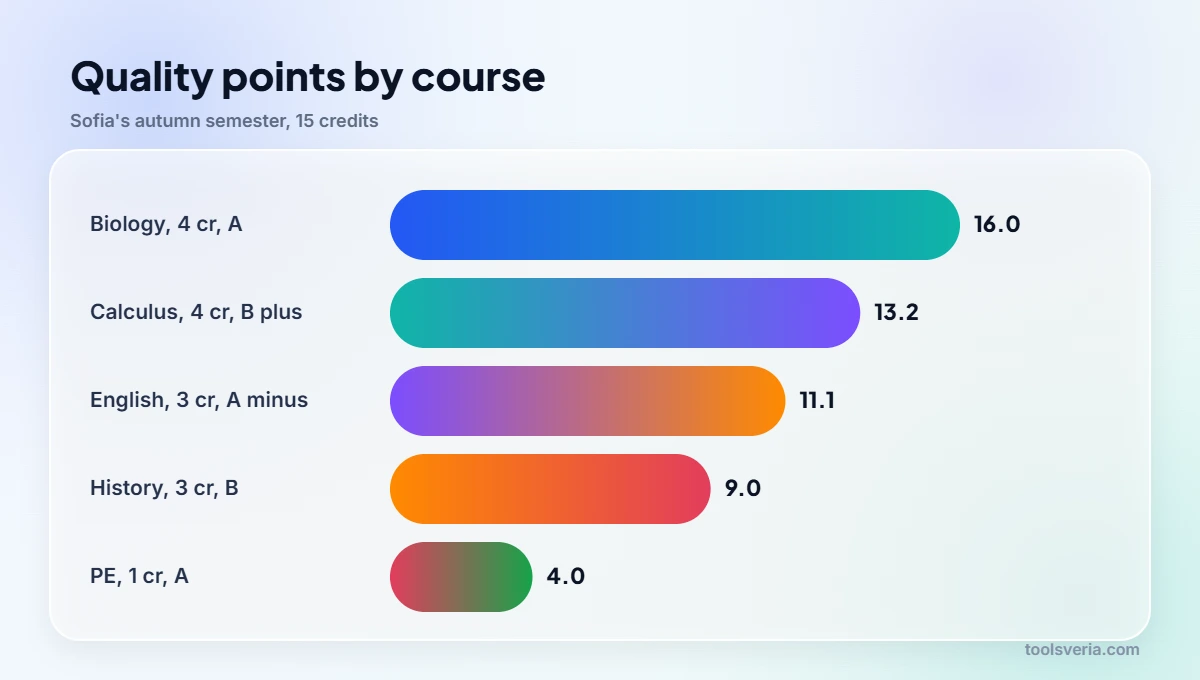
To calculate a semester GPA, multiply each course’s grade points by its credits to get quality points, add the quality points, and divide by the total credits attempted. Here is Sofia’s semester in full.
| Course | Credits | Grade | Grade points | Quality points |
|---|---|---|---|---|
| Biology | 4 | A | 4.0 | 16.0 |
| Calculus | 4 | B plus | 3.3 | 13.2 |
| English | 3 | A minus | 3.7 | 11.1 |
| History | 3 | B | 3.0 | 9.0 |
| Physical education | 1 | A | 4.0 | 4.0 |
| Total | 15 | 53.3 |
Dividing 53.3 quality points by 15 credits gives 3.553, which most transcripts round to 3.55. Sofia has cleared her 3.5 requirement for the term, though only just. Entering the same five courses into a GPA calculator is a quick way to check the arithmetic. Notice how the four credit B plus in calculus pulls harder on the result than the one credit A in physical education pushes it up.
Two rules catch people out. Pass or fail courses usually earn credits but no grade points, so leave them out of both totals. A failed course, on the other hand, normally stays in: its credits count in the denominator with zero quality points, which is why a single F can drop a GPA sharply.
How do you work out a cumulative GPA?
A cumulative GPA is total quality points from every term divided by total credits from every term; you cannot simply average the semester GPAs. Sofia’s first year gave her 30 credits at a 3.40 GPA, which is 30 × 3.40 = 102 quality points. Adding this semester’s 53.3 points gives 155.3, and adding the credits gives 45. Her cumulative GPA is 155.3 ÷ 45 = 3.45.
Averaging the two GPAs, 3.40 and 3.55, would give 3.475 and overstate her standing, because her first year carried twice as many credits. Many scholarships, including Sofia’s, look at the cumulative figure, so this is the number that matters.

What GPA do you need next term to hit a target?
To find the GPA you need next term, multiply your target by the total credits you will have, subtract the quality points you already hold, and divide by next term’s credits. Sofia wants a cumulative 3.5 after another 15 credits, making 60 in total. She needs 3.5 × 60 = 210 quality points and has 155.3, so she must earn 54.7 points from 15 credits, a term GPA of 3.65.
That is achievable, roughly an A minus average, but it shows how cumulative GPAs become harder to move as credits pile up. The same sum also tells you when a target is impossible: if the required term GPA comes out above 4.0, no combination of grades can reach it in one semester.
How does a weighted GPA work?
A weighted GPA adds extra points for harder classes, usually 0.5 for honours courses and 1.0 for Advanced Placement or International Baccalaureate courses, so the scale can rise above 4.0. Sofia’s younger brother Mateo took AP Calculus in high school and earned a B plus. Unweighted that is 3.3; weighted it becomes 4.3.
The bonus values vary by school district, and many university admissions offices recalculate applicants’ GPAs on their own scale. When applying, report the figures exactly as your school’s transcript states them, and say whether they are weighted or unweighted.
How does GPA compare with UK degree classifications?
Most UK universities do not use GPA; they award degree classifications based on percentage marks, with a First at 70% or above, an upper second (2:1) at 60 to 69%, a lower second (2:2) at 50 to 59% and a Third at 40 to 49%. A few institutions have trialled a GPA alongside the classification, but the class remains what employers ask for.
There is no single official conversion between the two systems, because a UK mark of 70% is a high distinction while 70% in a US class is often a C minus. Students applying to US graduate schools from the UK usually submit their transcript for an evaluation service to convert, rather than doing the sum themselves. If you need a percentage of marks for your own records, the percentage calculator turns raw scores into percentages quickly.
Key points
- GPA equals total quality points divided by total credits attempted.
- Quality points are grade points times credits, so 3.3 on a four credit course is 13.2.
- Cumulative GPA pools all terms; Sofia’s 155.3 points over 45 credits give 3.45.
- Weighted scales add 0.5 for honours and 1.0 for AP or IB, so they can exceed 4.0.
- UK universities use degree classes, with a First at 70% or above, not GPA.
Key GPA Terms Explained
These terms appear on every transcript and in every method for how to calculate GPA, whether for one semester, a whole degree or a target grade.
- Grade points
- The number each letter grade is worth on the 4.0 scale, such as 4.0 for an A, 3.3 for a B plus and 3.0 for a B. Schools publish their own conversion tables.
- Credit hours
- The weight a course carries, roughly reflecting weekly class time. Sofia’s biology and calculus courses carry 4 credits each, so their grades influence her GPA four times as much as physical education.
- Quality points
- Grade points multiplied by credit hours for one course. A B plus worth 3.3 on a 4 credit course gives 13.2 quality points, and the semester total is divided by credits.
- Cumulative GPA
- The GPA across every term so far, found by pooling all quality points and all credits. Sofia’s 155.3 points over 45 credits produce a cumulative figure of 3.45.
- Weighted GPA
- A version that adds bonus points for harder classes, commonly 0.5 for honours and 1.0 for Advanced Placement or International Baccalaureate, so results can rise above 4.0, as with Mateo’s 4.3.
- Degree classification
- The UK system of grading bachelor’s degrees by percentage: a First at 70% or above, a 2:1 at 60 to 69%, a 2:2 at 50 to 59% and a Third at 40 to 49%.
Frequently Asked Questions
Is a 3.0 GPA good?
A 3.0 equals a straight B average on the 4.0 scale. It meets many graduate school and employer minimums, but competitive programmes and scholarships, like Sofia’s, often ask for 3.5 or more on the unweighted scale.
I retook a course I failed. Does the F still count?
It depends on your school’s repeat policy. Many colleges replace the F with the new grade in the GPA while keeping both on the transcript; others average the two attempts. Check the registrar’s rules before planning a retake.
Why can I not just average my semester GPAs?
Because terms carry different numbers of credits. Averaging Sofia’s 3.40 and 3.55 gives 3.475, but her real cumulative GPA is 3.45, since the first figure covered 30 credits and the second only 15.
Do pass or fail classes affect my GPA?
Usually not. A pass earns credits toward graduation but no grade points, so it is left out of the GPA sum entirely. Some schools do count a fail as zero points, so read your handbook’s policy.
What does a 2:1 from a UK university equal in GPA?
There is no official equivalent. Each US institution or credential evaluation service sets its own conversion, and they do not all agree, so submit your transcript and state your classification and average mark, such as a 2:1 with 65%, rather than inventing a GPA.
How many decimal places should I report?
Two, unless your school specifies otherwise. Sofia’s 3.553 is reported as 3.55. Do not round up to 3.6 on a CV or application, since admissions staff compare it with the official transcript.
Sofia now knows her semester GPA is 3.55, her cumulative is 3.45 and she needs 3.65 next term to reach her scholarship target. Once you know how to calculate GPA with credits, those three numbers take minutes to check each term. Figures checked October 2026.