A free GPA calculator for high school and college: term, weighted and cumulative GPA on the 4.0 scale.
| Course | Credits | Grade | Points | Quality points |
|---|
Scales differ between schools and universities, so check your registrar's grading policy. Your transcript GPA is the official figure; this is an estimate.
This free GPA calculator works out your grade point average for a term, your weighted GPA with Honors and AP or IB courses, and your cumulative GPA across every term so far. It is built for high school and college students in the US and for international students applying to American universities, and it uses the standard 4.0 grade point average method, credit weighted, with an optional plus and minus scale.
Quick answer: To calculate GPA, multiply each course's grade points by its credits, add the results, then divide by the total credits. On the 4.0 scale an A is 4.0, an A- is 3.7, a B+ is 3.3 and a B is 3.0. A GPA calculator does this for every course and adds weighting and cumulative totals.
In This Guide
What Is a GPA Calculator?
A GPA calculator is a tool that turns letter grades or percentages into one average on a 0 to 4.0 scale, weighting each course by its credit hours. A 4 credit course counts a third more than a 3 credit course, so the same grade moves your GPA further.
In plain words: GPA = sum of (grade points × credits) ÷ total credits. Grade points times credits are called quality points. A weighted GPA adds a bonus to the points for harder classes, usually 0.5 for Honors and 1.0 for AP or IB, while a cumulative GPA divides all quality points earned so far by all credits attempted.
How to Use the GPA Calculator
Step 1: Choose the Grade Scale
Most colleges use the plus and minus scale, where A- is 3.7 and B+ is 3.3. Some high schools use letters only, where any A is 4 and any B is 3. Switch to percentages if your report shows marks rather than letters, and the tool converts them using the common 90, 80, 70, 60 bands.

Step 2: Enter Your Courses
For each class, type the name, the credit hours, the grade and the type. Add or remove rows as needed. If your school does not use credits, give every course the same value, such as 1, and the result becomes a simple average.

Step 3: Add Previous GPA and a Target
Enter your GPA and credits from your transcript, and the GPA calculator adds them to this term to give a cumulative figure. Then set a target and next term's credits, and the tool shows the term GPA you need. Leave the previous fields blank if this is your first term.

Step 4: Read Your Results
The large figure is your unweighted term GPA, with the GPA calculator's working underneath. The boxes give weighted GPA, cumulative GPA, credits and the GPA needed for your target, and the table lists quality points for each course so you can check every line against your report card.

GPA Scale: Letter Grades, Percentages and Points
The table shows the 4.0 scale this GPA calculator uses by default, as most US colleges do, with the percentage bands many high schools use. Your school's own policy always takes priority.
| Letter | Typical percent | Points (plus and minus) | Points (letters only) |
|---|---|---|---|
| A+ or A | 93 to 100 | 4.0 | 4 |
| A- | 90 to 92 | 3.7 | 4 |
| B+ | 87 to 89 | 3.3 | 3 |
| B | 83 to 86 | 3.0 | 3 |
| B- | 80 to 82 | 2.7 | 3 |
| C+ | 77 to 79 | 2.3 | 2 |
| C | 73 to 76 | 2.0 | 2 |
| C- | 70 to 72 | 1.7 | 2 |
| D+, D, D- | 60 to 69 | 1.3, 1.0, 0.7 | 1 |
| F | Below 60 | 0.0 | 0 |
A few schools give A+ a value of 4.3, so check before comparing GPAs between schools. The overview of US academic grading lists the main variations, including how pass and fail courses are left out of the average.
How Do You Calculate Cumulative GPA?
To calculate cumulative GPA, add the quality points from every term and divide by every credit attempted. Do not average the term GPAs, because a 12 credit term and an 18 credit term carry different weight.
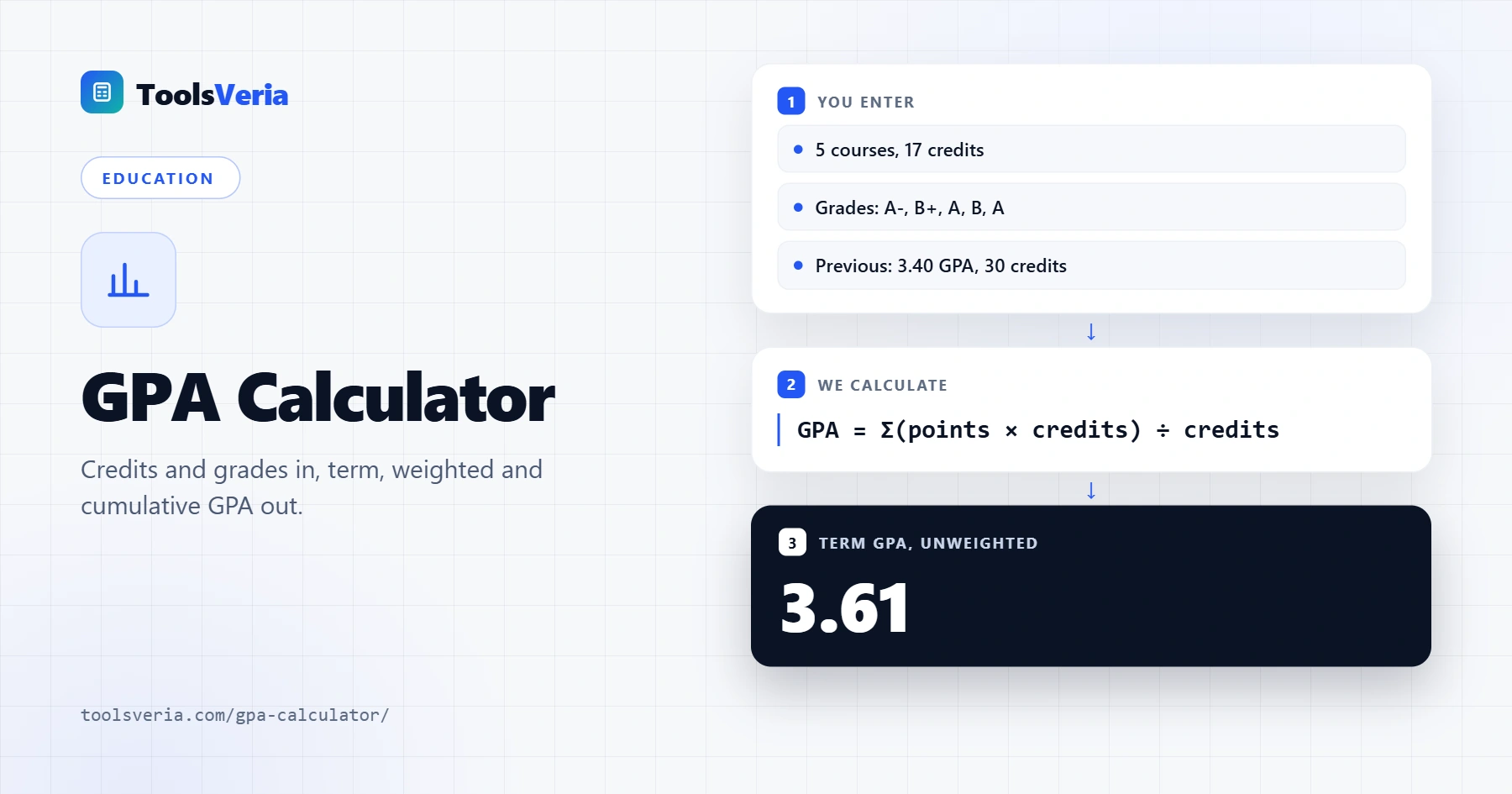
Worked example: Maya is a sophomore with a 3.40 GPA over 30 credits, so she has 102 quality points. This term she takes English Literature (3 credits, A-), Calculus Honors (4, B+), AP Biology (4, A), World History (3, B) and Spanish (3, A). That is 61.3 quality points over 17 credits, a term GPA of 3.61. Her weighted GPA is 3.96 because of the Honors and AP bonuses. Her cumulative GPA becomes 163.3 ÷ 47 = 3.47.
Maya wants a 3.50 cumulative GPA before applying for a scholarship. With 15 credits next term, the college GPA calculator shows she needs a term GPA of 3.58, which means mostly A and A- grades. To see how a plain average of marks behaves without credit weighting, the average calculator shows mean, median and mode side by side, which helps when a teacher grades by points rather than letters.
What Is the Difference Between Weighted and Unweighted GPA?
An unweighted GPA treats every class the same on a 4.0 maximum, while a weighted GPA adds points for harder classes, so it can go above 4.0. An A in AP Chemistry is 4.0 unweighted but 5.0 weighted.
Colleges usually see both on a transcript and many recalculate GPA in their own way, so neither number tells the whole story. Failing grades get no bonus in this grade point average calculator, which matches common school practice. To turn a raw test score into a percentage first, the percentage calculator handles marks such as 43 out of 50. Scales checked October 2026.
Key GPA Terms Explained
These terms describe every number a GPA calculator uses, from quality points to the weighting that lets some averages rise above 4.0.
- Grade point average
- A credit weighted average of grade points on a 0 to 4.0 scale. Each course's points are multiplied by its credits, added up and divided by the total credits, so a 4 credit course counts more.
- Credit hour
- The unit that measures how much a course counts, usually based on weekly class time. Most college classes are 3 credit hours and lab sciences are often 4, so the credit total is the divisor in GPA.
- Quality points
- Grade points multiplied by credit hours for one course. An A- worth 3.7 in a 3 credit class gives 11.1 quality points, and the sum of quality points divided by credits is the GPA.
- Weighted GPA
- A GPA that adds a bonus for harder classes, typically 0.5 for Honors and 1.0 for AP or IB. It can exceed 4.0, so an A in an AP class counts as 5.0 instead of 4.0.
- Cumulative GPA
- The GPA across every term so far, found by dividing all quality points by all credits attempted. It is not the average of term GPAs, because terms with more credits carry more weight.
</>Embed this calculator on your website
Add the free GPA Calculator to your own site or blog. Copy the code below and paste it into an HTML block. It resizes itself and works on phones.
How we checked this tool: the Tools Veria Editorial Team built this tool by hand, checked it against the official rules or published standards where they apply, and tested it against worked examples. Results are estimates for planning, not personal financial or tax advice. Read our editorial policy and disclaimer, or report an error.
Frequently Asked Questions
Is a 3.5 GPA good?
Yes. A 3.5 GPA means you average between a B+ and an A- and is above the typical average at most US colleges. Many scholarships and honours programmes set 3.0 or 3.5 as a minimum, while the most selective universities often expect 3.8 or higher.
How do I convert a UK grade to GPA?
There is no official conversion, because UK marks and degree classes work differently. Many US admissions offices place a UK First near the top of the 4.0 scale and a 2:1 at roughly a B+ to A- average, but each office or credential evaluation service sets its own rule.
Do pass or fail classes affect GPA?
Usually not. Pass and fail courses earn credit toward graduation but carry no grade points, so most schools leave them out of the GPA. A fail in a graded course counts as an F, worth 0 points, and lowers the average.
Can my GPA go above 4.0?
An unweighted GPA cannot go above 4.0 on this scale. A weighted GPA can, because Honors classes add 0.5 and AP or IB classes add 1.0, so straight A grades in AP classes give a weighted 5.0.
How many credits is a typical class?
Most college classes are 3 credit hours, with lab sciences often 4. A full time college term is usually 12 to 18 credits. High schools often use 1 credit for a full year course and 0.5 for a semester.
Does retaking a class replace the grade?
It depends on the school. Many colleges replace the original grade in the GPA when you retake a course, while others average both attempts. Check your registrar's repeat policy, then enter only the grades that count.