Convert cm to inches with decimals, tape measure fractions and feet and inches, or switch to inches to cm.
| cm | inches | fraction |
|---|
Exact by definition: 1 inch = 2.54 cm, so 1 cm = 0.393701 inches. Fractions round to the nearest mark on a tape measure.
This free cm to inches converter turns any length in centimetres into inches for shoppers, students, makers and travellers in the UK, US, Europe and elsewhere. Alongside the decimal answer it gives the nearest tape measure fraction and the height in feet and inches, using the exact international inch of 2.54 cm, and it also converts inches back to centimetres.
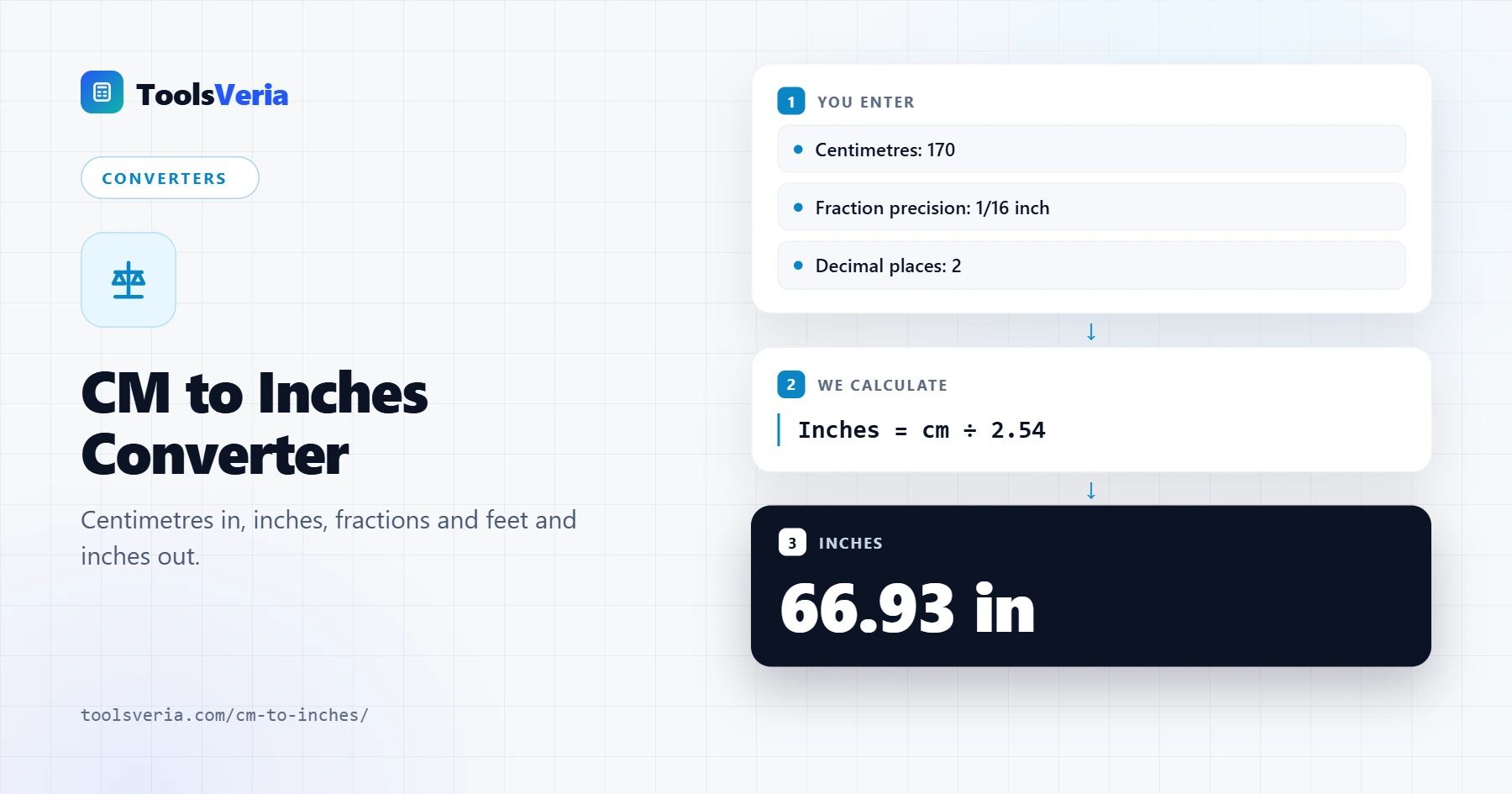
Quick answer: To convert cm to inches, divide the centimetres by 2.54, or multiply by 0.393701. So 10 cm is 3.94 inches, 30 cm is 11.81 inches and 170 cm is 66.93 inches, which is 5 feet 6.93 inches. One inch is exactly 2.54 cm, so the conversion never changes.
In This Guide
What Is a CM to Inches Conversion?
A cm to inches conversion changes a metric length into the imperial and US customary unit by dividing by 2.54. The factor is exact because the inch has been defined as 25.4 millimetres since the 1959 international yard and pound agreement.
In plain words: inches = centimetres ÷ 2.54, and centimetres = inches × 2.54. For feet and inches, divide the total inches by 12: the whole number is feet and the remainder is inches. US sites spell it centimeters to inches, but the maths is identical everywhere.
How to Use the CM to Inches Converter
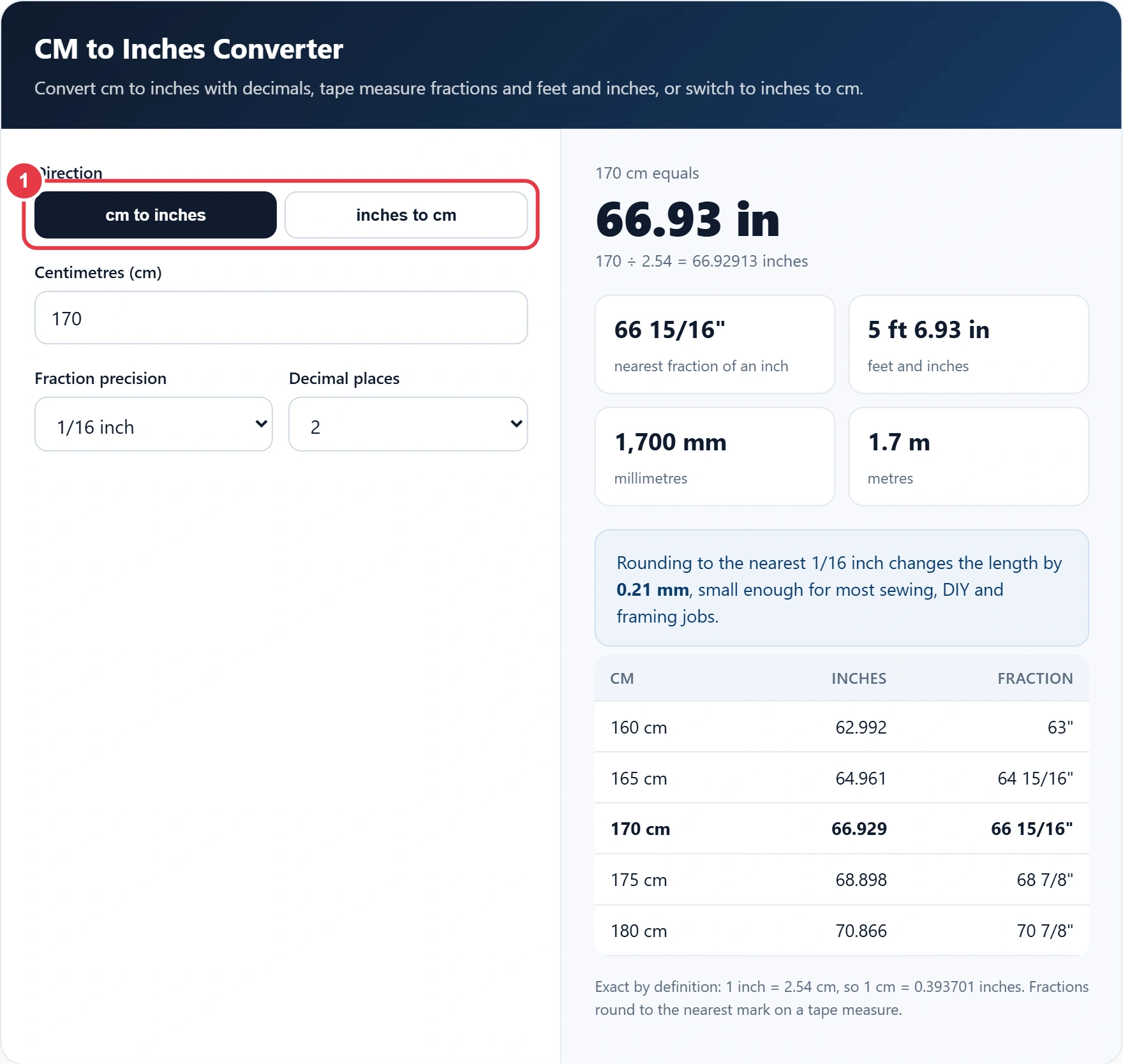
Step 1: Choose the Direction
Leave cm to inches selected for metric lengths, or pick inches to cm when you start from inches. The reverse mode has a feet box too, so a height such as 5 ft 7 in converts in one step.
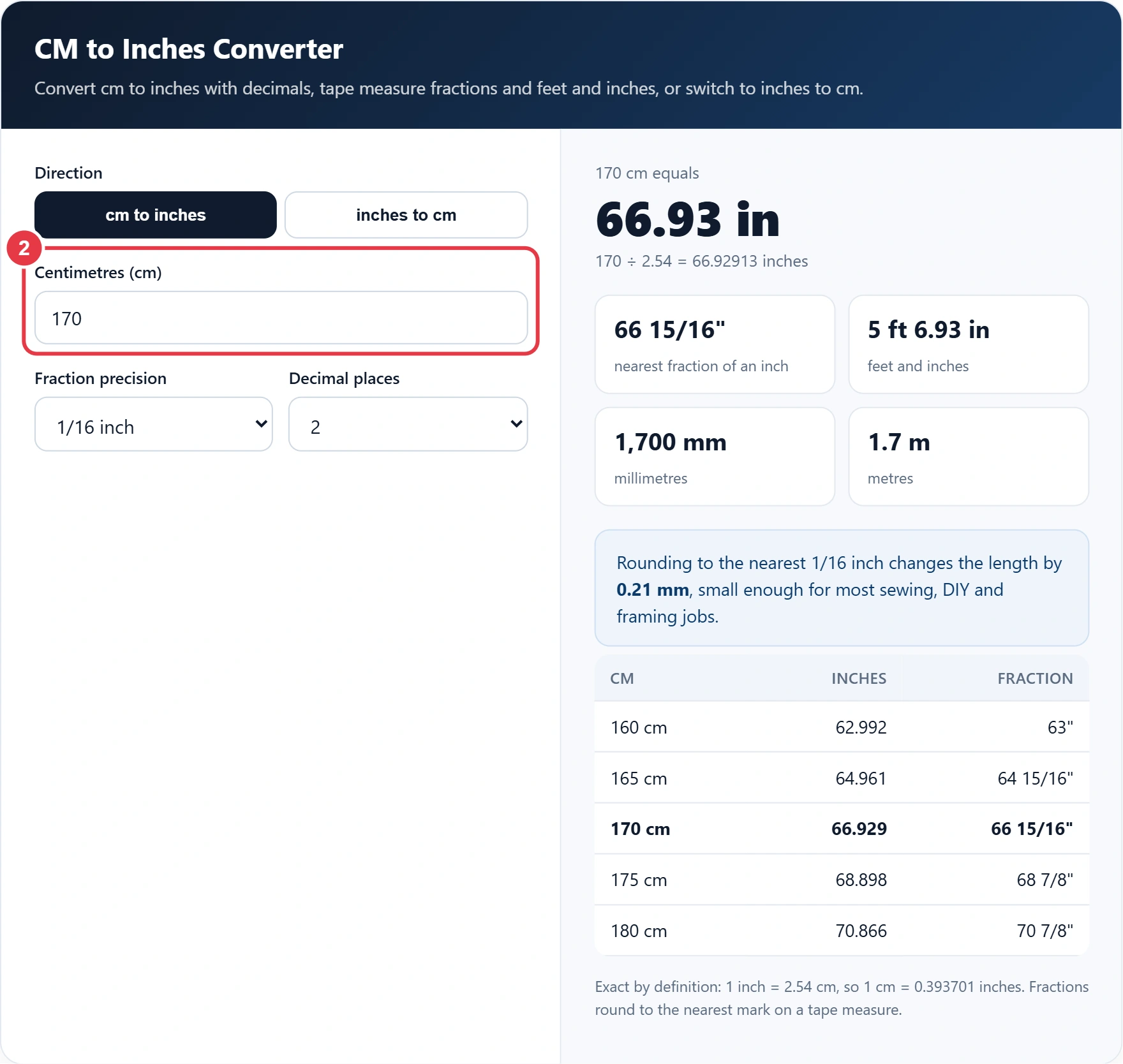
Step 2: Enter the Length
Type the number of centimetres. Decimals are fine, so 2.5 cm or 172.7 cm both work. To convert millimetres, divide by 10 first, so 85 mm is 8.5 cm.
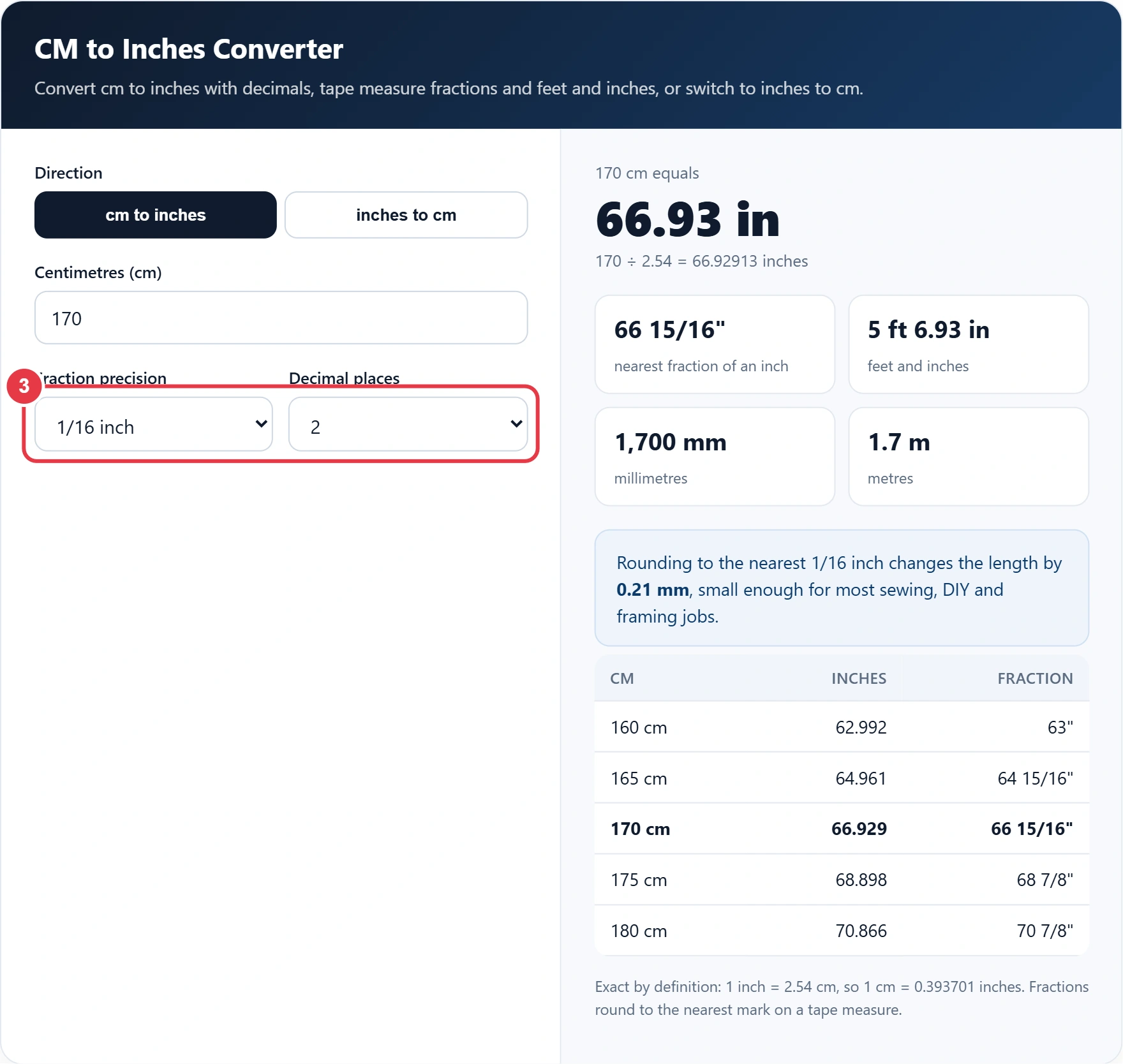
Step 3: Set Fraction Precision and Decimals
Pick the fraction that matches your ruler. Most tape measures mark 1/16 inch, sewing patterns often use 1/8, and woodworkers sometimes need 1/32. The panel shows how many millimetres the rounding adds or removes, so you know when it matters.
Step 4: Read the Results
The large figure is the decimal answer with the working underneath. The boxes give the nearest fraction, feet and inches, millimetres and metres, and the table lists nearby values. For miles, yards and metres, the length converter covers every common length unit in one place, while this page stays focused on centimetres and inches.

CM to Inches Conversion Chart
The chart shows common values worked out with the exact factor, rounded to three decimals, plus the nearest 1/16 inch you would read on a tape.
| Centimetres | Inches (decimal) | Nearest 1/16 inch | Feet and inches |
|---|---|---|---|
| 1 cm | 0.394 | 3/8" | 0 ft 0.39 in |
| 5 cm | 1.969 | 1 15/16" | 0 ft 1.97 in |
| 10 cm | 3.937 | 3 15/16" | 0 ft 3.94 in |
| 20 cm | 7.874 | 7 7/8" | 0 ft 7.87 in |
| 30 cm | 11.811 | 11 13/16" | 0 ft 11.81 in |
| 50 cm | 19.685 | 19 11/16" | 1 ft 7.69 in |
| 100 cm | 39.370 | 39 3/8" | 3 ft 3.37 in |
| 150 cm | 59.055 | 59 1/16" | 4 ft 11.06 in |
| 160 cm | 62.992 | 63" | 5 ft 2.99 in |
| 170 cm | 66.929 | 66 15/16" | 5 ft 6.93 in |
| 180 cm | 70.866 | 70 7/8" | 5 ft 10.87 in |
How Many Inches Is 1 cm?
One centimetre is 0.393701 inches, a little under 2/5 of an inch. For quick estimates, multiply by 0.4 and take a little off: 25 cm × 0.4 = 10, and the exact answer is 9.84 inches.
The shortcut drifts by about 1.6%, which is fine for a rough idea but not for fitting furniture or ordering blinds. Always divide by 2.54 when the size matters. The centimetre is one hundredth of a metre, the SI base unit of length, which is why metric conversions only ever need one factor.
How Do You Convert cm to Feet and Inches?
To convert cm to feet and inches, divide by 2.54 to get total inches, then divide by 12: the whole number is feet and the remainder is inches. For 170 cm, 170 ÷ 2.54 = 66.93 inches, and 66.93 ÷ 12 = 5 remainder 6.93, so the height is 5 ft 6.93 in, or about 5 ft 7 in.
Worked example: Amara is flying from Manchester to New York with a cabin bag that measures 55 × 40 × 20 cm. The US airline lists its limit as 22 × 14 × 9 inches. Converting cm to in gives 21.65 × 15.75 × 7.87 inches. Her bag is shorter and slimmer than the limit, but 15.75 inches is wider than 14, so it fails on width. The luggage size checker runs this comparison against airline limits for you, which saves a costly surprise at the gate.
Clothing and jewellery use the same maths. A 76 cm waist is 29.9 inches, so it sits between a 29 and a 30 inch trouser. For finger sizes, the ring size converter matches millimetres to UK, US and EU ring sizes. Conversion factor checked October 2026.
Key CM and Inch Terms Explained
These terms explain the units behind every cm to inches conversion and why the 2.54 factor is exact rather than an approximation.
- Centimetre
- A metric unit of length equal to one hundredth of a metre or 10 millimetres. It is the everyday unit for heights, clothing and furniture across Europe and most of the world, and 1 cm equals 0.393701 inches.
- Inch
- An imperial and US customary unit of length defined as exactly 25.4 millimetres, which is 2.54 centimetres. Twelve inches make one foot, and inches are still used for screens, clothing and heights in the UK and US.
- International yard and pound
- The 1959 agreement between the US, UK and other Commonwealth countries that fixed the yard at 0.9144 metres. It made the inch exactly 2.54 cm, so conversions no longer differed between countries.
- Fractional inch
- An inch length written as a fraction such as 1/2, 1/4, 1/8 or 1/16, matching the marks on a tape measure. The tool rounds each answer to the nearest chosen fraction and shows the error in millimetres.
- Foot
- An imperial unit equal to 12 inches or 30.48 centimetres. Heights in the UK and US are usually given in feet and inches, so 170 cm is written as 5 ft 6.93 in.
</>Embed this calculator on your website
Add the free CM to Inches Converter to your own site or blog. Copy the code below and paste it into an HTML block. It resizes itself and works on phones.
How we checked this tool: the Tools Veria Editorial Team built this tool by hand, checked it against the official rules or published standards where they apply, and tested it against worked examples. Results are estimates for planning, not personal financial or tax advice. Read our editorial policy and disclaimer, or report an error.
Frequently Asked Questions
How many cm are in an inch?
There are exactly 2.54 centimetres in one inch. The value was fixed by international agreement in 1959, when the inch was defined as 25.4 millimetres, so it is the same in the UK, US and every other country.
What is 30 cm in inches?
30 cm is 11.81 inches, which is just under 1 foot. A 30 cm school ruler is about 3/16 of an inch shorter than a 12 inch ruler, which is why many rulers show both scales side by side.
How tall is 5 ft 7 in in cm?
5 ft 7 in is 170.18 cm. Multiply the feet by 12 and add the inches to get 67 inches, then multiply by 2.54. Switch the tool to inches to cm and enter 5 and 7 to check any height.
Is 1 cm bigger than 1 inch?
No. One inch is 2.54 times longer than one centimetre, so 1 cm is only about 0.39 inches. Ten centimetres is a little under 4 inches.
How do I read 1/16 inch on a tape measure?
Each inch is split into 16 small marks. The longest middle mark is 1/2, the next longest are quarters, then eighths, then sixteenths. Count the small marks past the last whole inch and simplify the fraction, so 12/16 becomes 3/4.
Why do clothing labels show both cm and inches?
Most of the world sizes clothing in centimetres, while the US and many UK retailers still use inches for waist and inside leg. Dual labels let one product sell everywhere without separate tags for each market.