Measure your bag including wheels and handles, then see which airline allowances it fits.
Limits are typical published allowances for standard economy fares, checked October 2026. Airlines change them often and some vary by fare or route, so always confirm on your airline's website before you fly.
This luggage size checker tells UK and European travellers in seconds whether a suitcase or backpack fits the cabin bag and under seat allowances of 16 airlines, from Ryanair and easyJet to British Airways and Emirates, using typical limits checked for autumn 2026. Enter your bag's measurements in centimetres or inches and its packed weight in kilograms or pounds, and the table shows every allowance it fits and exactly how many centimetres over it is where it does not.
Quick answer: most cabin bags must be no larger than 55 x 40 x 20 cm to 56 x 45 x 25 cm including wheels and handles, usually weighing 7 to 10 kg. Free under seat bags are smaller, typically 40 x 30 x 20 cm. Use the luggage size checker above to test your exact bag against each airline.
In This Guide
What Is a Luggage Size Checker?
A luggage size checker is a tool that compares your bag's outside measurements and weight with airline baggage limits so you know before you reach the gate whether it will be accepted. The rule in plain words: sort your bag's three sides from longest to shortest, do the same with the airline limit, and the bag fits only if each side is no longer than the matching limit and the weight is within the maximum.
Sorting matters because a bag can go into the gate sizer on its side. A 40 x 55 x 20 cm bag is the same as a 55 x 40 x 20 cm bag. What cannot change is the total: wheels, handles, side pockets and anything strapped to the outside all count, and a soft bag stuffed full can bulge past the limit even if its label says otherwise.
How to Use the Luggage Size Checker
Step 1: Measure Your Bag
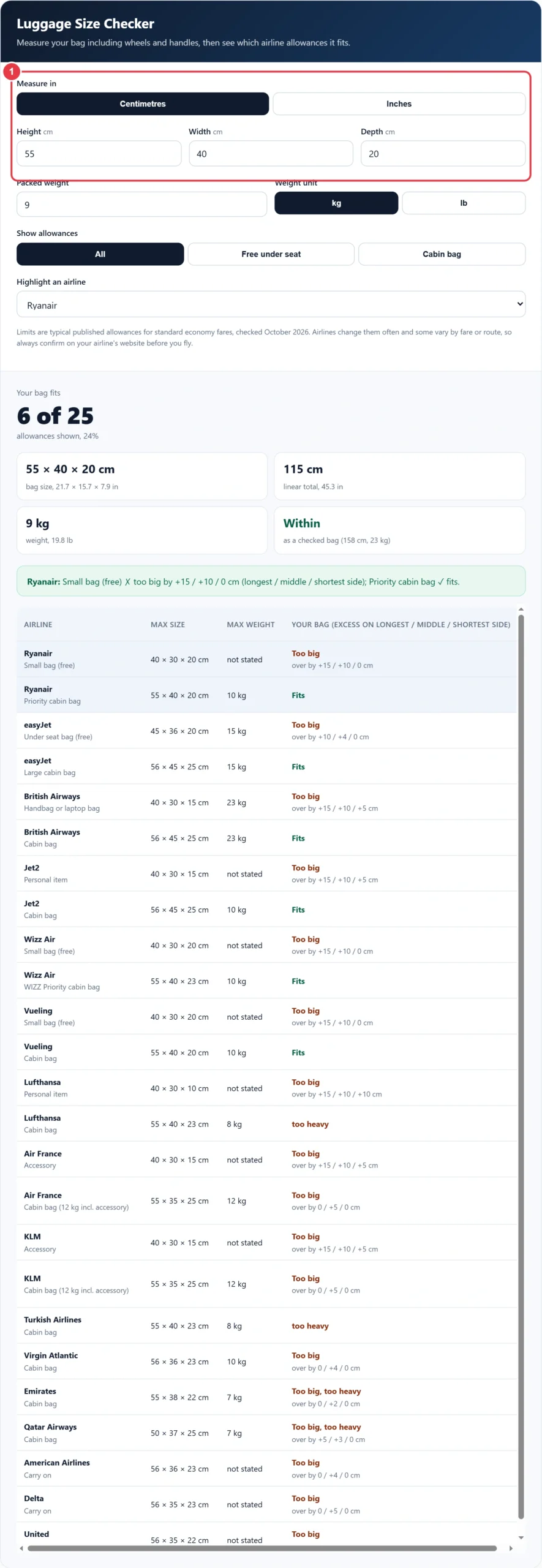
Stand the bag upright and measure the tallest point from the floor to the top of the handle, then the widest point and the deepest point, including wheels and packed pockets. Choose centimetres or inches; switching converts the numbers for you at exactly 2.54 cm to the inch.
Step 2: Enter the Packed Weight
Weigh the bag after packing, using bathroom scales: weigh yourself holding it, then subtract your own weight. Enter the figure in kg or lb. If you think of your weight in stone, the kg to stone converter makes the subtraction easier before you type the result in kilograms.

Step 3: Filter and Pick Your Airline
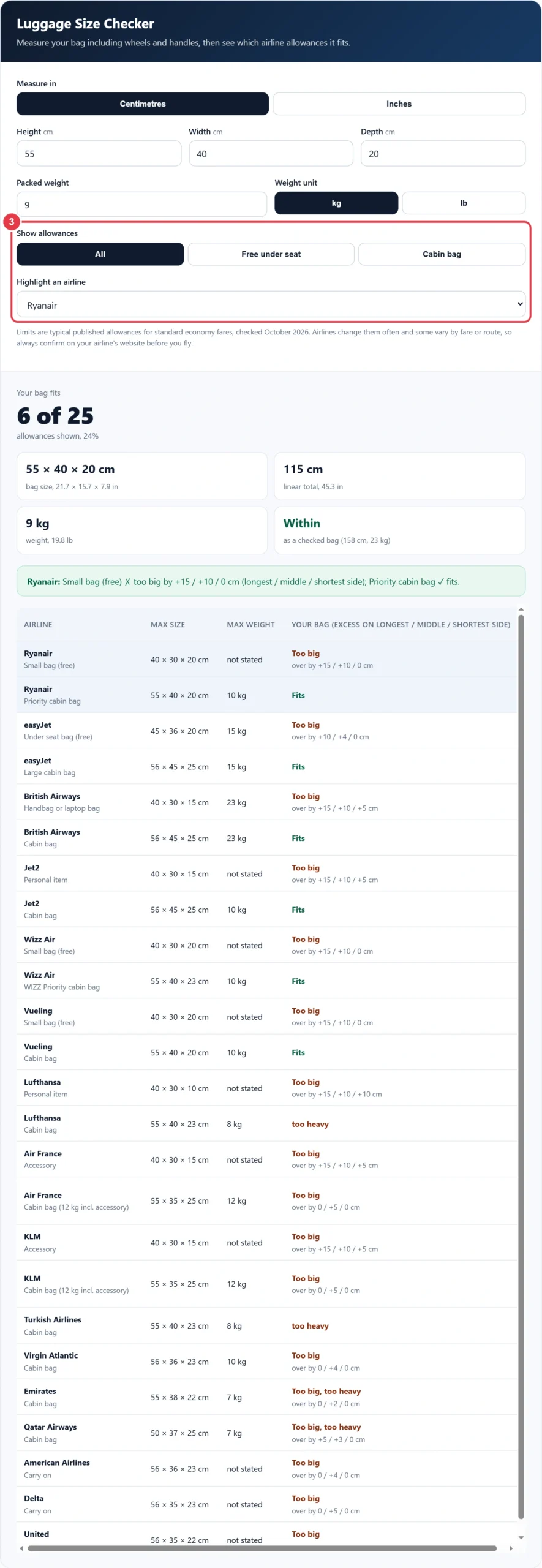
Show all allowances, only the free under seat bags, or only the larger cabin bags that go in the overhead locker. Pick the airline you are flying with and its rows are highlighted, with a one line verdict above the table.
Step 4: Read the Results
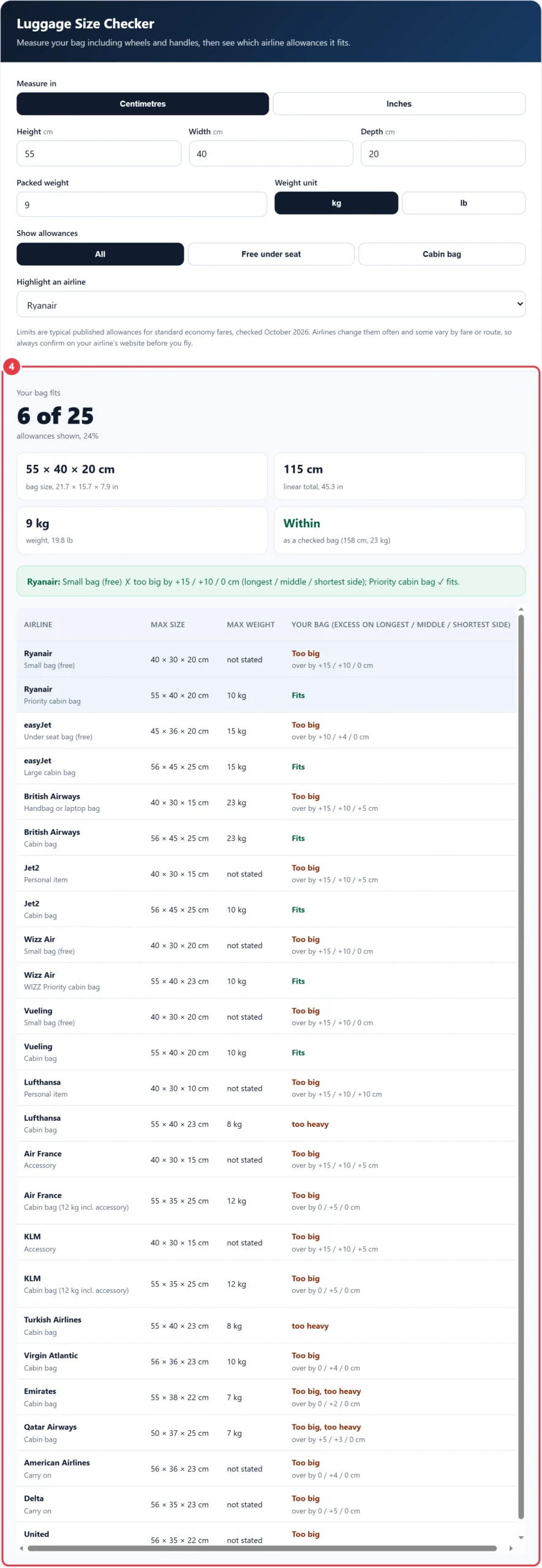
The headline shows how many allowances your bag fits. Each row gives the airline's maximum size and weight and either Fits or the exact amount it is over on each side. The stats also show the linear total, which is what checked baggage rules use. If the bag only fails by a centimetre on depth, try removing an outer pocket item and measuring again.
What Size Is Hand Luggage on UK and European Airlines?
Hand luggage on most airlines is limited to roughly 55 x 40 x 20 cm (21.7 x 15.7 x 7.9 in) for a cabin bag, with low cost airlines allowing a smaller free under seat bag and charging for the larger one. These are the typical standard economy limits used by the checker.
| Airline | Free under seat bag | Cabin bag (overhead) | Cabin bag weight |
|---|---|---|---|
| Ryanair | 40 x 30 x 20 cm | 55 x 40 x 20 cm (paid) | 10 kg |
| easyJet | 45 x 36 x 20 cm | 56 x 45 x 25 cm (paid) | 15 kg |
| British Airways | 40 x 30 x 15 cm | 56 x 45 x 25 cm | 23 kg |
| Jet2 | 40 x 30 x 15 cm | 56 x 45 x 25 cm | 10 kg |
| Wizz Air | 40 x 30 x 20 cm | 55 x 40 x 23 cm (paid) | 10 kg |
| Lufthansa | 40 x 30 x 10 cm | 55 x 40 x 23 cm | 8 kg |
| KLM and Air France | 40 x 30 x 15 cm | 55 x 35 x 25 cm | 12 kg in total |
| Emirates | None stated | 55 x 38 x 22 cm | 7 kg |
Airlines change these limits and fees often, and some differ by fare type or route, so treat the table as a guide and confirm on your airline's own website before you travel. The approach of free small bags plus paid large ones has spread across most European low cost airlines in the last few years.
Will a 55 x 40 x 20 cm Bag Fit Ryanair and easyJet?
Yes as a paid cabin bag, no as a free under seat bag. Worked example: Chloe from Manchester has a 55 x 40 x 20 cm wheeled case (21.7 x 15.7 x 7.9 in) that weighs 9 kg packed, and she is flying Ryanair to Málaga. The luggage size checker shows it fits 6 of the 25 allowances, including Ryanair's Priority cabin bag and easyJet's large cabin bag. It fails Ryanair's free 40 x 30 x 20 cm small bag by 15 cm in height and 10 cm in width, so she either pays for Priority or switches to a 40 x 30 x 20 cm backpack. On Lufthansa the same case is the right size but 1 kg over the 8 kg limit.
What Is the Maximum Size for Checked Luggage?
The usual maximum for a checked bag is 158 cm (62 in) in total, adding height, width and depth together, with a weight limit of 23 kg (50.7 lb) in economy. Bags over 23 kg normally cost extra, and many airports will not accept a single bag over 32 kg because of handling safety rules. Low cost airlines sell checked bags in weight bands such as 15 kg, 20 kg and 23 kg, so match the band you buy to the weight you see in the checker.
What Happens If Your Bag Is Too Big?
At the gate, staff may ask you to put the bag in a metal frame called a baggage sizer, and a bag that does not fit is usually sent to the hold for a fee that is far higher than booking it in advance. Low cost airlines check most strictly, so a centimetre or two over is a real risk on those flights.
Size is not the only rule. Most UK airports still limit liquids to containers of 100 ml carried in one clear bag of about 20 x 20 cm, and the GOV.UK hand luggage liquids rules note that some airports with new scanners now allow containers of up to 2 litres, so check your departure airport. Count the nights away with the days between dates calculator before you pack, because the length of the trip, not the size of the case, should decide what goes in. Airline limits checked October 2026.
Key Luggage Size Terms Explained
These terms clarify how airlines measure bags, so you can read every row of the luggage size checker and avoid surprise fees at the gate.
- Cabin bag
- A larger piece of hand luggage stored in the overhead locker rather than beneath the seat. Low cost carriers often charge for it separately, while full service airlines usually include one in the fare, each with its own size and weight limits.
- Under seat bag
- The small personal item, such as a handbag, laptop bag or compact backpack, that must fit beneath the seat in front of you. Many low cost airlines include only this item free of charge in their basic fares.
- Linear dimensions
- The sum of a bag's height, width and depth, measured at the outermost points. Airlines use this single total for checked luggage, so the checker compares it with a 158 cm limit to show whether the bag could travel in the hold.
- Checked baggage
- Luggage handed over at check in and carried in the aircraft hold, separate from the passenger. It is subject to larger size and weight allowances than hand luggage and is returned at the baggage reclaim belt on arrival.
- Gate sizer
- A rigid metal frame at the departure gate used to test whether hand luggage meets an airline's limits. A bag that will not slide in, wheels and handles included, may be moved to the hold for an extra charge.
- Baggage allowance
- The number, size and weight of bags a passenger may carry under their ticket, set separately by each airline and often varying by fare type and route. Exceeding it usually triggers an excess baggage fee.
</>Embed this calculator on your website
Add the free Luggage Size Checker to your own site or blog. Copy the code below and paste it into an HTML block. It resizes itself and works on phones.
How we checked this tool: the Tools Veria Editorial Team built this tool by hand, checked it against the official rules or published standards where they apply, and tested it against worked examples. Results are estimates for planning, not personal financial or tax advice. Read our editorial policy and disclaimer, or report an error.
Frequently Asked Questions
What size is a Ryanair free small bag?
Ryanair's free small bag can measure up to 40 x 30 x 20 cm (15.7 x 11.8 x 7.9 in) and must fit under the seat in front. A larger 55 x 40 x 20 cm cabin bag weighing up to 10 kg needs Priority or a fare that includes it.
Do wheels and handles count in cabin bag size?
Yes. Airlines measure the outside of the bag including wheels, handles, side pockets and anything attached. Measure from the floor to the top of the retracted handle, then the widest and deepest points, and use those figures in the checker.
What is the easyJet free cabin bag size?
easyJet's free under seat bag is 45 x 36 x 20 cm including handles and wheels, and it must weigh 15 kg or less. A large cabin bag of up to 56 x 45 x 25 cm is available with some fares or as an extra.
Is 55 x 40 x 20 cm a standard cabin bag size?
Yes. A 55 x 40 x 20 cm bag, about 21.7 x 15.7 x 7.9 inches, fits the cabin bag limits of most European airlines, including Ryanair Priority, easyJet, British Airways, Jet2 and Wizz Air Priority, but not KLM or Air France, which allow 35 cm width.
What is the maximum weight for hand luggage?
Hand luggage weight limits usually range from 7 kg on Emirates and Qatar Airways to 10 kg on Ryanair, Jet2 and Wizz Air, 12 kg in total on KLM and Air France, and 23 kg on British Airways. Always check your fare.
How big can a checked suitcase be?
A checked suitcase can usually be up to 158 cm, or 62 inches, when you add height, width and depth together. The standard economy weight allowance is 23 kg, and single bags heavier than 32 kg are generally refused for handling safety.