This probability calculator solves single events, two events and repeated trials, with odds and complements.
Probabilities are shown to 4 decimal places. Odds are written as for : against. Results assume every outcome is equally likely and trials are independent unless stated.
This probability calculator works out how likely an event is, for students, teachers, game players and anyone weighing up risk. It handles a single event, two events combined with and, or and given, and repeated trials such as rolling a die several times, using the standard rules of probability theory and showing each answer as a percentage, decimal, fraction and odds.
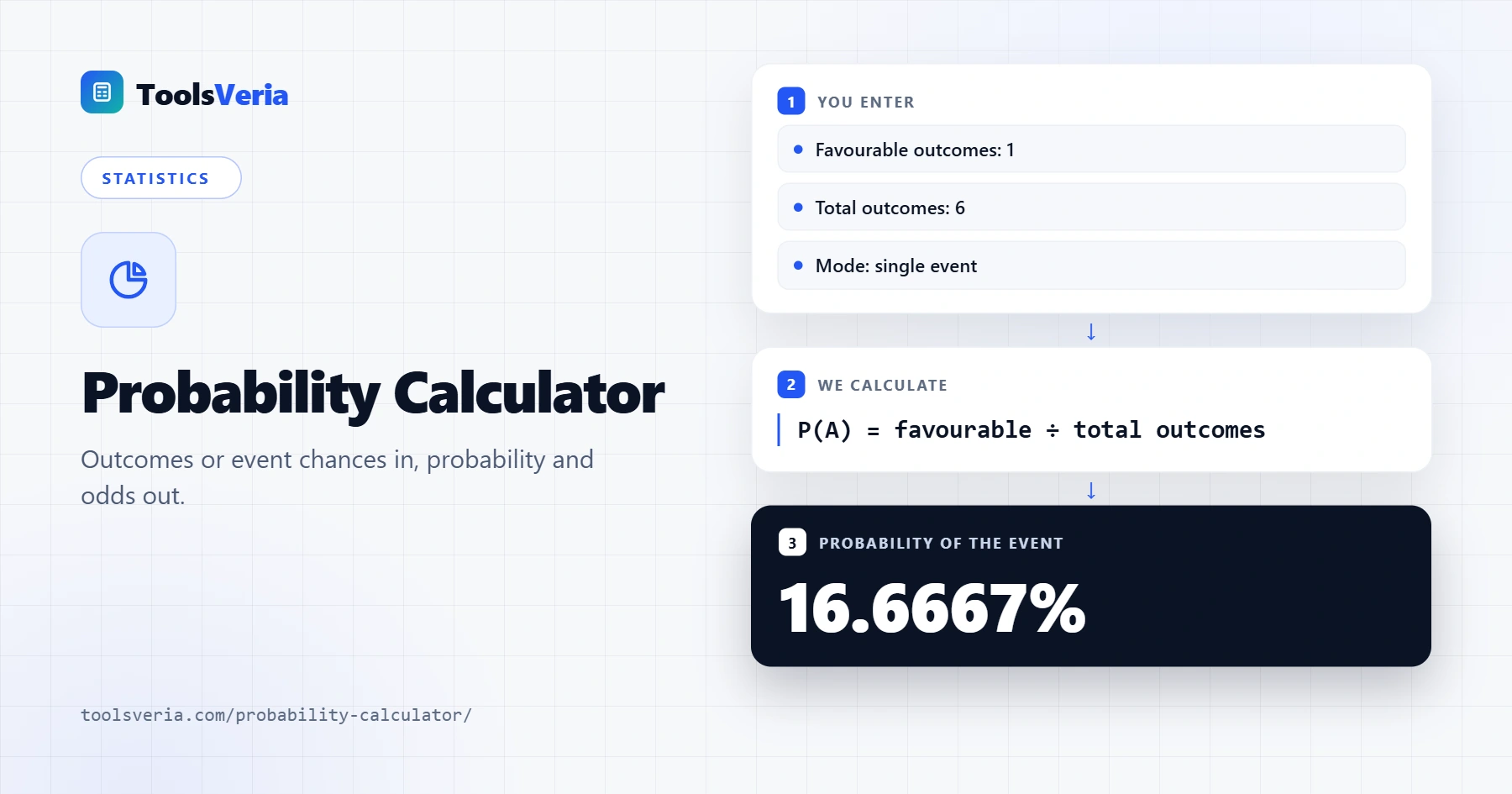
Quick answer: A probability calculator divides the number of favourable outcomes by the total number of equally likely outcomes, P(A) = favourable ÷ total. Rolling a six on a fair die is 1 ÷ 6 = 16.67%, or odds of 1 : 5. The chance it does not happen is 1 minus that, 83.33%.
In This Guide
What Is Probability?
Probability is a number from 0 to 1 that measures how likely something is to happen, where 0 means impossible and 1 means certain. It is often written as a percentage, so 0.25 and 25% mean the same thing.
To calculate probability for equally likely outcomes, use P(A) = number of favourable outcomes ÷ total outcomes. The probability of events combined follows three rules: multiply for independent events happening together, add and subtract the overlap for either event happening, and divide the overlap by P(B) for one event given another. The complement, 1 − P(A), is the chance the event does not happen.
How to Use the Probability Calculator
Step 1: Choose a Mode
The probability calculator has three modes. Pick single event for one outcome, two events to combine A and B, or repeated trials for questions like "what is the chance of at least one six in four rolls".

Step 2: Enter the Outcomes
For a single event, type the number of ways it can happen and the total number of equally likely outcomes. A die has 6 outcomes, a coin 2 and a standard deck of cards 52.

Step 3: Add Event Chances or Trials
In the other modes, type each chance as a percentage, a decimal or a fraction such as 1/6. For two events, say whether they are independent, mutually exclusive, or enter P(A and B) yourself. For repeated trials, add the number of trials and successes.

Step 4: Read the Results
The main figure answers your question, and the cards show the complement, odds, conditional chances or binomial results. To turn a percentage into a fraction of a group, the percentage calculator does the arithmetic, and the box under the results explains which rule was used.

How Do You Calculate the Probability of Two Events?
To calculate probability for two events both happening, multiply their chances if they are independent: P(A and B) = P(A) × P(B). To find the chance of either happening, use P(A or B) = P(A) + P(B) − P(A and B).
Mutually exclusive events cannot happen together, which is the simplest probability of events case, so their overlap is 0 and you simply add them. Dependent events change each other's chances, so you use conditional probability instead, P(A and B) = P(A) × P(B given A), as in drawing cards without putting them back.
| Event | Fraction | Probability | Odds for |
|---|---|---|---|
| Heads on one coin toss | 1/2 | 50% | 1 : 1 |
| Two heads from two coins | 1/4 | 25% | 1 : 3 |
| A six on one die | 1/6 | 16.67% | 1 : 5 |
| A total of 7 with two dice | 6/36 | 16.67% | 1 : 5 |
| An ace from a 52 card deck | 4/52 | 7.69% | 1 : 12 |
| A heart from a 52 card deck | 13/52 | 25% | 1 : 3 |
| At least one six in 4 rolls | 671/1296 | 51.77% | 1.07 : 1 |
What Is the Probability of Something Happening at Least Once?
The probability of something happening at least once in n independent tries, one of the most searched probability of events questions, is 1 − (1 − p)^n, where p is the chance on one try. It is easier to work out the chance it never happens and subtract that from 1.
Worked example: Leah uses the probability calculator to check a dice game. She rolls a fair die 4 times and wants at least one six. The chance of no six on one roll is 5/6, so no six in 4 rolls is (5/6)^4 = 0.4823. At least one six is therefore 1 − 0.4823 = 0.5177, or 51.77%. The chance of exactly one six is 4 × 1/6 × (5/6)^3 = 38.58%. If she then draws two cards from a deck without replacing the first, both being aces is 4/52 × 3/51 = 0.45%.
What Is the Difference Between Odds and Probability?
Probability compares favourable outcomes with all outcomes, while odds compare favourable outcomes with unfavourable ones. A 1 in 6 chance is a probability of 16.67% but odds of 1 : 5 for, or 5 : 1 against, which is why this tool also works as an odds calculator.
To calculate probability from odds of a : b, divide a by a + b, so odds of 1 : 3 mean 1 ÷ 4 = 25%. Bookmaker odds include a profit margin, so an odds calculator will not turn them into true probabilities. For random draws you can test in practice, the random number generator simulates dice and raffles, and long runs settle close to these figures. Figures checked October 2026.
Key Probability Terms Explained
These terms explain the rules a probability calculator applies, from complements and independence to the binomial formula used for repeated trials.
- Complement
- The event that A does not happen, written as 1 minus P(A). A six on one die has a probability of 16.67%, so its complement, rolling anything other than a six, is 83.33%.
- Independent events
- Two events where the outcome of one has no effect on the other, such as separate coin tosses. Their joint probability is the product of the two chances, so 50% and 30% give 15%.
- Mutually exclusive events
- Events that cannot happen together, such as one die showing both a 2 and a 5. Their overlap is zero, so the chance of either one is found by adding their probabilities.
- Conditional probability
- The chance of one event once another is known to have happened, found by dividing P(A and B) by P(B). Drawing a second ace after a first is 3 in 51, because one ace is gone.
- Binomial distribution
- The pattern of results when the same independent trial is repeated n times with success chance p. It gives the 38.58% chance of exactly one six in four rolls of a fair die.
- Odds
- A ratio of favourable to unfavourable outcomes rather than to all outcomes. A 1 in 6 chance has odds of 1 to 5 for and 5 to 1 against, and odds of 1 to 3 equal a 25% probability.
</>Embed this calculator on your website
Add the free Probability Calculator to your own site or blog. Copy the code below and paste it into an HTML block. It resizes itself and works on phones.
How we checked this tool: the Tools Veria Editorial Team built this tool by hand, checked it against the official rules or published standards where they apply, and tested it against worked examples. Results are estimates for planning, not personal financial or tax advice. Read our editorial policy and disclaimer, or report an error.
Frequently Asked Questions
How do you calculate probability?
To calculate probability, divide the number of favourable outcomes by the total number of equally likely outcomes. Drawing a heart from a 52 card deck is 13 ÷ 52 = 0.25, which is 25% or a 1 in 4 chance.
What does P(A given B) mean?
P(A given B) is the chance that A happens when you already know B has happened. It equals P(A and B) ÷ P(B). If A and B are independent, it is simply equal to P(A).
What are independent events?
Independent events do not affect each other, such as two separate coin tosses. Their joint probability is found by multiplying, so two heads in a row is 0.5 × 0.5 = 0.25, or 25%.
What are mutually exclusive events?
Mutually exclusive events cannot happen at the same time, such as rolling a 2 and a 5 on one die. Their probability of both happening is 0, so the chance of either is found by adding them: 1/6 + 1/6 = 1/3.
Can a probability be more than 100%?
No. A probability always lies between 0 and 1, or 0% and 100%. If a calculation gives more than 100%, events have probably been added without subtracting their overlap.
What is the probability of at least one six in 4 rolls?
The probability is 51.77%. The chance of no six in one roll is 5/6, so no six in four rolls is (5/6)^4 = 48.23%, and subtracting that from 100% gives the answer.