This debt snowball calculator builds your payoff plan and compares it with the avalanche method.
| # | Debt | Paid off |
|---|
Assumes fixed rates, interest added monthly (APR ÷ 12), no new spending and the same total payment every month. Figures checked October 2026. If you are struggling to pay, free debt advice is available.
This debt snowball calculator turns a list of credit cards, loans and store cards into a month by month payoff plan, showing when you will be debt free and how much interest you will pay. It works in dollars, pounds or euros, and compares the debt snowball method with the avalanche method, so you can choose between quick wins and the lowest total cost.
Quick answer: A debt snowball calculator pays the minimum on every debt, puts any extra money on the smallest balance, then rolls that payment onto the next debt once the first is cleared. With $15,000 across four debts, $445 of minimums and $200 extra a month, you are debt free in 28 months.

In This Guide
What Is the Debt Snowball Method?
The debt snowball method is a repayment plan where you clear your debts in order of size, smallest balance first, while paying the minimum on everything else. It was popularised in the US by Dave Ramsey and is now used widely in the UK and Europe.
The maths is simple. Each month, interest is added at APR ÷ 12 on every balance. You then pay each minimum, and all remaining money from your fixed monthly budget goes to the target debt. When a debt hits zero, its minimum is not spent elsewhere; it joins the snowball, so the payment on the next debt grows each time.
How to Use the Debt Snowball Calculator
Step 1: List Your Debts
Pick your currency, then enter each debt's name, current balance, APR and minimum monthly payment from your latest statements. Add up to 10 debts and remove any you have already cleared.

Step 2: Add Your Extra Payment
Enter the amount you can pay above the minimums every month, and the month you start. Even a small extra amount makes a big difference, because it keeps compounding through the snowball.
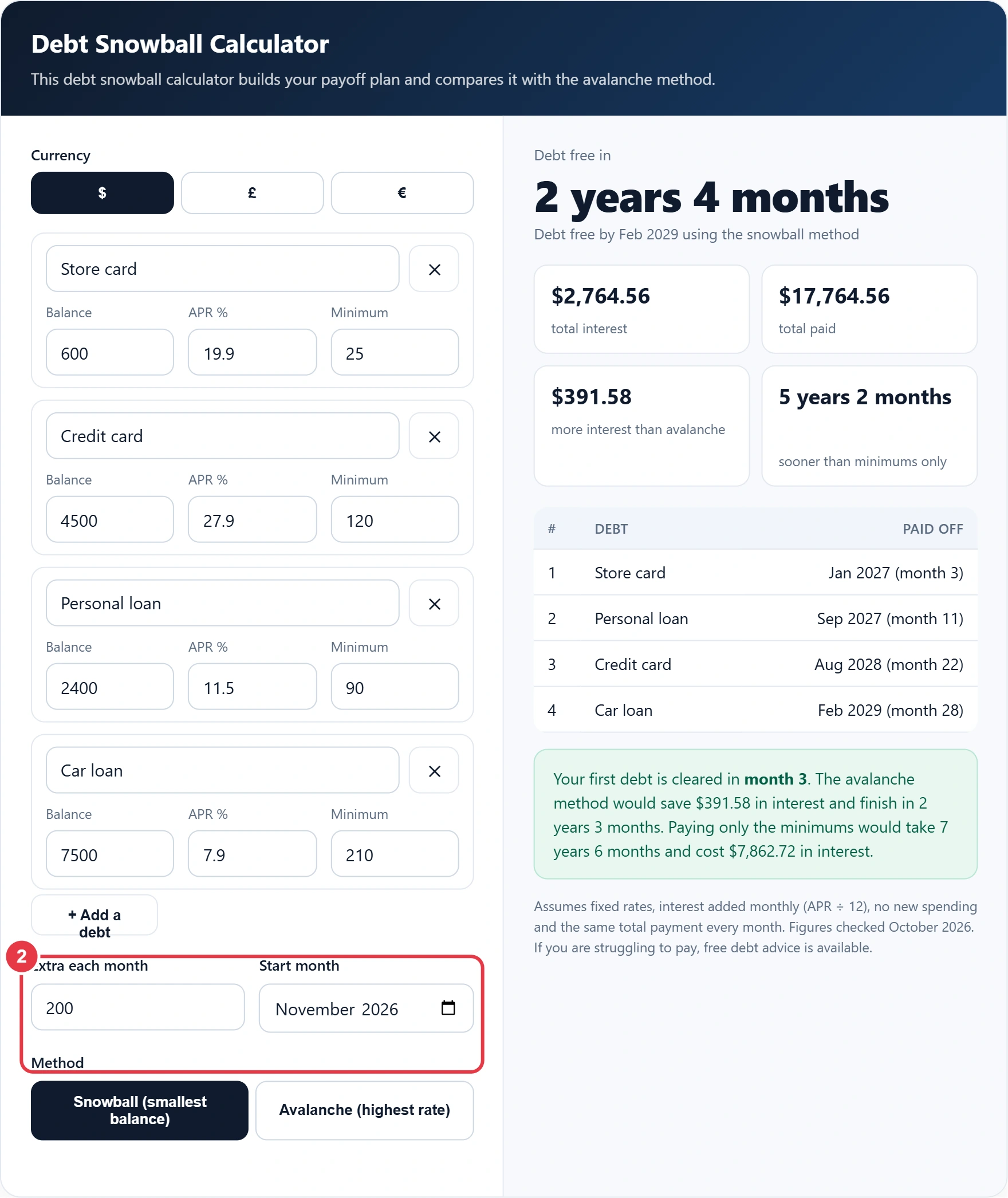
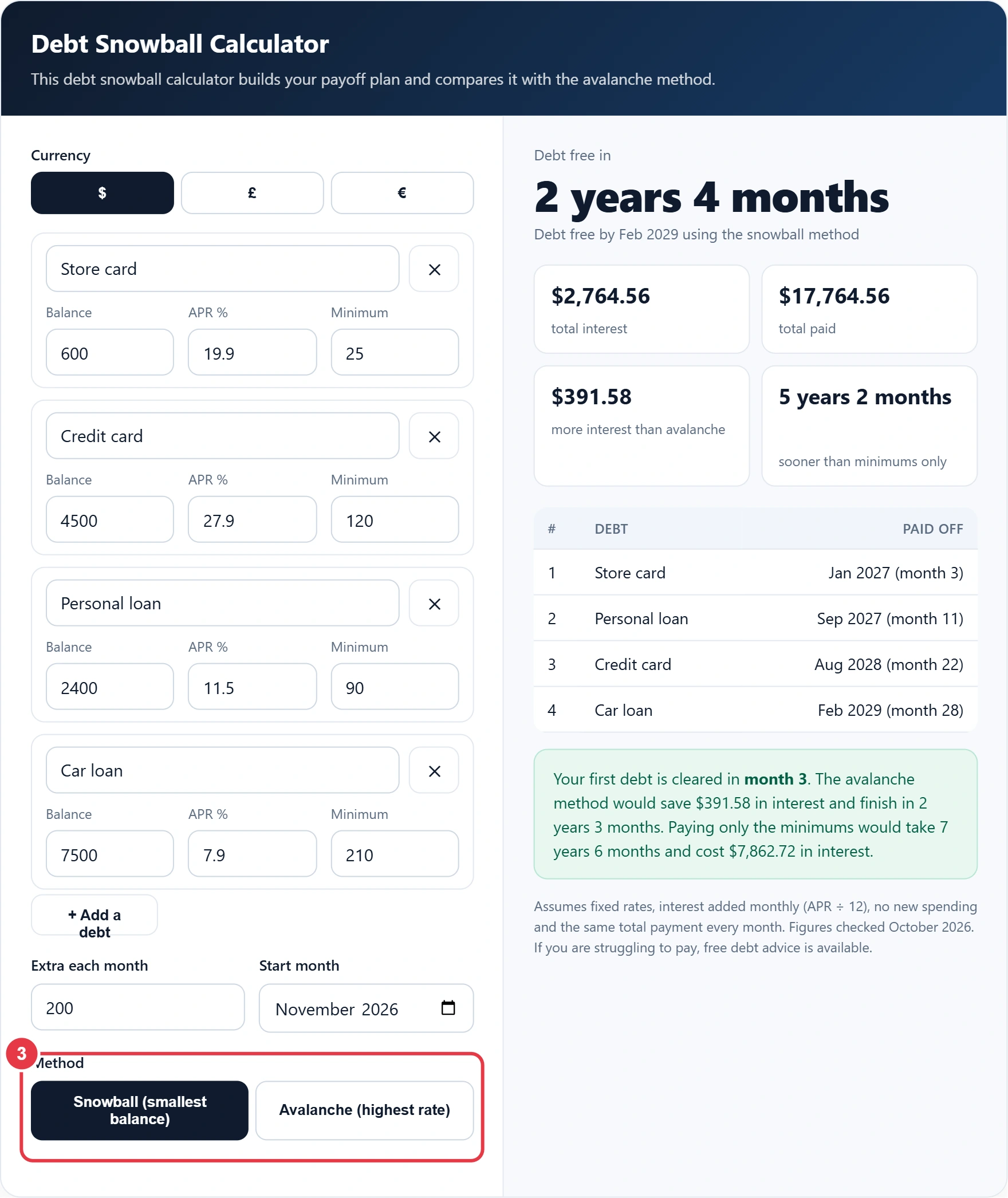
Step 3: Choose Snowball or Avalanche
Snowball orders debts by smallest balance. Avalanche orders them by highest interest rate. Switch between the two and the results update, showing the difference in interest and time.
Step 4: Read Your Plan
You see your debt free date, total interest, total paid, the comparison with the other method and with minimum payments only, plus the month each debt is cleared. For a single card, the credit card payoff calculator goes deeper on one balance, and this table shows the order for all of them.

Is Debt Snowball or Avalanche Better?
The avalanche method always costs the same or less in interest, while the debt snowball usually gives you a paid off account much sooner, which helps many people stay motivated. The best method is the one you will stick with.
| Plan for the example debts | First debt cleared | Debt free in | Total interest |
|---|---|---|---|
| Snowball, $200 extra | Month 3 | 28 months | $2,764.56 |
| Avalanche, $200 extra | Month 18 | 27 months | $2,372.98 |
| Minimum payments only | Month 31 | 90 months | $7,862.72 |
The example uses a $600 store card at 19.9% APR, a $4,500 credit card at 27.9%, a $2,400 personal loan at 11.5% and a $7,500 car loan at 7.9%. Here avalanche saves $391.58 and one month, but snowball clears its first debt 15 months sooner, which is why this debt avalanche calculator comparison matters before you commit.
How Long Will It Take to Pay Off My Debt?
How long it takes depends mainly on your total monthly payment compared with your total balance and rates; adding extra money is the biggest lever. In the example above, $200 extra a month cuts the time from 90 months to 28 and saves $5,098.16 of interest compared with paying minimums only.
Worked example: Jordan has the four debts above. Using the snowball, the $225 a month left after the other minimums clears the store card in month 3. Its $25 minimum then joins the extra on the personal loan, which is gone by month 11. The credit card follows in month 22 and the car loan in month 28. Jordan pays $17,764.56 in total, of which $2,764.56 is interest.
What If I Cannot Afford My Minimum Payments?
If you cannot afford your minimum payments, contact your lenders straight away and get free, confidential debt advice before missing payments, as fees and credit damage add up fast. A debt payoff calculator only works when the minimums are affordable.
In the US, non profit credit counselling agencies can help you set up a plan. In the UK, MoneyHelper offers free advice, and GOV.UK sets out options for paying off your debts, including debt management plans and Breathing Space. To build a safety net once debts are gone, the savings interest calculator shows how the same monthly amount grows. Figures checked October 2026.
Key Debt Snowball Terms Explained
These terms explain the figures a debt snowball calculator uses to build your plan, from APR and minimum payments to the rollover that speeds it up.
- Debt snowball method
- A repayment order that targets the smallest balance first while paying minimums on the rest. In the example on this page it clears a 600 dollar store card in month 3 and all four debts in 28 months.
- Debt avalanche method
- A repayment order that targets the highest interest rate first. For the same four debts and 200 dollars extra, it finishes in 27 months with 2,372.98 dollars of interest, 391.58 dollars less than the snowball.
- Annual percentage rate (APR)
- The yearly cost of borrowing as a percentage. The calculator divides it by 12 to get a monthly rate, so a 27.9% credit card adds about 2.325% of the balance in interest each month.
- Minimum payment
- The smallest amount a lender accepts each month to keep an account in good standing. Paying only the minimums on the example debts would take 90 months and cost 7,862.72 dollars in interest.
- Payment rollover
- Moving the payment from a cleared debt onto the next one instead of spending it. Because the total monthly payment stays fixed, each new target receives a larger amount and is cleared faster.
</>Embed this calculator on your website
Add the free Debt Snowball Calculator to your own site or blog. Copy the code below and paste it into an HTML block. It resizes itself and works on phones.
How we checked this tool: the Tools Veria Editorial Team built this tool by hand, checked it against the official rules or published standards where they apply, and tested it against worked examples. Results are estimates for planning, not personal financial or tax advice. Read our editorial policy and disclaimer, or report an error.
Frequently Asked Questions
How does the debt snowball work?
You pay the minimum on every debt and put all spare money on the smallest balance. When it is cleared, you add its payment to the next smallest, so the amount aimed at each debt grows like a rolling snowball until everything is paid.
Does the snowball method save money?
It saves a lot compared with paying minimums only, because the extra and freed payments clear debts faster. It usually costs a little more interest than the avalanche method, which targets the highest rate first, but often gives quicker early wins.
Should I include my mortgage in the debt snowball?
Most people leave the mortgage out and use the snowball for credit cards, overdrafts, car finance and personal loans. Mortgages have low rates and long terms, so they are usually tackled separately once other debts are cleared.
What if two debts have the same balance?
When balances are equal, this calculator pays the one with the higher interest rate first, which saves a little interest without changing the snowball order of smallest balances first for every other debt.
Should I save an emergency fund before using the snowball?
Many advisers suggest a small emergency fund first, such as one month of essential costs, so an unexpected bill does not go on a credit card and undo your progress. Then put every spare amount into the snowball.
What happens if my interest rate changes?
The calculator assumes rates stay fixed. If a promotional 0% rate ends or a variable rate rises, update the APR and rerun the plan. Higher rates make the avalanche order more valuable, so compare both methods again.