Find your debt free date and see what minimum payments really cost.
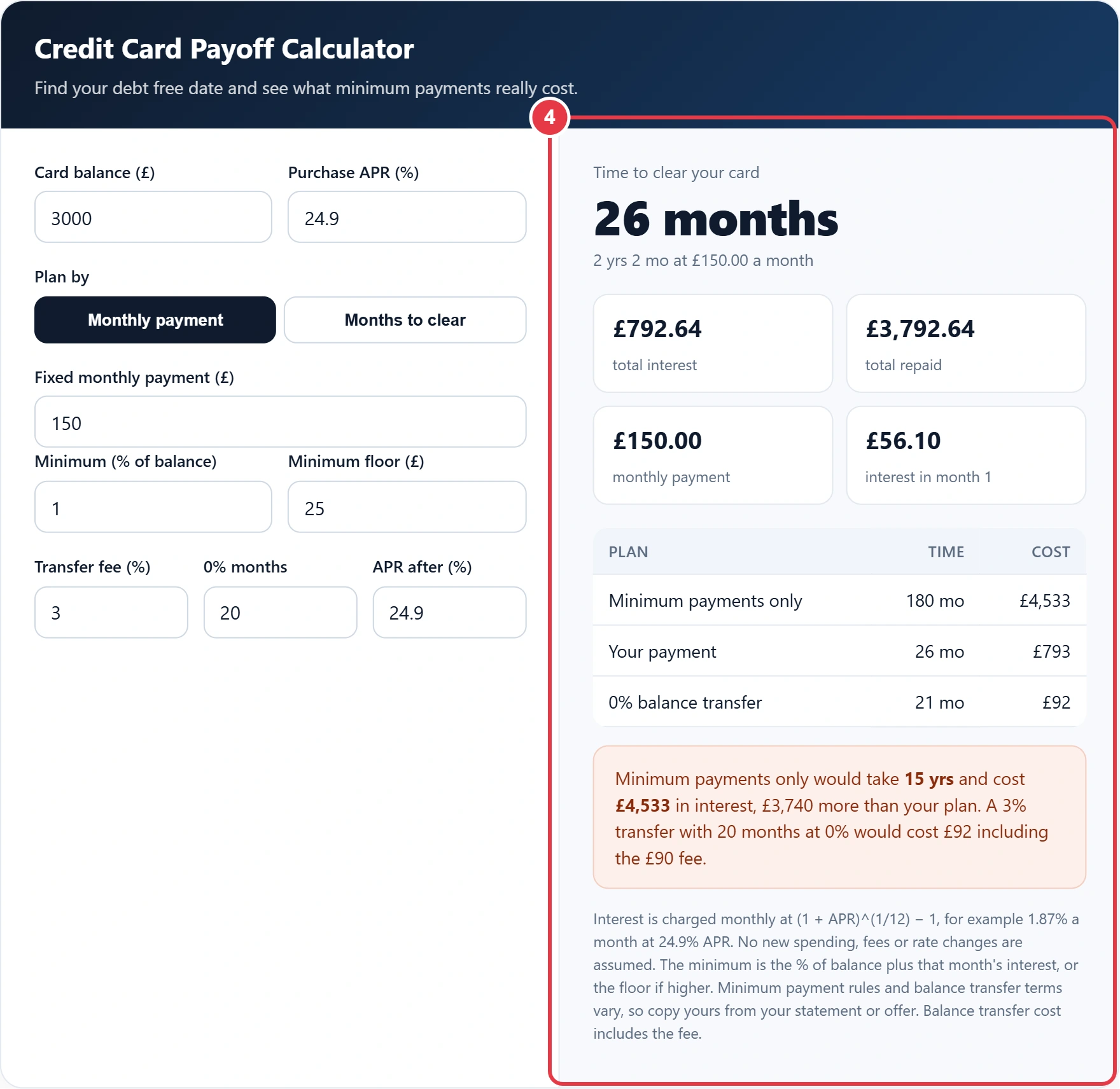
| Plan | Time | Cost |
|---|
Interest is charged monthly at (1 + APR)^(1/12) − 1, for example 1.87% a month at 24.9% APR. No new spending, fees or rate changes are assumed. The minimum is the % of balance plus that month's interest, or the floor if higher. Minimum payment rules and balance transfer terms vary, so copy yours from your statement or offer. Balance transfer cost includes the fee.
This credit card payoff calculator shows UK cardholders how many months it takes to clear a balance, how much interest they will pay, and how that compares with paying only the minimum or moving the debt to a 0% balance transfer card. If the numbers feel unmanageable, the free MoneyHelper debt help service can point you to no cost advice, and acting early keeps far more options open.
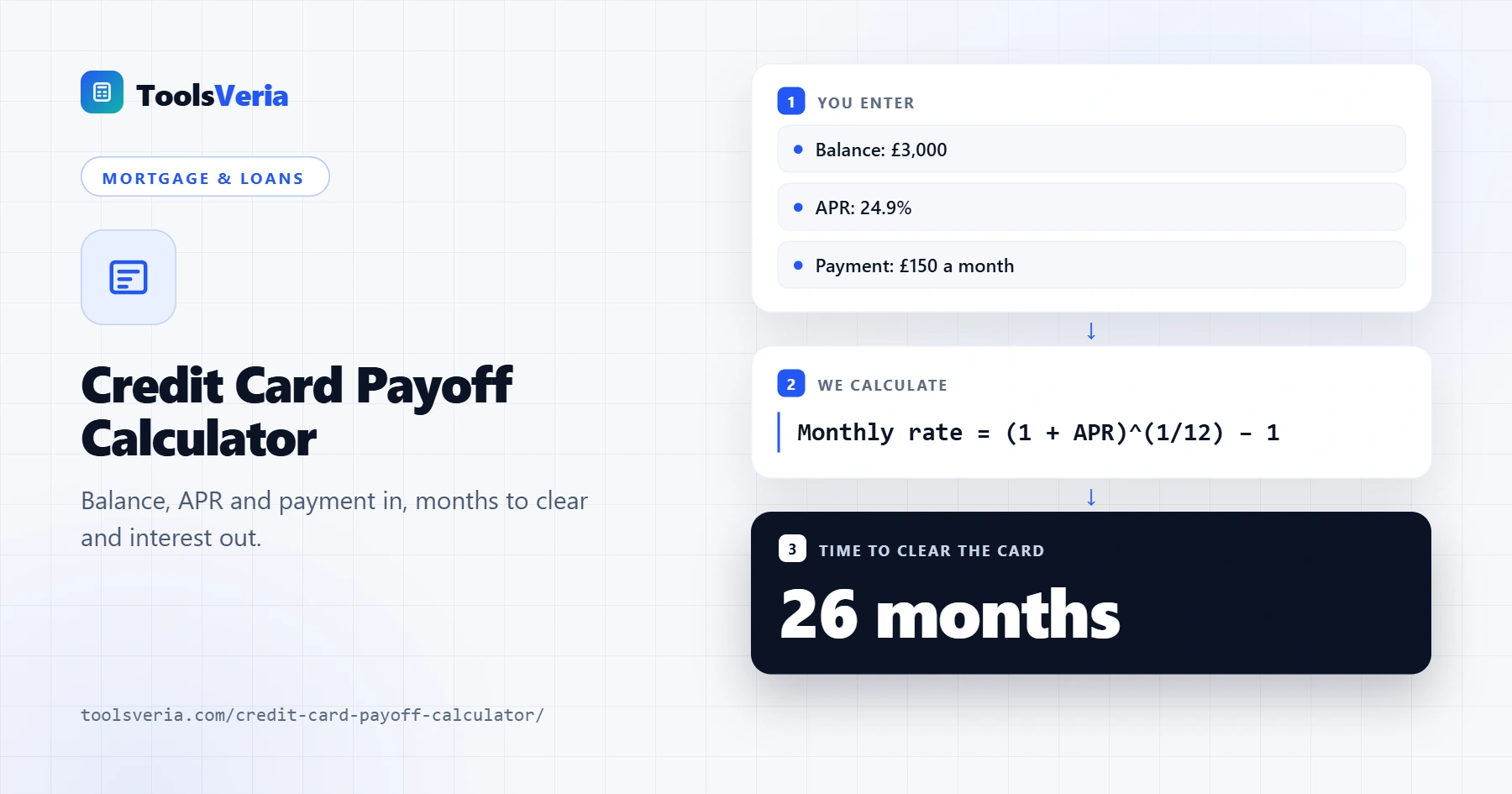
Quick answer: A credit card payoff calculator shows that at 24.9% APR, a £3,000 balance takes 26 months to clear at £150 a month, with £793 of interest. Paying only the minimum of 1% plus interest with a £25 floor stretches the same debt to around 15 years and £4,533 of interest, because the minimum shrinks as the balance falls.
In This Guide
What Is a Credit Card Payoff Calculation?
A credit card payoff calculation works out how long a fixed monthly payment takes to reduce a card balance to zero, and the total interest charged along the way. Each month, interest is added to the balance and your payment is taken off.
UK card APRs include monthly compounding, so the monthly rate is (1 + APR)^(1/12) − 1. At 24.9% APR that is 1.87% a month, or £56.10 of interest on a £3,000 balance in month one. Any payment at or below that interest means the balance never falls.
How to Use the Credit Card Payoff Calculator
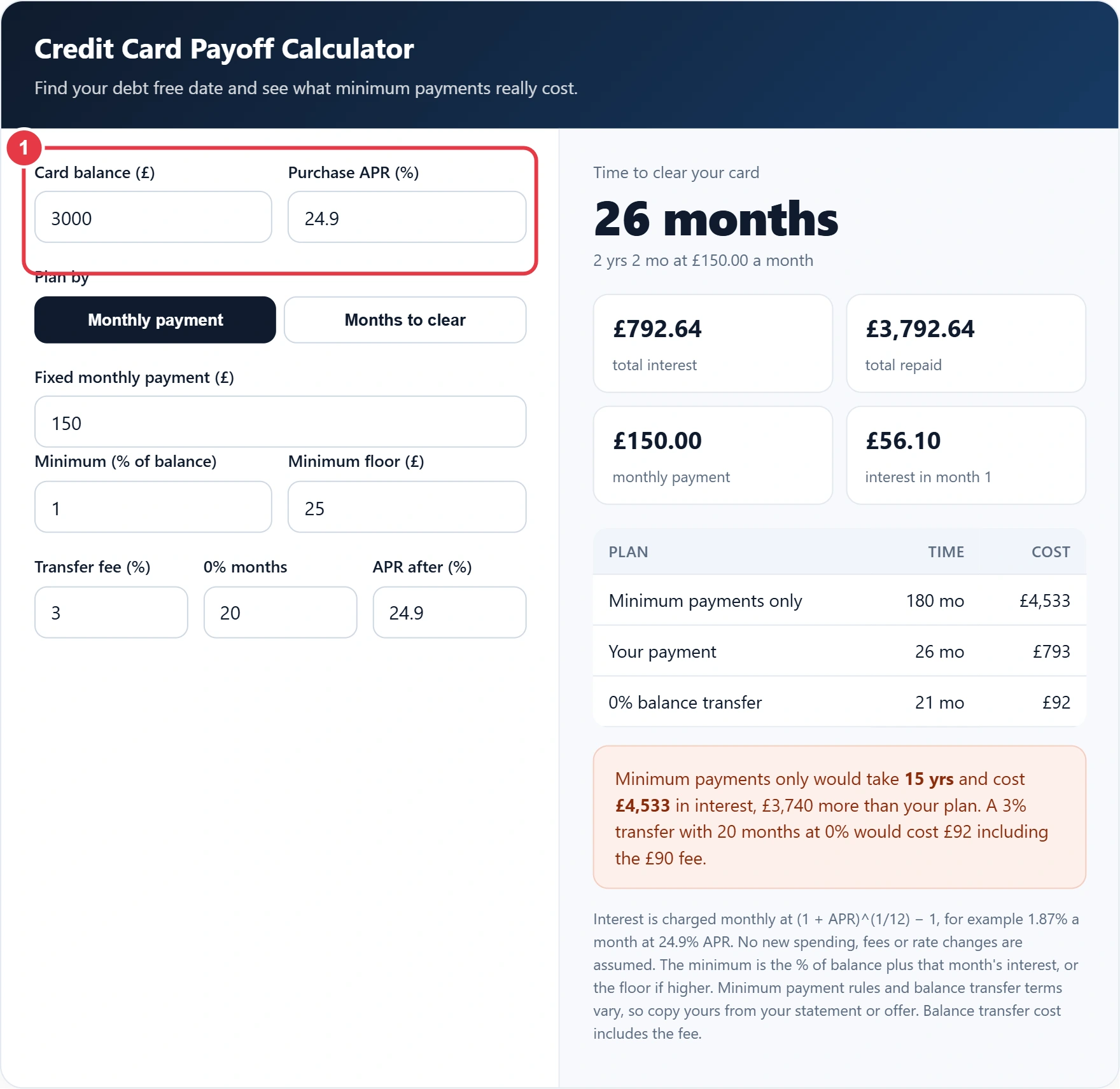
Step 1: Enter Your Balance and APR
Copy the balance and purchase APR from your latest statement. The 24.9% default is only an example, and cash withdrawals often carry a higher rate.
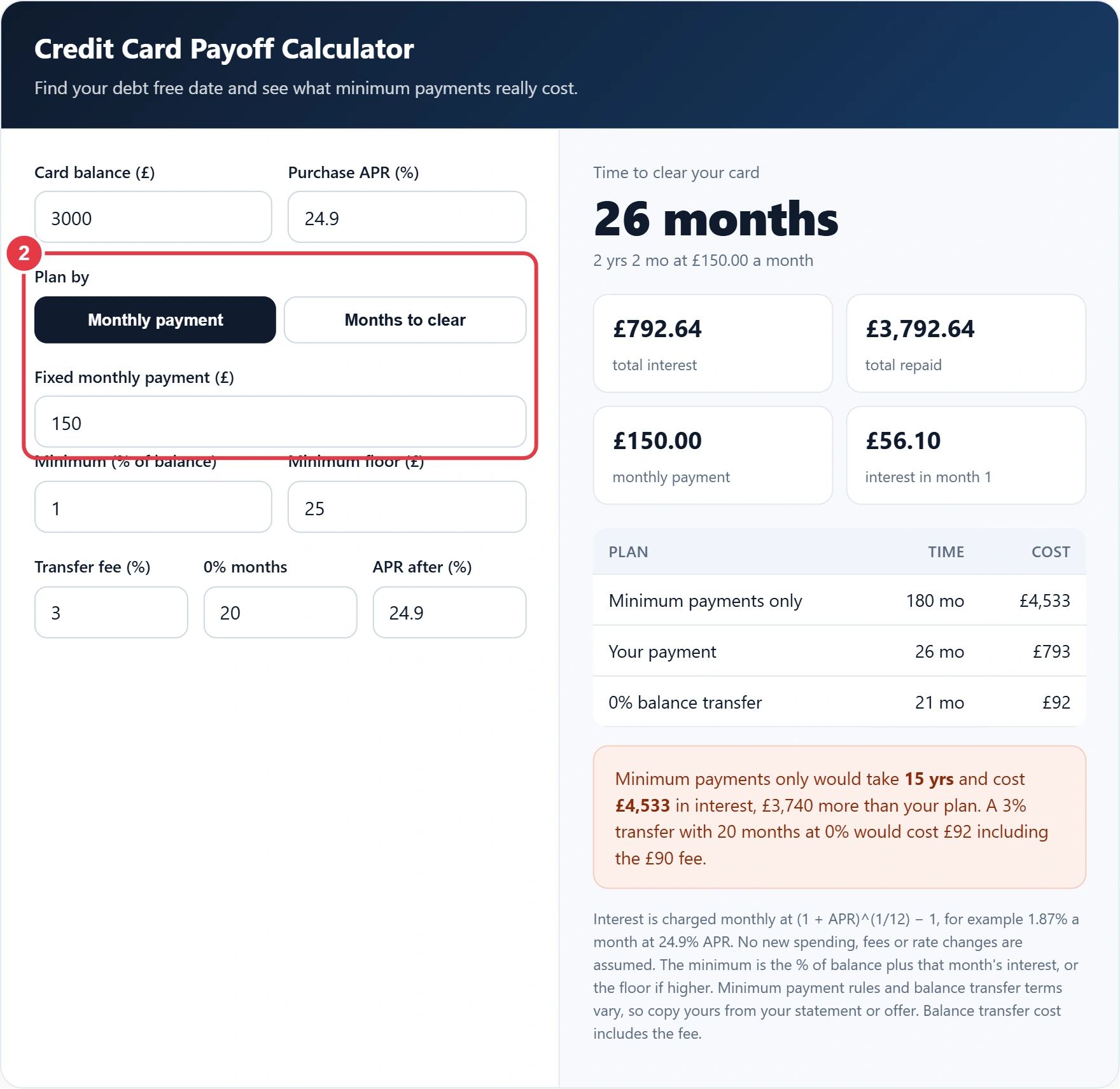
Step 2: Choose Your Plan
Enter the fixed amount you can pay each month, or switch to months to clear and the calculator tells you the payment needed. Clearing £3,000 in 24 months at 24.9% takes £156.29 a month.
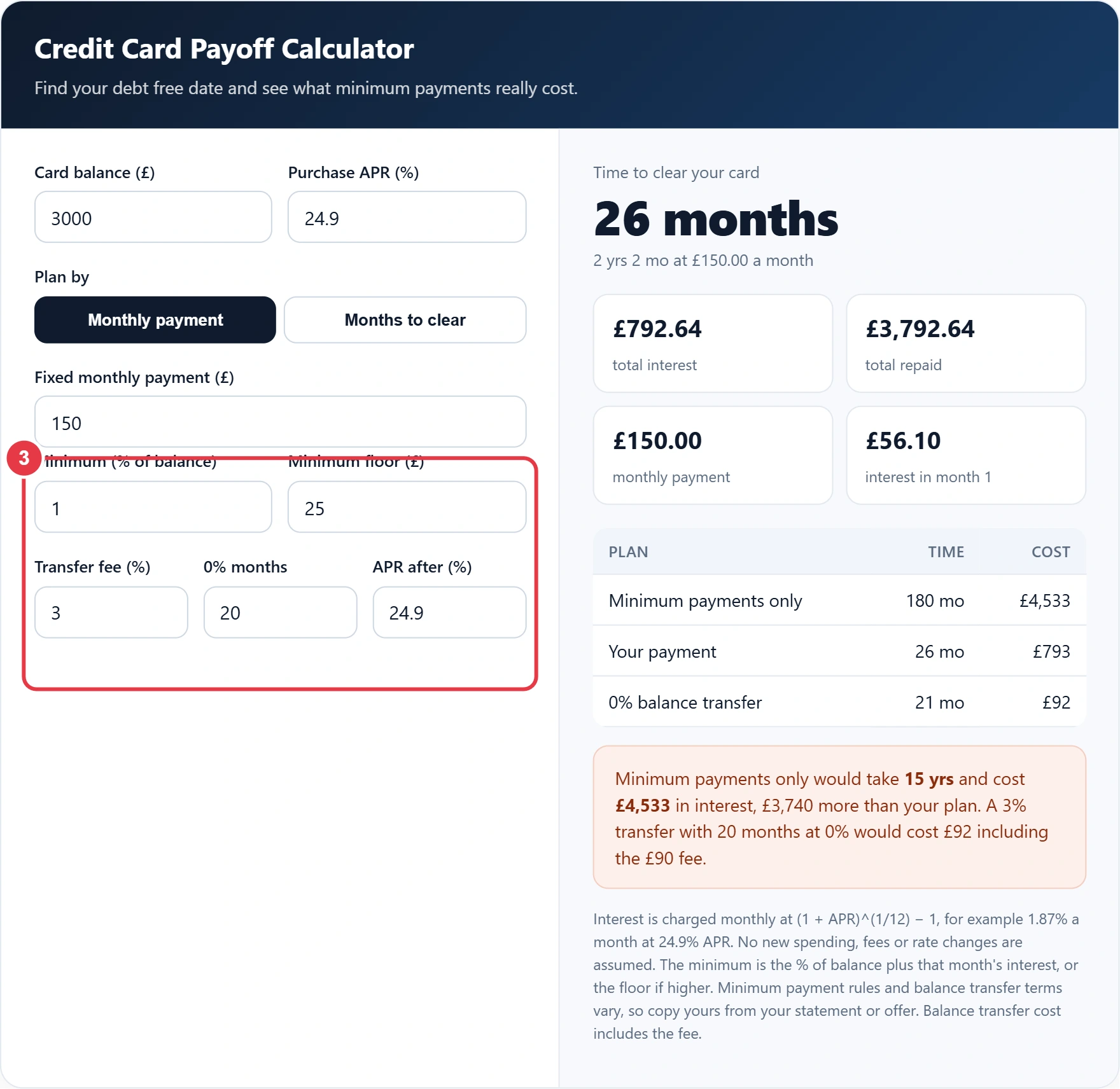
Step 3: Set Minimum and Transfer Terms
Many UK cards set the minimum at 1% of the balance plus that month's interest, with a cash floor. Check your own card's rule, then enter the fee, 0% period and follow on rate from any balance transfer offer you are weighing up.
Step 4: Compare the Results
The headline is your time to clear the card. The table sets minimum payments, your plan and a balance transfer side by side, with the transfer fee counted as a cost.
How Long Will It Take to Pay Off My Credit Card?
At 24.9% APR, a £3,000 balance takes 26 months to clear at £150 a month, with £793 of interest, but around 15 years and £4,533 of interest on minimum payments of 1% plus interest with a £25 floor. Sophie, a teaching assistant in Manchester, tested her options:
| Sophie's plan | Time to clear | Interest and fees |
|---|---|---|
| Minimum payments only | 15 years | £4,533 |
| £100 a month | 45 months | £1,444 |
| £150 a month | 26 months | £793 |
| £200 a month | 18 months | £554 |
| 3% transfer, 20 months at 0%, £150 a month | 21 months | £92 |
The minimum payment shrinks as the balance falls, which is why the debt drags on for years. Under FCA persistent debt rules, your card provider must contact you if you pay more in interest and charges than you repay over 18 months. Once the card is cleared, the emergency fund calculator helps you build a cash buffer, and the loan calculator shows whether a cheaper personal loan could replace the debt sooner.
Key Credit Card Payoff Terms Explained
These definitions explain the borrowing terms used by the credit card payoff calculator, helping you compare minimum payments, fixed plans and balance transfers.
- Annual percentage rate
- The yearly cost of borrowing expressed as a percentage, including interest and certain compulsory fees. UK card APRs already reflect monthly compounding, which is why the monthly rate is found with a root rather than simple division by twelve.
- Minimum payment
- The smallest amount a card issuer accepts each month to keep an account in good standing. Because it is usually tied to the shrinking balance, paying only this amount stretches repayment over many years and multiplies the interest paid.
- Balance transfer
- Moving debt from one credit card to another, usually to take advantage of a promotional interest rate. A one off fee is normally added to the transferred balance, and a higher standard rate applies once the offer period ends.
- Promotional rate period
- A fixed number of months during which a card charges a reduced or zero interest rate on certain balances. Clearing the debt before it ends avoids the revert rate that applies to whatever balance remains afterwards.
- Amortisation
- The gradual reduction of a debt through regular payments, each split between interest and capital. Early payments are mostly interest, so the capital share grows only as the outstanding balance and its interest charge shrink.
- Cash advance rate
- The interest rate a card charges on cash withdrawals and similar transactions, which is often higher than the purchase rate. Interest on cash usually starts from the day of the withdrawal, with no interest free period before it applies.
</>Embed this calculator on your website
Add the free Credit Card Payoff Calculator to your own site or blog. Copy the code below and paste it into an HTML block. It resizes itself and works on phones.
How we checked this tool: the Tools Veria Editorial Team built this tool by hand, checked it against the official rules or published standards where they apply, and tested it against worked examples. Results are estimates for planning, not personal financial or tax advice. Read our editorial policy and disclaimer, or report an error.
Frequently Asked Questions
How long does it take to pay off £3,000 on a credit card?
At 24.9% APR, paying £150 a month clears £3,000 in 26 months with £793 of interest. Paying £200 a month cuts it to 18 months and £554, while minimum payments alone can take around 15 years.
Why do minimum payments take so long?
Minimum payments are usually a small percentage of the balance plus interest, so they fall as the debt falls. On £3,000 at 24.9%, a 1% plus interest minimum starts near £86 and repays only about £30 of the balance in month one.
Is a 0% balance transfer worth the fee?
Usually yes, if you can clear most of the debt within the 0% period. A 3% fee on £3,000 is £90, compared with £793 of interest paying £150 a month at 24.9%. Check the follow on rate and any fee before applying.
What is persistent credit card debt?
The FCA treats you as being in persistent debt when, over 18 months, you pay more in interest, fees and charges than you repay of the balance. Your card provider must then contact you and suggest repaying faster.
How much should I pay to clear my card in two years?
You need £156.29 a month to clear £3,000 at 24.9% APR in 24 months, which adds £751 of interest. Switch the calculator to months to clear to get the exact payment for your own balance and rate.
Where can I get free help with credit card debt in the UK?
MoneyHelper, backed by the government, lists free and confidential debt advice services across the UK, including StepChange, National Debtline and Citizens Advice. Contact them before you miss payments if you can.