Fixed monthly instalment, interest cost and a month by month schedule for any loan.
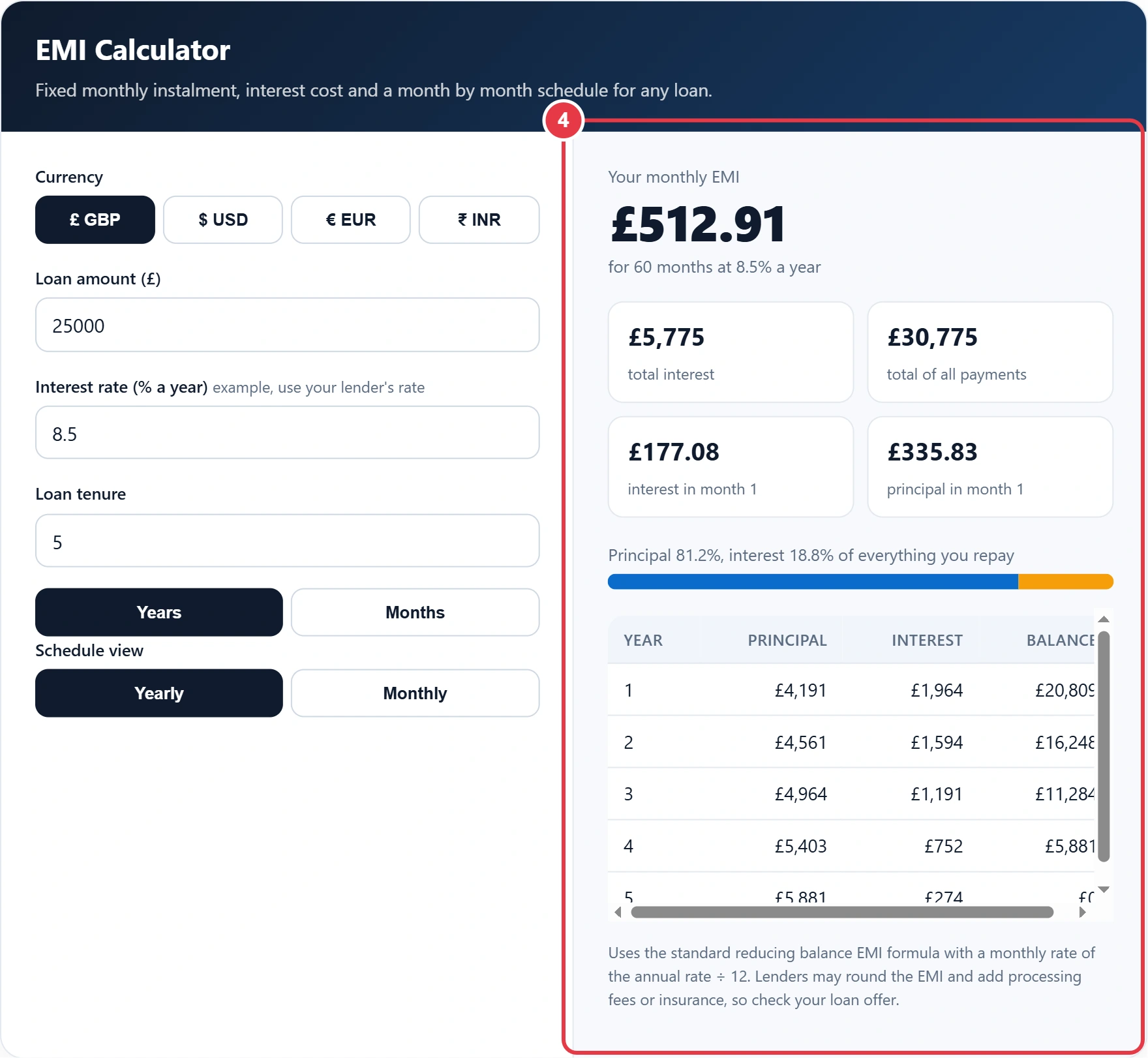
| Year | Principal | Interest | Balance |
|---|
Uses the standard reducing balance EMI formula with a monthly rate of the annual rate ÷ 12. Lenders may round the EMI and add processing fees or insurance, so check your loan offer.
This EMI calculator works out the fixed monthly instalment on a home, car or personal loan, and shows how much of each payment is interest and how much clears the debt. EMI is the term lenders in India and South Asia use, and India's central bank sets rules on it in its RBI circular on floating rate EMI resets, but the maths is identical to a UK or US repayment loan, so you can switch between £, $, € and ₹.
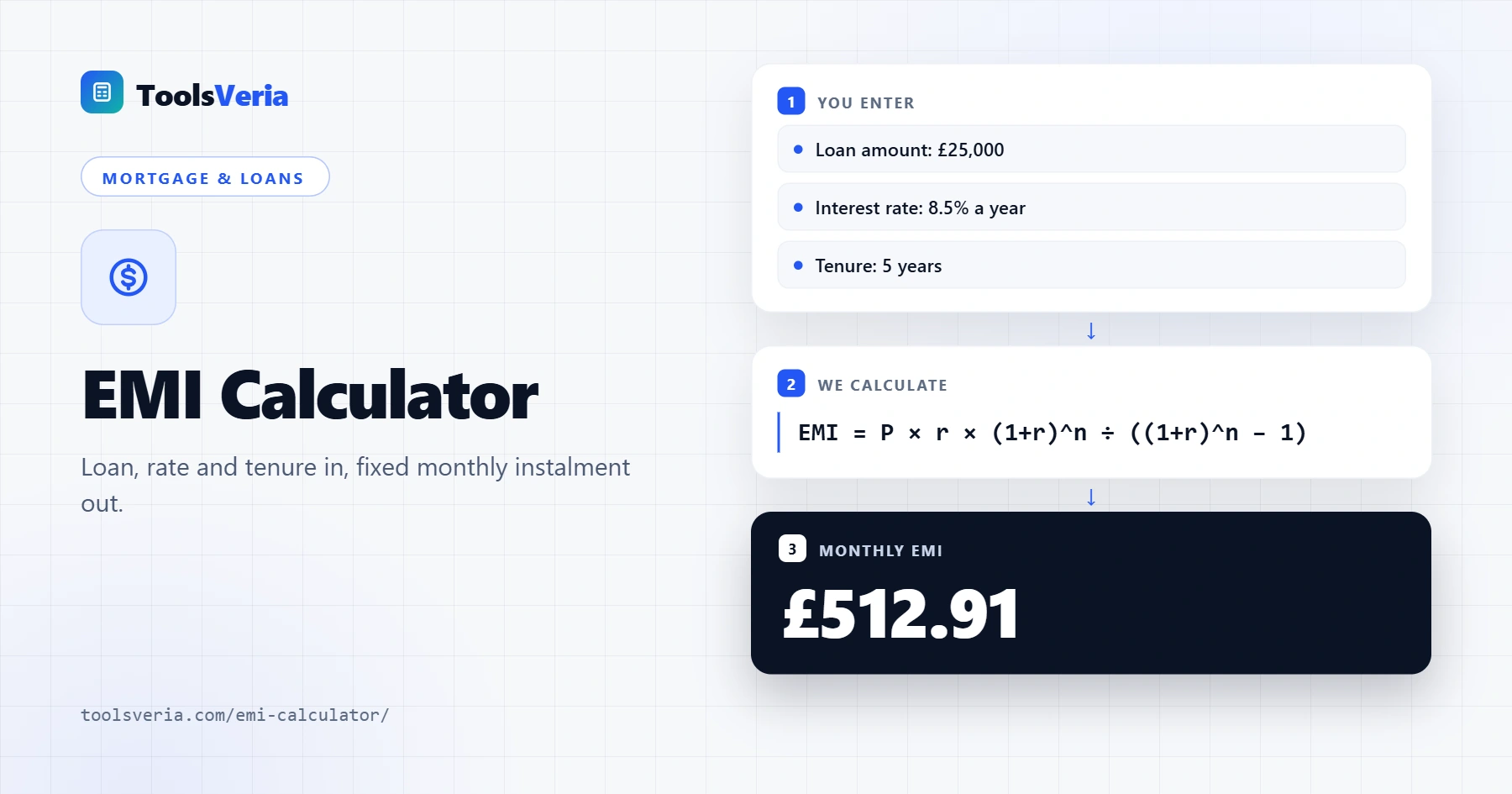
Quick answer: An EMI calculator uses EMI = P × r × (1 + r)^n ÷ ((1 + r)^n − 1), where P is the loan, r is the annual rate ÷ 12 ÷ 100 and n is the number of months. On £25,000 at 8.5% over 5 years, the EMI is £512.91, with £177.08 of interest in month one.
In This Guide
What Is an EMI?
An equated monthly instalment (EMI) is a fixed amount you pay your lender every month until a loan is fully repaid, covering both interest and principal. In the UK the same thing is simply called a monthly repayment, and in the US a monthly loan payment.
The formula is EMI = P × r × (1 + r)^n ÷ ((1 + r)^n − 1), where P is the loan, r is the annual rate ÷ 12 ÷ 100 and n is the number of months. Interest is charged on the reducing balance, so early instalments are mostly interest. On £25,000 at 8.5% over 5 years, the EMI is £512.91, and month one splits into £177.08 of interest and £335.83 of principal.
How to Use the EMI Calculator
Step 1: Pick a Currency and Enter the Loan
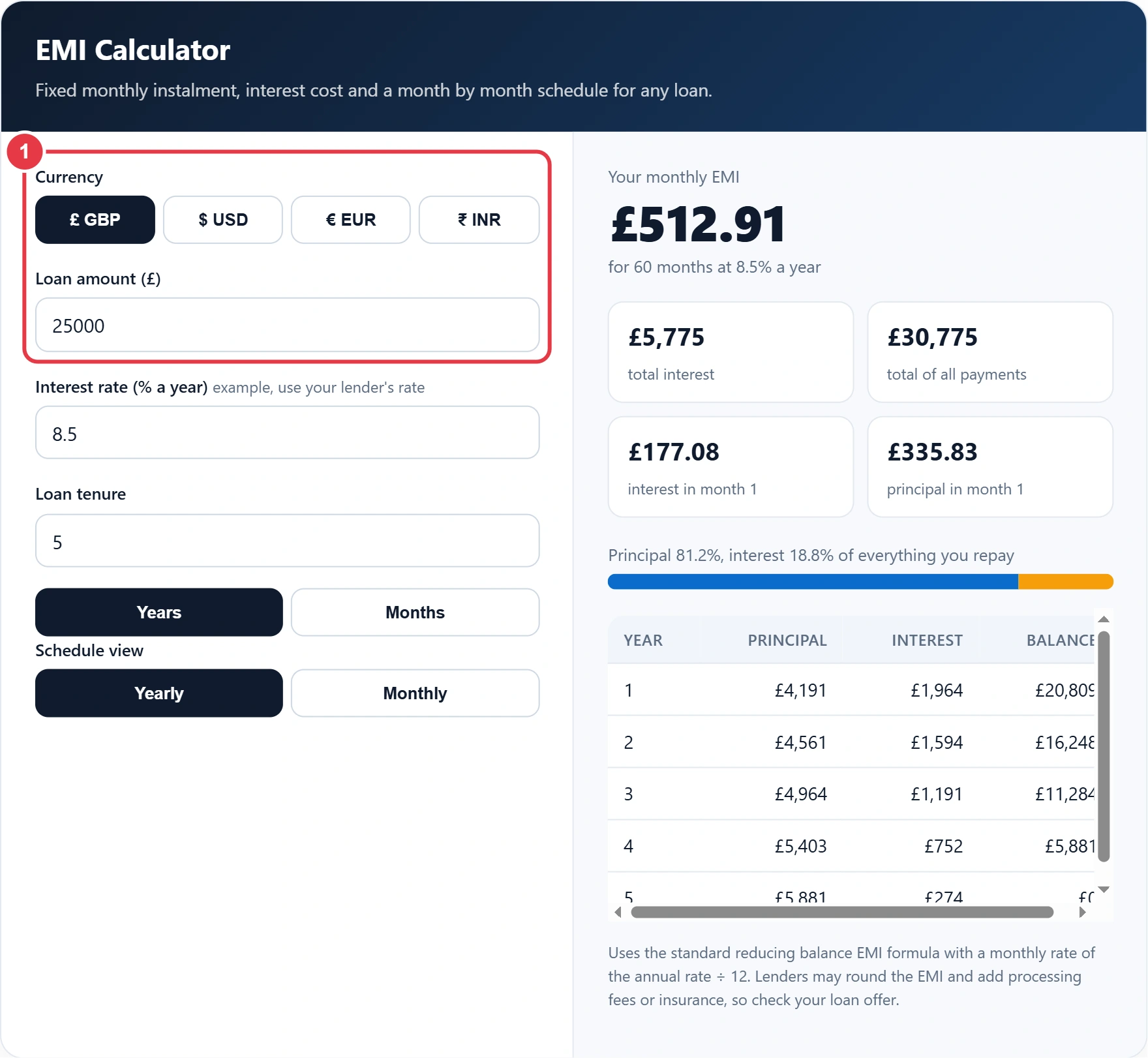
Choose £, $, € or ₹, then type the amount you are borrowing after any down payment. Rupee results use Indian lakh and crore grouping, so ₹10,00,000 reads the way your bank writes it.
Step 2: Enter the Interest Rate
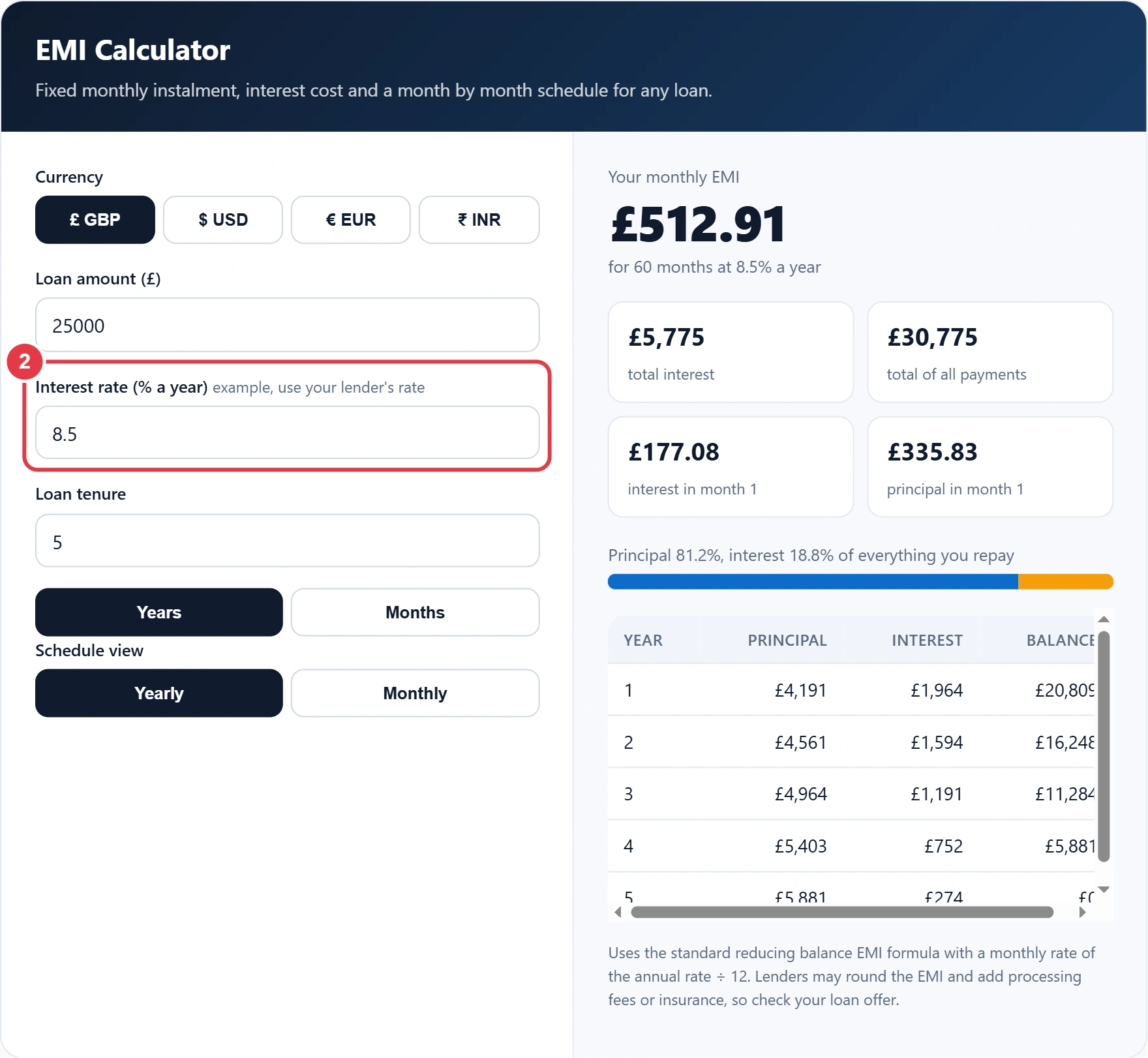
Use the annual rate from your sanction letter or loan offer. The 8.5% default is only an example, and even a quarter point difference changes the total interest noticeably on a long loan.
Step 3: Set the Tenure
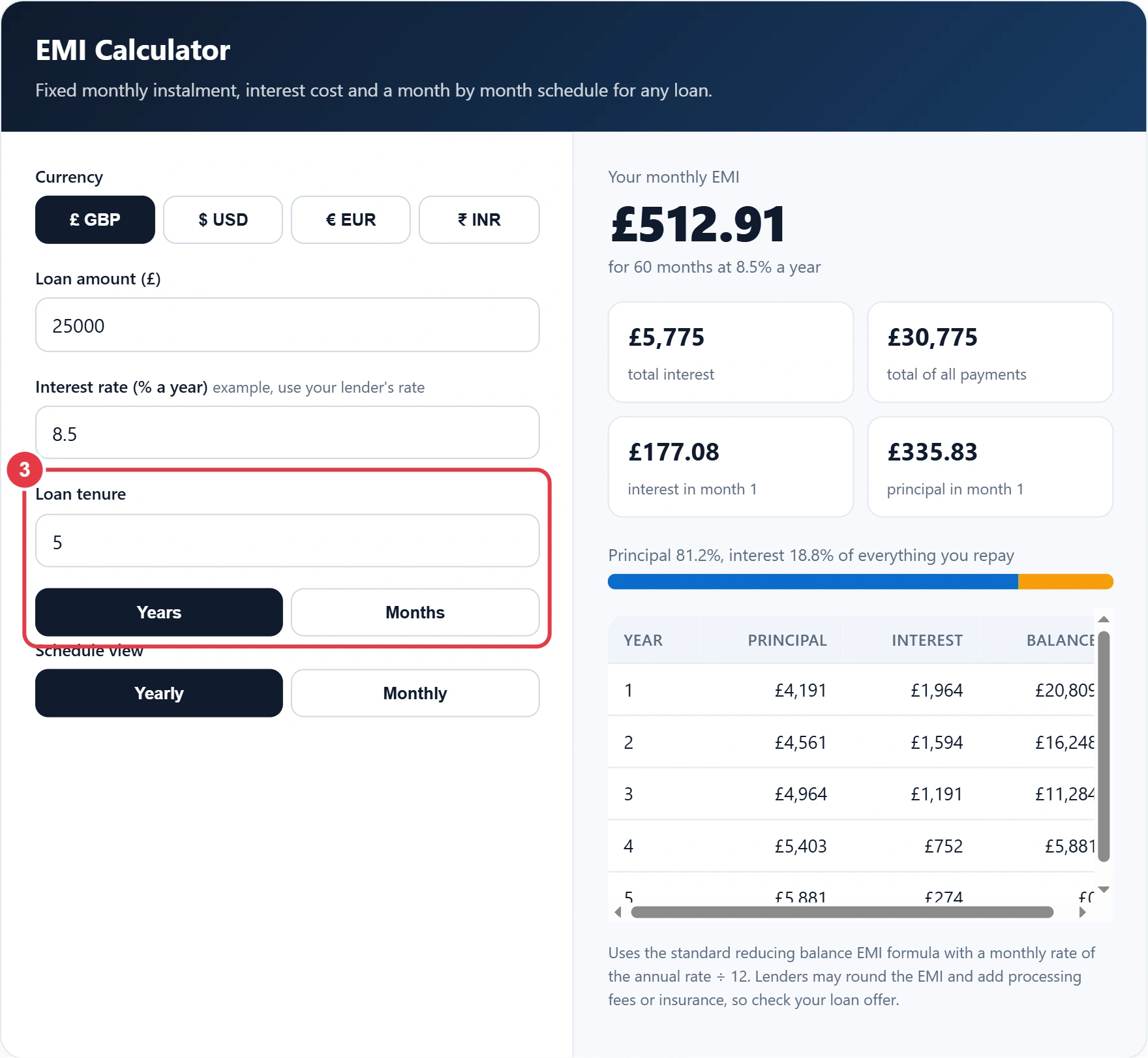
Enter the term in years or switch to months. A longer tenure lowers the EMI but raises the total interest, which the loan calculator also shows in APR terms if you are comparing UK personal loan quotes.
Step 4: Read the EMI and Schedule
You get the EMI, total interest, total repaid and the principal to interest split. Switch the schedule between yearly and monthly to see the balance fall instalment by instalment.
How Much EMI Will I Pay on a ₹50 Lakh Home Loan?
At an example rate of 8.5% over 20 years, a ₹50 lakh home loan has an EMI of about ₹43,391, and total interest of ₹54,13,879, which is more than the amount borrowed. Priya, buying a flat in Pune, compared tenures before signing:
| Tenure | Monthly EMI | Total interest |
|---|---|---|
| 10 years | ₹61,993 | ₹24,39,141 |
| 15 years | ₹49,237 | ₹38,62,656 |
| 20 years | ₹43,391 | ₹54,13,879 |
| 25 years | ₹40,261 | ₹70,78,406 |
| 30 years | ₹38,446 | ₹88,40,443 |
Stretching from 20 to 30 years saves Priya under ₹5,000 a month but adds over ₹34 lakh of interest. Part prepayments early in the loan have the biggest effect, and the mortgage overpayment calculator shows how extra payments shorten the term. The EMI entry on Wikipedia sets out the same formula if you want to check the working by hand.
Key EMI Calculator Terms Explained
These definitions explain the loan maths behind the EMI calculator, so you can read your instalment, interest split and repayment schedule with confidence before you sign.
- Equated monthly instalment (EMI)
- A level payment made to a lender each month for the full tenure of a loan. Every instalment is the same size, but the share going to interest shrinks over time while the share repaying principal grows, until the balance reaches zero.
- Principal
- The sum actually borrowed after any down payment, before interest is added. Each EMI contains a principal portion that reduces the outstanding debt, and in the calculator it is the figure P that the monthly rate and term act upon.
- Reducing balance method
- An interest method in which each month's interest is worked out only on the amount still owed, not on the original loan. As principal is repaid, the interest charge falls, which is why early instalments are weighted towards interest and later ones towards capital.
- Amortisation schedule
- A table listing every payment over the life of a loan, showing how much of each goes to interest, how much to principal and what balance remains afterwards. Lenders use it to track a loan, and borrowers use it to plan prepayments.
- Loan tenure
- The agreed length of time over which a loan is repaid, written in years or months. In the EMI formula it becomes n, the number of monthly payments, and lengthening it lowers each instalment while increasing the total interest paid.
- Part prepayment
- An extra lump sum paid towards a loan on top of the scheduled instalments. It goes straight to principal, so later interest is charged on a smaller balance, and the borrower can usually choose to cut either the remaining term or the EMI.
</>Embed this calculator on your website
Add the free EMI Calculator to your own site or blog. Copy the code below and paste it into an HTML block. It resizes itself and works on phones.
How we checked this tool: the Tools Veria Editorial Team built this tool by hand, checked it against the official rules or published standards where they apply, and tested it against worked examples. Results are estimates for planning, not personal financial or tax advice. Read our editorial policy and disclaimer, or report an error.
Frequently Asked Questions
What does EMI stand for?
EMI stands for equated monthly instalment, the fixed sum a borrower pays each month to repay a loan with interest. The term is used mainly in India, Pakistan, Bangladesh and Sri Lanka; UK lenders call it a monthly repayment.
How is EMI calculated?
EMI is calculated as P × r × (1 + r)^n ÷ ((1 + r)^n − 1), with P the loan, r the monthly rate and n the months. For £25,000 at 8.5% over 60 months, r is 0.0070833 and the EMI is £512.91.
Why is most of my early EMI interest?
Interest is charged on the outstanding balance, which is highest at the start. On £25,000 at 8.5%, the first EMI of £512.91 includes £177.08 of interest, while the last EMI is almost entirely principal.
Does a longer tenure reduce the total cost of a loan?
No. A longer tenure lowers the monthly EMI but increases total interest. A ₹50 lakh loan at 8.5% costs ₹54.1 lakh in interest over 20 years and ₹88.4 lakh over 30 years.
What happens to my EMI when a floating rate changes?
Your lender either raises the EMI or extends the tenure, or a mix of both. In India, RBI rules require lenders to let borrowers choose between these options and to allow part or full prepayment at reset.
Is EMI the same as a mortgage payment in the UK?
Yes, mathematically. A UK capital and interest mortgage payment uses the same reducing balance formula, although UK lenders often calculate interest daily or monthly and quote an APR including fees.