This LCM calculator finds the lowest common multiple of 2 to 20 whole numbers and shows the working.
| Number | Prime factorisation |
|---|
Works with whole numbers up to 1,000,000,000,000. Negative signs are ignored, because the LCM is always given as a positive number.
This LCM calculator finds the lowest common multiple of 2 to 20 whole numbers and shows the working by two methods, for pupils, parents helping with homework and anyone adding fractions or lining up repeating schedules. It lists the prime factorisation of each number, works step by step with the greatest common factor, and gives the HCF alongside so you can check both answers together.
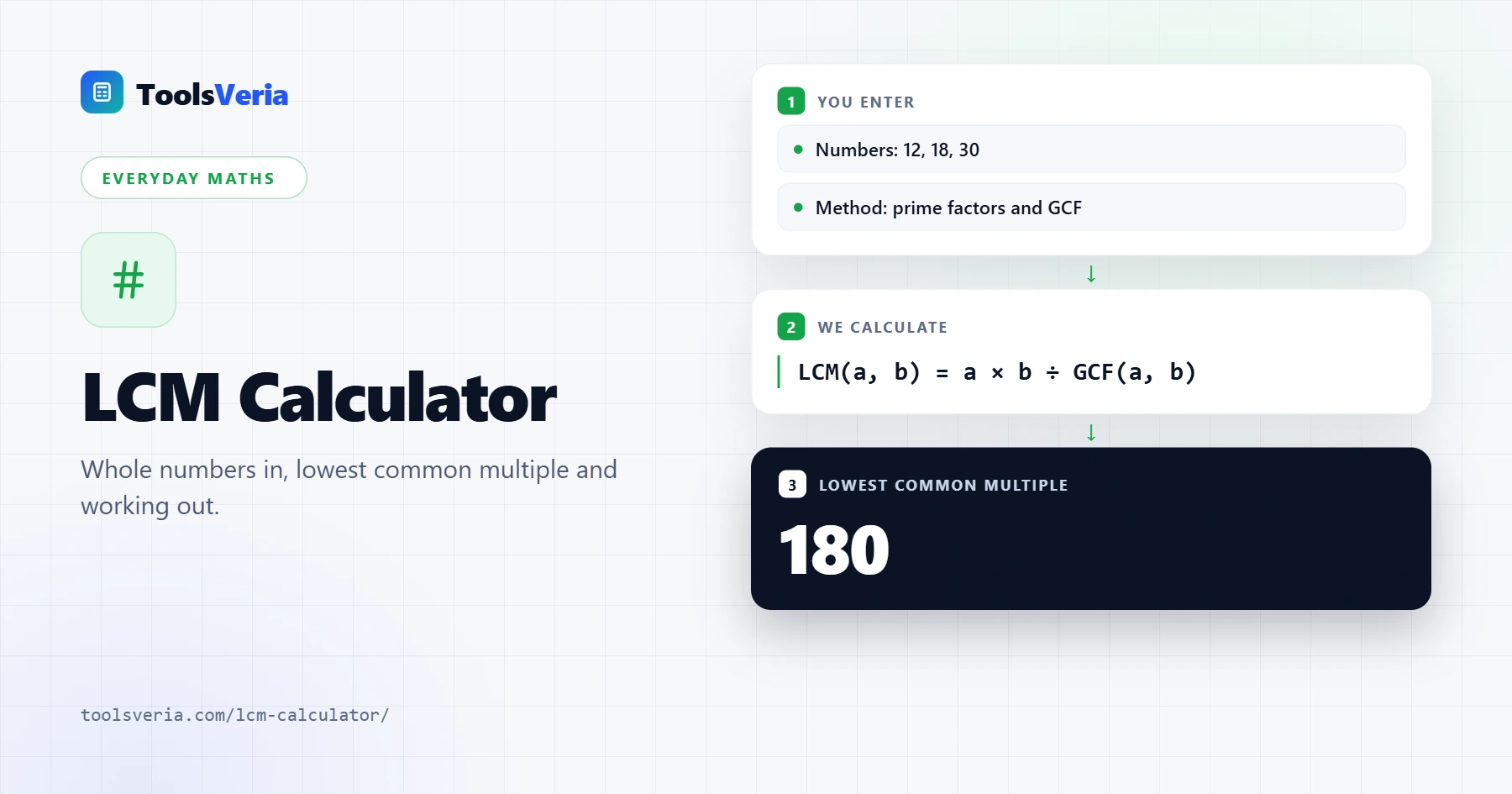
Quick answer: An LCM calculator finds the smallest positive number that every input divides into exactly. For two numbers, LCM = a × b ÷ GCF(a, b), so LCM(12, 18) = 216 ÷ 6 = 36. For more numbers, repeat the rule pair by pair: LCM(12, 18, 30) = 180.
In This Guide
What Is the Lowest Common Multiple?
The lowest common multiple (LCM) of a set of whole numbers is the smallest positive number that is a multiple of all of them. British schools say lowest common multiple, while the US usually says least common multiple; they mean exactly the same thing.
Multiples of 4 are 4, 8, 12, 16 and so on, and multiples of 6 are 6, 12, 18. The first number on both lists is 12, so LCM(4, 6) = 12. Listing works for small numbers, but the prime factor method and the GCF formula are faster for anything larger, and the calculator shows both.
How to Use the LCM Calculator
Step 1: Enter Your Numbers
Type two or more whole numbers separated by commas or spaces, such as 12, 18, 30. You can enter up to 20 numbers, each up to one trillion, and the result updates as you type.

Step 2: Try an Example
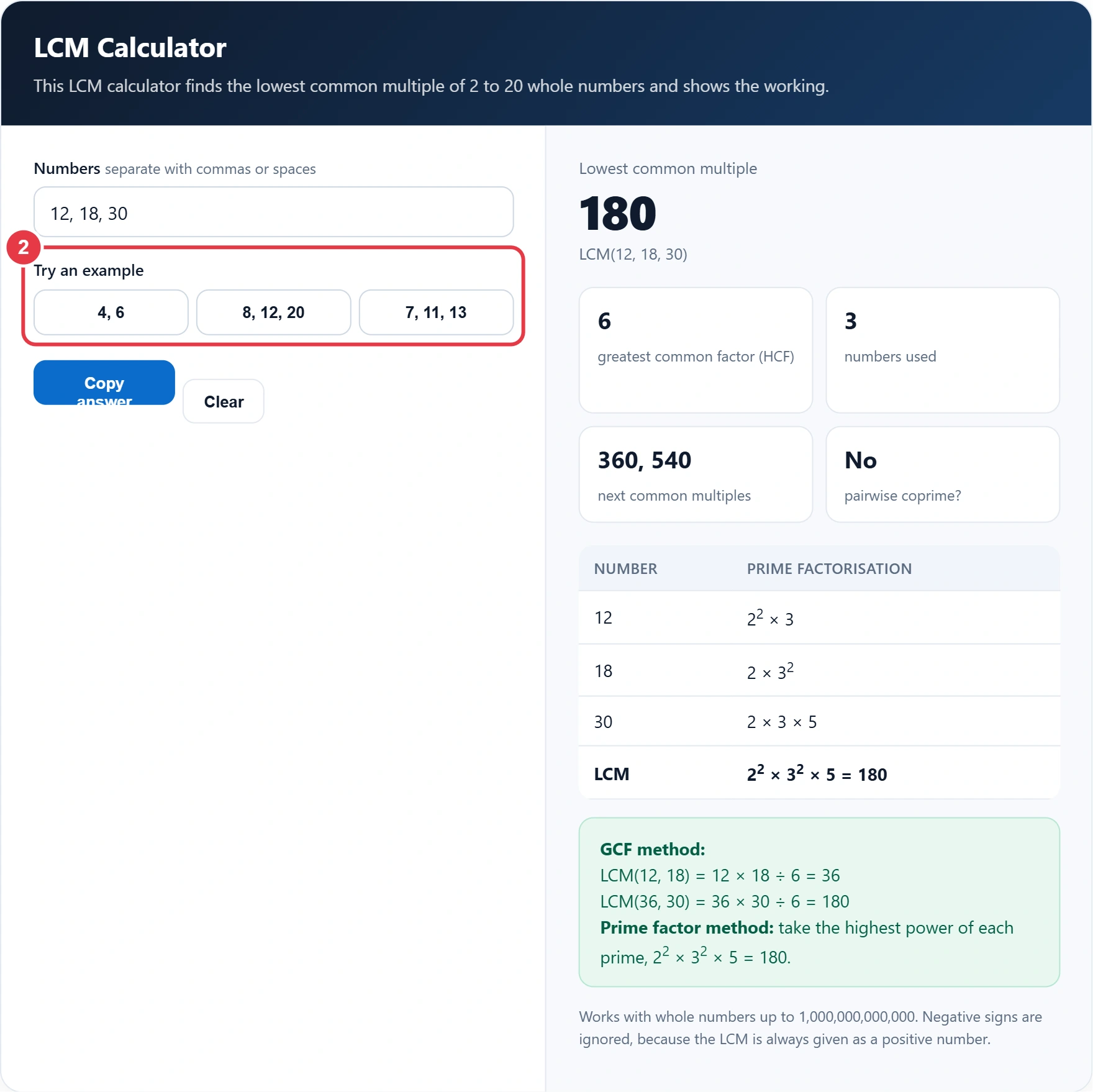
Tap one of the example sets to see how the working changes. The set 7, 11, 13 shows that numbers with no common factors have an LCM equal to their product, 1,001.
Step 3: Copy or Clear
Press Copy answer to paste the LCM into your notes or homework app, or Clear to start a new set. Invalid entries such as decimals or zero get a clear message instead of a wrong answer.

Step 4: Read the Working
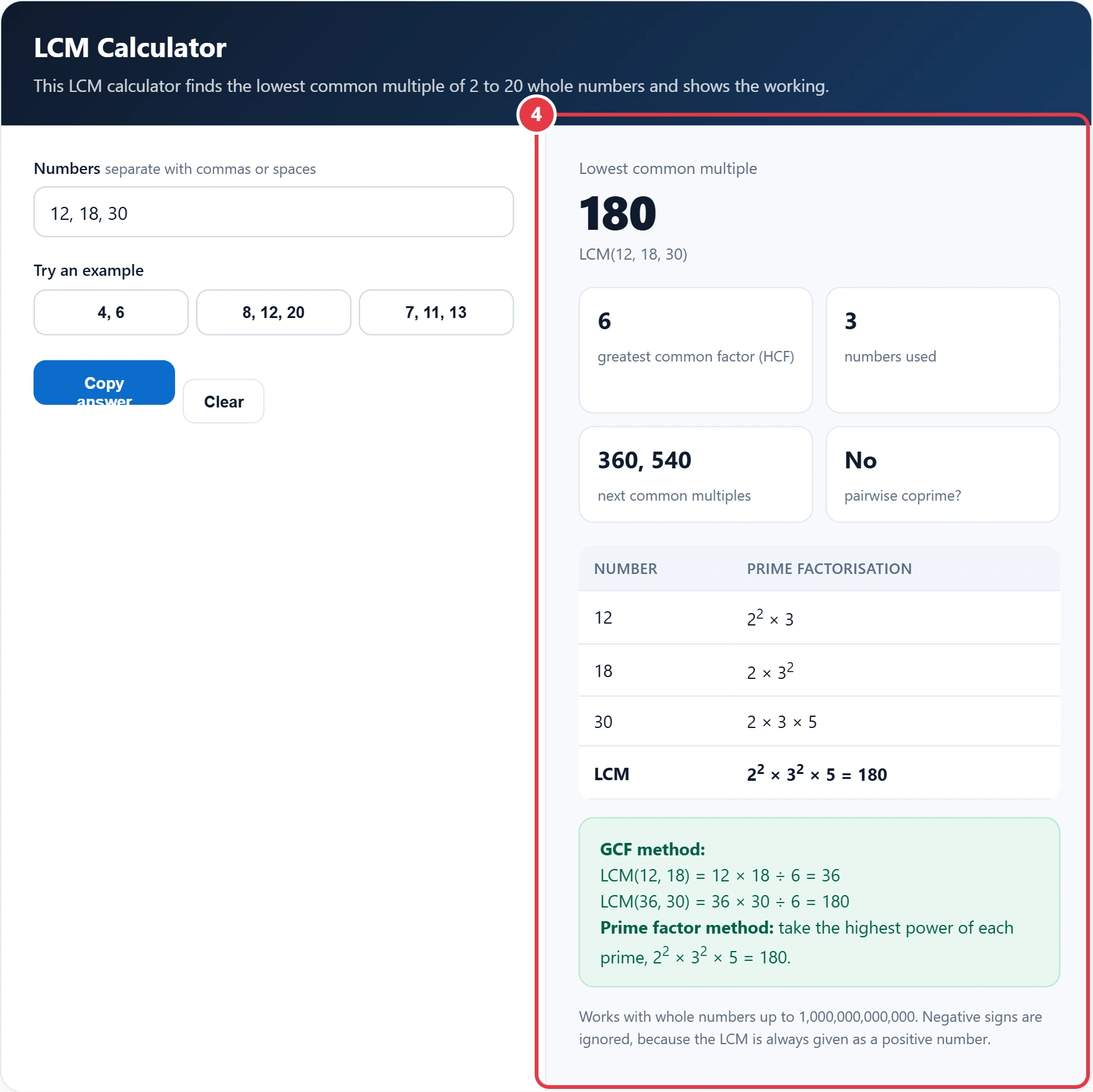
You see the LCM, the GCF, the next common multiples, a table of prime factorisations and both methods written out. If you are using the LCM as a common denominator, the fraction calculator adds and subtracts fractions with it, and the working here shows where that denominator came from.
How Do You Find the LCM Using Prime Factorisation?
To find the LCM with prime factorisation, write each number as a product of primes, take the highest power of every prime that appears, and multiply those powers together. Each prime is counted only once, at its largest power.
For 12, 18 and 30: 12 = 2² × 3, 18 = 2 × 3² and 30 = 2 × 3 × 5. The highest powers are 2², 3² and 5, so the LCM is 4 × 9 × 5 = 180. The GCF uses the lowest powers instead, which here is 2 × 3 = 6. The method works because every whole number above 1 has exactly one prime factorisation, as the fundamental theorem of arithmetic states, so the answer never depends on how you start.
| Numbers | GCF (HCF) | LCM | Quick check |
|---|---|---|---|
| 2 and 3 | 1 | 6 | 2 × 3 ÷ 1 |
| 4 and 6 | 2 | 12 | 24 ÷ 2 |
| 6 and 8 | 2 | 24 | 48 ÷ 2 |
| 8 and 12 | 4 | 24 | 96 ÷ 4 |
| 9 and 12 | 3 | 36 | 108 ÷ 3 |
| 12 and 15 | 3 | 60 | 180 ÷ 3 |
| 15 and 20 | 5 | 60 | 300 ÷ 5 |
| 6, 10 and 15 | 1 | 30 | 2 × 3 × 5 |
| 12, 18 and 30 | 6 | 180 | 2² × 3² × 5 |
When Would You Use the Least Common Multiple?
You use the least common multiple whenever things repeat on different cycles and you need to know when they line up, and when fractions need a common denominator. It also appears in gear ratios, music rhythms and rota planning.
Worked example: at Ben's local station, a bus leaves every 12 minutes, a train every 18 minutes and a coach every 30 minutes, and all three leave together at 9:00. They next leave together after LCM(12, 18, 30) = 180 minutes, at 12:00. In that time Ben would see 15 buses, 10 trains and 6 coaches, because 180 ÷ 12 = 15, 180 ÷ 18 = 10 and 180 ÷ 30 = 6.
What Is the Difference Between LCM and HCF?
The LCM is the smallest number that all your numbers divide into, while the HCF (also called the GCF or GCD) is the largest number that divides into all of them. The LCM is never smaller than the biggest input, and the HCF is never bigger than the smallest.
For two numbers they are tied together by LCM × HCF = a × b. With 8 and 12, the HCF is 4 and the LCM is 24, and 4 × 24 = 96 = 8 × 12. To simplify ratios built from these numbers, the ratio calculator divides by the HCF for you. The product rule does not hold for three or more numbers, which is why this least common multiple calculator works pair by pair.
Key Lowest Common Multiple Terms Explained
These terms explain the number facts an LCM calculator uses, from primes and factorisation to the greatest common factor and coprime numbers.
- Multiple
- The result of multiplying a whole number by 1, 2, 3 and so on. Multiples of 4 are 4, 8, 12 and 16, and the first value shared with the multiples of 6 is 12, their LCM.
- Prime factorisation
- Writing a whole number as a product of prime numbers, such as 12 equals 2 squared times 3. Taking the highest power of each prime across a set of numbers builds their lowest common multiple.
- Greatest common factor (GCF)
- The largest whole number that divides exactly into every number in a set, also called the HCF or GCD. For 12, 18 and 30 it is 6, while their LCM is 180.
- Coprime numbers
- Numbers whose only common factor is 1, such as 7, 11 and 13. Their LCM is simply their product, so the LCM of 7, 11 and 13 is 1,001.
- Euclidean algorithm
- A fast method for finding the GCF by repeatedly replacing the larger number with the remainder of dividing it by the smaller. The calculator uses it before applying LCM equals a times b divided by the GCF.
</>Embed this calculator on your website
Add the free LCM Calculator to your own site or blog. Copy the code below and paste it into an HTML block. It resizes itself and works on phones.
How we checked this tool: the Tools Veria Editorial Team built this tool by hand, checked it against the official rules or published standards where they apply, and tested it against worked examples. Results are estimates for planning, not personal financial or tax advice. Read our editorial policy and disclaimer, or report an error.
Frequently Asked Questions
What is the LCM of 12 and 18?
The LCM of 12 and 18 is 36. Their greatest common factor is 6, so 12 × 18 ÷ 6 = 216 ÷ 6 = 36. Check: 36 ÷ 12 = 3 and 36 ÷ 18 = 2, both whole numbers.
Is lowest common multiple the same as least common multiple?
Yes. Lowest common multiple is the usual term in British schools and least common multiple is common in the US. Both mean the smallest positive number that every number in the set divides into exactly.
What is the LCM of two prime numbers?
The LCM of two different prime numbers is their product, because they share no factors other than 1. For example, the LCM of 7 and 11 is 77, and the LCM of 3 and 5 is 15.
Can the LCM be one of the numbers?
Yes. If one number divides exactly into another, the larger number is the LCM. The LCM of 6 and 18 is 18, and the LCM of 4, 8 and 16 is 16.
Can you find the LCM of decimals or fractions?
The LCM is defined for whole numbers. For fractions, a common method is the LCM of the numerators divided by the HCF of the denominators, but most homework only needs the LCM of the denominators to add fractions.
What is the LCM of 0 and another number?
The LCM involving 0 is usually left undefined for school maths, because 0 has no positive multiples. Some textbooks define it as 0. This calculator asks you to remove the zero instead.