Statutory annual leave in days or hours, for a full or part leave year.
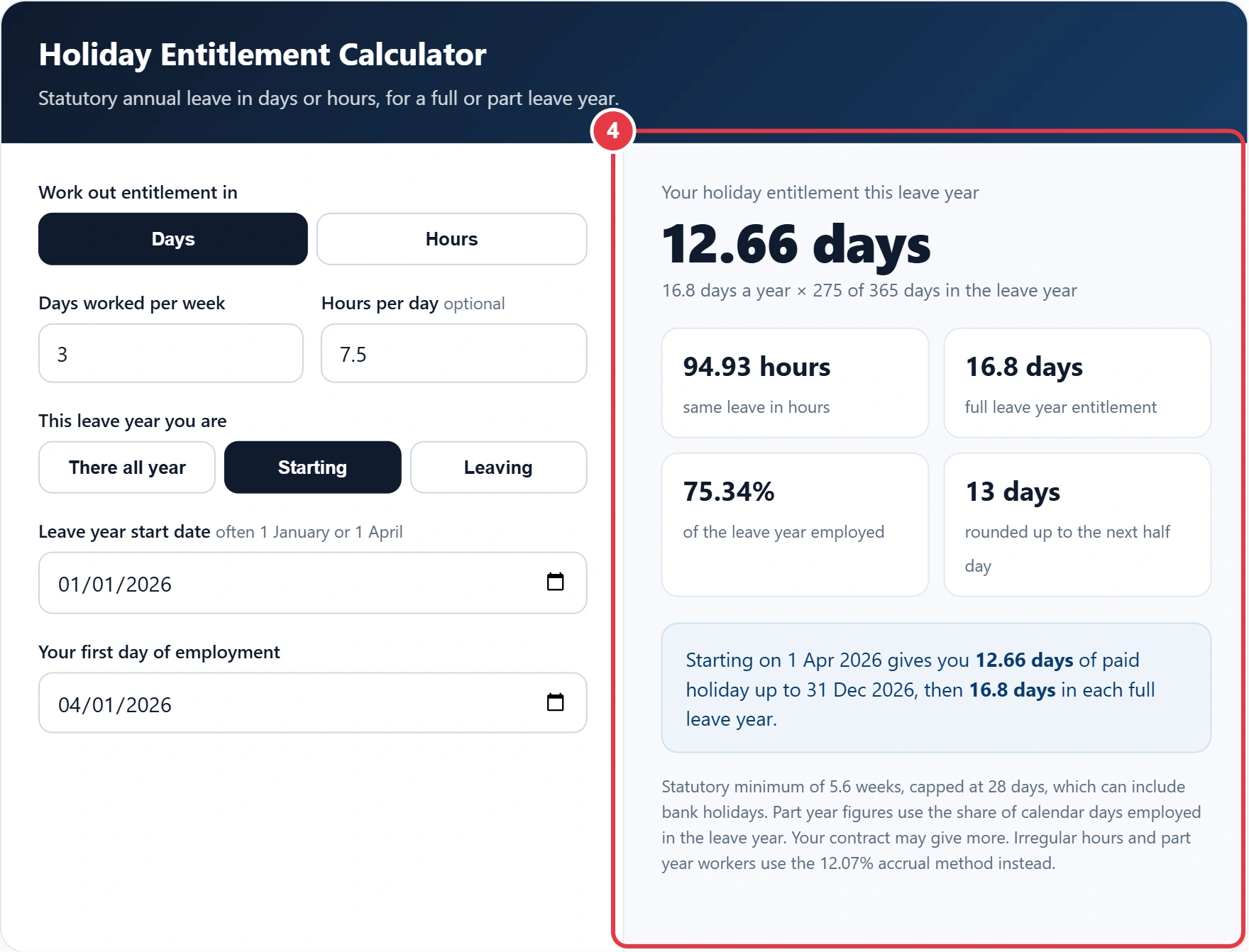
Statutory minimum of 5.6 weeks, capped at 28 days, which can include bank holidays. Part year figures use the share of calendar days employed in the leave year. Your contract may give more. Irregular hours and part year workers use the 12.07% accrual method instead.
Starting a new job in April, leaving in August, or moving to a three day week? This holiday entitlement calculator works out your statutory annual leave in days or hours, using the GOV.UK method for workers on different contracts to pro rata your leave when you only work part of the leave year. Leavers also see how much holiday they still have to take or be paid for.
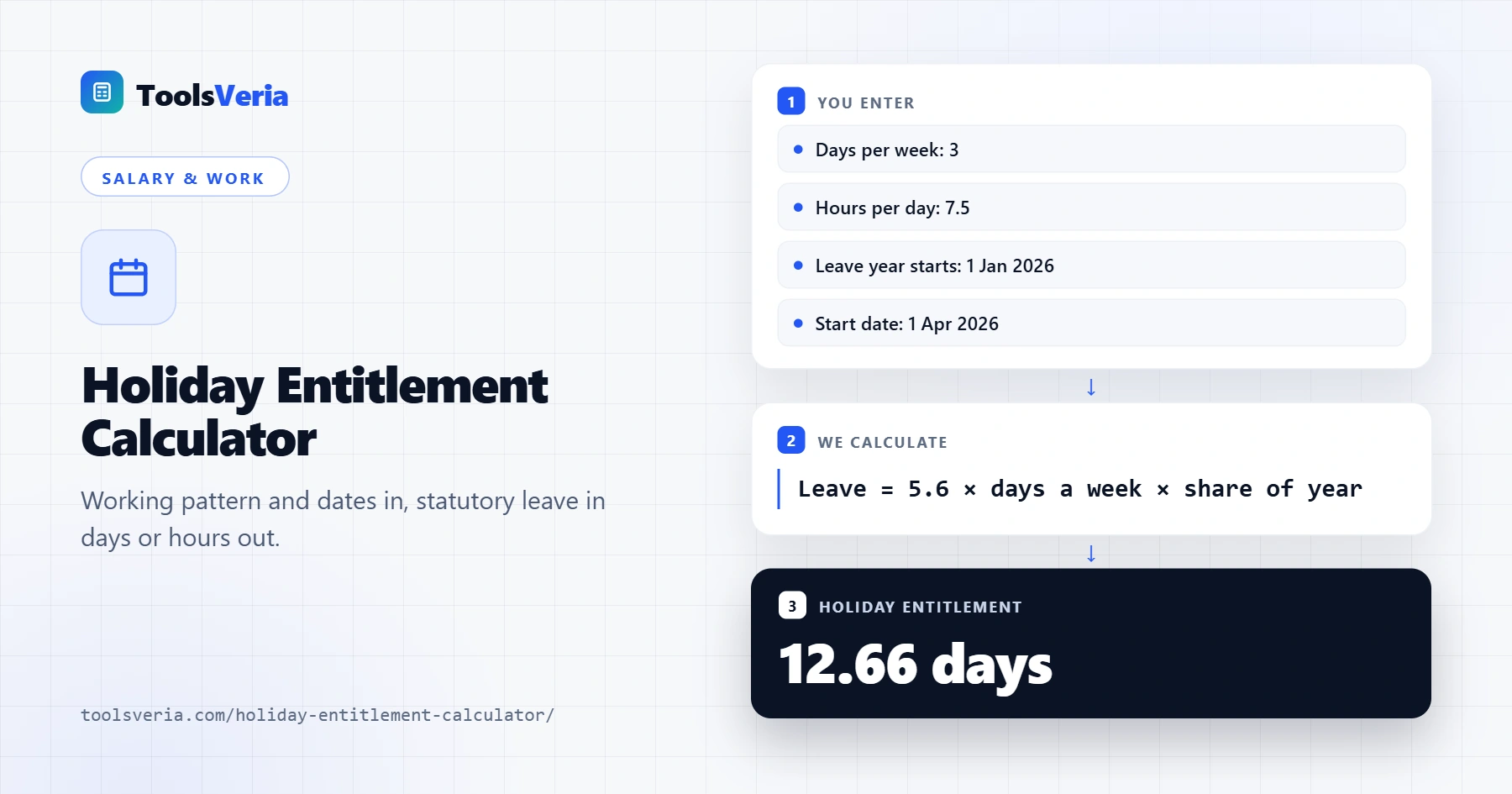
Quick answer: A holiday entitlement calculator applies the UK rule of 5.6 weeks of paid holiday each leave year: 5.6 × days worked per week, capped at 28 days. A five day worker gets 28 days and a three day worker gets 16.8 days. Starters and leavers get full entitlement × days employed ÷ days in the leave year.
In This Guide
What Is Holiday Entitlement?
Almost every UK worker is entitled to 5.6 weeks of paid holiday each leave year. On a fixed pattern that is 5.6 × days worked per week, capped at 28 days, so a five day worker gets 28 days and a three day worker gets 16.8 days. In hours, the days figure is multiplied by your average working day, so 22.5 hours over three days gives 126 hours.
If you start or leave part way through the leave year, the full entitlement is multiplied by the share of the year you are employed: full entitlement × days employed ÷ days in the leave year. Someone on three days a week who starts on 1 April in a January leave year is employed for 275 of 365 days, so they get 16.8 × 275 ÷ 365 = 12.66 days.
How Do You Use the Holiday Entitlement Calculator?
Step 1: Choose Days or Hours
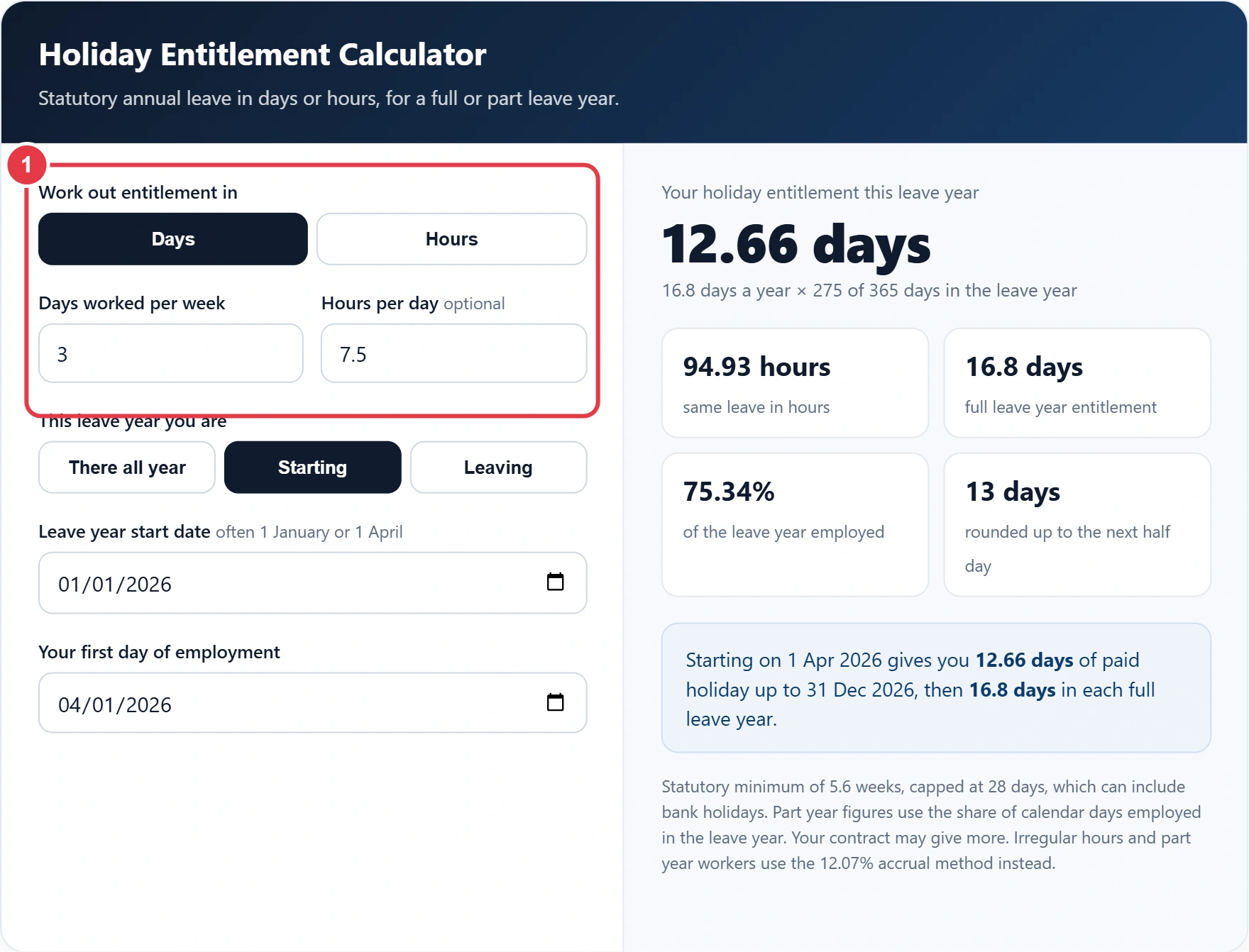
Pick Days if your contract states days per week, or pick Hours if it states weekly hours, then enter how many days those hours are spread over. Pick Days if your contract states days per week, then add your usual hours per day to see the hours figure as well. Pick Hours if your contract states weekly hours, and enter how many days those hours are spread over.
Step 2: Choose Your Situation
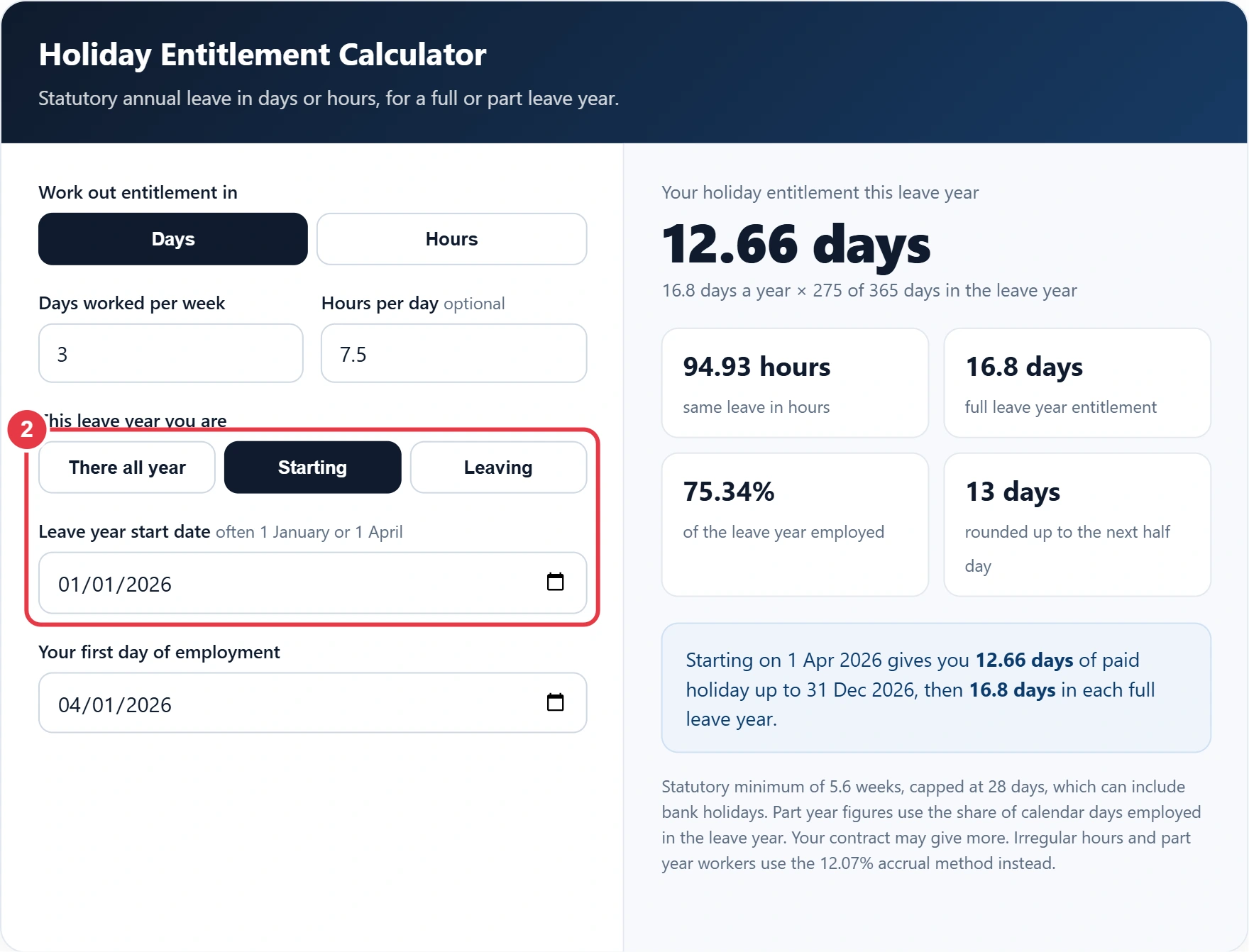
Select There all year, Starting or Leaving, then enter the date your leave year begins. Your contract or staff handbook states it. If it does not, the leave year starts on the anniversary of your first day.
Step 3: Add Your Dates
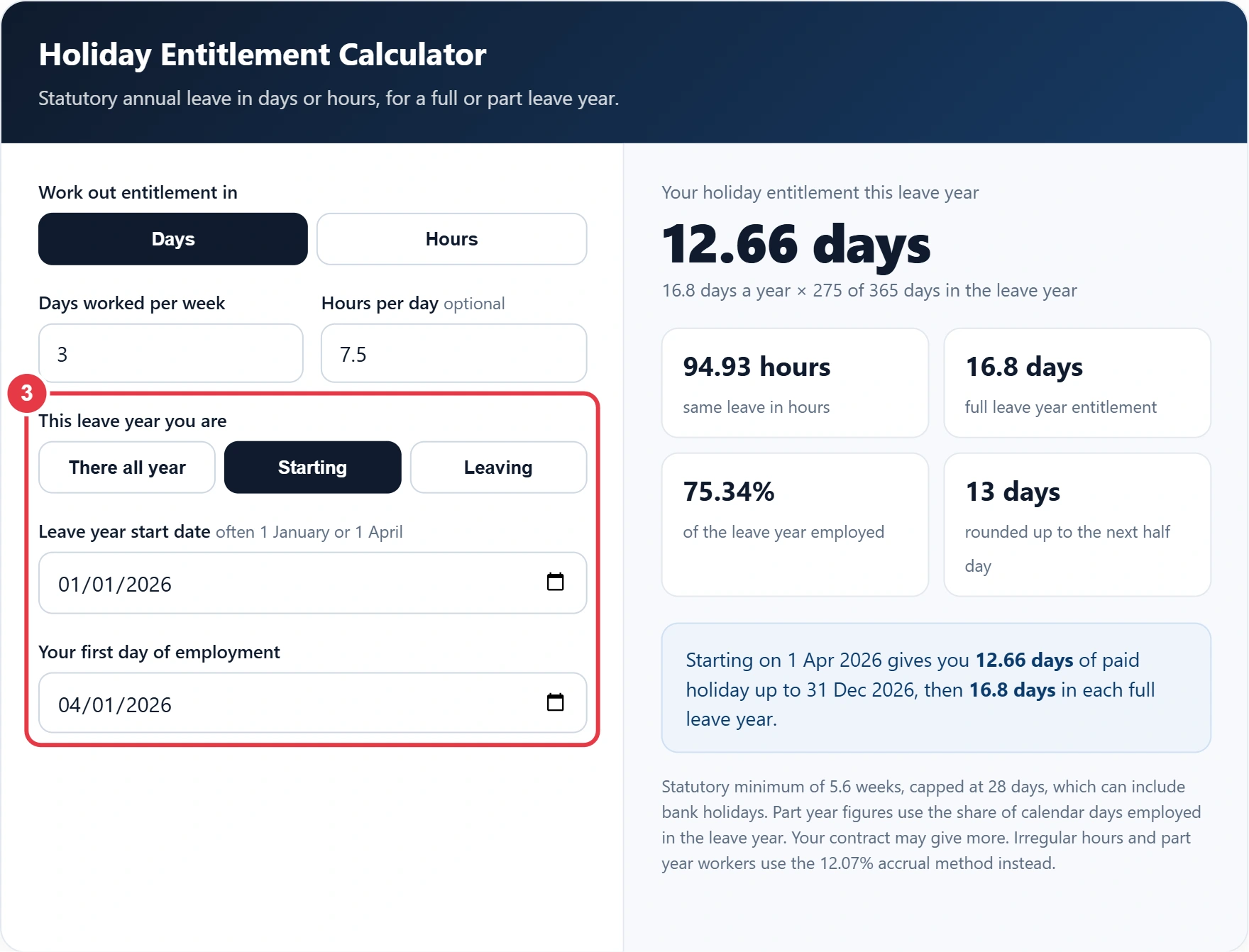
Starters enter their first day of employment. Leavers enter their last day and the holiday already taken this leave year, in days or hours. To count working days between two dates, the working days calculator handles weekends and bank holidays for you.
Step 4: Read Your Results
You will see your entitlement for the period, the same figure in the other unit, your full year entitlement, the share of the year employed and the figure rounded up to the next half day. To put a pound value on that leave, the holiday pay calculator multiplies your days or hours by your rate of pay. Leavers also see the balance still owed or the amount overtaken.
How Much Holiday Entitlement Do You Get?
| Situation | Calculation | Entitlement |
|---|---|---|
| 5 days a week, full year | 5.6 × 5 | 28 days |
| 3 days a week, full year | 5.6 × 3 | 16.8 days |
| 37.5 hours over 5 days | 28 days × 7.5 hours | 210 hours |
| 3 days, starts 1 April | 16.8 × 275 ÷ 365 | 12.66 days |
| 5 days, leaves 30 June | 28 × 181 ÷ 365 | 13.88 days |
Statutory entitlement is 5.6 times your working days, so a full year at 5 days a week gives 28 days and 3 days a week gives 16.8 days. Employers can round entitlement up but should not round it down. When you leave, any statutory holiday you have earned but not taken must be paid in your final pay, and Acas explains how holiday entitlement works if you need to raise a query with your employer.
</>Embed this calculator on your website
Add the free Holiday Entitlement Calculator to your own site or blog. Copy the code below and paste it into an HTML block. It resizes itself and works on phones.
How we checked this tool: the Tools Veria Editorial Team built this tool by hand, checked it against the official rules or published standards where they apply, and tested it against worked examples. Results are estimates for planning, not personal financial or tax advice. Read our editorial policy and disclaimer, or report an error.
Frequently Asked Questions
How is holiday entitlement calculated in the UK?
Multiply 5.6 weeks by the days you work each week, up to a maximum of 28 days. Five days a week gives 28 days and three days gives 16.8 days.
How do I work out holiday if I start part way through the year?
Multiply your full year entitlement by the days you are employed in the leave year, divided by the days in that leave year. Starting on 1 April in a January leave year on five days gives 28 × 275 ÷ 365 = 21.1 days.
How do I calculate holiday entitlement in hours?
Work out the entitlement in days, then multiply it by the average length of your working day. For example, 28 days × 7.5 hours is 210 hours.
Do bank holidays count towards my 28 days?
They can. Employers may include the eight bank holidays in England and Wales within the 5.6 weeks, or give them on top.
What happens to unused holiday when I leave?
Your employer must pay you for statutory holiday you have earned but not taken by your leaving date. Your contract may also let them deduct pay for holiday taken in excess.
Does the 28 day cap apply to part time workers?
The cap only matters if you work more than five days a week. Part time workers get 5.6 times their working days, which is always below 28.