Daniel was dismissed from a Sheffield logistics firm on 9 October 2026. Aisha, a sales assistant in Cardiff, was refused a promotion on 22 September 2026 in a decision she believes was discriminatory. Only thirteen working days separate the two events, yet the employment tribunal time limit for Daniel is twice as long as Aisha’s, because the law changed in between.
Deadlines decide more tribunal cases than people expect, since a claim that arrives a day late can be thrown out before anyone looks at the facts. Below we work both cases through to an exact final date, including the Acas early conciliation step that trips up many hand calculations.
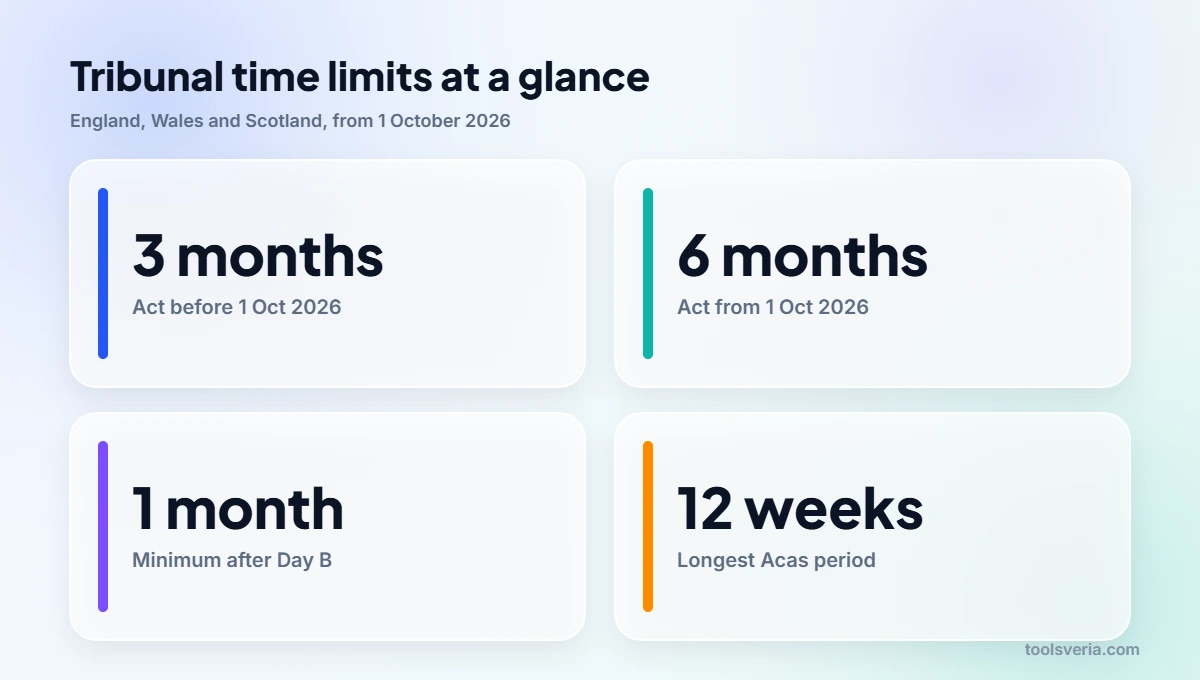
Quick answer: For acts or dismissals on or after 1 October 2026, the employment tribunal time limit is 6 months less one day; before that date it is 3 months less one day, as GOV.UK and Acas confirm. You must contact Acas within the limit, and early conciliation then extends it, always leaving at least one month after your certificate.
In This Guide
What is the employment tribunal time limit in 2026?
The employment tribunal time limit for most claims in England, Wales and Scotland is 6 months less one day where the act or dismissal happened on or after 1 October 2026, and 3 months less one day where it happened before. The longer limit comes from the Employment Rights Act 2025 and covers unfair dismissal, discrimination, unlawful deductions from wages and most other common claims.
What counts is the date of the thing you are complaining about, not the date you file. The transitional rule in regulation 4 of the 2026 commencement regulations says the new limit does not apply where this relevant date falls before 1 October 2026. For a run of linked acts, such as repeated harassment, the relevant date is the last act in the series, so a pattern that began in August and ended on 5 October 2026 gets the 6 month limit.
| Type of claim | Act before 1 October 2026 | Act on or after 1 October 2026 |
|---|---|---|
| Unfair dismissal | 3 months less one day | 6 months less one day |
| Discrimination | 3 months less one day | 6 months less one day |
| Unlawful deductions from wages | 3 months less one day | 6 months less one day |
| Breach of contract, England and Wales | 3 months less one day | 6 months less one day |
| Breach of contract, Scotland | 3 months less one day | 6 months less one day from 9 November 2026 |
| Statutory redundancy pay | 6 months less one day | 6 months less one day |
| Equal pay | 6 months less one day | 6 months less one day |
How do you count 3 or 6 months less one day?
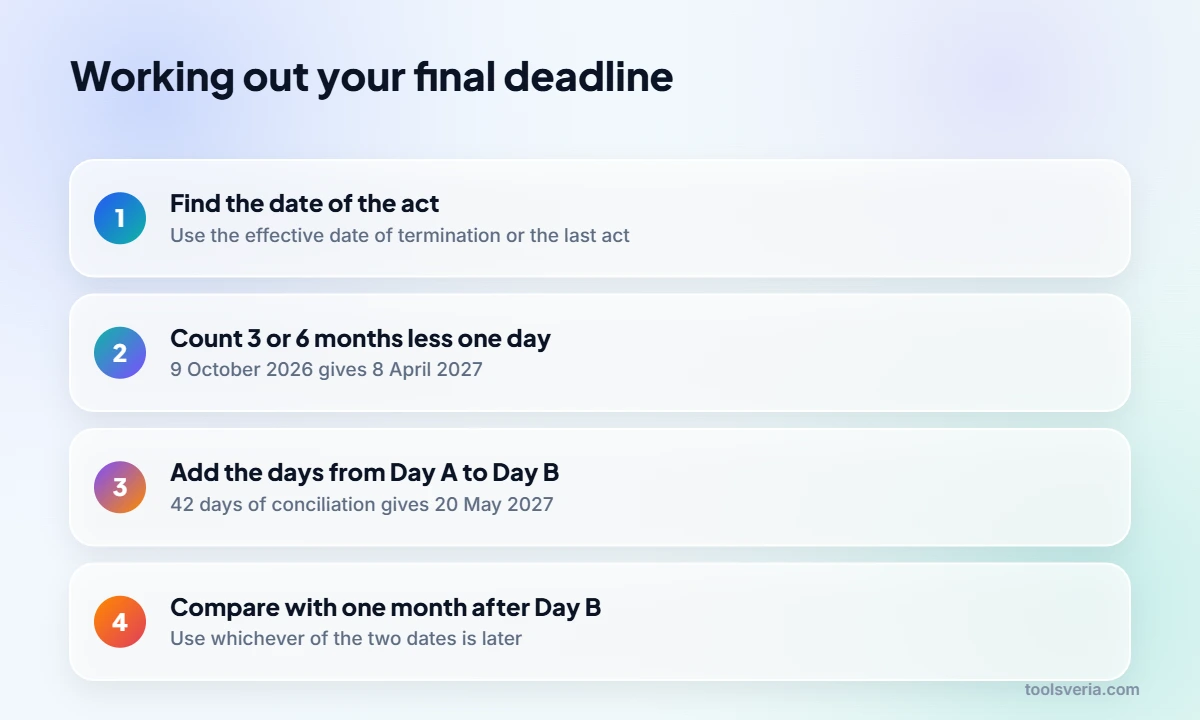
To count the limit, go to the same date 3 or 6 months after the act or dismissal and step back one day. A dismissal on 9 October 2026 therefore has a 6 month limit ending on 8 April 2027, and an act on 22 September 2026 has a 3 month limit ending on 21 December 2026.
For dismissal claims the start point is the effective date of termination. That is your last day if you worked your notice, or the day you were told if you were dismissed without notice or paid in lieu, and it can differ from the date on your P45. Our notice period calculator helps you pin down when notice actually ran out before you start counting.
| Date of act or dismissal | Limit that applies | Original deadline |
|---|---|---|
| 22 September 2026 | 3 months less one day | 21 December 2026 |
| 30 September 2026 | 3 months less one day | 29 December 2026 |
| 1 October 2026 | 6 months less one day | 31 March 2027 |
| 9 October 2026 | 6 months less one day | 8 April 2027 |
| 15 January 2027 | 6 months less one day | 14 July 2027 |
The original deadline is also the last day to contact Acas. Miss it, and conciliation cannot rescue the claim.
How does Acas early conciliation extend the deadline?
Acas early conciliation extends the employment tribunal time limit in two steps, set out in section 207B of the Employment Rights Act 1996, and they must be applied one after the other. Day A is the date Acas receives your notification and Day B is the date you receive, or are treated as receiving, the early conciliation certificate.
- Step one: add the number of days from Day A to Day B to your original deadline.
- Step two: if that new date lands before one month after Day B, your deadline becomes one month after Day B instead.
Daniel: dismissed after the change
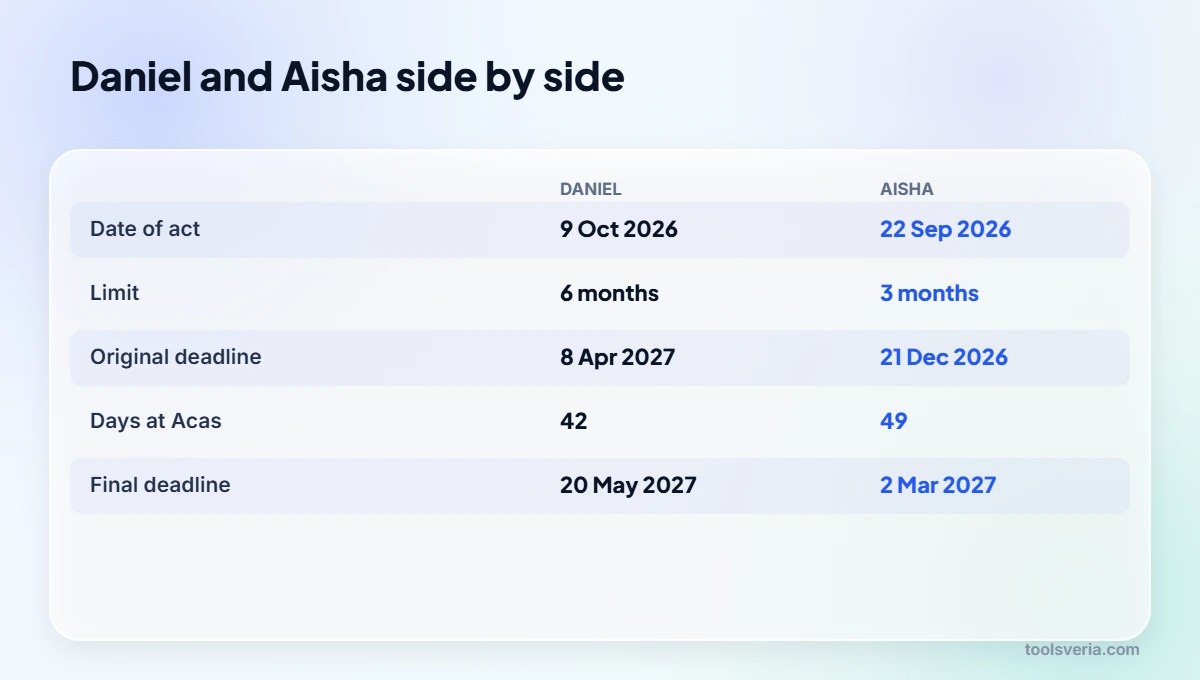
Daniel’s 6 month limit ends on 8 April 2027. He spends some weeks trying an internal appeal, then notifies Acas on 2 February 2027 (Day A) and receives his certificate on 16 March 2027 (Day B), 42 days later. Adding 42 days to 8 April gives 20 May 2027. One month after Day B is only 16 April 2027, so step two changes nothing and his final deadline is 20 May 2027.
Aisha: an act before the change
Aisha’s 3 month limit ends on 21 December 2026. She contacts Acas on 15 December 2026, just in time, and her certificate arrives on 2 February 2027, 49 days later. Step one gives 8 February 2027, but that falls before 2 March 2027, one month after Day B, so step two moves her final deadline to 2 March 2027.
Since 1 December 2025 conciliation can last up to 12 weeks, so a certificate may take far longer than the old six weeks. The days between dates calculator counts the gap from Day A to Day B exactly, which is the number you add in step one.
What happens if you miss the tribunal time limit?
If you miss the employment tribunal time limit, your claim will usually be rejected unless the tribunal agrees to extend time, and extensions are hard to win. The test depends on the claim: for unfair dismissal and wages you must show it was not reasonably practicable to claim in time, while for discrimination the tribunal asks whether an extension would be just and equitable.
Three things do not stop the clock. An internal grievance or appeal runs alongside the deadline rather than pausing it, as Daniel’s case shows. Not knowing about the limit rarely persuades a tribunal. And contacting Acas after the original deadline has passed gives no extension at all, because Day A must fall inside the limit.
Waiting for a final payslip does not help either. If your dismissal also raises a redundancy question, our redundancy pay calculator shows what you are owed, and the 6 month limit for that claim already applied before October 2026.
How can you protect your deadline?
The safest way to protect your deadline is to note the date of the act or dismissal, contact Acas well before the original limit, and submit your ET1 claim well before the final date rather than on it. The GOV.UK guide to employment tribunals explains how to submit the claim form online, which you can do on any day, including weekends.
- Write down the effective date of termination or the date of the last act straight away.
- Keep the early conciliation certificate safe, because its number goes on the ET1.
- Check whether an email certificate counts as received on the day it was sent.
- Ask Acas, Citizens Advice, a trade union or an employment solicitor if more than one claim is involved, since each can have its own date.
Key points
- Acts or dismissals on or after 1 October 2026 have an employment tribunal time limit of 6 months less one day.
- Acts before 1 October 2026 keep the 3 months less one day limit, even if the claim is made later.
- You must notify Acas before the original limit ends, or early conciliation gives no extension.
- The days from Day A to Day B are added first, then the deadline is moved to one month after Day B if that is later.
- Breach of contract claims in Scotland moved to the 6 month limit on 9 November 2026.
Employment Tribunal Time Limits: Key Terms Explained
These terms explain how employment tribunal time limits are counted, extended and applied, so you can work out an exact final date for your own claim.
- Relevant date
- The date of the act or dismissal that a claim is about, which decides both when the clock starts and whether the older or newer limit applies. Filing date is irrelevant; only the date of the complained-of event counts.
- Transitional provision
- A rule in commencement regulations that sets out how a legal change treats events straddling the switchover. Here, regulation 4 keeps the three month limit for any relevant date falling before 1 October 2026.
- Continuing act
- A connected series of acts, such as repeated harassment or a run of unlawful deductions, treated as one course of conduct. Time runs from the final act in the series rather than from the first incident.
- Employment Rights Act 2025
- The statute that lengthened the standard tribunal time limit from three months less one day to six months less one day. Its commencement regulations bring the change into force for acts on or after 1 October 2026.
- Unlawful deduction from wages
- A claim that an employer paid less than was properly owed, such as missing pay, holiday pay or commission, without lawful authority or written consent. Where deductions repeat, the limit counts from the last deduction in the series.
- Out of time claim
- A claim presented after the deadline has passed. A tribunal may refuse to hear it without examining the merits, unless the claimant persuades the judge that a statutory test for extending time is met.
Frequently Asked Questions
I was dismissed on 30 September 2026. Do I get the new 6 months?
No, a dismissal on 30 September 2026 falls before the 1 October change, so the 3 month limit applies and ends on 29 December 2026. Acas early conciliation can still extend that date if you notify Acas on or before 29 December.
My grievance appeal is still running. Should I wait for the outcome?
No, an internal grievance or appeal does not pause the employment tribunal time limit. Contact Acas inside your 3 or 6 month limit while the appeal continues, because the conciliation period then extends your deadline in a way the appeal never will.
Acas took 12 weeks to issue my certificate. Do I lose that time?
No, every day from Day A to Day B is added to your original deadline, so 84 days of conciliation adds 84 days. You also always get at least one month after Day B to submit your ET1.
The harassment started in August but the last incident was in October. Which limit applies?
The 6 month limit applies if the last act in the series happened on or after 1 October 2026. For a linked series the clock starts from the final act, so an incident on 5 October 2026 gives a limit ending on 4 April 2027.
Daniel now has until 20 May 2027 and Aisha until 2 March 2027, two very different dates produced by the same rules. Work out your own deadline as soon as the dispute begins, contact Acas early, and get advice from Acas, Citizens Advice or a solicitor if your case is complicated, because this guide is general information and not legal advice. Figures checked October 2026.