Estimate the motor vehicle excise your city or town will bill, including proration and abatement.
| Calendar year | Factor | Full year excise |
|---|
Estimate only, check with your local assessor. Rules from Massachusetts General Laws chapter 60A section 1 and the Division of Local Services guide, checked October 2026. Your bill uses the list price on record for your exact vehicle.
This Massachusetts excise tax calculator estimates the motor vehicle excise bill that a Massachusetts city or town sends to car, truck and motorcycle owners for 2026, using the state rate of $25 per $1,000 of value. Enter the manufacturer's list price and the model year, and it shows the value used, the full year bill, the prorated bill if you registered the vehicle part way through the year and the abatement you can claim after a sale.
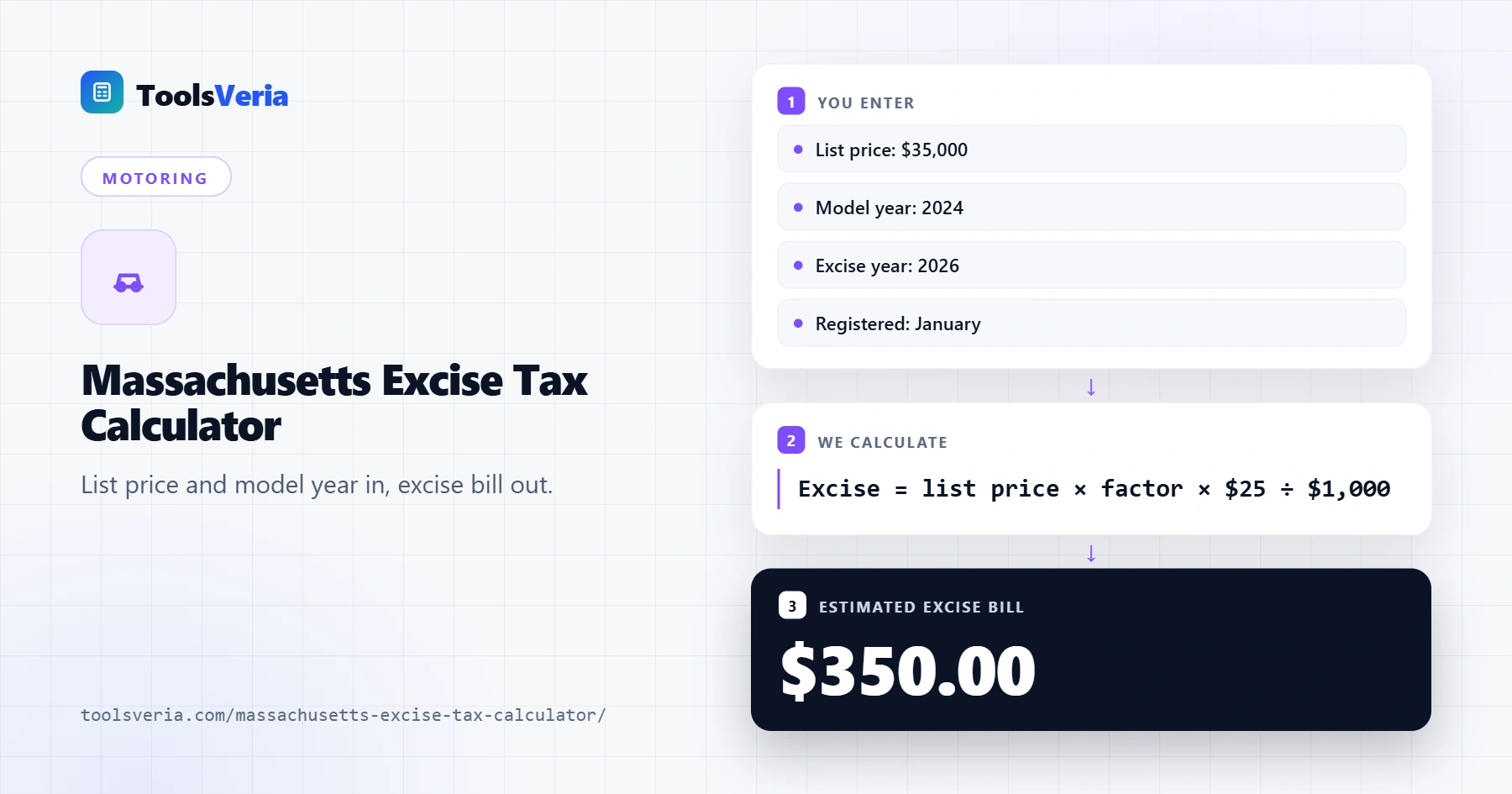
Quick answer: Massachusetts excise is $25 for every $1,000 of value, and value is the list price times an age factor: 50%, 90%, 60%, 40%, 25%, then 10%. The Massachusetts excise tax calculator shows a $35,000 car in its third calendar year owes $35,000 × 40% × 2.5% = $350.
In This Guide
What Is the Massachusetts Motor Vehicle Excise?
The motor vehicle excise is an annual local tax on every vehicle registered in Massachusetts, billed by the community where the vehicle is garaged and paid in place of personal property tax. In plain words: multiply the manufacturer's list price by the factor for the vehicle's age, then multiply by 0.025. The rate of $25 per $1,000 is the same in every city and town, set by state law in chapter 60A of the General Laws.
Two details catch people out, and the Massachusetts excise tax calculator handles both. First, the value comes from the manufacturer's suggested list price for that make, model and year, not what you paid, so a big dealer discount or a cheap private sale does not lower the bill. Second, the age factor follows the calendar year, not the date you bought the car, so a 2024 model is in its third year for every bill dated 2026.
How to Use the Massachusetts Excise Tax Calculator
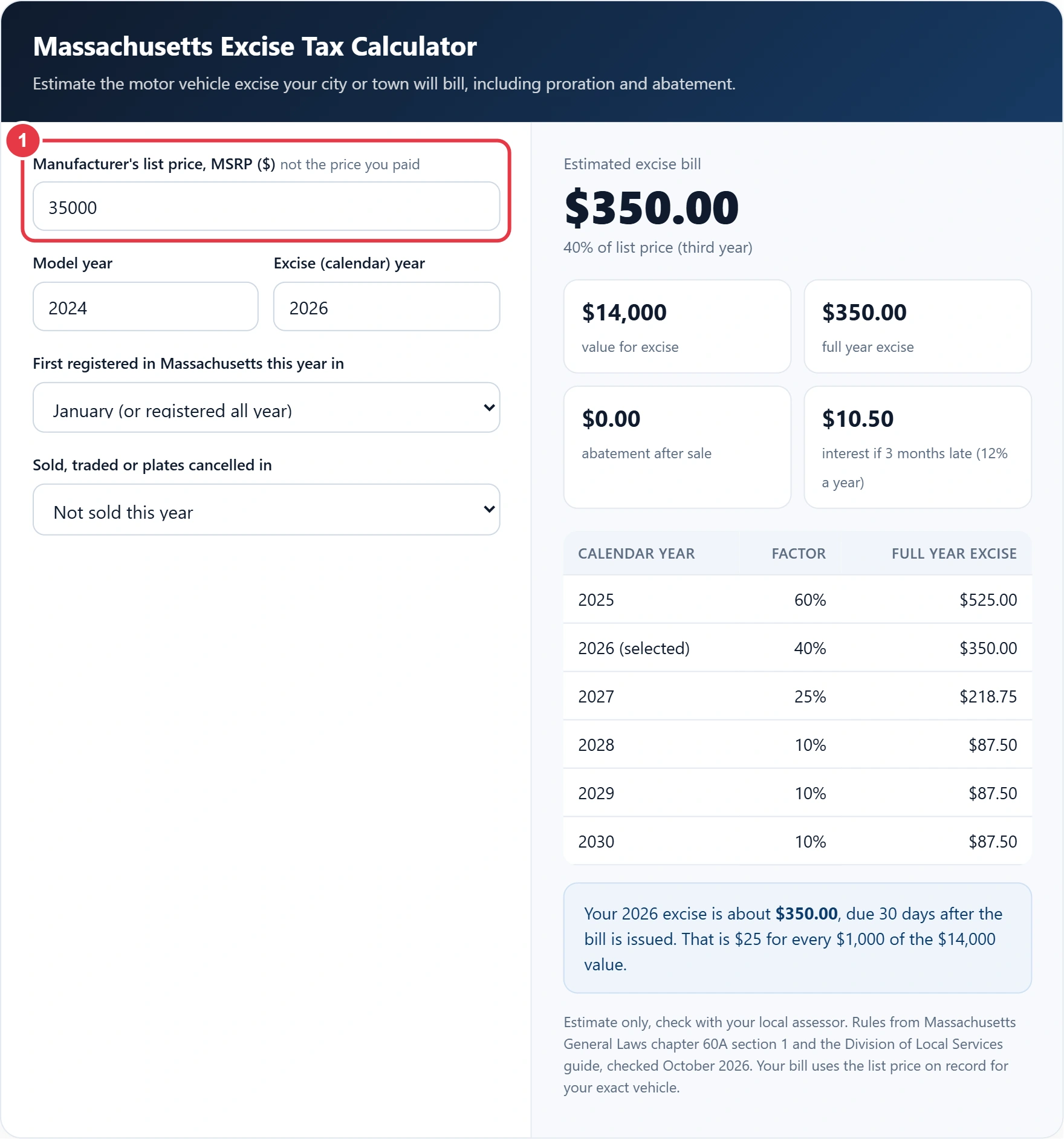
Step 1: Enter the List Price
Type the original MSRP for your exact trim, which you can find on the window sticker, the dealer invoice or last year's excise bill, where it is printed as the valuation base.
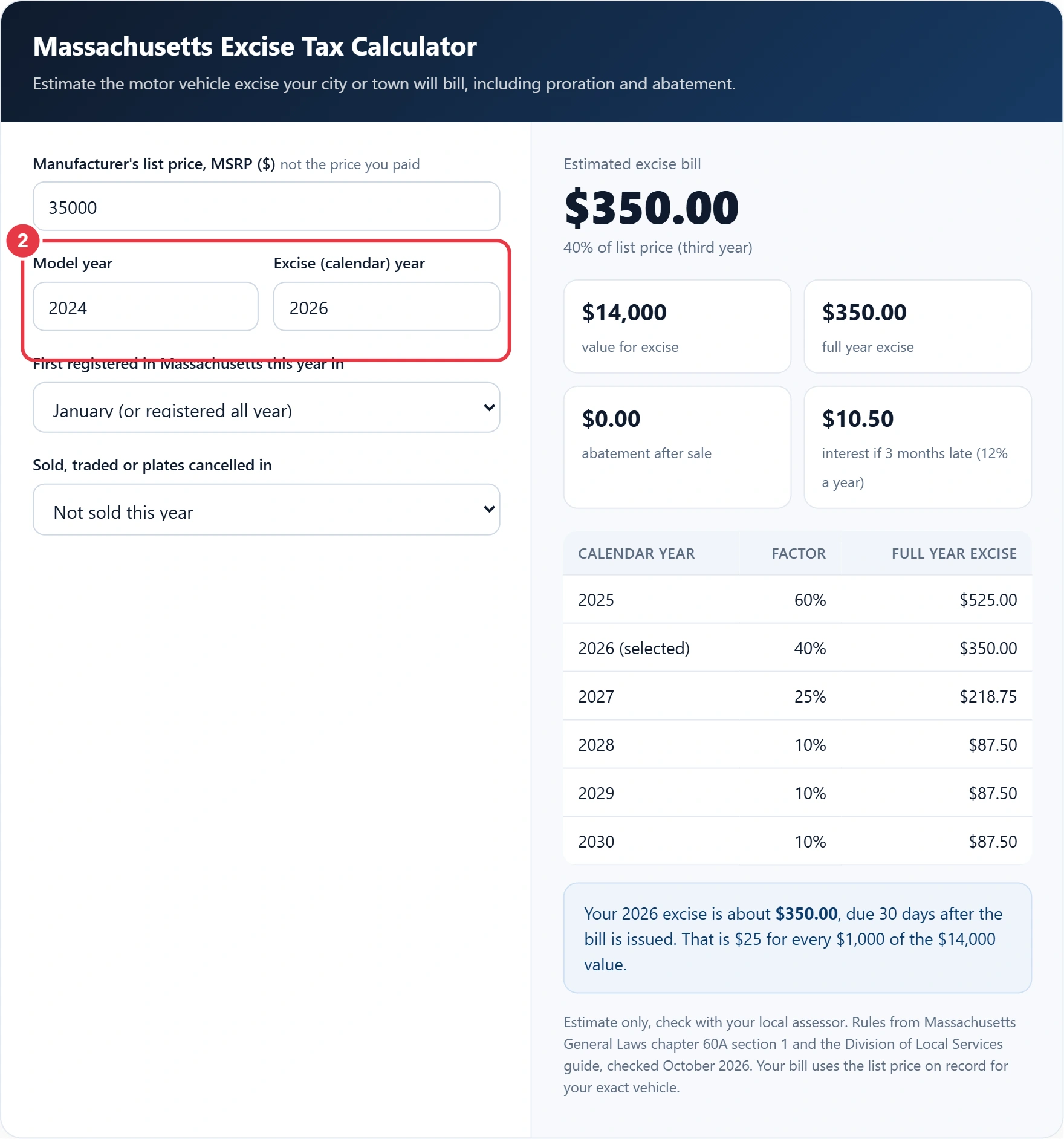
Step 2: Enter the Model Year and Excise Year
The model year sets the age factor. If you are not sure of it, the 10th character of the VIN tells you, and the VIN model year decoder reads it for you. Leave the excise year at 2026 for this year's bill, or change it to see a past or future year.
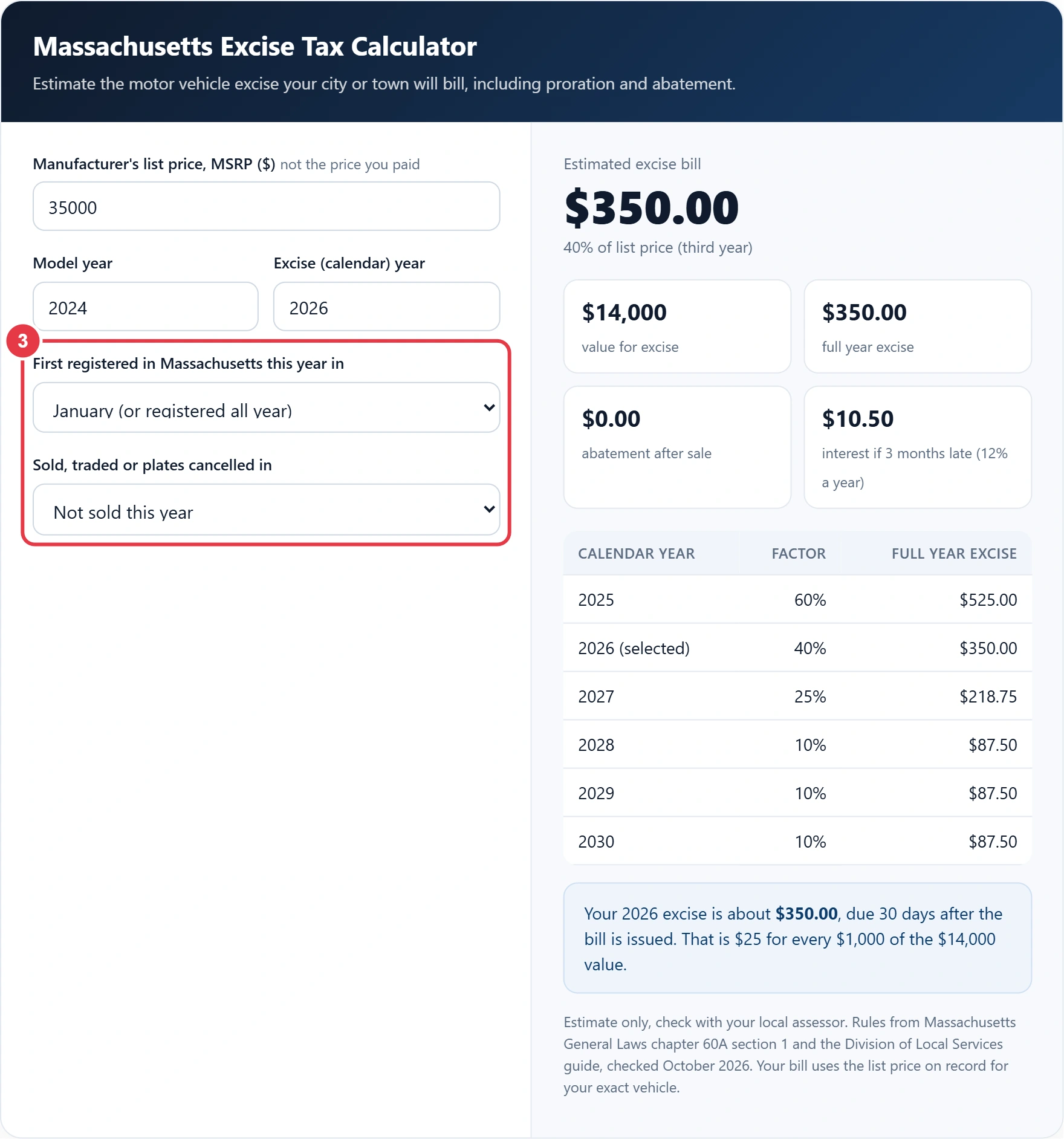
Step 3: Add Registration and Sale Months
Leave January selected for a vehicle registered all year. Choose a later month if you first registered it this year, and choose a sale month if you sold it, traded it in, had it written off or cancelled the plates.
Step 4: Read Your Bill
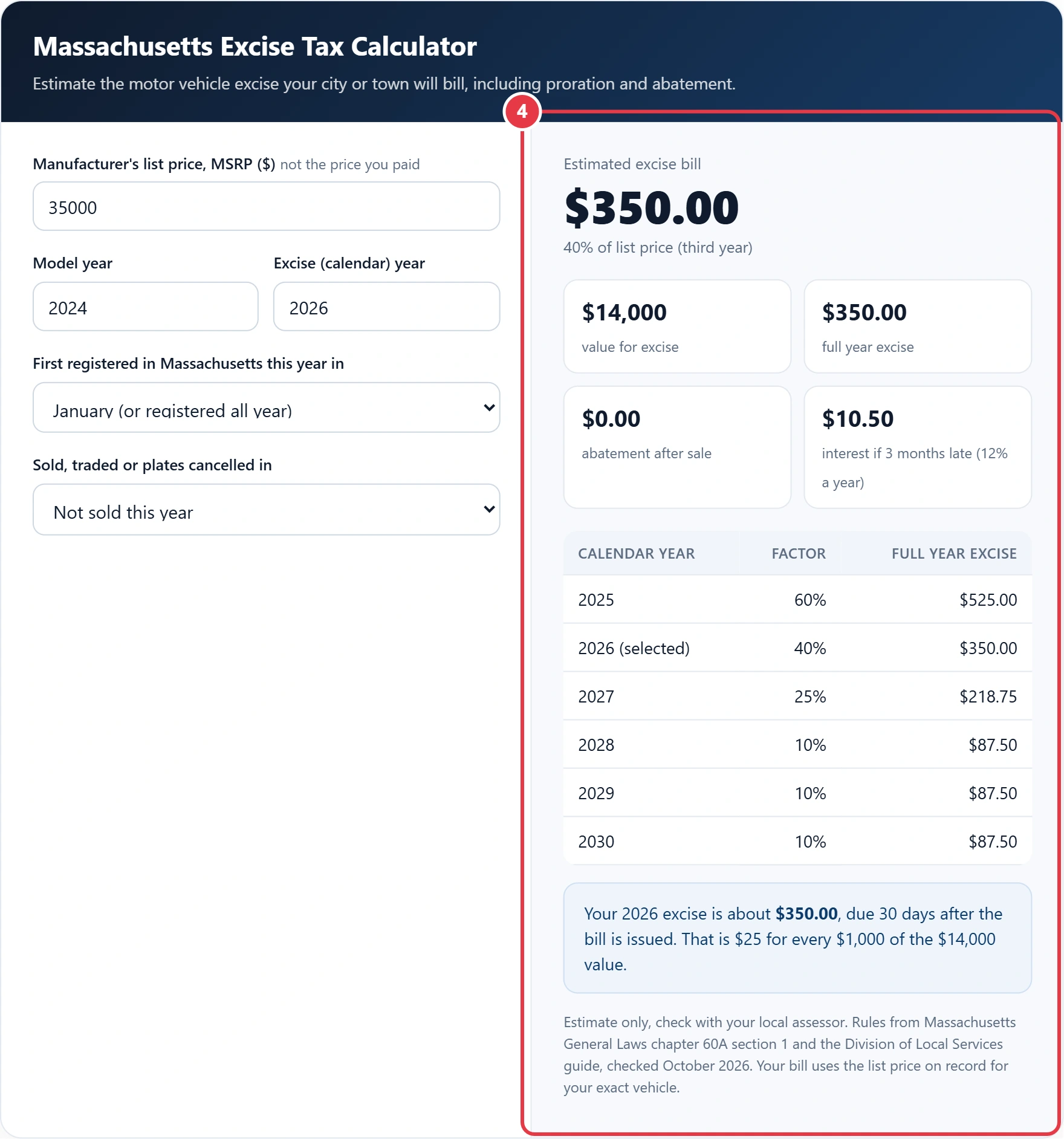
The headline is the excise you owe after any proration and abatement. The table shows the full year bill for six calendar years, so you can see the drop from 90% to 10% as the vehicle ages.
How Is Excise Tax Calculated in Massachusetts?
Excise is calculated as list price × age factor × $25 ÷ $1,000, with a minimum bill of $5. Worked example: Dana in Worcester drives a 2024 SUV with a list price of $35,000. For 2026 it is in its third year, so the value is 40% of $35,000, which is $14,000, and the excise is 14 × $25 = $350. In 2027 the factor falls to 25% and the bill to $218.75.
| Calendar year of the bill | Value as % of list price | Excise on a $35,000 list price |
|---|---|---|
| Year before the model year | 50% | $437.50 |
| Model year | 90% | $787.50 |
| Second year | 60% | $525.00 |
| Third year | 40% | $350.00 |
| Fourth year | 25% | $218.75 |
| Fifth year and later | 10% | $87.50 |
How Much Excise Do You Pay on a New Car Bought Mid Year?
You pay only for the months from the registration month to December, so a car first registered in April is billed for 9 of 12 months. If Dana had registered a brand new 2026 model with the same $35,000 list price in April 2026, the full year figure would be $787.50 and the prorated bill $590.63. The Massachusetts excise tax calculator applies this when you pick the registration month.
Do You Get Excise Tax Back When You Sell Your Car?
Yes, you can apply for an abatement for each full month left after the month you sold the car or cancelled the plates. Sell Dana's SUV in August 2026 and the four months from September to December are abated: 4 ÷ 12 × $350 = $116.67, leaving $233.33. You must also cancel or transfer the plates with the Registry of Motor Vehicles and apply to your local assessors with the bill of sale and plate return receipt. An abatement under $5 is not granted, and nothing is abated for a December sale.
When Is Massachusetts Excise Due and What If You Pay Late?
Excise is due 30 days after the bill is issued, even if you have applied for an abatement. Late bills add interest at 12% a year from the due date plus collection charges, and unpaid excise can stop you renewing your licence and registration. Count the 30 days from the issue date with the days between dates calculator so a bill that arrives late in the post is not missed.
Some owners are exempt, including certain disabled veterans, people with qualifying disabilities and some charities, so ask your assessors if that may apply. For federal returns, the IRS rules on deductible taxes allow a yearly tax based only on a car's value to count as personal property tax if you itemise, and the Massachusetts excise is value based. Figures checked October 2026.
</>Embed this calculator on your website
Add the free Massachusetts Excise Tax Calculator to your own site or blog. Copy the code below and paste it into an HTML block. It resizes itself and works on phones.
How we checked this tool: the Tools Veria Editorial Team built this tool by hand, checked it against the official rules or published standards where they apply, and tested it against worked examples. Results are estimates for planning, not personal financial or tax advice. Read our editorial policy and disclaimer, or report an error.
Frequently Asked Questions
What is the excise tax rate in Massachusetts?
The Massachusetts motor vehicle excise rate is $25 for every $1,000 of value, which equals 2.5%. It is the same in every city and town because it is set by state law, and the minimum bill is $5.
Is Massachusetts excise based on what I paid for the car?
No. Excise uses the manufacturer's list price for the make, model and year, not the price you paid. A $35,000 list price car bought for $30,000 is still valued from $35,000, times the factor for its age.
How much is excise on a 10 year old car in Massachusetts?
A car in its fifth calendar year or later is valued at 10% of its original list price. A car with a $30,000 list price is valued at $3,000, so the excise is $75 a year for as long as it stays registered.
Do I pay excise if I move out of Massachusetts?
You can claim an abatement for the months after you register the vehicle in your new state and cancel the Massachusetts registration. Apply to the assessors of the town that billed you, with proof of the new registration and plate cancellation.
When is Massachusetts excise tax due?
Massachusetts excise is due 30 days after the bill is issued. Late payment adds 12% annual interest from the due date plus collection charges, and continued non payment can block renewal of your licence and registration.
Is Massachusetts excise tax deductible?
The value based Massachusetts excise generally counts as a deductible personal property tax on your federal return if you itemise deductions. It sits within the state and local tax deduction limit, so many people who take the standard deduction get no benefit.