Exact ICAO standard atmosphere maths, METAR reading and a humidity corrected density altitude.
| Method | Pressure alt. | Density alt. |
|---|---|---|
| Exact, humid air | 0 | 0 |
| Exact, dry air | 0 | 0 |
| Rule of thumb | 0 | 0 |
Planning aid only, based on the ICAO standard atmosphere. It does not replace the aircraft flight manual or POH performance charts, official weather briefings or your own checks.
This pressure altitude calculator gives pilots, students and drone operators the pressure altitude and density altitude for any airfield from its elevation, the QNH and the outside air temperature, using the ICAO International Standard Atmosphere rather than shortcuts. It works in hPa or inHg, feet or metres, reads a pasted METAR for you and, unlike most tools, corrects density altitude for humidity. Formulas checked October 2026.
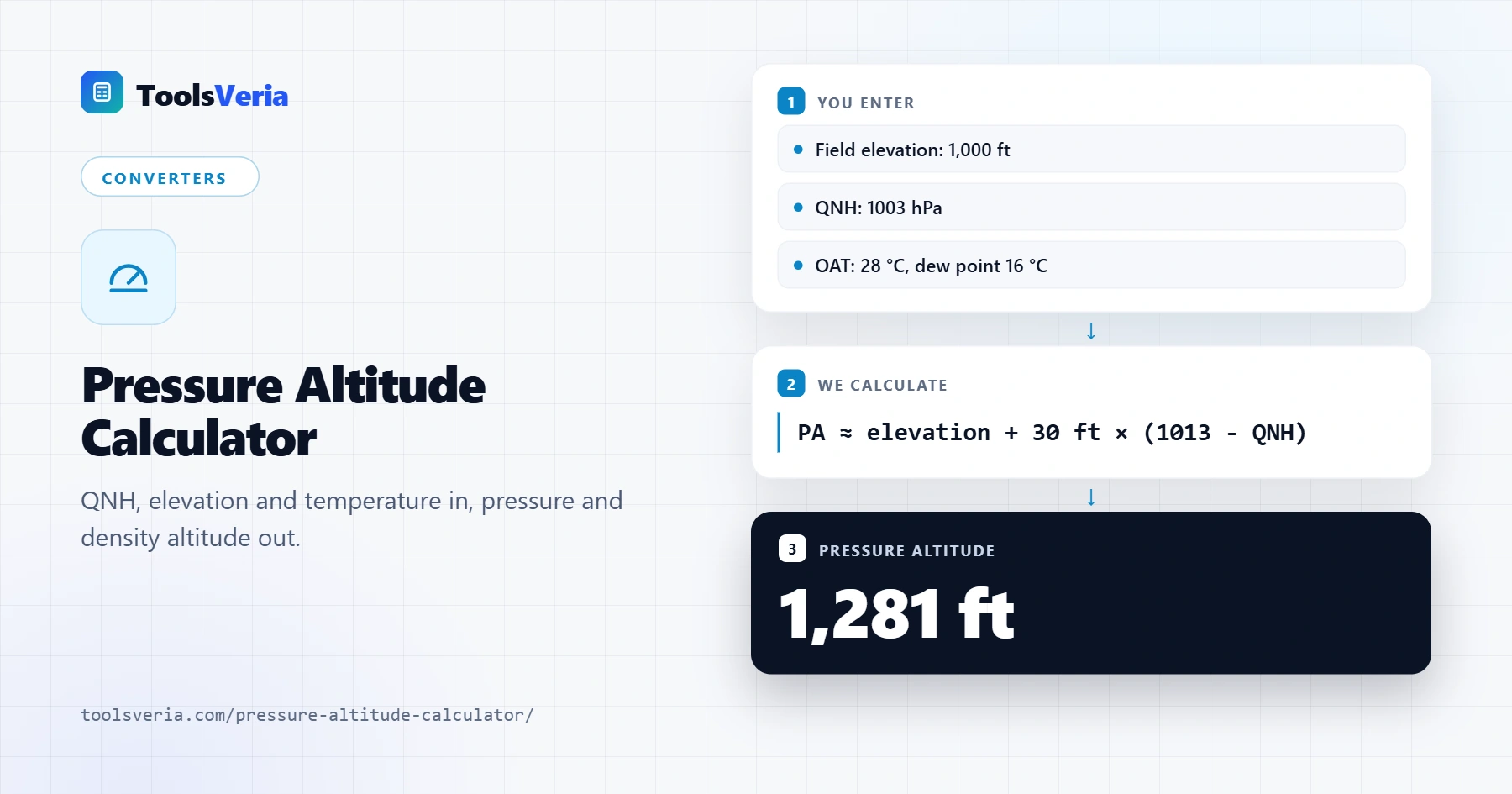
Quick answer: pressure altitude is field elevation plus about 30 ft for every hPa that the QNH sits below 1013 hPa (or 1,000 ft per inHg below 29.92). A 1,000 ft airfield with QNH 1003 hPa is at about 1,300 ft by rule of thumb; this pressure altitude calculator gives the exact figure, 1,281 ft.
In This Guide
What Is Pressure Altitude?
Pressure altitude is the height in the standard atmosphere at which the pressure equals the pressure you actually have, which is what an altimeter shows when it is set to 1013.25 hPa (29.92 inHg). It is the starting point for aircraft performance charts, flight levels and density altitude.
In plain words, the exact formula is: pressure altitude = field elevation + 145,442 × (1 - (QNH ÷ 1013.25)0.190263) feet. The constants come from the ISA: 15 °C and 1013.25 hPa at sea level, a lapse rate of 6.5 °C per kilometre (1.98 °C per 1,000 ft), gravity of 9.80665 m/s² and a gas constant for dry air of 287.053 J/(kg·K). When QNH is above 1013.25 the second term turns negative, so pressure altitude falls below the real elevation.
How to Use the Pressure Altitude Calculator
Step 1: Paste a METAR (Optional)
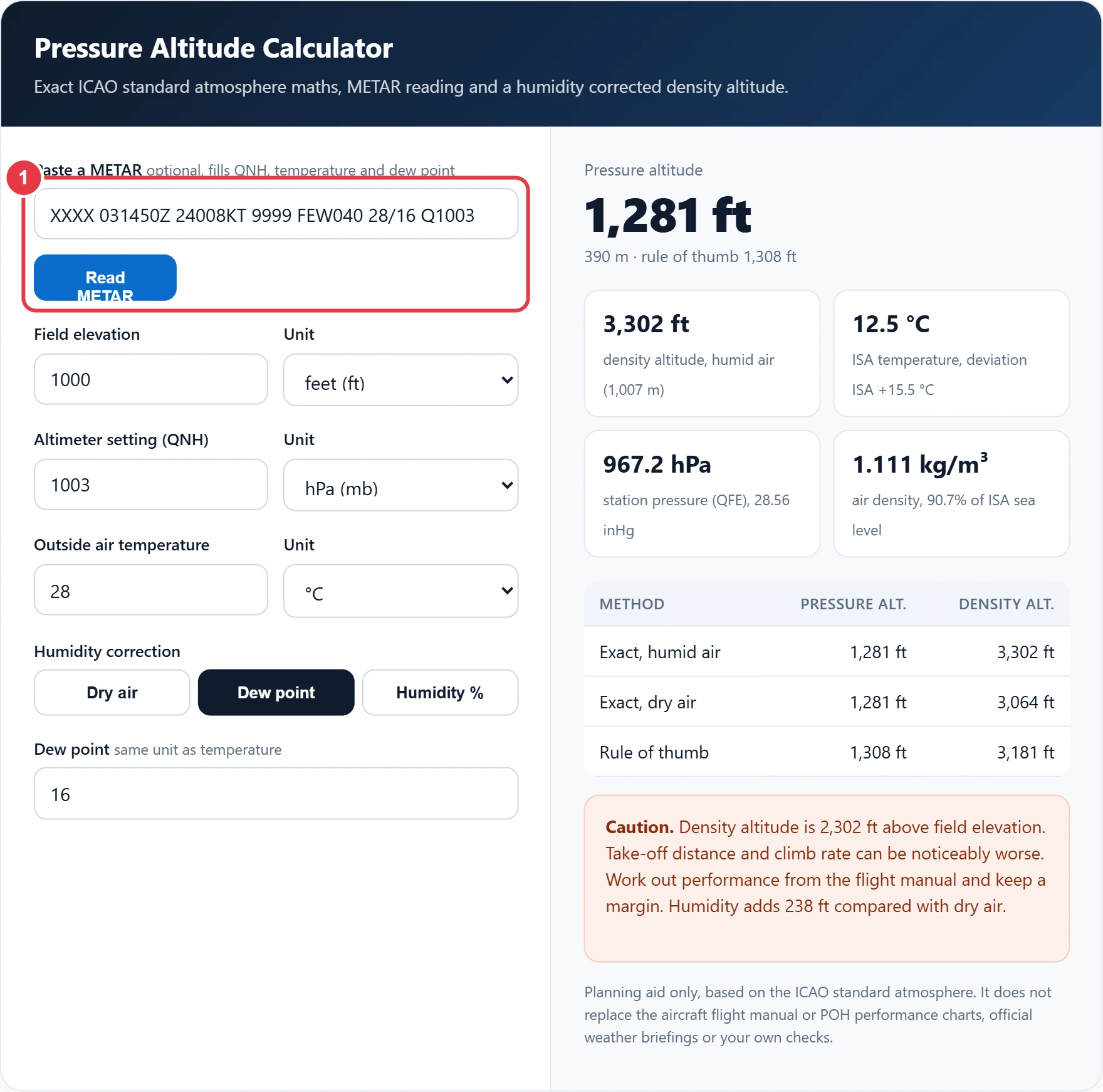
Copy the latest METAR for your airfield into the box at the top of the pressure altitude calculator and press Read METAR. The calculator picks out the QNH group (Q1003 in hPa or A2962 in inHg), the temperature and the dew point, including M for minus values, and switches the units to match.
Step 2: Enter Elevation and QNH
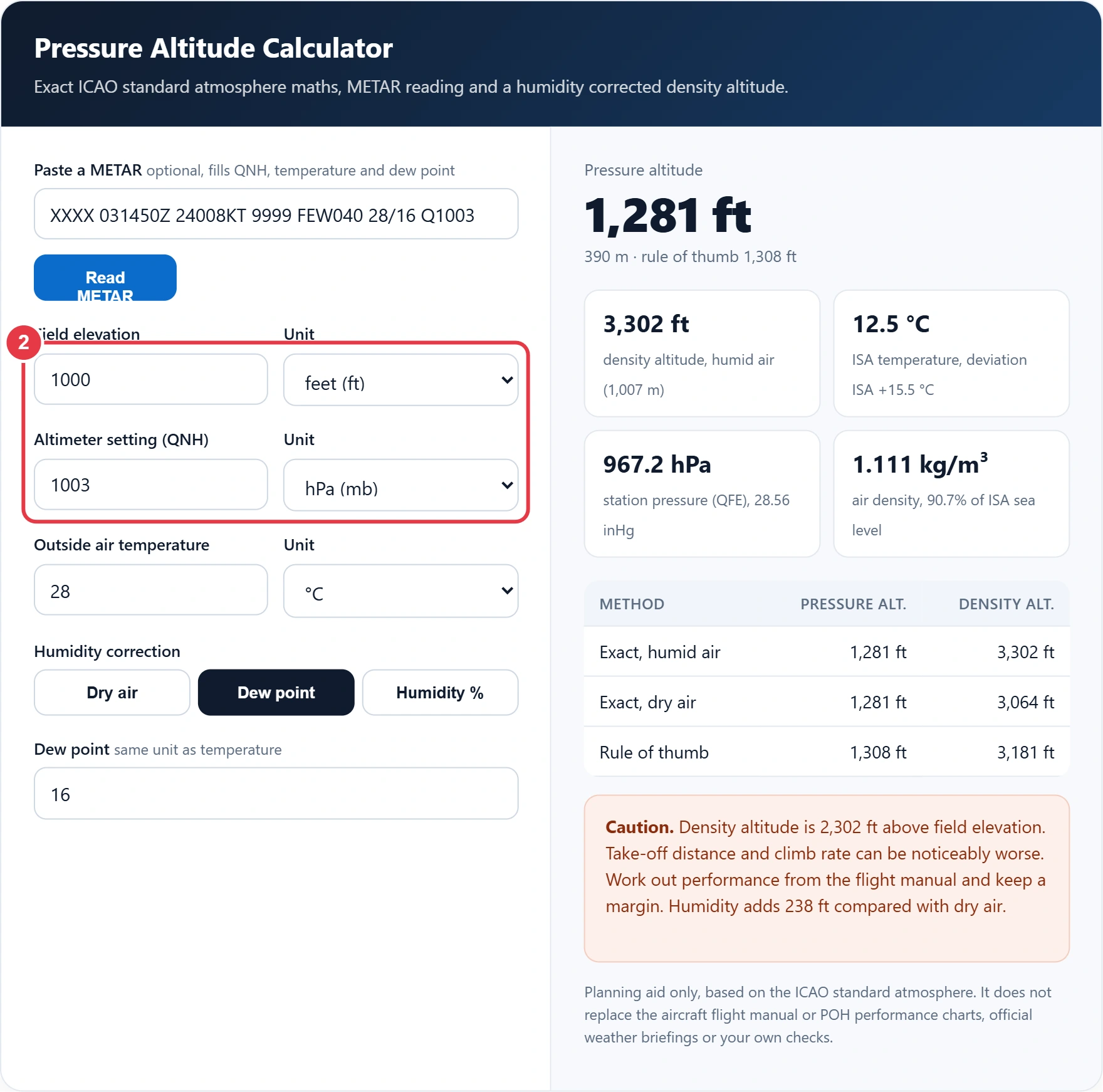
A METAR never includes the field elevation, so take it from the aerodrome chart or the AIP entry. Feet and hPa are the defaults used in the UK and most of Europe, and the unit converters on Tools Veria help if your source gives metres or millibars. Switching a unit here converts the value already in the box.
Step 3: Add Temperature and Humidity
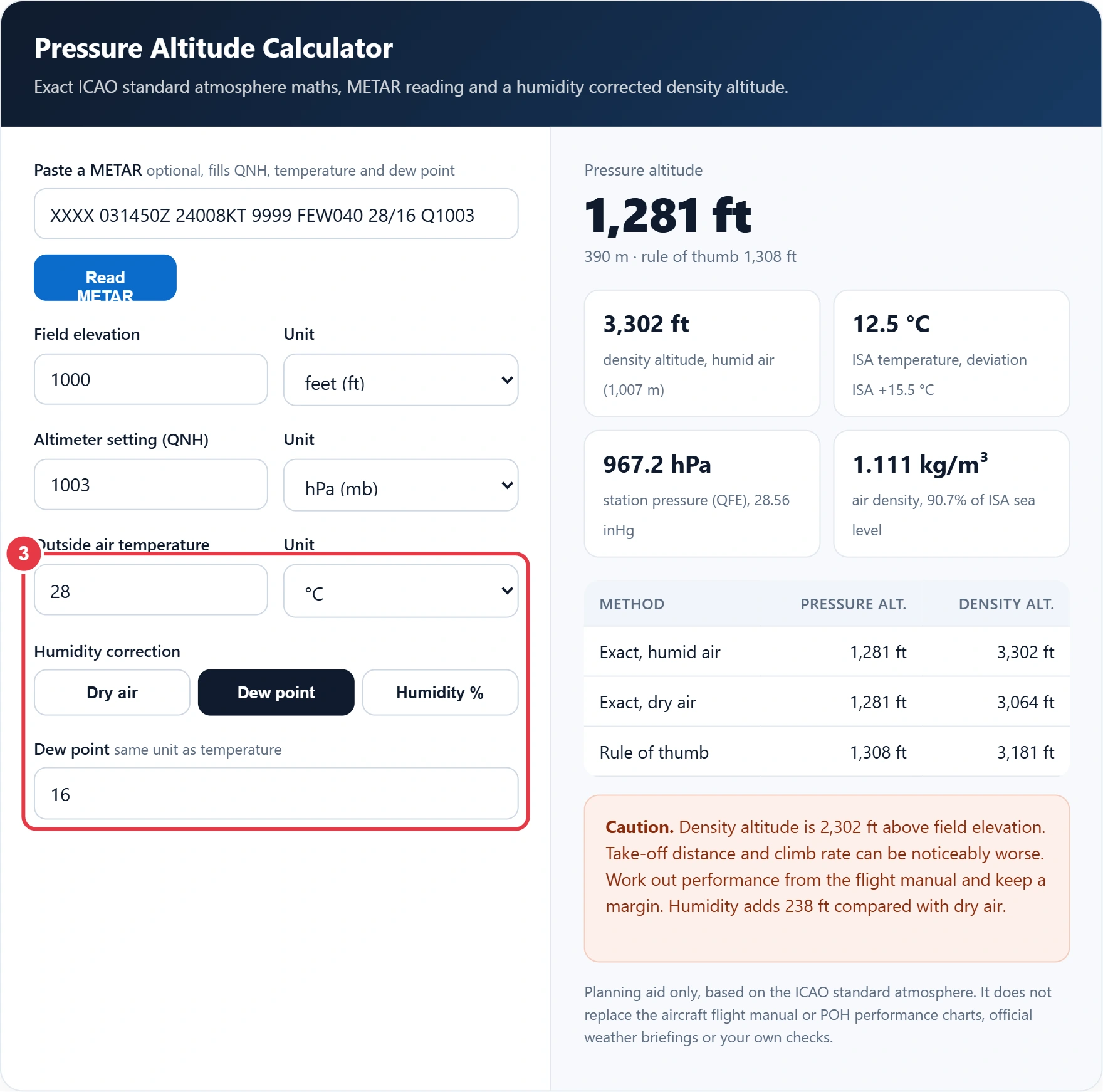
Enter the outside air temperature, then choose Dew point or Humidity % for a moisture correction, or Dry air to match the textbook method. The dew point from the METAR is the most reliable choice because it comes from the same observation as the temperature.
Step 4: Read the Results and the Warning
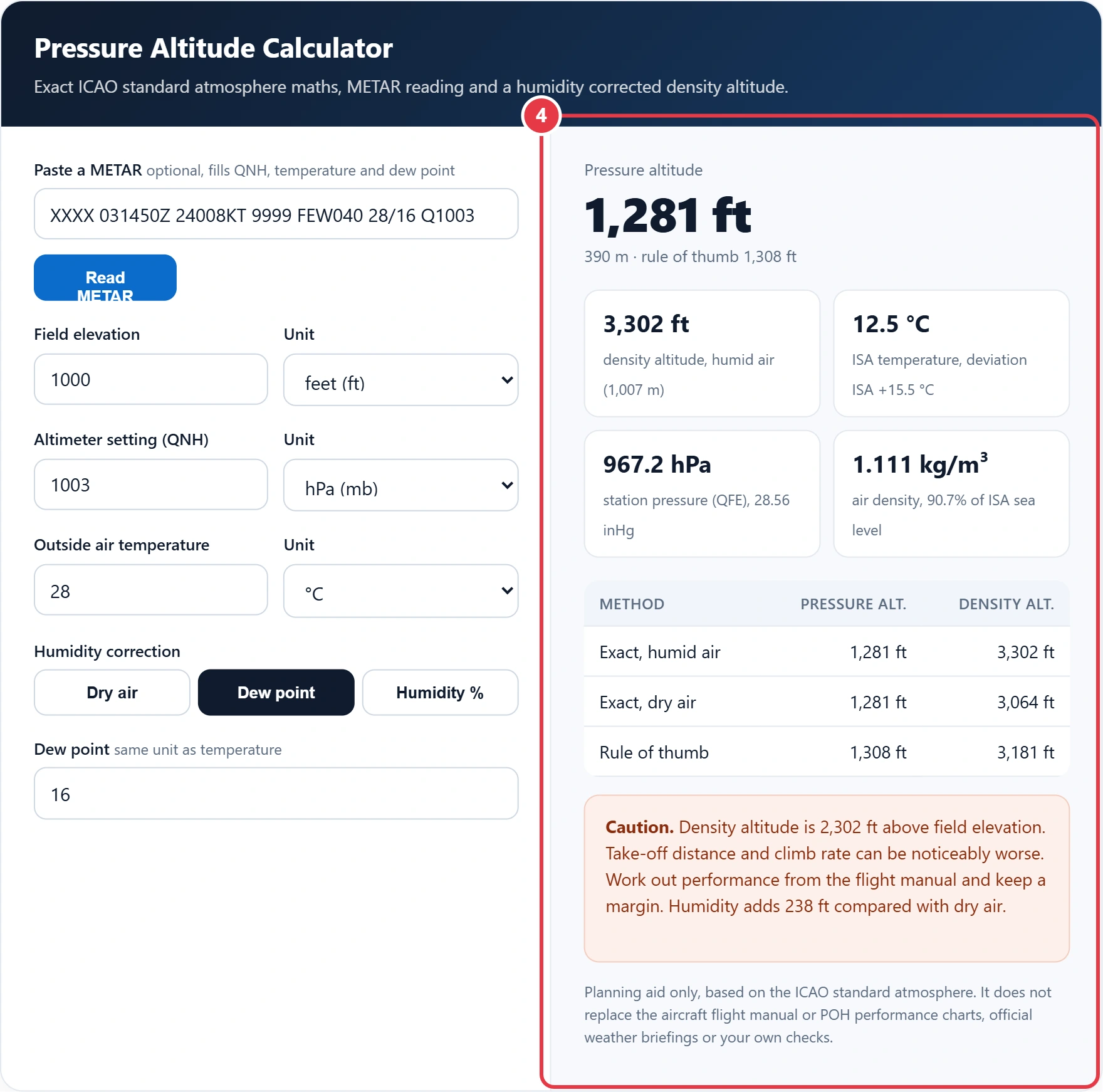
You get exact pressure altitude, density altitude, the ISA temperature and deviation, station pressure (QFE) and air density, with exact and rule of thumb figures side by side. The coloured band compares density altitude with field elevation: under 1,000 ft above is near standard, 1,000 to 2,000 ft is reduced performance, 2,000 to 3,000 ft is a caution and anything higher is a high density altitude warning.
How Do You Calculate Pressure Altitude From QNH?
Take the QNH away from 1013.25, multiply the difference by 30 ft and add the result to the field elevation; a QNH above 1013.25 gives a negative difference, so pressure altitude ends up below the elevation. With inHg, use 1,000 ft for every inch below or above 29.92. The 30 ft figure is a convenient round number; near sea level 1 hPa is closer to 27 ft, which is why the exact result is usually a little lower.
Worked example, a hot afternoon at a 1,000 ft airfield: QNH 1003 hPa, temperature 28 °C, dew point 16 °C. The exact pressure altitude is 1,000 + 281 = 1,281 ft (the rule of thumb says 1,308 ft). Station pressure is 967.2 hPa (28.56 inHg). ISA temperature at 1,281 ft is 12.5 °C, so the day is ISA +15.5 °C. Air density is 1.111 kg/m³, which is 90.7% of the sea level standard. Density altitude is 3,064 ft for dry air and 3,302 ft once the dew point is included, while the 120 ft per degree shortcut gives 3,181 ft. That is 2,302 ft above the field, inside the caution band.
What Is Density Altitude and Why Does Humidity Matter?
Density altitude is pressure altitude corrected for non standard temperature, and it is the height at which the aircraft and engine actually feel they are flying. The FAA Pilot's Handbook of Aeronautical Knowledge explains that high density altitude means a longer take-off run, a lower rate of climb and less engine power, which is why it matters on warm summer days at ordinary UK airfields, not only in the mountains.
Water vapour is lighter than dry air, so humid air is less dense. This calculator uses the virtual temperature, Tv = T ÷ (1 - 0.378 × e ÷ p), where e is the vapour pressure found from the dew point with the Magnus formula and p is station pressure. Density is then p ÷ (287.053 × Tv), and density altitude is the ISA height with that same density. Most online tools assume dry air, which in the example above understates density altitude by 238 ft.
The rule of thumb is density altitude ≈ pressure altitude + 120 ft × (OAT minus ISA temperature). The table shows how it compares with the exact dry air result at sea level with standard pressure, and you can work out the percentage gap between any two figures with the percentage increase calculator if you want to see it in relative terms.
| OAT at sea level, QNH 1013.25 | Exact density altitude (dry) | Rule of thumb |
|---|---|---|
| 0 °C | -1,838 ft | -1,800 ft |
| 10 °C | -599 ft | -600 ft |
| 15 °C (ISA) | 0 ft | 0 ft |
| 20 °C | 587 ft | 600 ft |
| 25 °C | 1,161 ft | 1,200 ft |
| 30 °C | 1,724 ft | 1,800 ft |
| 35 °C | 2,275 ft | 2,400 ft |
What Is the Difference Between QNH, QFE and QNE?
QNH is the altimeter setting that makes the altimeter read the airfield elevation on the ground, so in flight it shows altitude above mean sea level. QFE is the actual pressure at the airfield, so the altimeter reads zero on the runway and shows height above the aerodrome; the calculator shows it as station pressure. QNE describes flying on the standard setting of 1013.25 hPa, used above the transition altitude, and the altimeter then reads pressure altitude, the figure this pressure altitude calculator works out.
Countries differ in how they publish these settings, and Wikipedia's article on the altimeter setting explains the regional conventions, including why North America uses inHg while the UK and Europe use hPa.
ISA Reference Table
| Pressure altitude | ISA temperature | Pressure | Density |
|---|---|---|---|
| 0 ft | 15.0 °C | 1013.25 hPa (29.92 inHg) | 1.225 kg/m³ (100%) |
| 1,000 ft | 13.0 °C | 977.2 hPa (28.86 inHg) | 1.190 kg/m³ (97.1%) |
| 2,000 ft | 11.0 °C | 942.1 hPa (27.82 inHg) | 1.155 kg/m³ (94.3%) |
| 3,000 ft | 9.1 °C | 908.1 hPa (26.82 inHg) | 1.121 kg/m³ (91.5%) |
| 5,000 ft | 5.1 °C | 843.1 hPa (24.90 inHg) | 1.056 kg/m³ (86.2%) |
| 8,000 ft | -0.8 °C | 752.6 hPa (22.22 inHg) | 0.963 kg/m³ (78.6%) |
| 10,000 ft | -4.8 °C | 696.8 hPa (20.58 inHg) | 0.905 kg/m³ (73.8%) |
Use these results for planning and training only. The pressure altitude calculator does not replace the aircraft flight manual or POH, which gives the certified performance figures and any safety factors for your aircraft type, and it does not replace an official weather briefing.
</>Embed this calculator on your website
Add the free Pressure Altitude Calculator to your own site or blog. Copy the code below and paste it into an HTML block. It resizes itself and works on phones.
How we checked this tool: the Tools Veria Editorial Team built this tool by hand, checked it against the official rules or published standards where they apply, and tested it against worked examples. Results are estimates for planning, not personal financial or tax advice. Read our editorial policy and disclaimer, or report an error.
Frequently Asked Questions
How do I calculate pressure altitude?
Add 30 ft to the field elevation for every hPa the QNH is below 1013, or subtract 30 ft for every hPa above it. In inHg, use 1,000 ft per inch from 29.92. The exact ISA formula is usually a few feet lower near sea level.
What is the difference between pressure altitude and density altitude?
Pressure altitude corrects only for non standard pressure. Density altitude also corrects for temperature and humidity, so it shows the height the aircraft performs as if it were at. On a hot day density altitude can be thousands of feet higher.
Does humidity really change density altitude?
Yes. Water vapour is lighter than dry air, so humid air is less dense. At 28 °C with a 16 °C dew point at 1,000 ft, humidity adds about 238 ft of density altitude compared with dry air.
What altimeter setting gives pressure altitude?
Setting the standard pressure of 1013.25 hPa, or 29.92 inHg, on the subscale makes the altimeter read pressure altitude. Pilots do this above the transition altitude, where flight levels are used.
What is ISA temperature at my altitude?
ISA temperature starts at 15 °C at sea level and falls by about 1.98 °C per 1,000 ft. At a pressure altitude of 5,000 ft it is about 5.1 °C, and at 10,000 ft about -4.8 °C.
Can I use this calculator instead of my flight manual?
No. It gives planning estimates from the standard atmosphere. Always take take-off, landing and climb figures from the aircraft flight manual or POH, apply recommended safety factors and use an official weather briefing.