A quadratic formula calculator that solves ax² + bx + c = 0 with exact roots, working and a graph.
| Working |
|---|
This quadratic formula calculator solves any equation of the form ax² + bx + c = 0 for GCSE, A level, SAT and university students, teachers and anyone checking physics or engineering homework. Enter a, b and c to get both roots as decimals and, for whole number coefficients, in exact form with simplified surds, together with the line by line working behind the standard quadratic formula, the discriminant, the vertex, the factored form and a graph of the parabola.
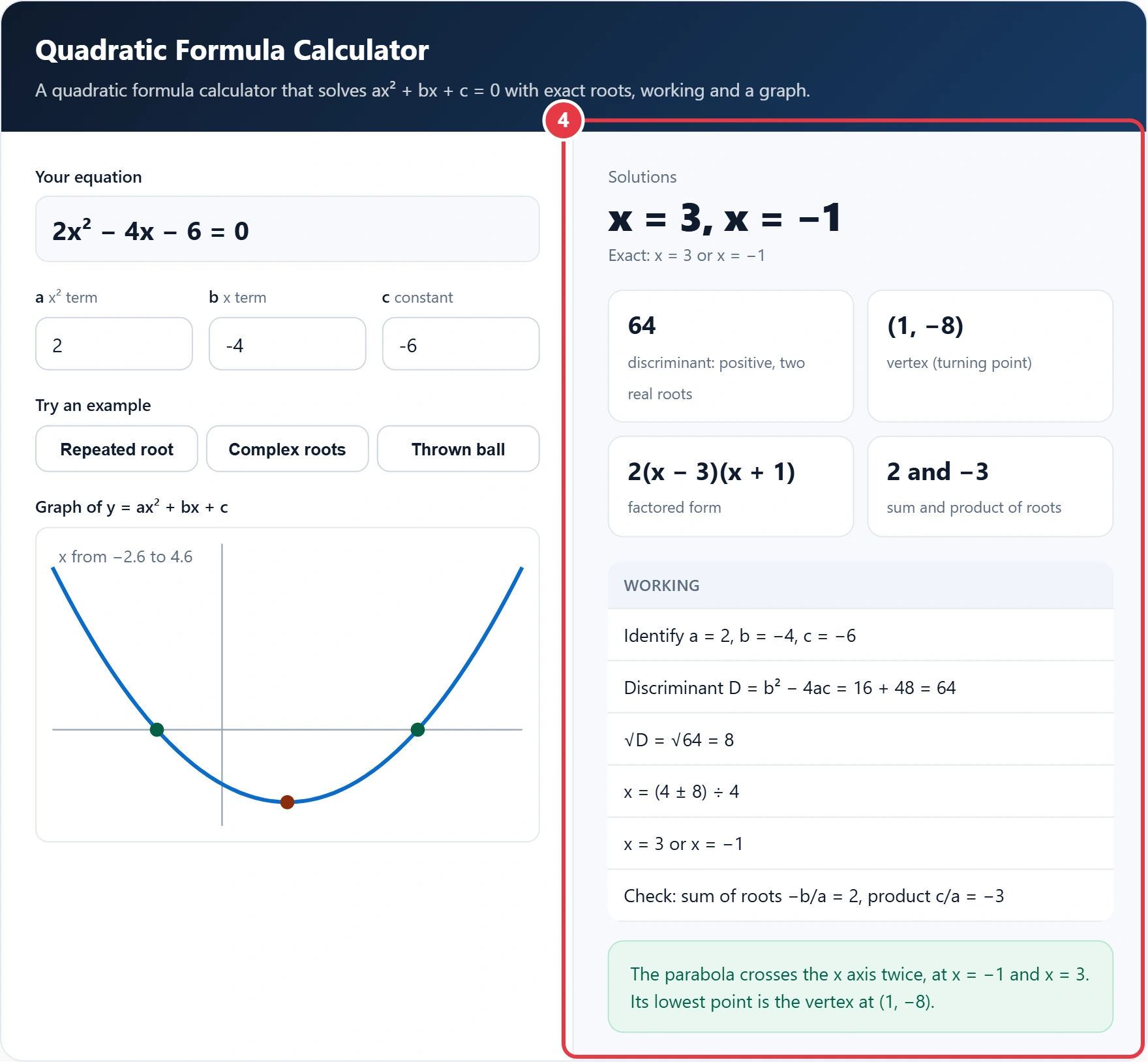
Quick answer: The quadratic formula is x = (−b ± √(b² − 4ac)) ÷ 2a. For 2x² − 4x − 6 = 0, the discriminant is 16 + 48 = 64, its square root is 8, and x = (4 ± 8) ÷ 4, so x = 3 or x = −1. This quadratic formula calculator shows every step.

In This Guide
What Is the Quadratic Formula?
The quadratic formula is a rule that gives the solutions of any quadratic equation directly from its three coefficients, without factorising or completing the square. A quadratic equation is one whose highest power of x is 2, written in standard form as ax² + bx + c = 0 with a not equal to 0.
In plain words: x equals minus b, plus or minus the square root of b squared minus 4ac, all divided by 2a. The part under the square root, b² − 4ac, is called the discriminant. The plus or minus sign is why most quadratics have two answers, and the formula itself comes from completing the square on the general equation.
How to Use the Quadratic Formula Calculator
Step 1: Enter a, b and c
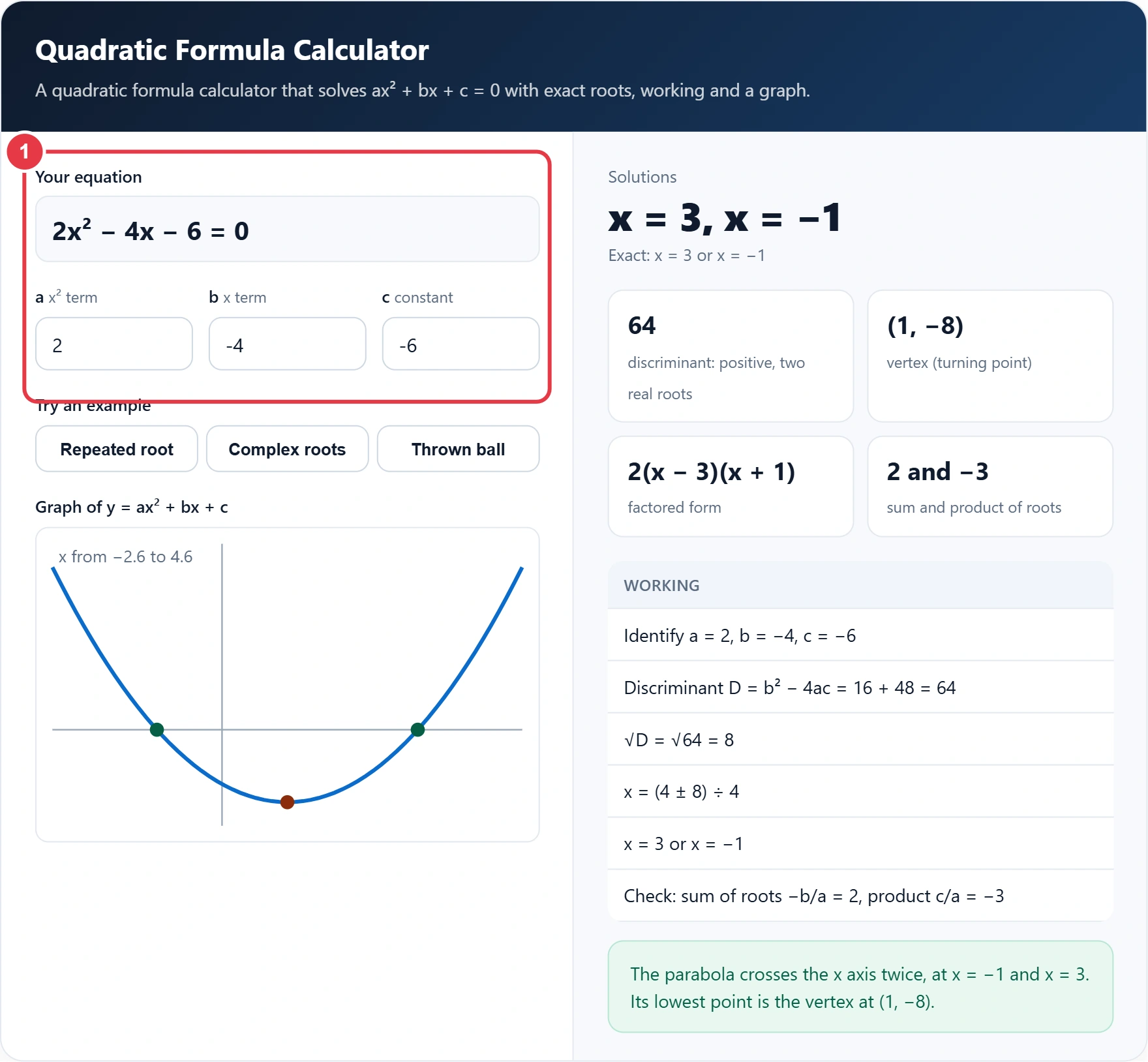
To solve a quadratic equation with the quadratic formula calculator, rearrange it so one side is 0, then type the number in front of x² as a, the number in front of x as b and the constant as c. Use negative signs where needed, and 0 for a missing term.
Step 2: Try an Example
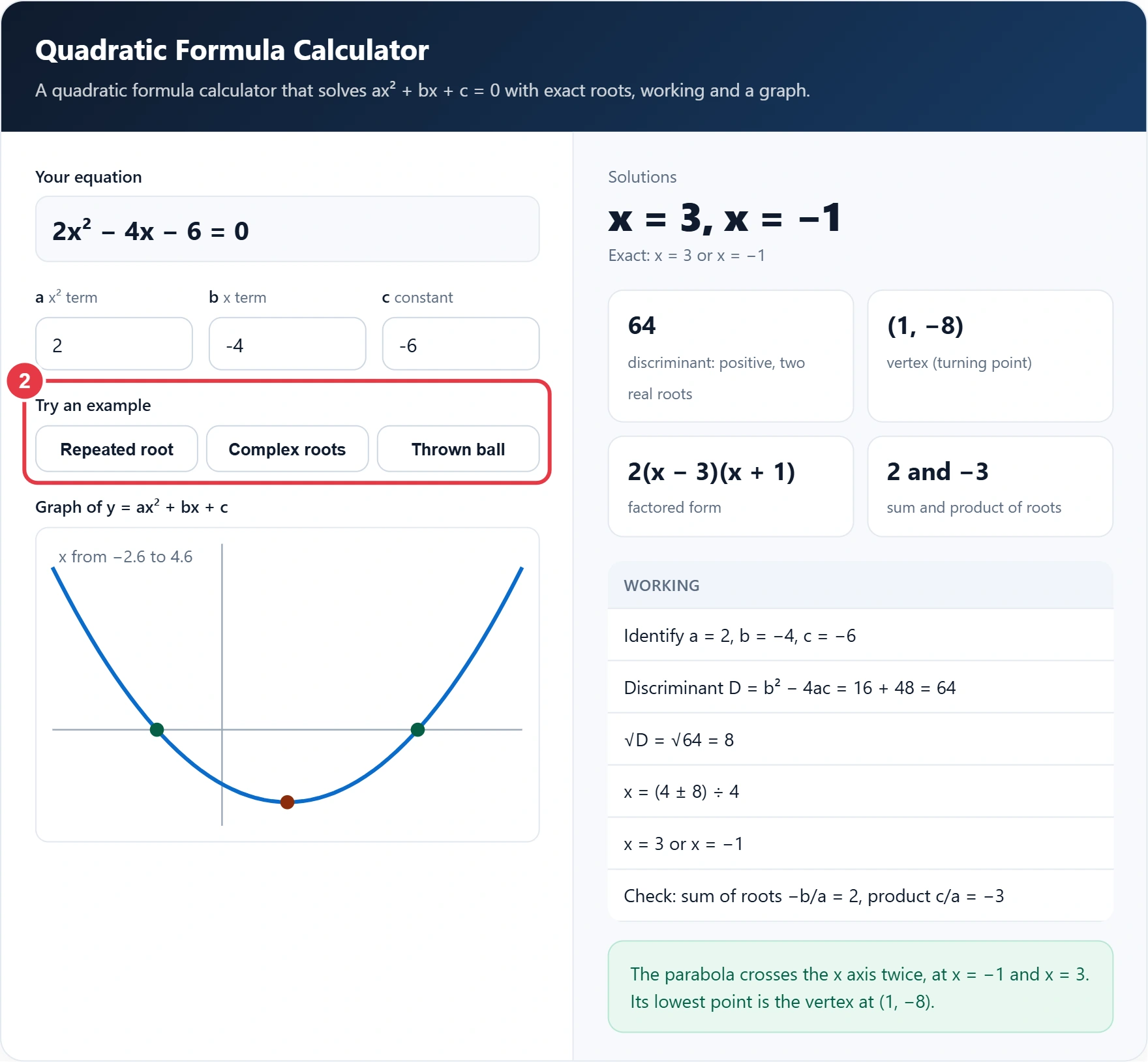
Press Repeated root, Complex roots or Thrown ball in the quadratic equation solver to load a ready made case and see how the results change with the type of answer.
Step 3: Check the Graph
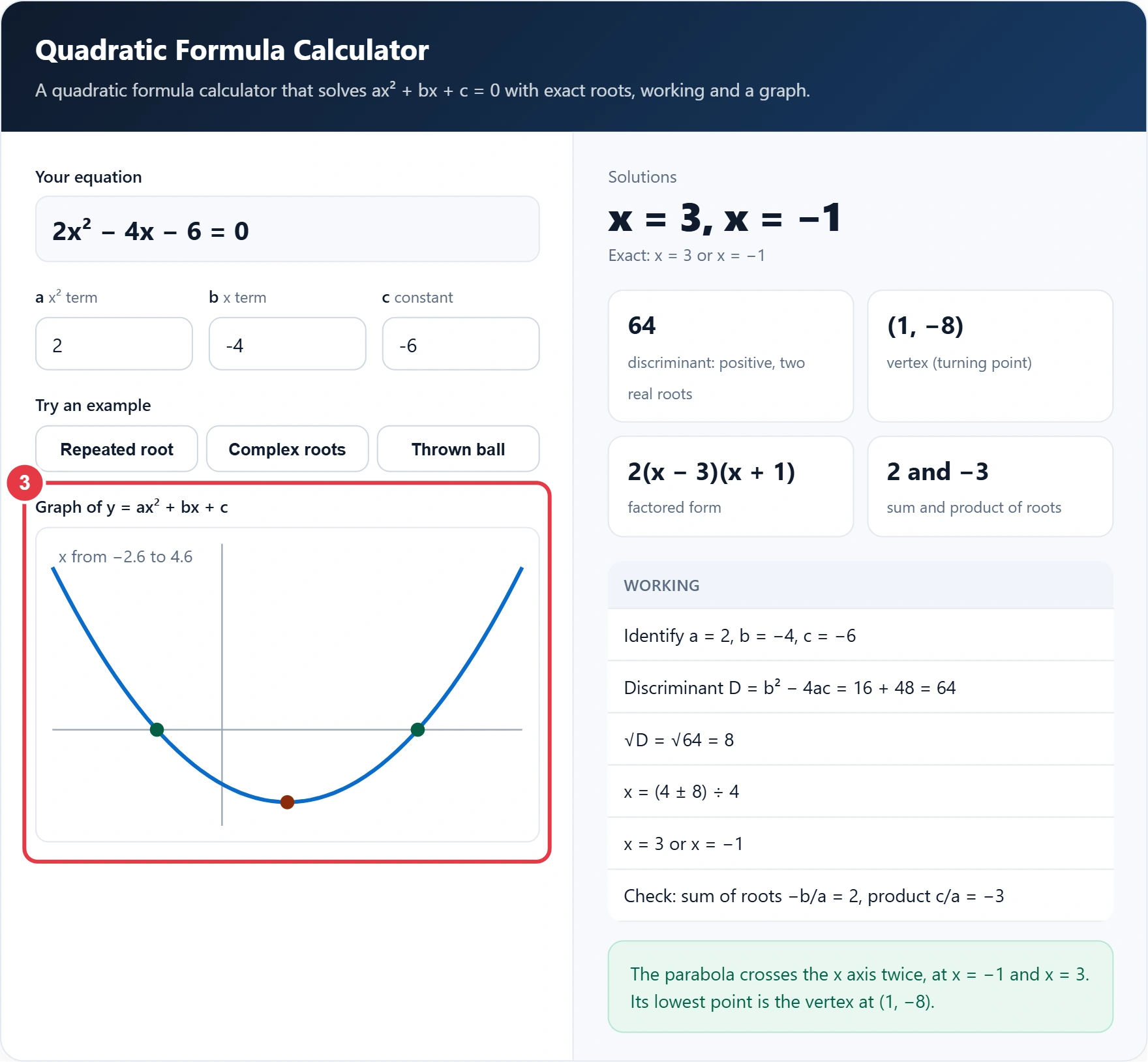
The quadratic formula calculator draws the parabola for your equation. Green dots mark the real roots where it crosses the x axis, and the red dot marks the vertex, its turning point.
Step 4: Read the Roots and Working
The results give the roots, the exact form, the discriminant, the vertex, the factored form and the sum and product of the roots as a check. If a turns out to be 0, the equation is linear, and the linear equation calculator explains that case step by step.
What Does the Discriminant Tell You?
The discriminant, b² − 4ac, tells you how many real solutions a quadratic has before you finish solving it. Positive means two real roots, zero means one repeated root, and negative means no real roots but two complex ones.
| Discriminant | Roots | Graph | Example | Solution |
|---|---|---|---|---|
| Positive perfect square | Two rational roots | Crosses the x axis twice | 2x² − 4x − 6 = 0 (D = 64) | x = 3, x = −1 |
| Positive, not a square | Two irrational roots | Crosses the x axis twice | x² − 2x − 1 = 0 (D = 8) | x = 1 ± √2 |
| Zero | One repeated root | Touches the x axis at the vertex | x² − 6x + 9 = 0 (D = 0) | x = 3 |
| Negative | Two complex roots | Never meets the x axis | x² + 4x + 13 = 0 (D = −36) | x = −2 ± 3i |
A perfect square discriminant also tells you the quadratic factorises neatly, which is why 2x² − 4x − 6 becomes 2(x − 3)(x + 1). The discriminant of a polynomial generalises this idea to higher powers.
How Do You Solve a Quadratic Equation From a Real Problem?
You solve a quadratic equation from a real problem by writing the situation in the form ax² + bx + c = 0, using a quadratic equation solver, then keeping only the roots that make sense in context.
Worked example: Ella throws a ball upwards at 14.7 m/s from a height of 2 m. Its height after t seconds is h = −4.9t² + 14.7t + 2, using 9.8 m/s² for gravity. To find when it lands, she sets h = 0, so a = −4.9, b = 14.7 and c = 2. The discriminant is 216.09 + 39.2 = 255.29, and its square root is 15.978. The roots are t = 3.130 and t = −0.130. Time cannot be negative, so the ball lands after about 3.13 seconds. The vertex at t = 1.5 shows it peaks at 13.025 m.
When Should You Use the Quadratic Formula Instead of Factorising?
You should use the quadratic formula when a quadratic does not factorise with whole numbers, when the coefficients are decimals, or when you need exact surd answers. Factorising is faster for simple cases such as x² − 5x + 6 = 0, but the formula always works.
A quick test is the discriminant: if it is not a perfect square, factorising will not give whole numbers, so go straight to the formula to solve a quadratic equation of that kind. Surds such as √2 appear in exact answers, and the slope calculator is useful when a related question asks for the gradient of a line through two points on the curve. Every example on this page was checked October 2026.
Key Quadratic Formula Calculator Terms Explained
These definitions explain each value the quadratic formula calculator reports, so you can connect the roots, the graph and the working on the page.
- Coefficients a, b and c
- The numbers multiplying x², x and the constant in standard form ax² + bx + c = 0. In 2x² − 4x − 6 = 0 they are 2, −4 and −6, and the sign of a decides whether the parabola opens upwards or downwards.
- Discriminant
- The value b² − 4ac found under the square root in the formula. Its sign predicts the type of solution before any further work, and when it is a perfect square such as 64 the roots are rational.
- Vertex
- The turning point of a parabola, located at x = −b ÷ 2a. For Ella's thrown ball it sits at t = 1.5 seconds, the moment the ball reaches its greatest height of 13.025 metres.
- Complex conjugate roots
- A pair of solutions with the same real part and opposite imaginary parts, produced whenever the discriminant is negative. The equation x² + 4x + 13 = 0 gives the pair −2 plus 3i and −2 minus 3i.
- Vieta's formulas
- Relations linking roots to coefficients: their sum equals −b ÷ a and their product equals c ÷ a. They offer a fast check, since roots 3 and −1 give a sum of 2 and a product of −3.
</>Embed this calculator on your website
Add the free Quadratic Formula Calculator to your own site or blog. Copy the code below and paste it into an HTML block. It resizes itself and works on phones.
How we checked this tool: the Tools Veria Editorial Team built this tool by hand, checked it against the official rules or published standards where they apply, and tested it against worked examples. Results are estimates for planning, not personal financial or tax advice. Read our editorial policy and disclaimer, or report an error.
Frequently Asked Questions
What is the quadratic formula?
The quadratic formula is x = (−b ± √(b² − 4ac)) ÷ 2a. It solves any equation of the form ax² + bx + c = 0 where a is not zero, giving up to two real solutions or two complex solutions.
What if the discriminant is negative?
A negative discriminant means the equation has no real solutions, because you cannot take the square root of a negative number in the real numbers. The roots are a complex conjugate pair, such as −2 ± 3i for x² + 4x + 13 = 0.
Can a quadratic have only one solution?
Yes. When the discriminant is exactly 0, both roots are equal, so there is one repeated solution. For x² − 6x + 9 = 0 the only solution is x = 3, where the parabola touches the x axis.
How do I find the vertex of a parabola?
The vertex x value is −b ÷ 2a. Substitute it back into the equation to get the y value. For 2x² − 4x − 6, the vertex is at x = 1 and y = −8, the lowest point of the curve.
What happens if a equals 0?
The equation is no longer quadratic, because the x² term disappears. It becomes the linear equation bx + c = 0, with the single solution x = −c ÷ b, and the calculator switches to that method automatically.
How can I check my roots are right?
Add them and multiply them. The sum should equal −b ÷ a and the product should equal c ÷ a. For roots 3 and −1 of 2x² − 4x − 6, the sum is 2 and the product is −3, both correct.