Test a markdown before you run it and see what it does to margin and break even.
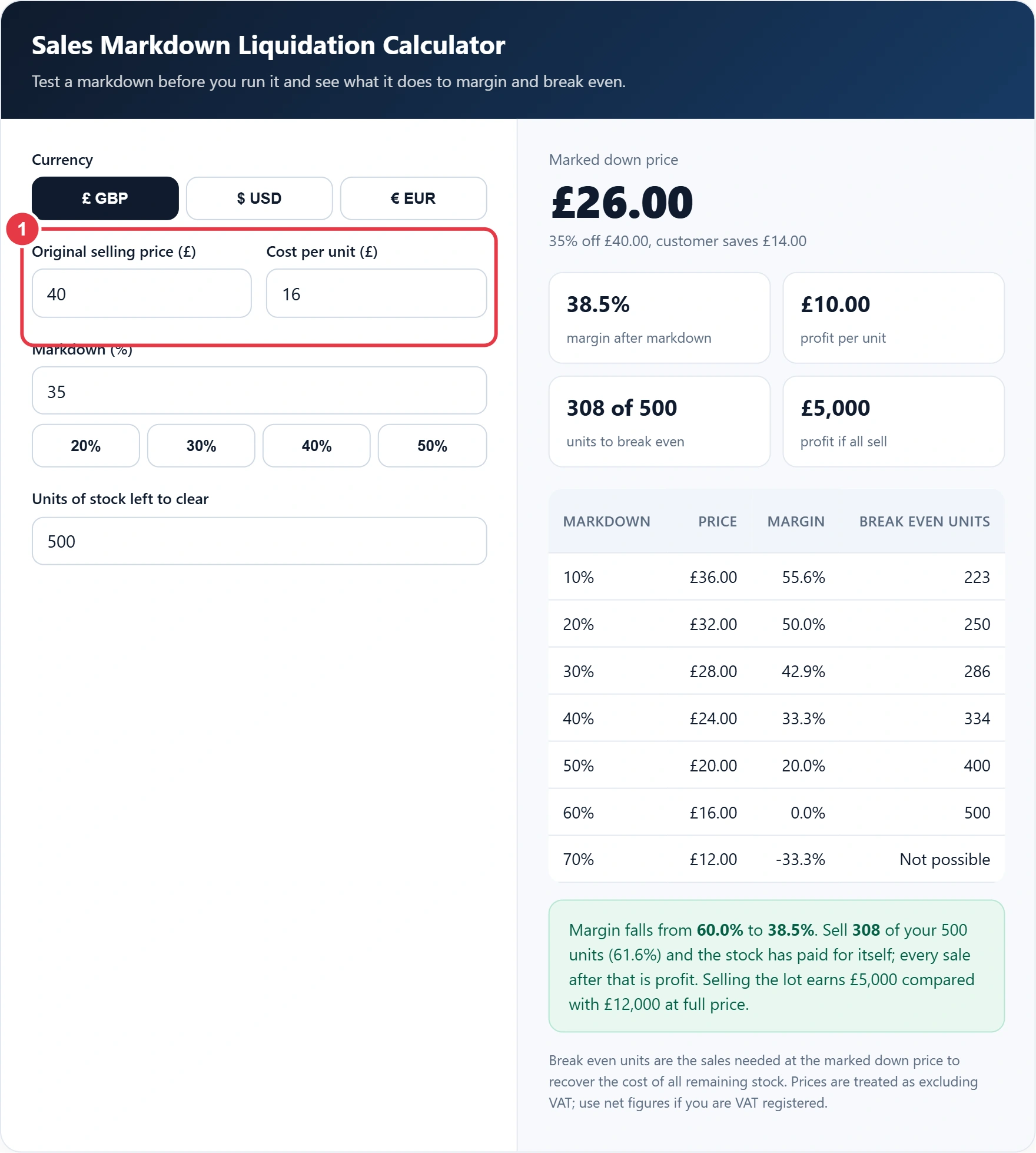
| Markdown | Price | Margin | Break even units |
|---|
Break even units are the sales needed at the marked down price to recover the cost of all remaining stock. Prices are treated as excluding VAT; use net figures if you are VAT registered.
This sales markdown liquidation calculator helps retailers, ecommerce sellers and wholesalers test a clearance discount before it goes live, showing the new price, the margin left and how many units must sell to recover the cost of the remaining stock. It applies the standard gross margin formula to the marked down price, so you can compare a 20% cut with a 50% cut in seconds.
Quick answer: A markdown calculator finds the new price as original price × (1 − markdown %) and the margin as (new price − unit cost) ÷ new price. Margin falls faster than price: a 35% markdown on a £40 item costing £16 cuts the margin from 60% to 38.5%. A first cut of 20% to 30% is typical.

In This Guide
What Is a Markdown?
A markdown is a permanent or temporary reduction in a product's selling price, usually expressed as a percentage of the original price, used to clear slow selling, seasonal or end of line stock. The new price is original price × (1 − markdown %), and the margin after markdown is (new price − unit cost) ÷ new price.
Break even on the remaining stock is units left × unit cost ÷ new price, rounded up. That tells you how many sales recover what you paid for the whole batch. Note that margin falls faster than price: a 35% markdown on a 60% margin product leaves 38.5%, not 25%.
How to Use the Markdown Calculator for Sales and Liquidation
Step 1: Enter Price and Cost
Pick £, $ or €, then enter the full selling price and what each unit cost you, both excluding VAT. If you originally priced with a markup rather than a margin, the markup calculator converts between the two before you start.
Step 2: Choose the Markdown
Type any percentage into the markdown calculator or tap 20%, 30%, 40% or 50%. Most retailers start with a modest first markdown and deepen it in stages if stock still does not move.

Step 3: Enter Units Left
Count the units still in stock across your shop, warehouse and any marketplace fulfilment centre. This drives the break even and total profit figures.

Step 4: Read the Results
You get the sale price, the margin after markdown, profit per unit, break even units and profit if everything sells. The markdown calculator table compares markdowns from 10% to 70% side by side, and a red warning appears if the new price falls below cost.

How Much Should I Mark Down Clearance Stock?
Start with a markdown that keeps your margin positive, typically 20% to 30% for a first cut, and only go deeper than your original margin percentage when holding the stock costs more than the loss. On a product with a 60% margin, any markdown under 60% still sells above cost.
Here is a worked example. Daniel runs an online outdoor clothing shop with 500 winter jackets left in March. They sell for £40 and cost £16 each, a 60% margin. A 35% markdown gives a price of £26.00 and a margin of 38.5%, or £10.00 profit per jacket. He needs to sell 308 jackets, 61.6% of the stock, to recover the £8,000 he paid, and clearing all 500 earns £5,000 instead of £12,000 at full price.
Daniel treats the jackets he already owns as the cost to recover, which is a simple form of break even analysis with no extra fixed costs added. He then uses the discount calculator to show shoppers the saving, and the profit margin calculator to check the full price lines that are still selling well.
Sales Markdown Liquidation Terms Explained
These retail pricing terms explain the results the sales markdown liquidation calculator shows, helping you plan clearance discounts that protect margin and recover stock costs.
- End-of-line stock
- Products a retailer has stopped reordering, such as discontinued lines, last season's ranges or the final sizes of a style. Clearing them frees cash and shelf space, which makes them typical candidates for staged markdowns.
- Margin erosion
- The faster fall in percentage margin than in price when a discount is applied, because the unit cost stays fixed while revenue per unit shrinks. A deep enough cut can remove most of the profit earned on each sale.
- Sell-through rate
- Units sold during a period divided by the units available at its start, shown as a percentage. Retailers track it to decide when a markdown is needed and whether a first reduction has moved enough stock.
- Liquidation sale
- Selling remaining inventory quickly, often in bulk to clearance buyers, at prices that may fall below cost. It recovers some cash when markdowns through normal channels have failed to clear the stock in time.
- Sunk cost
- Money already spent that cannot be recovered whatever happens next, such as the purchase price of unsold stock. Clearance decisions should focus on the cash that future sales will bring in rather than on recouping this past outlay.
</>Embed this calculator on your website
Add the free Markdown Calculator to your own site or blog. Copy the code below and paste it into an HTML block. It resizes itself and works on phones.
How we checked this tool: the Tools Veria Editorial Team built this tool by hand, checked it against the official rules or published standards where they apply, and tested it against worked examples. Results are estimates for planning, not personal financial or tax advice. Read our editorial policy and disclaimer, or report an error.
Frequently Asked Questions
What is the difference between a markdown and a discount?
A markdown lowers the shelf price for every customer, usually to clear stock, while a discount is often a targeted reduction such as a voucher or loyalty offer. Both cut margin in the same way: a 35% reduction on a £40 item leaves £26.
How do I calculate margin after a markdown?
Work out the new price, subtract the unit cost and divide by the new price. A £40 item costing £16, marked down 35% to £26, has a margin of (£26 − £16) ÷ £26 = 38.5%.
How many units do I need to sell to break even on clearance stock?
Multiply units left by unit cost and divide by the sale price, then round up. With 500 units costing £16 each and a £26 sale price, you need to sell 308 units to recover the £8,000 stock cost.
When is it worth selling stock below cost?
When storage, insurance, the cash tied up or the risk of the stock becoming worthless costs more than the loss per unit. Seasonal and fashion lines often lose most of their value once the season ends.
Should I enter prices with or without VAT?
Use prices excluding VAT if you are VAT registered, because VAT is passed to HMRC and is not part of your margin. A £48 shelf price including 20% VAT is £40 net.
How deep should a final clearance markdown be?
Many retailers go to 50% to 70% off for a final clearance. Check the table first: on a 60% margin product, a 70% markdown sells below cost and recovers only part of what the stock cost.