A square root calculator that also finds cube and nth roots, with simplified radicals and the working.
| Step | Estimate |
|---|
Results are rounded to the decimal places chosen. The principal (positive) root is shown; every positive number also has a negative square root.
This square root calculator finds the square root of any number for students, teachers, builders and anyone checking a measurement, and it also works as a cube root calculator and an nth root calculator. Type a whole number, a decimal, a negative number or a fraction, and you get the root to up to 12 decimal places, the simplest radical form of the square root when one exists, and the step by step working that produced it.
Quick answer: The square root of a number x is the value r where r × r = x. The square root of 72 is 8.485281 to six decimal places, and in simplest radical form it is 6√2, because 72 = 36 × 2 and √36 = 6. This square root calculator also handles cube roots, such as ∛72 = 4.160168.

In This Guide
What Is a Square Root?
A square root is the number that gives the original number when multiplied by itself once. Every positive number has two square roots, one positive and one negative, and the radical symbol √ means the positive one, called the principal root. So √25 = 5, even though -5 × -5 also equals 25.
A cube root calculator goes one step further: ∛x = r where r × r × r = x, so ∛27 = 3. An nth root generalises this to any whole number index n. Numbers such as 16, 49 and 144 are perfect squares with whole number roots, while numbers such as 2 and 72 have irrational roots whose decimals never end or repeat, so any decimal answer is rounded.
How to Use the Square Root Calculator
Step 1: Enter Your Number
Type the number in the square root calculator box. You can enter 72, 0.25, -8 or a fraction such as 9/16, and the result updates as you type.

Step 2: Choose the Root
Pick square, cube or nth root. Choosing cube turns the page into a cube root calculator. For an nth root, set the index, for example 4 for a fourth root or 5 for a fifth root.
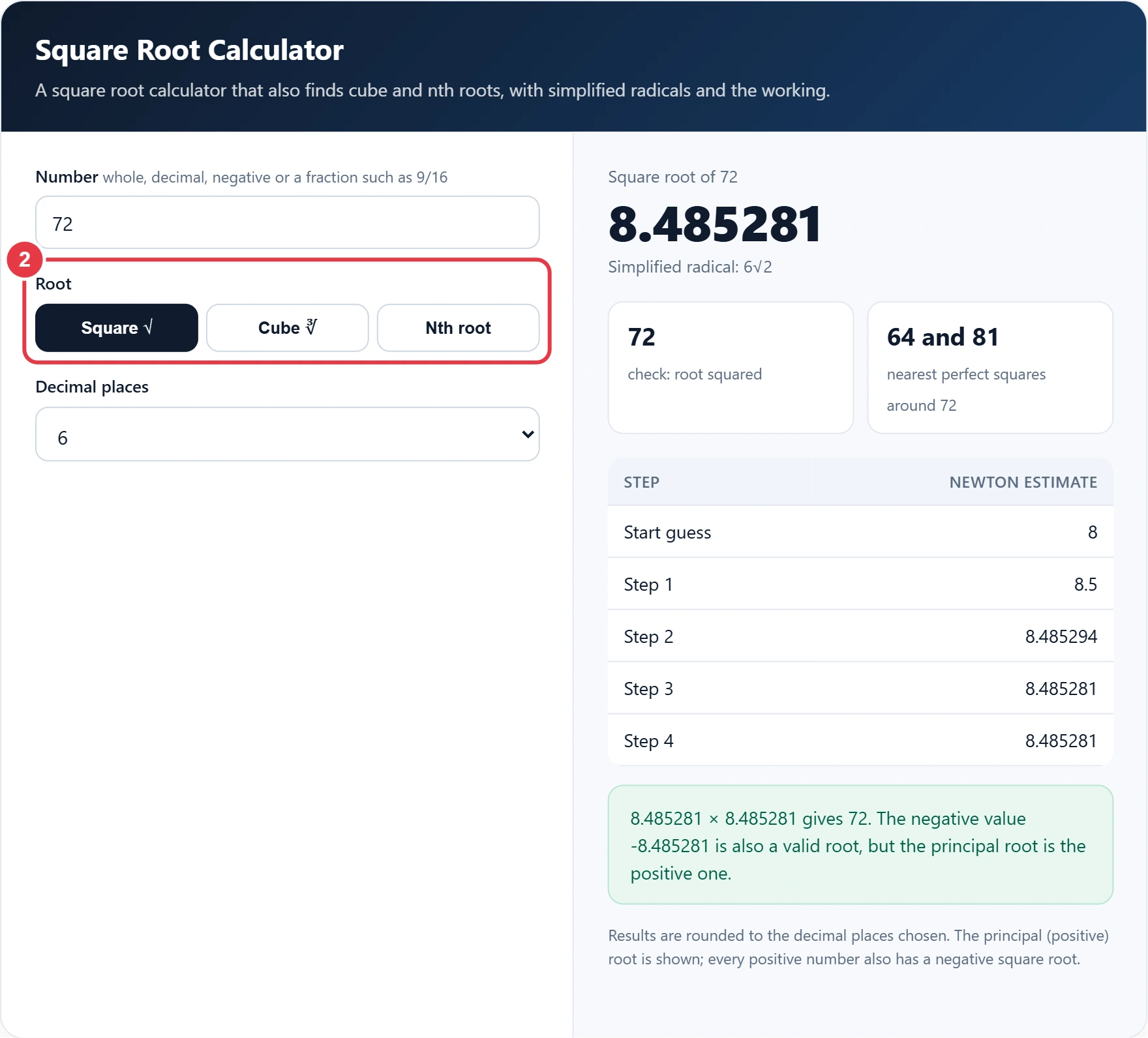
Step 3: Set the Decimal Places
Choose from 2 to 12 decimal places. Two places suit measurements in metres or inches; more places help when you need to check homework or a programming result.
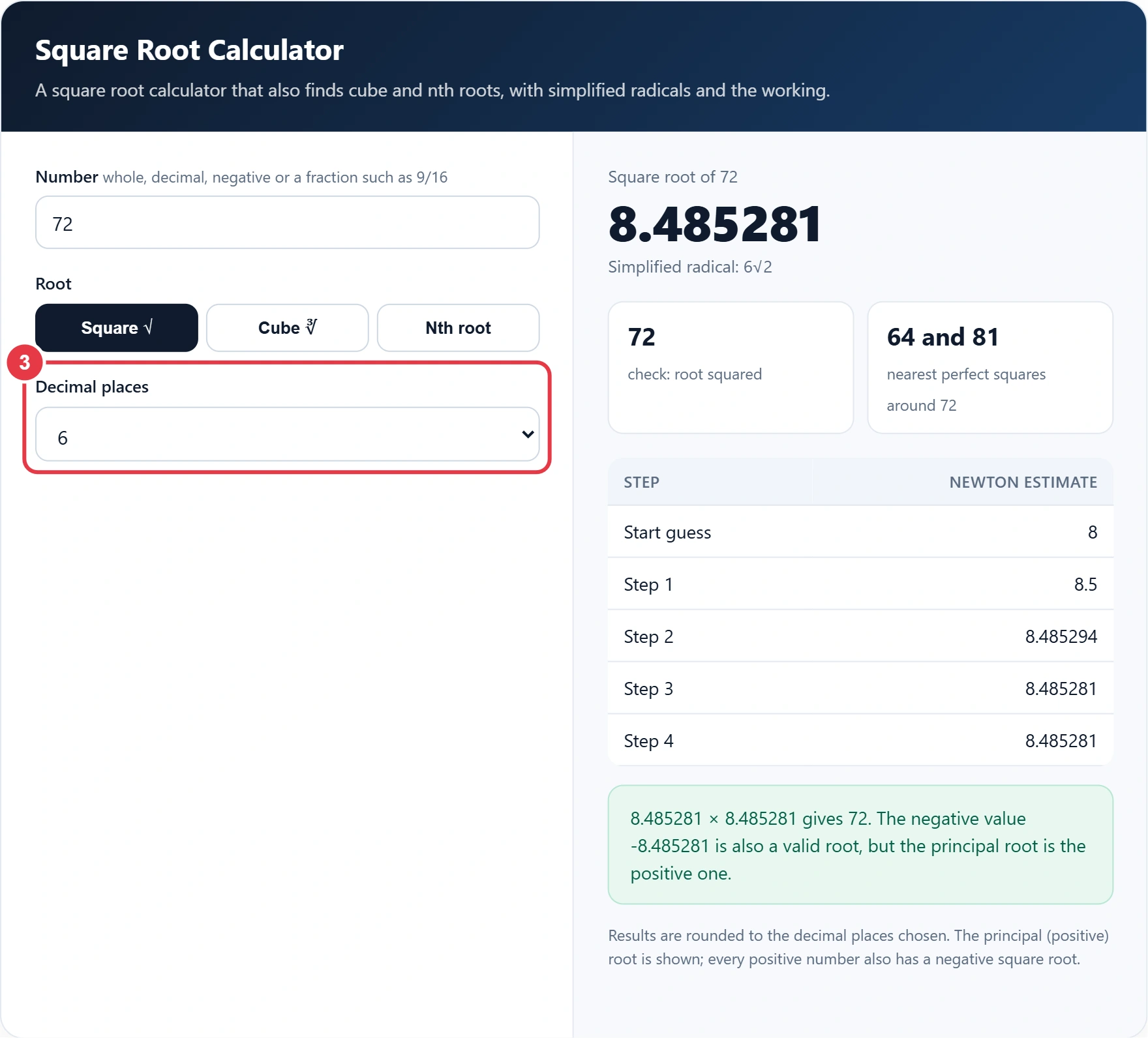
Step 4: Read the Root and the Working
The results show the root, the simplified radical, a check that raises the root back to the original power, the nearest perfect squares or cubes, and each step of Newton's method. If you are working with a fraction, the fraction to decimal converter shows the decimal you are taking the root of.

What Are the Square Roots of Common Numbers?
The square roots of common numbers are listed below, as any sqrt calculator would return them, to six decimal places, alongside their cube roots, so you can check an answer at a glance. Perfect squares and cubes give whole numbers; everything else is rounded.
| Number | Square root | Simplest radical | Cube root |
|---|---|---|---|
| 2 | 1.414214 | √2 | 1.259921 |
| 3 | 1.732051 | √3 | 1.442250 |
| 5 | 2.236068 | √5 | 1.709976 |
| 8 | 2.828427 | 2√2 | 2 (exact) |
| 20 | 4.472136 | 2√5 | 2.714418 |
| 50 | 7.071068 | 5√2 | 3.684031 |
| 72 | 8.485281 | 6√2 | 4.160168 |
| 100 | 10 (exact) | 10 | 4.641589 |
| 1,000 | 31.622777 | 10√10 | 10 (exact) |
How Do You Work Out a Square Root by Hand?
You work out a square root by hand with the Babylonian method: guess, divide the number by your guess, then average the guess and the result, and repeat. Each round roughly doubles the number of correct digits, which is why the sqrt calculator table above needs only three or four steps.
Worked example: Leah is laying a square patio with an area of 20 m² and needs the length of each side. She guesses 4, because 4 × 4 = 16. Step 1: 20 ÷ 4 = 5, and the average of 4 and 5 is 4.5. This averaging trick is Newton's method for roots in its simplest form, and the square root calculator uses the same idea for every index. Step 2: 20 ÷ 4.5 = 4.4444, and the average is 4.4722. Step 3 gives 4.472136, so each side is about 4.47 m, or exactly 2√5 m.
How Do You Simplify a Square Root?
You simplify a square root by finding the largest perfect square that divides the number, taking its root outside the radical and leaving the rest inside. For 72, the largest perfect square factor is 36, so √72 = √36 × √2 = 6√2. For cube roots, look for the largest perfect cube instead: ∛54 = ∛27 × ∛2 = 3∛2.
The square root calculator shows both forms, but exact radical answers are preferred in algebra and exams because rounding loses information. Square roots also appear inside Pythagoras' theorem, so the trigonometry calculator is a natural next step when you are finding sides of right angled triangles.
Can You Take the Square Root of a Negative Number?
You cannot take the square root of a negative number using real numbers, because any real number multiplied by itself is zero or positive. Mathematicians use the imaginary unit i, where i × i = -1, so √-16 = 4i, and the calculator shows results in that form. Cube roots are different: ∛-8 = -2, since -2 × -2 × -2 = -8. Every value on this page was checked October 2026.
Key Square Root Calculator Terms Explained
These definitions cover the ideas behind each square root calculator result, from principal roots to radicals, so you can follow the working with confidence.
- Principal root
- The non negative root that the radical symbol stands for. Both 5 and -5 square to 25, but √25 means 5 only, which is why the tool displays the positive value unless the input is negative.
- Radicand
- The number written under the radical sign. In 6√2 the radicand is 2, and simplifying a radical means moving every perfect power factor of the radicand outside, as when √72 becomes 6√2.
- Index of a root
- The small number that says which root is taken: 2 for a square root, 3 for a cube root and any whole number for an nth root. An even index needs a non negative radicand to give a real answer.
- Irrational number
- A number that cannot be written as a ratio of two whole numbers, so its decimal expansion never terminates or repeats. The square roots of 2, 3, 5 and 72 are all irrational and must be rounded.
- Imaginary unit
- The number i defined by i × i = -1, which lets even roots of negative numbers be written down. Using it, the square root of -16 becomes 4i, a result real numbers alone cannot express.
- Newton's method
- An iterative technique that improves a guess by repeatedly applying a correction formula. For square roots it reduces to the Babylonian method of averaging the guess with the number divided by the guess.
</>Embed this calculator on your website
Add the free Square Root Calculator to your own site or blog. Copy the code below and paste it into an HTML block. It resizes itself and works on phones.
How we checked this tool: the Tools Veria Editorial Team built this tool by hand, checked it against the official rules or published standards where they apply, and tested it against worked examples. Results are estimates for planning, not personal financial or tax advice. Read our editorial policy and disclaimer, or report an error.
Frequently Asked Questions
What is the square root of 2?
The square root of 2 is 1.414214 to six decimal places. It is irrational, so its decimal never ends or repeats, and in exact form it is simply written as √2. Squaring 1.414214 gives 2.000001, which shows the tiny rounding error.
How do I find a cube root without a calculator?
Guess a number, cube it and adjust. For ∛72, 4 cubed is 64 and 5 cubed is 125, so the answer sits just above 4. Newton's method refines this to 4.160168 in a few steps.
Is the square root of 0 defined?
Yes. The square root of 0 is 0, because 0 × 0 = 0. It is the only number with exactly one square root rather than a positive and a negative pair.
What does sqrt mean?
Sqrt is the short name for square root used in spreadsheets and programming languages. In Excel or Google Sheets, =SQRT(72) returns 8.485281, and most languages offer a sqrt function in their maths library.
How do you find the square root of a fraction?
Take the square root of the top and bottom separately. For example, √(9/16) = 3/4 = 0.75. If the numbers are not perfect squares, the calculator converts the fraction to a decimal and finds the root of that.
Why does my calculator show a different last digit?
Roots of most numbers are irrational, so every calculator rounds the final digit. Changing the decimal places setting from 6 to 8 or 12 shows more of the true value and explains small differences.