Choose the laws that apply, tick what is already in place, and get a progress score with your next actions.
Core items count double in the score. This is a self assessment aid, not legal advice: it cannot confirm you comply. Nothing you tick is saved or sent anywhere.
This GDPR compliance checklist is a free, interactive self check for UK small businesses, charities, sole traders and anyone who also handles data on people in the EU, updated for the UK GDPR changes that took effect during 2026. Tick what is already in place and it gives you a weighted progress score, shows which sections are complete, and writes a prioritised action plan you can copy or download.
Quick answer: a GDPR compliance checklist should cover a data map, a lawful basis for each purpose, a privacy notice, consent records, answering rights requests within one month, security, breach reporting within 72 hours, processor contracts, transfer safeguards and retention periods. In the UK, add a complaints process and the data protection fee.
In This Guide
What Is a GDPR Compliance Checklist?
A GDPR compliance checklist is a list of the practical steps an organisation must take to meet the General Data Protection Regulation, used to find gaps before a regulator or customer does. The score in this tool works in plain words like this: add up the weight of the items you have ticked, divide by the weight of every item that applies to you, and multiply by 100. Core legal duties count double, so a missing breach plan hurts the score more than a missing annual review.
Every item names the article or regulation behind it, so you can read the duty for yourself. Evidence matters more than intent: a tick should mean you could hand over a document, a signed contract, a training record or a tested process if the regulator asked tomorrow. Items that do not apply drop out automatically: a business with no staff is not scored on training, and the Article 9 item appears only if you handle special category data such as health information.
How to Use the GDPR Compliance Checklist
Step 1: Choose the Law and What Applies
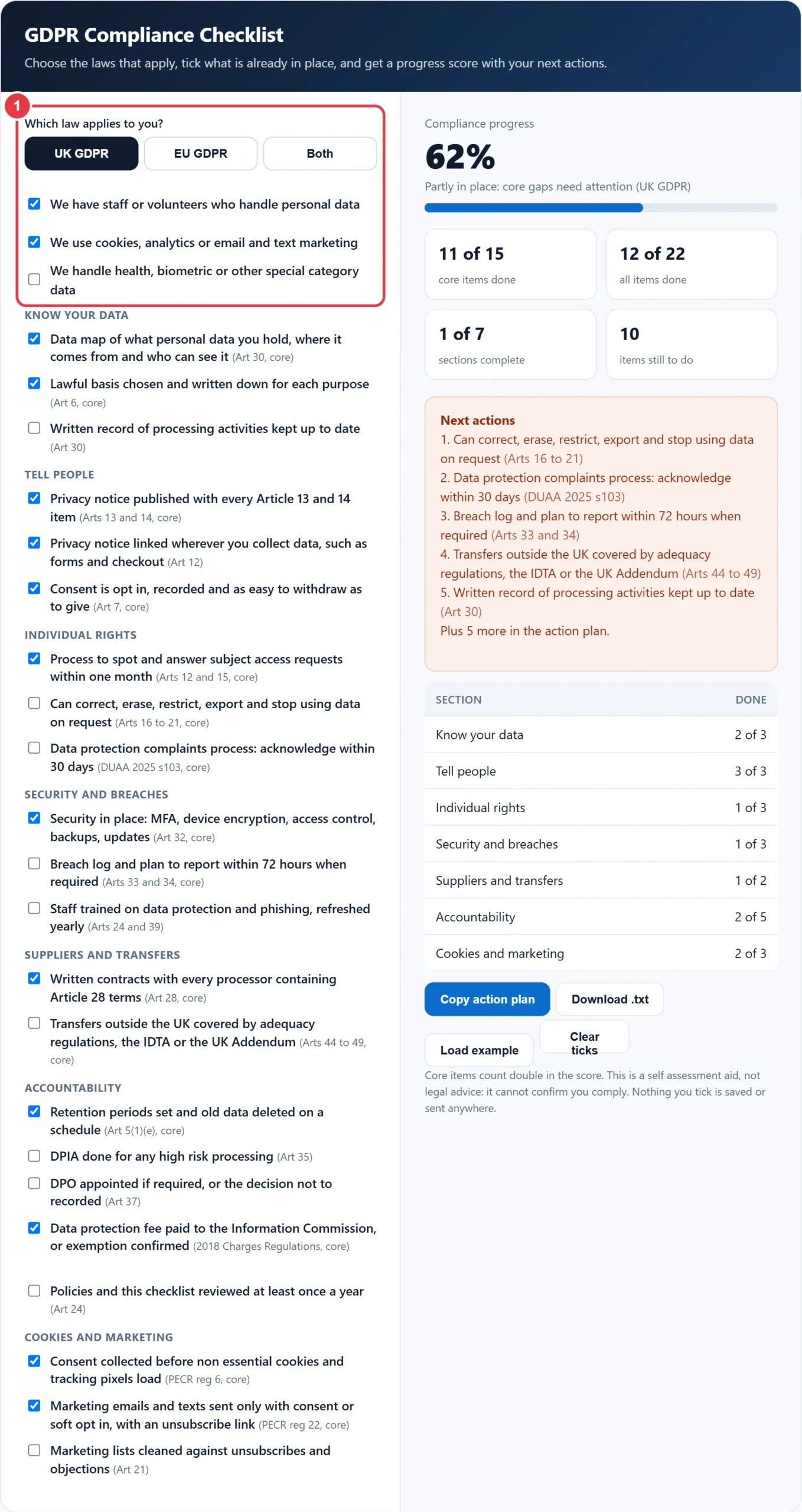
Pick UK GDPR if you operate in the UK, EU GDPR if you are based in the EU, or Both if you are a UK business that sells to or monitors people in the EU. Then tick whether you have staff, use cookies or marketing, and handle special category data.
Step 2: Tick What Is Already in Place
Work through each section honestly and tick an item only if you could show evidence today, such as a written document, a contract or a tested process. Items marked core are legal duties for almost every organisation; the others are strong good practice.

Step 3: Read Your Progress Score
The score updates with every tick. Below 50% means you are at an early stage, 50% to 79% means core gaps remain, and 80% or more means most of the framework is in place. The table shows how many items are done in each section.

Step 4: Copy or Download Your Action Plan
The next actions box lists the five most important gaps, core items first. Copy the full action plan or download it as a .txt file to share with a director or adviser. If the first gap is your privacy notice, the privacy policy generator writes a UK GDPR notice from your answers in a few minutes.

What Does GDPR Compliance Require in the UK?
UK GDPR compliance requires you to follow seven principles: lawfulness, fairness and transparency; purpose limitation; data minimisation; accuracy; storage limitation; integrity and confidentiality; and accountability, which means being able to prove the other six. They are set out in Article 5 of the UK GDPR on legislation.gov.uk, and every item in the checklist above traces back to one of them.
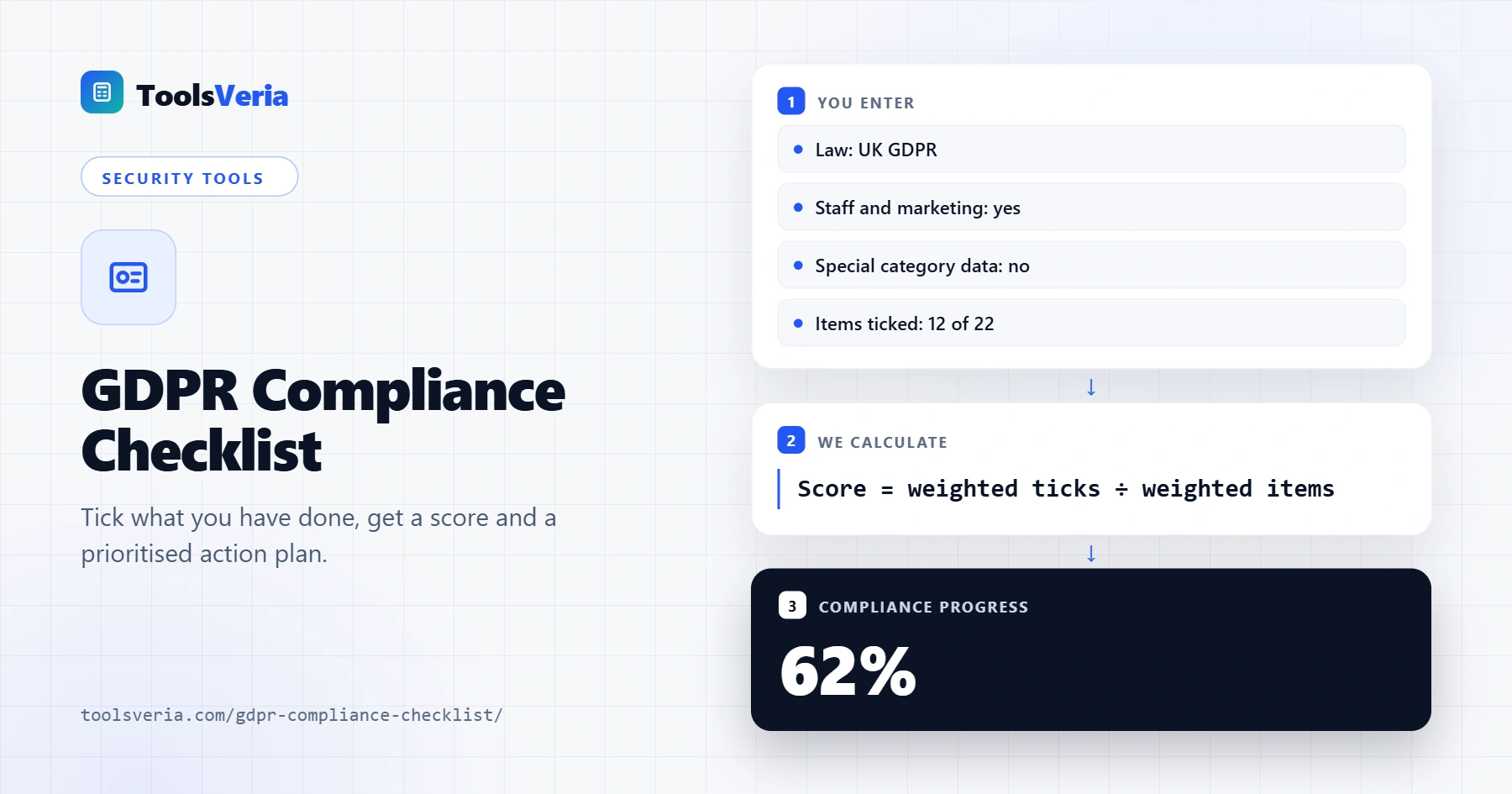
Worked example: Ravi runs a six person online tea shop in Leeds with a newsletter and Google Analytics. He selects UK GDPR, leaves staff and marketing ticked, and ticks 12 of the 22 items that apply, including his privacy notice, cookie banner and processor contracts. Because 11 of his 15 core items and 1 of his 7 other items are done, he scores 23 out of 37 weighted points (11 × 2 + 1, divided by 15 × 2 + 7), which is 62%. His top three actions are a process for correction and erasure requests, a complaints process, and a breach log with a 72 hour reporting plan.
UK GDPR vs EU GDPR: What Is Different?
The two laws share the same core rules, but the regulator, fines and some duties differ. A UK business with EU customers can be subject to both at once.
| Topic | UK GDPR | EU GDPR |
|---|---|---|
| Regulator | Information Commission (replaced the ICO on 30 September 2026) | Supervisory authority in each EU country |
| Maximum fine | £17.5 million or 4% of worldwide turnover | €20 million or 4% of worldwide turnover |
| Breach report deadline | 72 hours after becoming aware | 72 hours after becoming aware |
| Subject access response | One month, extendable by two months | One month, extendable by two months |
| Complaints process duty | Yes, from 19 June 2026: acknowledge within 30 days | No equivalent duty |
| Transfer tools | UK adequacy regulations, IDTA, UK Addendum | EU adequacy decisions, standard contractual clauses |
| Representative for non local firms | UK representative (Article 27) | EU representative (Article 27) |
| Annual fee | Data protection fee unless exempt | No general fee |
What Changed for UK GDPR in 2026?
The biggest change is that the Data (Use and Access) Act 2025 came fully into force for data protection during 2026. Most of its data protection provisions started on 5 February 2026, and the duty to run a data protection complaints process started on 19 June 2026: you must make it easy to complain, acknowledge each complaint within 30 days and respond without undue delay.
Two further changes matter for small firms. Fines under the cookie and marketing rules in PECR can now reach £17.5 million or 4% of turnover, the same as UK GDPR. And under the Commencement No. 9 Regulations 2026, the Information Commissioner's Office was replaced by a new body, the Information Commission, on 30 September 2026, so update any reference to the ICO in your privacy notice and staff guidance.
The cookie rules also now allow some analytics cookies without consent, provided you explain them clearly and offer an easy way to object. The cookie policy generator writes that explanation for you, but advertising pixels and remarketing tags still need consent before they load, so check your banner blocks them until people accept.
How Much Can You Be Fined for Breaking GDPR?
Under UK GDPR the higher maximum is £17.5 million or 4% of total worldwide annual turnover, whichever is higher; the standard maximum, used for failings such as poor records or contracts, is £8.7 million or 2%. Under EU GDPR the equivalent figures are €20 million or 4% and €10 million or 2%. Small firms rarely face the maximum, but reprimands, enforcement notices and lost customer trust follow even modest breaches, which is why the checklist puts breach readiness and security in its core items.
This GDPR compliance checklist is a starting point, not legal advice. For complex processing, large volumes of special category data or a breach you are unsure about, take advice from a data protection specialist. Rules checked October 2026 against legislation.gov.uk.
GDPR Compliance Checklist Terms Explained
These data protection terms explain what each item on the GDPR compliance checklist means, so you can judge honestly whether your organisation has it covered.
- Personal data
- Any information relating to an identified or identifiable living individual, such as a name, email address, location data or online identifier. Data protection law applies whenever an organisation collects, stores or otherwise uses it.
- Lawful basis
- One of six legal grounds, such as consent, contract or legitimate interests, on which an organisation must rely for each purpose it processes personal data. It has to be chosen and documented before the processing starts.
- Special category data
- Personal data needing extra protection, such as health, biometric, genetic, racial or ethnic, religious and sexual orientation information. Processing it requires both a lawful basis and an additional condition under Article 9.
- Data controller and processor
- A controller decides why and how personal data is processed and carries primary responsibility, while a processor handles data only on the controller's instructions. Their relationship must be governed by a written contract containing set terms.
- Personal data breach
- A security incident leading to accidental or unlawful destruction, loss, alteration, disclosure of or access to personal data. Breaches that risk harm to individuals must be reported to the regulator within strict deadlines.
- Information Commissioner's Office (ICO)
- The UK's independent regulator for data protection and freedom of information. It enforces UK GDPR, handles complaints, receives breach reports and collects the data protection fee most organisations processing personal data must pay.
</>Embed this calculator on your website
Add the free GDPR Compliance Checklist to your own site or blog. Copy the code below and paste it into an HTML block. It resizes itself and works on phones.
How we checked this tool: the Tools Veria Editorial Team built this tool by hand, checked it against the official rules or published standards where they apply, and tested it against worked examples. Results are estimates for planning, not personal financial or tax advice. Read our editorial policy and disclaimer, or report an error.
Frequently Asked Questions
Does GDPR apply to small businesses in the UK?
Yes. UK GDPR applies to any business, charity or sole trader that handles personal data such as customer names, emails or staff records, whatever its size. Firms with fewer than 250 staff have lighter record keeping duties, but every other rule still applies.
What is the difference between UK GDPR and EU GDPR?
They share the same principles and rights, but UK GDPR is enforced by the Information Commission with fines up to £17.5 million, while EU GDPR is enforced by each EU country's authority with fines up to €20 million. The UK also requires a complaints process and an annual fee.
How long do I have to answer a subject access request?
You have one month from receiving a subject access request to respond, and you can extend this by up to two further months for complex or numerous requests if you tell the person why within the first month. Responses are normally free.
When must a data breach be reported?
A personal data breach must be reported to the regulator within 72 hours of becoming aware of it, unless it is unlikely to put people's rights at risk. If the risk to people is high, you must also tell the affected individuals without undue delay.
Do I need a Data Protection Officer?
You need a Data Protection Officer only if you are a public authority, or your core activities involve large scale monitoring of people or large scale special category or criminal offence data. Most small businesses do not, but should record that decision.
Is this GDPR checklist legal advice?
No. This GDPR checklist is a self assessment aid that highlights common gaps and the law behind each item. A high score does not prove you comply, so take advice from a qualified data protection specialist for complex processing or after a serious breach.