Convert between metric, imperial and nautical lengths using exact international factors.
| Unit | Equivalent |
|---|
Factors are exact by definition: 1 inch is 25.4 mm and 1 yard is 0.9144 m (1959 international yard). Only the rounding you choose limits precision.
This length converter changes any measurement between millimetres, centimetres, metres, kilometres, inches, feet, yards, miles, nautical miles, chains and furlongs, for anyone working across metric and imperial units in the UK or abroad. Every factor follows the exact definitions in the Weights and Measures Act 1985, so a yard is 0.9144 m and an inch is 25.4 mm with no rounding hidden in the maths. Results also appear in feet and inches, which is how most people in Britain still describe height and room sizes.
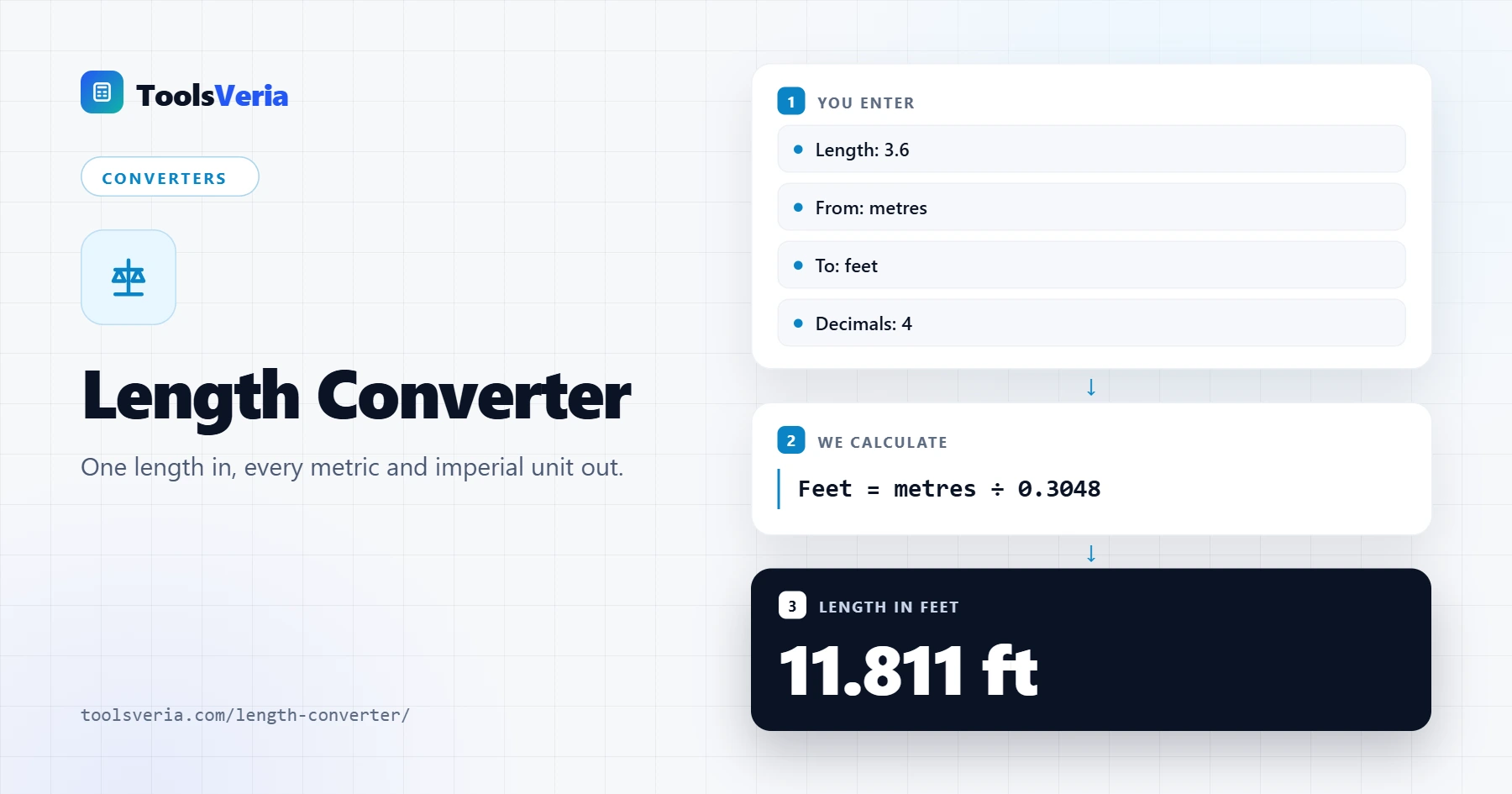
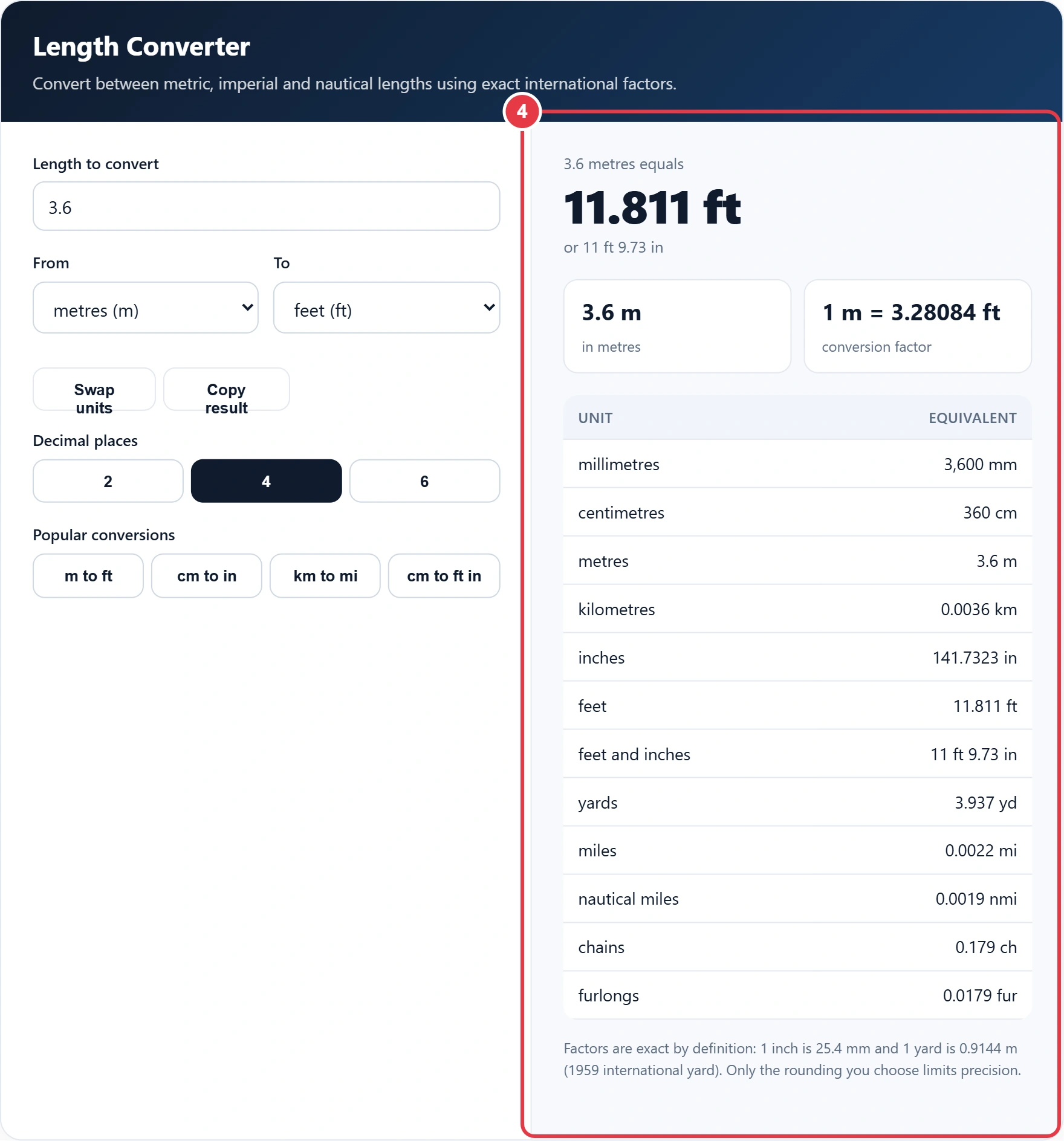
Quick answer: To use a length converter by hand, turn your figure into metres first, then divide by the size of the target unit in metres. One foot is exactly 0.3048 m, so 3.6 m ÷ 0.3048 = 11.811 ft, or 11 ft 9.73 in. One inch is exactly 2.54 cm and one mile is exactly 1,609.344 m.
In This Guide
What Is a Length Converter?
A length converter is a tool that expresses one distance in a different unit without changing the distance itself. It works in two moves: multiply your number by the size of its unit in metres, then divide by the size of the unit you want. Because every imperial unit has been tied to the metre since the 1959 international yard agreement, the result is exact up to the decimal places you choose.
Take Hannah, who is ordering flooring in Bristol for a bedroom the estate agent listed as 3.6 m long. The supplier quotes in feet, so she converts: 3.6 × 1 ÷ 0.3048 = 11.811 ft. The tool also shows 11 ft 9.73 in, which matches the tape measure her fitter will use, and 141.73 in if the planks are sold by the inch.
How to Use the Length Converter
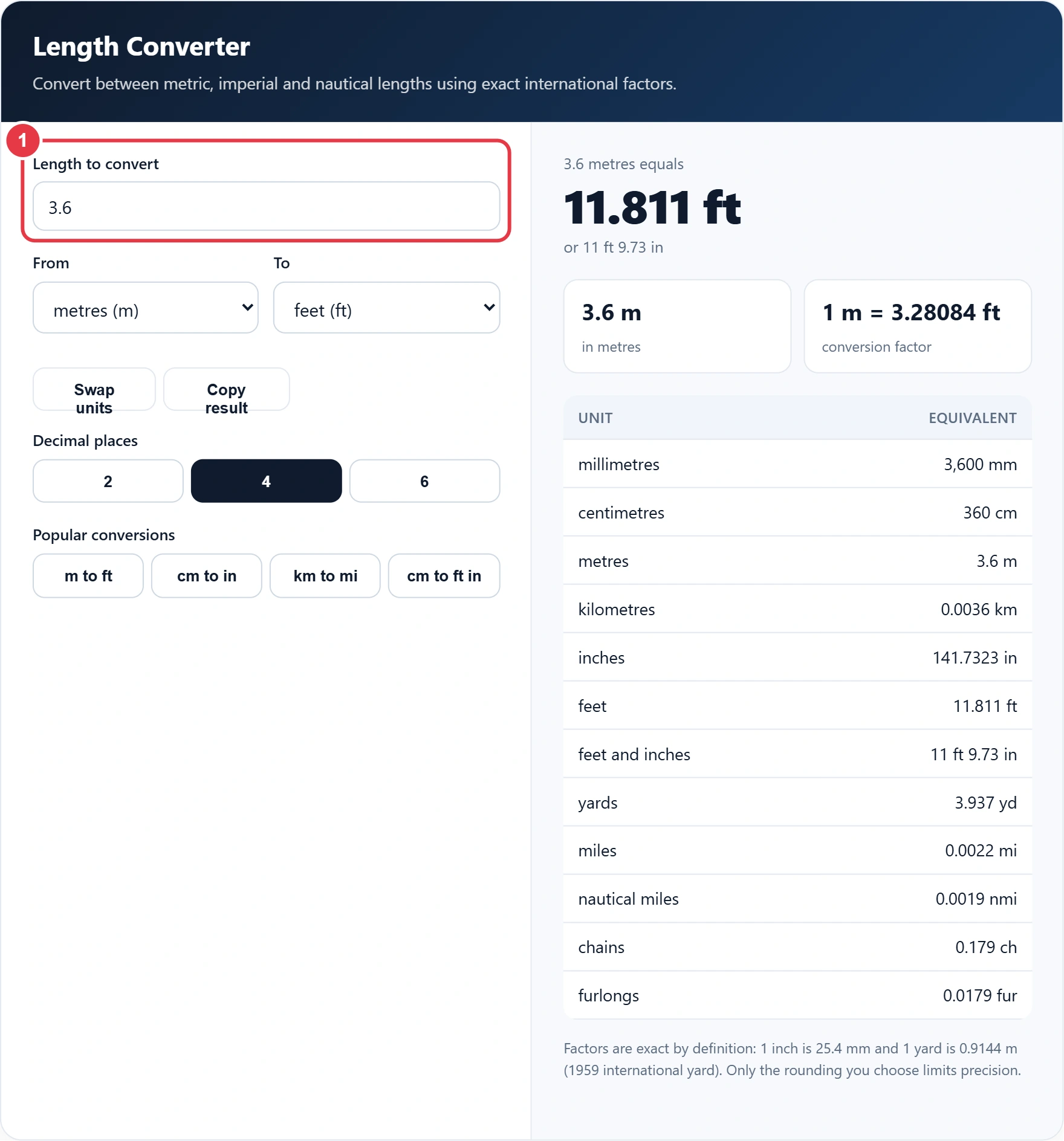
Step 1: Enter the Length
Type the number you want to convert. Decimals are fine, so 0.75 miles or 182.5 cm work as typed. If you pick feet and inches as the starting unit, the box changes into two fields so you can enter a height such as 5 ft 9 in directly.
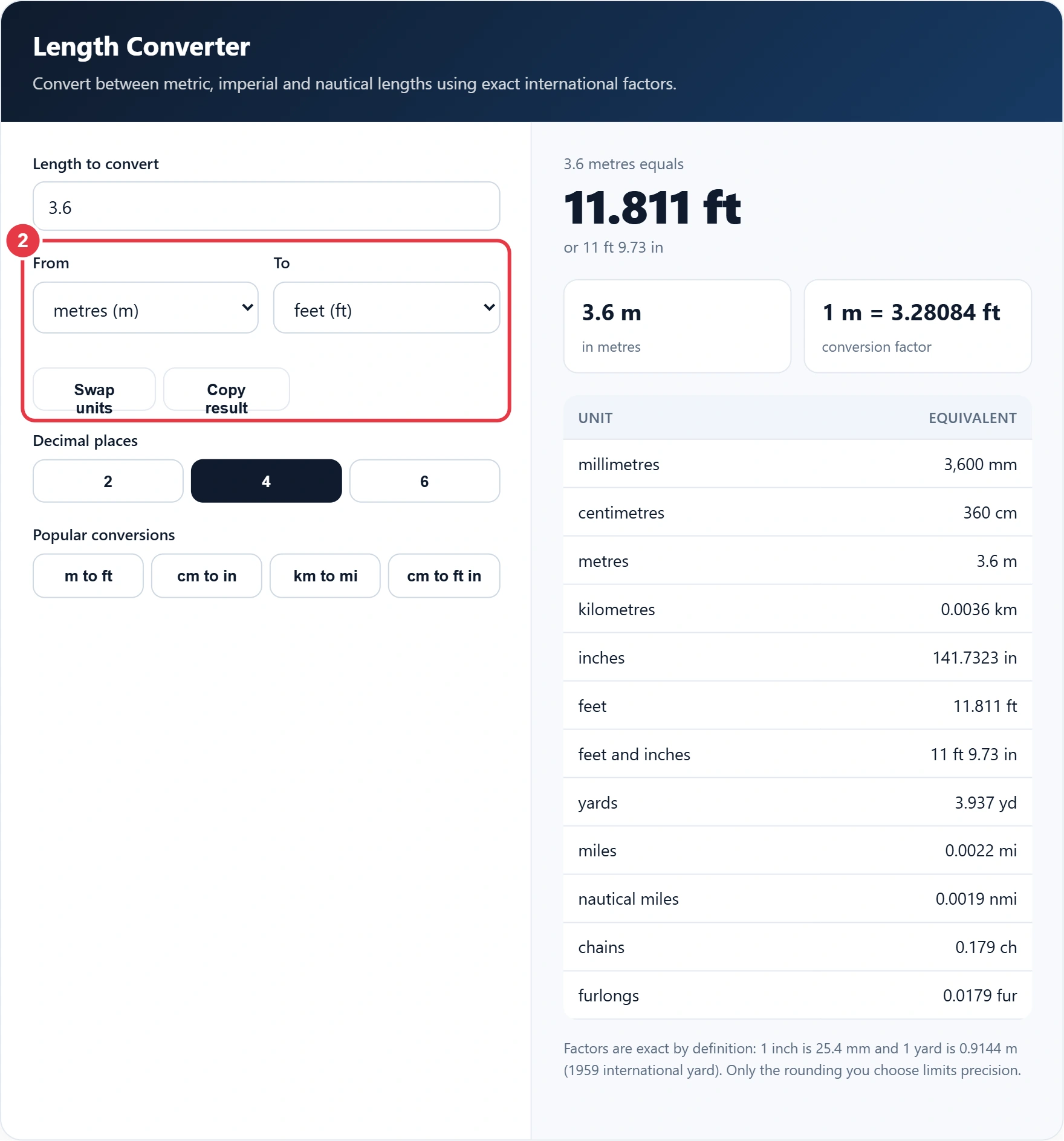
Step 2: Choose the From and To Units
Select the unit you are starting with and the one you need. The popular conversions buttons set the most searched pairs in one tap, and the swap button reverses the direction and carries the current answer across, which is handy for checking a conversion both ways. Copy result puts the full sentence on your clipboard for a quote or a spreadsheet.
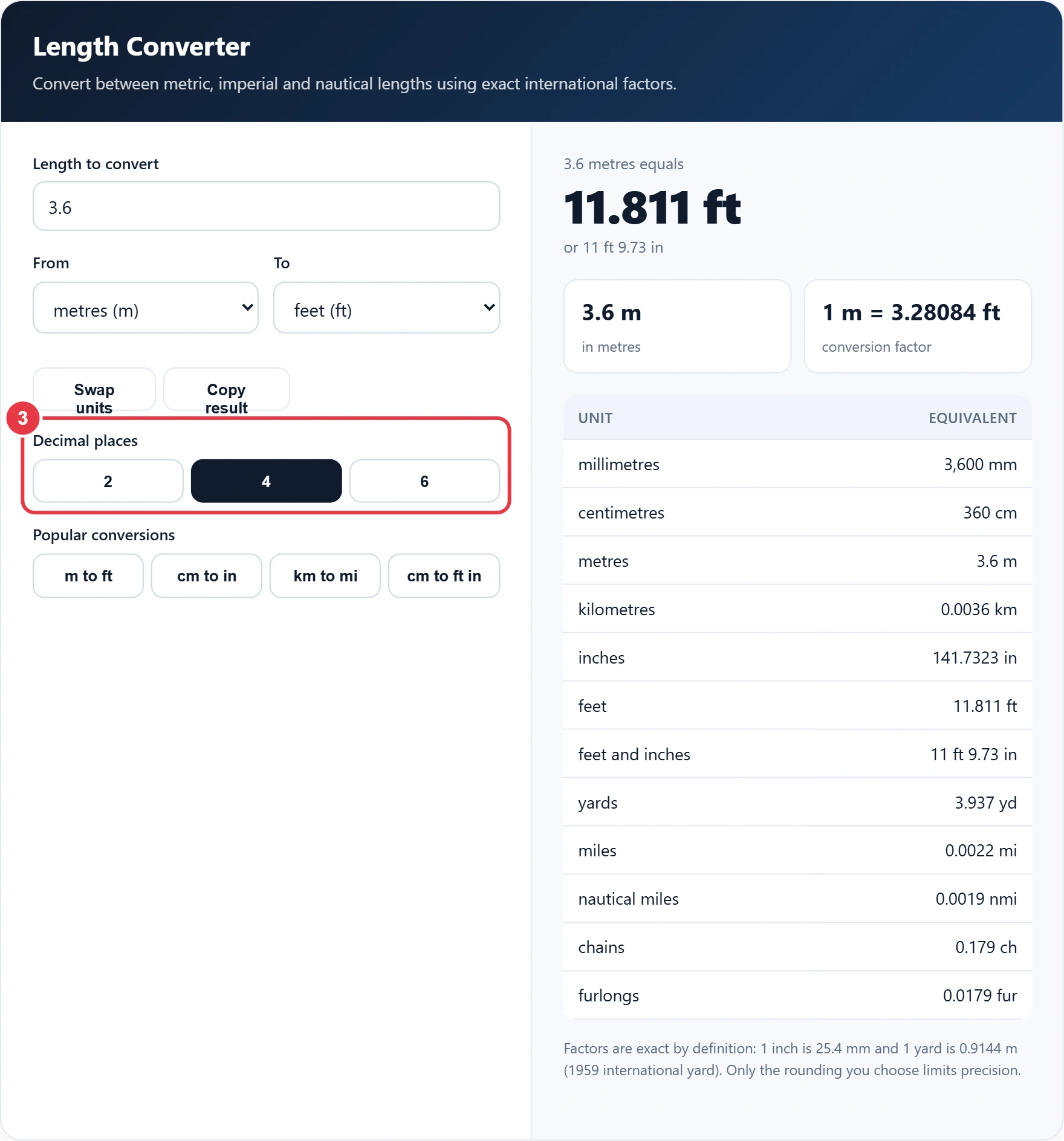
Step 3: Pick the Decimal Places
Two decimals suit everyday measurements, four suit DIY and engineering drawings, and six help when you are checking another calculator. Very small results, such as a millimetre expressed in miles, switch to four significant figures so they never show as zero.
Step 4: Read the Result and the Full Table
The large figure answers your chosen pair, with feet and inches underneath for metric and imperial lengths. The table lists the same distance in all 11 units at once, and the factor box shows exactly what one unit equals. If you are converting race distances, the running pace calculator turns those kilometres and miles into pace and finish times.
How Do You Convert Metres to Feet?
Divide metres by 0.3048, or multiply by 3.28084, to get feet. For feet and inches, keep the whole number of feet, then multiply the leftover decimal by 12. A 1.75 m person is 5.741 ft tall, and 0.741 × 12 gives 8.9 in, so the height reads 5 ft 8.9 in. Going back, multiply feet by 0.3048 and inches by 0.0254, then add the two.
How Many Centimetres Are in an Inch?
There are exactly 2.54 cm in an inch, so divide centimetres by 2.54 to get inches. This figure has been fixed since 1959, when the UK, US and other Commonwealth countries agreed the international yard and pound, and it means a 32 inch waist is 81.28 cm. The US survey foot, slightly longer at 1200/3937 m, was retired by NIST at the end of 2022, so this converter uses the international foot throughout.
How Many Metres Are in a Mile?
A mile is exactly 1,609.344 metres, or 1,760 yards. UK road signs still use miles and yards, so a junction marked 800 yards away is 731.52 m ahead. Older units survive too: a chain is 22 yards (20.1168 m), the length of a cricket pitch, and a furlong is 220 yards (201.168 m), which British horse racing still uses for race distances. A nautical mile is different again at 1,852 m, and it underpins the knot used at sea and in aviation.
Length Conversion Table
| From | To | Multiply by | Exact? |
|---|---|---|---|
| inches | centimetres | 2.54 | Yes |
| centimetres | inches | 0.393701 | Rounded |
| feet | metres | 0.3048 | Yes |
| metres | feet | 3.28084 | Rounded |
| yards | metres | 0.9144 | Yes |
| metres | yards | 1.093613 | Rounded |
| miles | kilometres | 1.609344 | Yes |
| kilometres | miles | 0.621371 | Rounded |
| nautical miles | kilometres | 1.852 | Yes |
| chains | metres | 20.1168 | Yes |
Factors in one direction are exact by law, while the reverse factors are rounded to six or seven figures because they are recurring decimals. The tool always divides by the exact value instead, which is why its answers can differ in the last digit from tables that use 3.28084. When you are comparing fuel figures between countries, the L/100km to mpg converter applies the same exact mile and gallon definitions to economy figures. Figures checked October 2026.
Everyday Lengths Worth Knowing
- A sheet of A4 paper is 210 mm by 297 mm, or 8.27 in by 11.69 in.
- A standard UK door is about 1,981 mm tall, which is the metric version of 6 ft 6 in.
- A 5K run is 3.107 miles and a marathon is 26.219 miles (42.195 km).
- A 6 ft person is 182.88 cm tall, and you can pair height with the kg to stone converter when filling in a form that wants imperial units.
Key Terms for Using the Length Converter
These terms explain the exact unit definitions the length converter relies on, so metric, imperial and nautical results stay precise whichever pair you choose.
- Metre
- The base unit of length in the International System of Units, defined by the distance light travels in a vacuum in a set fraction of a second. Every other unit is converted through it.
- International yard
- The yard fixed at exactly 0.9144 metres by the 1959 agreement between English speaking countries. The foot and inch are defined as fractions of it, which ties all imperial lengths exactly to the metre.
- Foot
- An imperial unit equal to 12 inches, or one third of a yard, defined as exactly 0.3048 metres. Britons still use it with inches for heights and room sizes, so the converter shows both together.
- Inch
- The smallest common imperial length, defined as exactly 25.4 millimetres, or 2.54 centimetres. Waist sizes, screen sizes and timber widths are often given in inches, so it is one of the most converted units.
- Nautical mile
- A unit used at sea and in aviation, defined as exactly 1,852 metres and originally based on one minute of latitude. It is longer than the land mile, so the two should never be swapped.
- Chain and furlong
- Traditional British land measures, with a chain equal to 22 yards and a furlong equal to 10 chains. They survive in horse racing distances, railway mileposts and the length of a cricket pitch.
</>Embed this calculator on your website
Add the free Length Converter to your own site or blog. Copy the code below and paste it into an HTML block. It resizes itself and works on phones.
How we checked this tool: the Tools Veria Editorial Team built this tool by hand, checked it against the official rules or published standards where they apply, and tested it against worked examples. Results are estimates for planning, not personal financial or tax advice. Read our editorial policy and disclaimer, or report an error.
Frequently Asked Questions
How many feet are in a metre?
There are 3.28084 feet in one metre, because a foot is defined as exactly 0.3048 m. In feet and inches, a metre is 3 ft 3.37 in, so 2 m is 6 ft 6.74 in and 10 m is 32.81 ft.
How do I convert cm to feet and inches?
Divide the centimetres by 2.54 to get inches, then divide by 12. The whole number is feet and the remainder is inches. For example, 170 cm is 66.93 in, which is 5 ft 6.93 in.
How many kilometres are in a mile?
One mile is exactly 1.609344 km, so multiply miles by 1.609344 to get kilometres. A 10 mile run is 16.09 km, and 26.2 miles is 42.16 km. To go back, multiply kilometres by 0.621371.
What is the difference between a mile and a nautical mile?
A statute mile is 1,609.344 m and a nautical mile is 1,852 m, about 15% longer. Nautical miles are used at sea and in aviation because one nautical mile was originally one minute of latitude.
How many yards are in a mile?
There are exactly 1,760 yards in a mile, and 3 feet in each yard, so a mile is 5,280 feet. On UK roads, a sign reading 300 yards means 274.32 metres to the junction.
Is this length converter exact?
Yes. It uses the legal definitions of 25.4 mm per inch and 0.9144 m per yard, so every conversion is exact before rounding. You choose 2, 4 or 6 decimal places, and tiny results switch to significant figures.