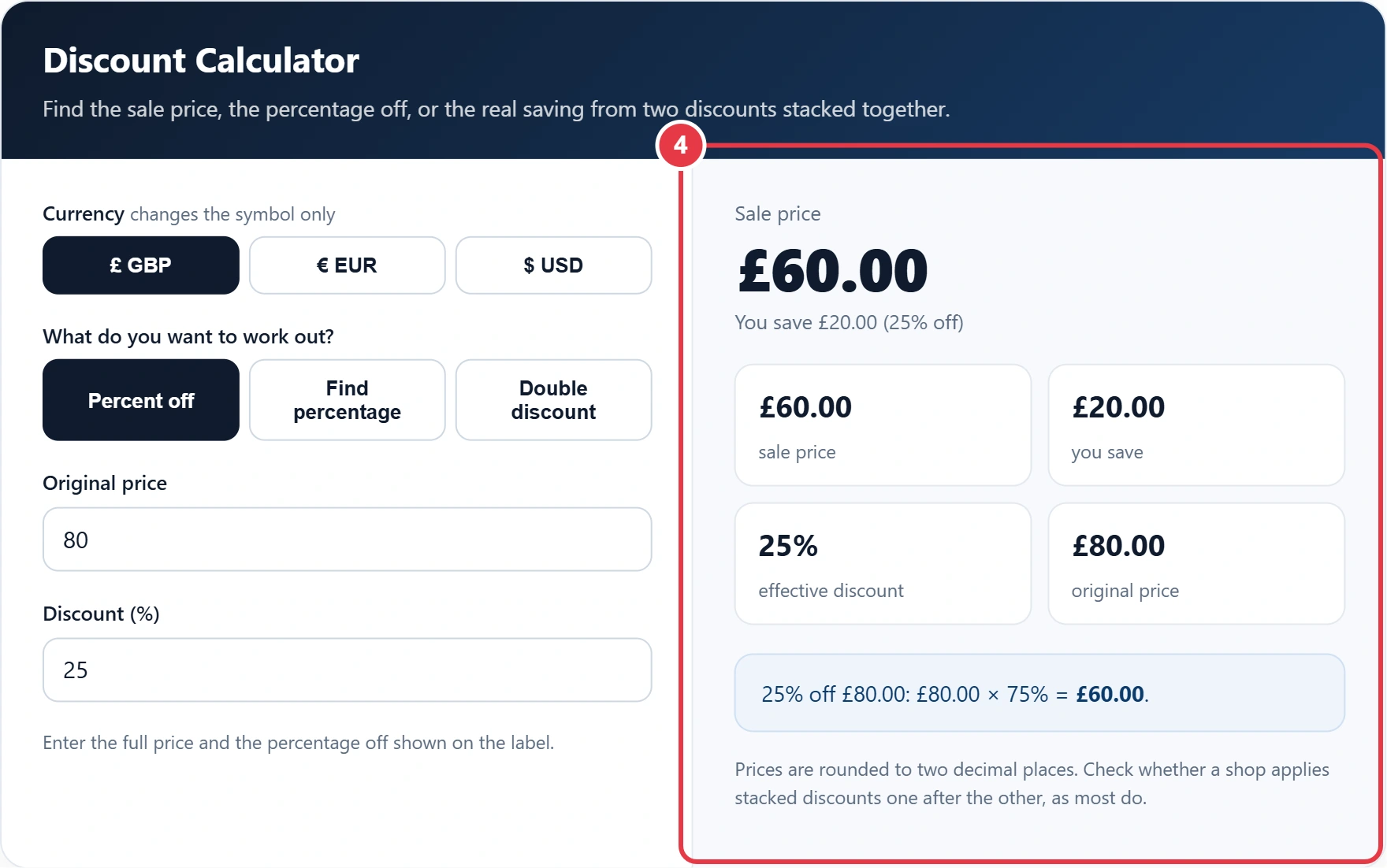
Find the sale price, the percentage off, or the real saving from two discounts stacked together.
Enter the full price and the percentage off shown on the label.
Prices are rounded to two decimal places. Check whether a shop applies stacked discounts one after the other, as most do.
Shopping a sale and want to know what you will actually pay? This discount calculator uses the basic rules of percentages to work out the sale price from any percent off, find the percentage discount between two prices, and show the real saving when two discounts are stacked. It handles pounds, euros and dollars, so the maths is always clear.
Quick answer: A discount calculator finds the sale price with original price × (1 − discount ÷ 100), so 25% off £80 is £60, a saving of £20. Stacked discounts multiply rather than add: 20% off then an extra 10% off leaves 0.72 of the price, which is 28% off in total, not 30%.
In This Guide
What Is a Discount Calculation?
A discount is a reduction from the original price, usually shown as a percentage. To find the sale price, multiply the original price by what is left after the discount: sale price = original price × (1 − discount ÷ 100). So 25% off £80 is £80 × 0.75 = £60, a saving of £20.
To find the percentage off from two prices, use (original − sale) ÷ original × 100. For a general comparison of any two numbers, the percentage difference calculator shows the gap either way. Stacked discounts multiply rather than add: 20% off then an extra 10% off leaves 0.8 × 0.9 = 0.72 of the price, which is 28% off in total, not 30%.
How Do You Use the Discount Calculator?
Step 1: Choose Currency and Mode
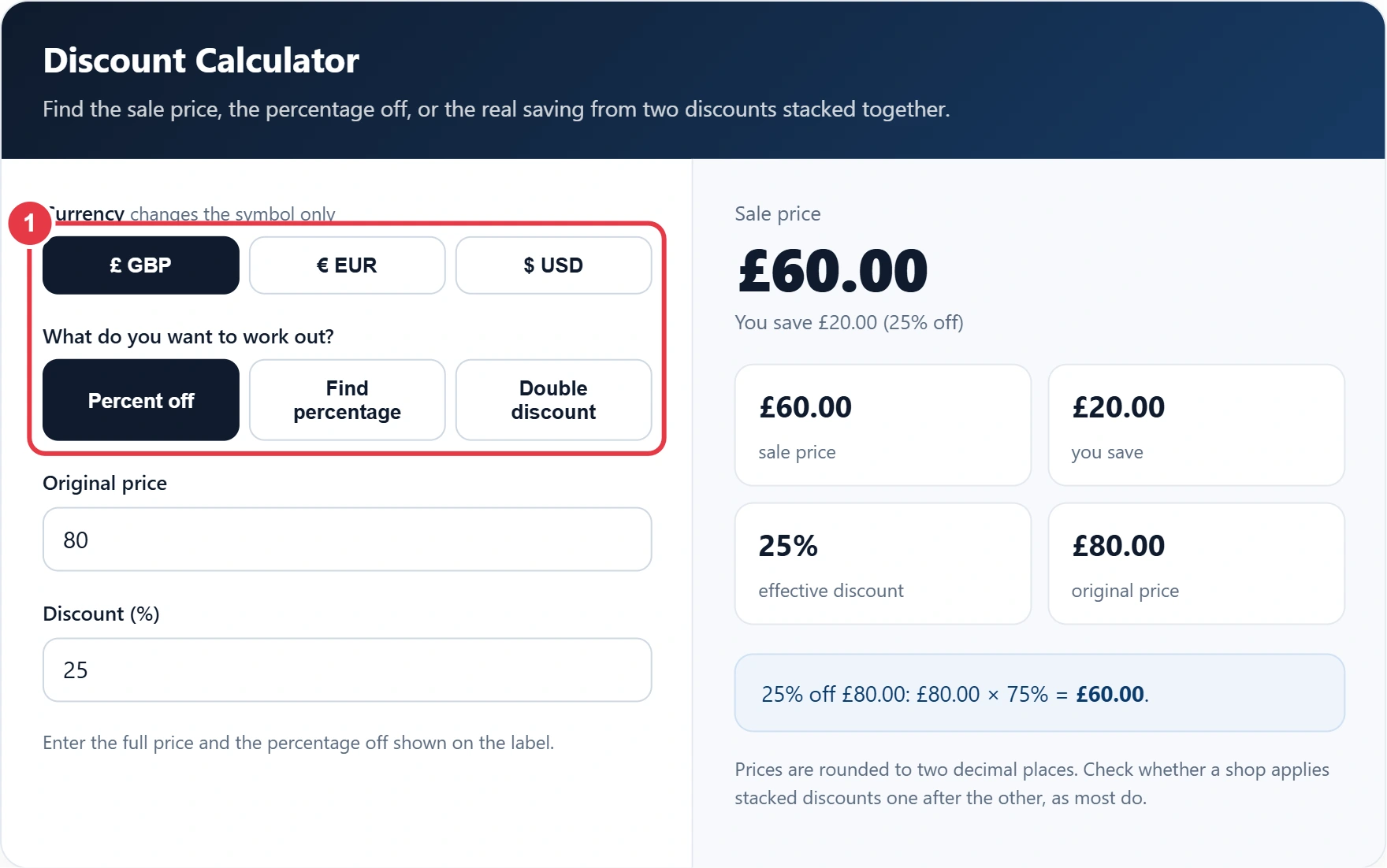
You pick £, € or $, then choose Percent off, Find percentage or Double discount, and the fields change to match what you want to work out. Pick £, € or $, then choose Percent off, Find percentage or Double discount. The fields change to match what you want to work out.
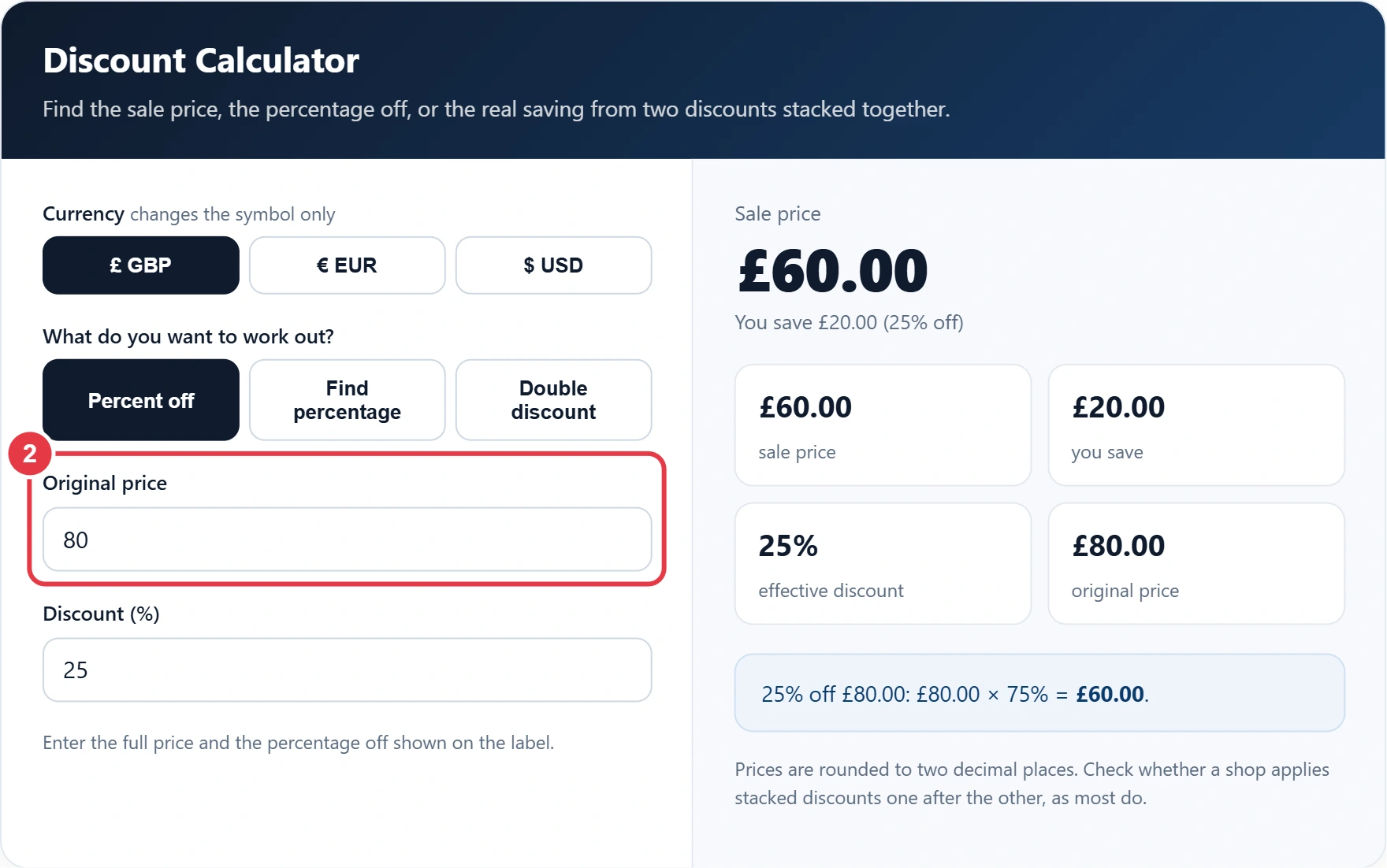
Step 2: Enter the Original Price
Type the full price before any discount. This is often the crossed out "was" price on the label or website.
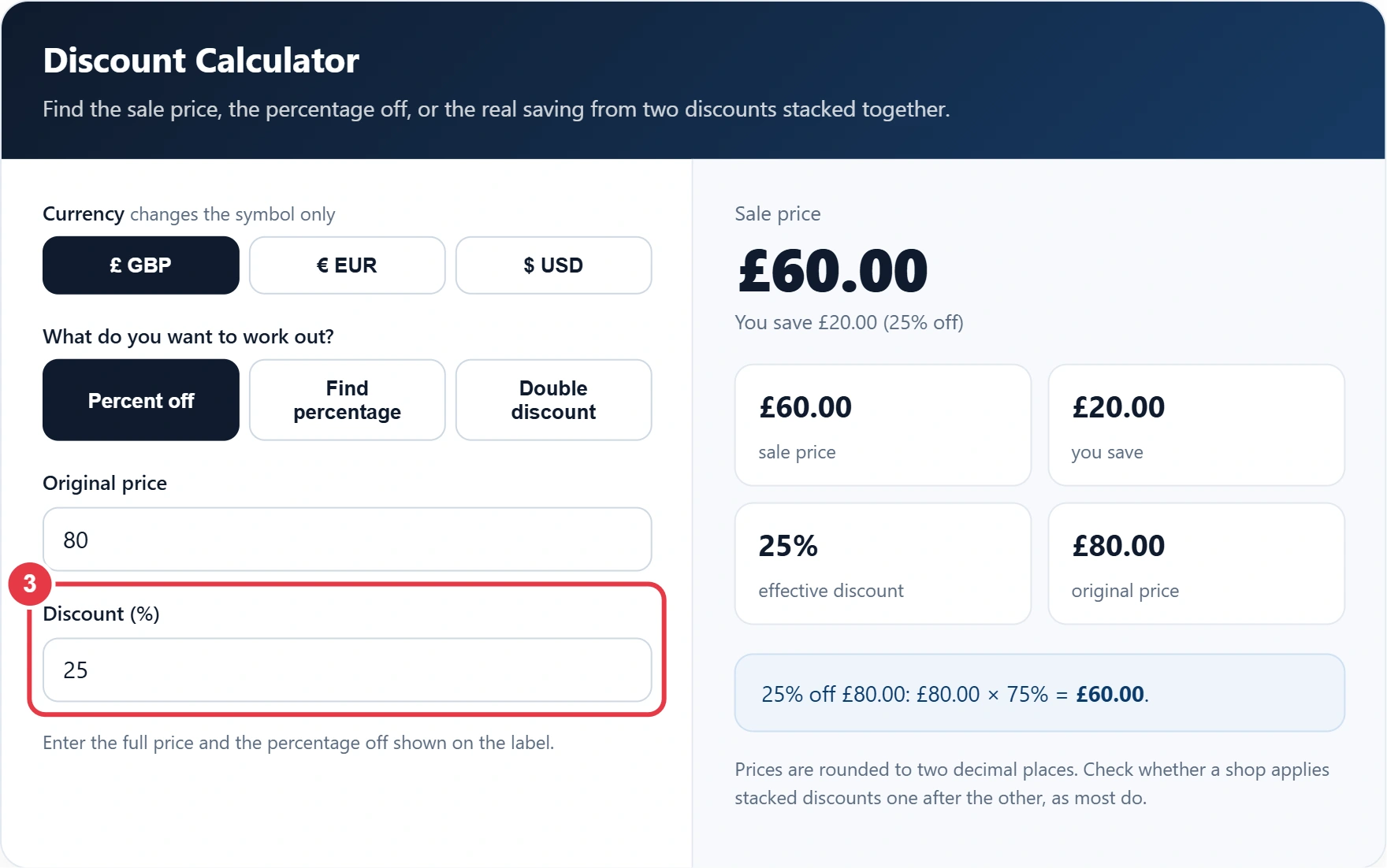
Step 3: Enter the Discount
Enter the percentage off, the sale price you have been offered, or two separate discounts such as a sale price plus a voucher code.
Step 4: Read Your Results
You will see the sale price, how much you save and the effective discount, with the working shown underneath so you can check it. If you sell goods yourself, the profit margin calculator shows how a discount eats into your margin, so you can plan offers that still pay.
How Much Do You Save With a Discount?
| Original price | Discount | Sale price | You save |
|---|---|---|---|
| £80 | 25% off | £60.00 | £20.00 |
| £49.99 | 30% off | £34.99 | £15.00 |
| £120 | Sale price £90 | £90.00 | £30.00 (25%) |
| £100 | 20% then 10% off | £72.00 | £28.00 (28%) |
For example, 25% off £80 brings the price to £60.00, saving £20.00, while 20% then 10% off £100 gives £72.00, a total saving of 28%. A big percentage only matters if the original price was genuine. Under UK rules, traders must not mislead you with fake "was" prices, and you can read more about your rights in the GOV.UK consumer protection guide. Comparing the sale price with other shops is often more useful than the discount itself.
A discount only saves money if the price per gram or per item really falls, which the unit price comparison calculator checks across up to four products.
What the Key Discount Calculator Terms Mean
These definitions explain the percentage rules used by the discount calculator, so you can check sale prices, compare offers and spot misleading reductions.
- Percentage discount
- A price reduction expressed as a share of the original price out of one hundred. Converting it to a multiplier, by subtracting it from one hundred and dividing by one hundred, gives the fraction of the price you still pay.
- Effective discount
- The single overall percentage reduction that results from all discounts applied to a price. It is the honest measure of saving when offers are combined, because stacked percentages do not simply add together.
- Successive discounts
- Two or more reductions applied one after another, each to the price already reduced by the one before. Their combined effect is the product of the remaining fractions, so the total saving is always less than the sum.
- Reference price
- The earlier or usual price a shop compares a sale price against, often shown as a crossed out was price. UK consumer law requires it to be genuine, as an inflated reference price makes a discount look larger than it is.
- Markdown
- A permanent reduction in a retailer's selling price, usually to clear stock or respond to falling demand. Unlike a voucher or promotion, it changes the shelf price for every customer rather than applying at checkout.
- Percentage point
- The arithmetic difference between two percentages, as opposed to their relative change. Moving from 20% off to 30% off is a rise of ten percentage points, though the discount itself grows by half.
</>Embed this calculator on your website
Add the free Discount Calculator to your own site or blog. Copy the code below and paste it into an HTML block. It resizes itself and works on phones.
How we checked this tool: the Tools Veria Editorial Team built this tool by hand, checked it against the official rules or published standards where they apply, and tested it against worked examples. Results are estimates for planning, not personal financial or tax advice. Read our editorial policy and disclaimer, or report an error.
Frequently Asked Questions
How do I calculate a percentage discount?
Multiply the original price by the discount as a decimal to get the saving, then take it off. For 25% off £80, 80 × 0.25 = £20, so you pay £60.
How do I work out the percentage off from two prices?
Subtract the sale price from the original, divide by the original and multiply by 100. £120 down to £90 is 30 ÷ 120 × 100 = 25% off.
Is 20% off plus 10% off the same as 30% off?
No. The second discount comes off the already reduced price, so 20% then 10% is 28% off in total.
How do I find the original price before a discount?
Divide the sale price by what is left after the discount. If £60 is 25% off, the original was £60 ÷ 0.75 = £80.
What is 30% off £50?
30% of £50 is £15, so the sale price is £35.
Does the discount apply before or after VAT?
UK shop prices for consumers include VAT, so a percentage off the shelf price reduces the VAT inclusive price you pay.