Sophie moved from Glasgow to Leeds in the summer holidays and asked a simple question: what school year is my child in now? Her daughter had done one year of school, P1 in Scotland, yet the Leeds school placed her in Year 2, the third class of an English primary. Nothing had gone wrong. England and Scotland simply cut their school years at different points in the calendar and start school at different ages.
Below you will find the 2026/27 birth date ranges for every year group in England and Wales, the separate rules for Scotland and Northern Ireland, and worked examples for the birthdays that cause the most confusion.
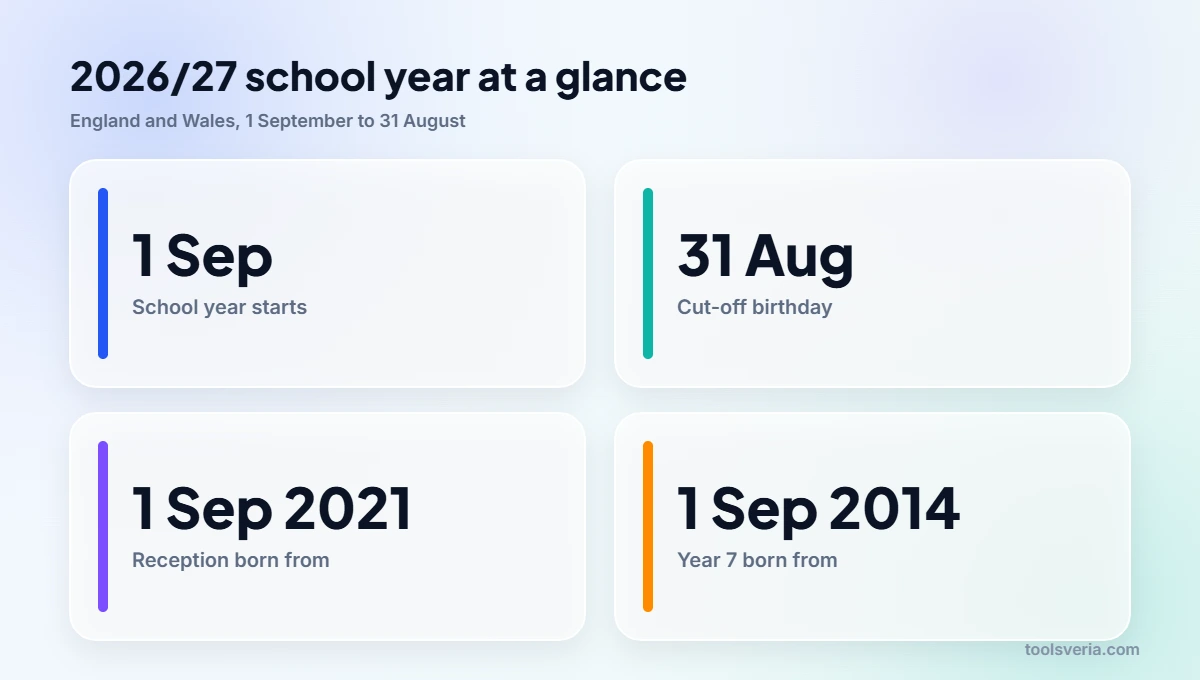
Quick answer: In England and Wales, a child’s school year depends on whether their birthday falls between 1 September and 31 August. For 2026/27, children born between 1 September 2021 and 31 August 2022 are in Reception, and those born between 1 September 2019 and 31 August 2020 are in Year 2. Scotland and Northern Ireland use different cut-offs.
In This Guide
What school year is my child in for 2026/27?
For the 2026/27 school year in England and Wales, your child’s year group is set by the 12 month band their birthday falls in, running from 1 September to 31 August. Find the band in the table below and read across. The same table applies to every state school in England and Wales, whatever the council.
| Born between | Year group in 2026/27 | Age on 1 September 2026 | Stage |
|---|---|---|---|
| 1 Sep 2021 and 31 Aug 2022 | Reception | 4 | Early years |
| 1 Sep 2020 and 31 Aug 2021 | Year 1 | 5 | Key stage 1 |
| 1 Sep 2019 and 31 Aug 2020 | Year 2 | 6 | Key stage 1 |
| 1 Sep 2018 and 31 Aug 2019 | Year 3 | 7 | Key stage 2 |
| 1 Sep 2017 and 31 Aug 2018 | Year 4 | 8 | Key stage 2 |
| 1 Sep 2016 and 31 Aug 2017 | Year 5 | 9 | Key stage 2 |
| 1 Sep 2015 and 31 Aug 2016 | Year 6 | 10 | Key stage 2 |
| 1 Sep 2014 and 31 Aug 2015 | Year 7 | 11 | Key stage 3 |
| 1 Sep 2013 and 31 Aug 2014 | Year 8 | 12 | Key stage 3 |
| 1 Sep 2012 and 31 Aug 2013 | Year 9 | 13 | Key stage 3 |
| 1 Sep 2011 and 31 Aug 2012 | Year 10 | 14 | Key stage 4 |
| 1 Sep 2010 and 31 Aug 2011 | Year 11 | 15 | Key stage 4 (GCSEs) |
| 1 Sep 2009 and 31 Aug 2010 | Year 12 | 16 | Sixth form |
| 1 Sep 2008 and 31 Aug 2009 | Year 13 | 17 | Sixth form |
Ages show how old most children in each class are on the first day of term, and every child moves up a year in age during the school year. Several council pages that rank for this question still display their 2024/25 or 2025/26 tables, so always check which school year a table refers to before trusting it.
Why does 31 August decide which class my child joins?
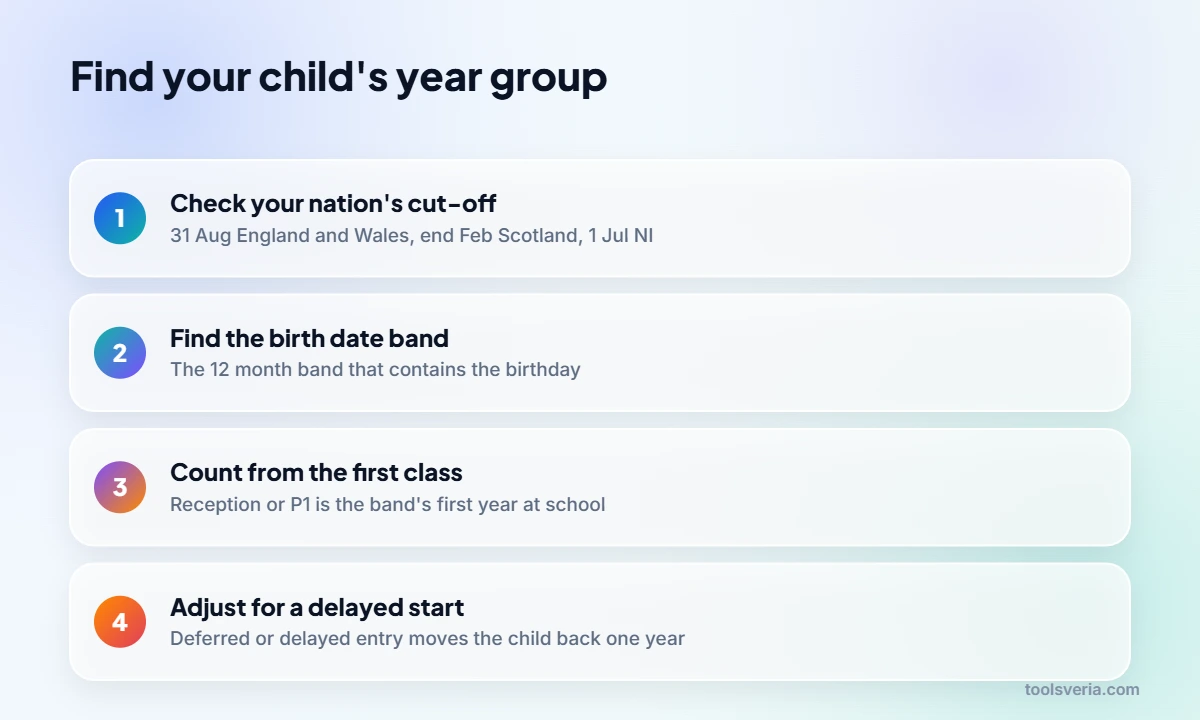
In England and Wales, 31 August is the last day of the school year, so every child born on or before it joins the class above a child born on 1 September of the same year. The rule in plain words: find the 1 September to 31 August band your child was born in, then count the school years since that band started Reception.
Ava was born on 1 September 2021 and Oliver on 25 August 2022. Both start Reception in September 2026, yet Ava is 358 days older. Ava turns 5 on the second day of term, while Oliver turned 4 only a week before it. Teachers plan for this spread, and it is the reason summer born children sometimes look young for their class in the early years.
One day can change everything. A child born at 11pm on 31 August 2020 sits in Year 2 in 2026/27, while a friend born two hours later on 1 September 2020 is in Year 1. If you want to check exactly how many days separate two birthdays, the days between dates calculator gives the gap in days, weeks and months.
When does my child have to start school in England?
In England, most children start Reception full time in the September after their fourth birthday, but the law only requires full time education from compulsory school age. The GOV.UK school starting age rules set that point at 31 December, 31 March or 31 August following the fifth birthday, whichever comes first.
Ben was born on 10 October 2021. He can join Reception in September 2026, aged 4, but he only reaches compulsory school age on 31 December 2026, so his parents could legally keep him at home until the spring term starting in January 2027. Most families still take the September place, because a child who joins mid year misses the settling in weeks.
Summer born children: delaying a year
Oliver, born on 25 August 2022, does not reach compulsory school age until 31 August 2027. His parents can delay his start to September 2027. Here is the catch many guides gloss over: by default he would then join Year 1 with his own birth cohort. Starting in Reception at age 5 needs the agreement of the admission authority, so his parents must apply in the normal round for September 2026 and explain why Reception suits him better.
Part time attendance until compulsory school age is another option that keeps the Reception place. If either parent is planning a new baby around the same time, our maternity pay calculator estimates Statutory Maternity Pay, which helps when weighing a delayed start against childcare costs.
Which year group is my child in Scotland or Northern Ireland?
Scotland groups children born from 1 March to the end of February, and Northern Ireland groups children born from 2 July to 1 July, so the same birthday can land in a different class from England. The year names change too: Scotland uses P1 to P7 then S1 to S6, while Northern Ireland uses P1 to P7 then Year 8 to Year 14.
| Nation | Birth date band | First class in 2026/27 (born) | Starts secondary | GCSE or equivalent |
|---|---|---|---|---|
| England | 1 Sep to 31 Aug | Reception (Sep 2021 to Aug 2022) | Year 7 | GCSEs in Year 11 |
| Wales | 1 Sep to 31 Aug | Reception (Sep 2021 to Aug 2022) | Year 7 | GCSEs in Year 11 |
| Scotland | 1 Mar to end Feb | P1 (1 Mar 2021 to 28 Feb 2022) | S1 | National 5 in S4 |
| Northern Ireland | 2 Jul to 1 Jul | P1 (2 Jul 2021 to 1 Jul 2022) | Year 8 | GCSEs in Year 12 |
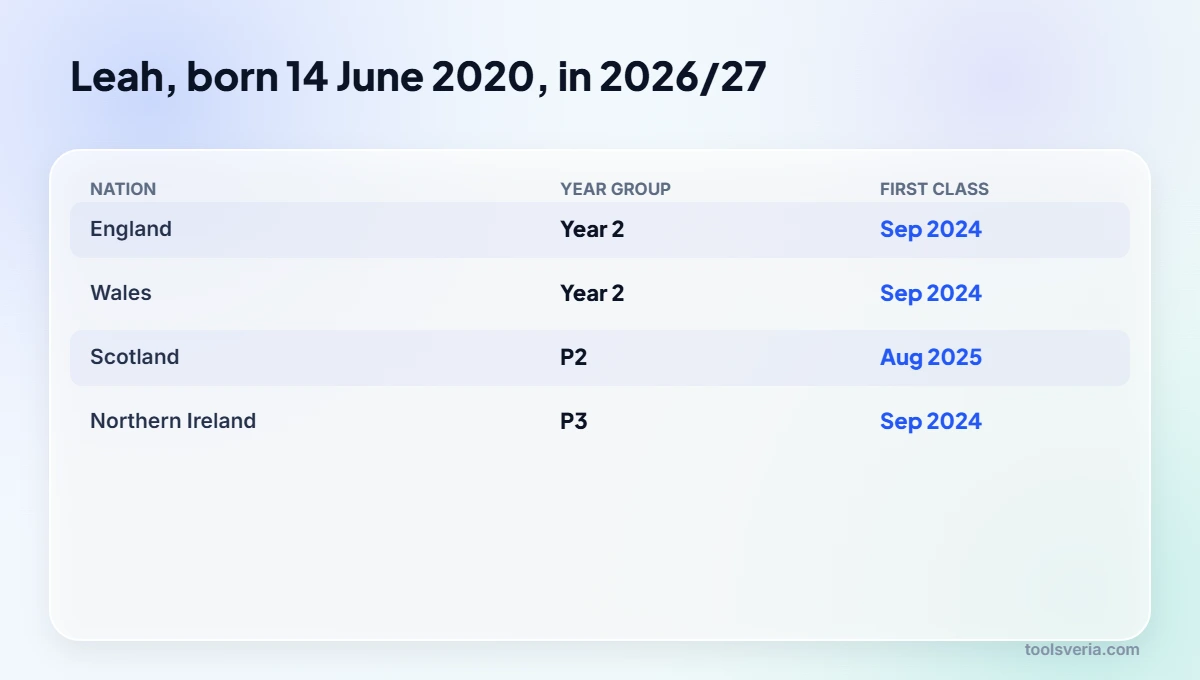
Leah was born on 14 June 2020, which shows the difference neatly. In England she started Reception in September 2024 and is in Year 2 for 2026/27. In Scotland her birthday sits in the March 2020 to February 2021 band, so she started P1 in August 2025 and is now in P2. In Northern Ireland she turned 4 before 1 July 2024, so she started P1 that September and is now in P3.
Both nations also allow deferral. In Scotland, parents of a child who is still 4 when term starts can defer P1 for a year, and the Scottish Government funds an extra year of early learning and childcare for them. In Northern Ireland, the Department of Education allows parents of children born between 1 April and 1 July to request a deferred start, an option available since September 2025.
What happens to the year group if we move nation?
When a family moves between UK nations, the new school places the child in the year group that matches their birthday under the new nation’s rules, which can feel like jumping or repeating a year. Sophie’s daughter, born in May 2020, is the classic case: P1 in Scotland in 2025/26, then Year 2 in England in 2026/27, alongside children who started Reception a year before she started P1.
Exam timing shifts in the same way. Leah sits GCSEs in summer 2036 if she stays in England, at the end of Year 11. Children in Northern Ireland take GCSEs in Year 12, at roughly the same age, while most Scottish pupils sit National 5 exams in S4. If you are relocating, the UK working days calculator helps you set term dates against your annual leave, bank holidays included, and the new school can explain any curriculum gap before you agree a start date.
Families arriving from overseas follow the same birthday rule, not the class the child was in abroad. The national curriculum explained on GOV.UK’s key stages page then follows the year group, so a 10 year old from Spain or the United States usually joins Year 5 or Year 6 in England.
Key points
- In England and Wales, the school year runs from 1 September to 31 August, and a child’s birthday decides their class.
- For 2026/27, children born between 1 September 2021 and 31 August 2022 are in Reception.
- Compulsory school age in England is 31 December, 31 March or 31 August after the fifth birthday, whichever comes first.
- Scotland uses a 1 March cut-off with P1 to S6, and Northern Ireland uses a 1 July cut-off with P1 to Year 14.
- A summer born child in England who delays a year joins Year 1 unless the admission authority agrees to Reception.
What School Year Is My Child In: Key Terms
These terms explain how UK year groups are set and named, helping you answer what school year is my child in for 2026/27 in any nation.
- Year group
- A class of pupils born within the same twelve month band, who move up together each September. The band’s start and end dates vary between the UK nations, which is why the same child can be placed differently after a move.
- School year cut-off
- The birthday boundary that decides which year group a child joins. In England and Wales it runs from 1 September to 31 August, so a late August birthday makes a child the youngest in the class.
- Reception
- The first year of primary school in England, which children join in the September after they turn four. It is the final year of the Early Years Foundation Stage, before Year 1 begins Key Stage 1.
- Key stage
- A block of school years in the national curriculum of England, Wales and Northern Ireland, each with its own programmes of study and assessments. Key Stage 4, covering Years 10 and 11, ends with GCSEs.
- Summer born child
- A child whose birthday falls in the summer months near the end of the school year band, making them among the youngest in their class. In England parents can ask the admission authority to delay school entry, although each request is decided locally.
- Primary 1
- The first year of primary school in Scotland, known as P1. Scotland uses a different birthday cut-off and entry age from England, so a child’s P class number does not match an English year number.
Frequently Asked Questions
My son was born on 31 August 2019. Is he the youngest in Year 3?
Yes, a child born on 31 August 2019 is in Year 3 in England and Wales for 2026/27 and is the youngest possible member of that class. A child born one day later, on 1 September 2019, is in Year 2 instead.
Our daughter turns 4 in July 2026. Must she start school this September?
No, a child turning 4 in July 2026 can start Reception in September 2026 but does not reach compulsory school age in England until 31 August 2027. You can choose part time hours, or ask the admission authority for a Reception place in September 2027.
We live in Belfast and our son was born on 3 July 2021. When does he start P1?
He starts P1 in September 2026. Northern Ireland groups children born from 2 July to 1 July, so a 3 July 2021 birthday falls in the band that begins P1 in September 2026, making him one of the oldest in his class.
My niece in Scotland is in S1, but my son born the same month is in Year 8. Why?
Different cut-offs explain it. Scotland groups birthdays from 1 March to February, England from 1 September to August. Both children were born between March and August 2014, which puts them in S1 in Scotland but Year 8 in England for 2026/27.
Sophie now knows her daughter skipped nothing: English children with her birthday simply started school a year earlier. Enter your own child’s date of birth and nation in the calculator to confirm the class, and check with your council admissions team if a delayed or deferred start applies. Figures checked October 2026.