
Hannah and Leo found a two bedroom flat in Manchester at £1,200 a month, and the letting agent asked for a £1,500 deposit. It sounded like a round five weeks. It was not. Under the tenancy deposit cap in England, the most the agent could legally take was £1,384.61, so the couple were being asked for £115.39 too much.
The gap came from one shortcut: treating a month as four weeks. The sections below show the sum the law actually uses, where the 6 week limit starts, and what you can be asked to hand over before you get the keys now that the rent in advance rules changed on 1 May 2026.
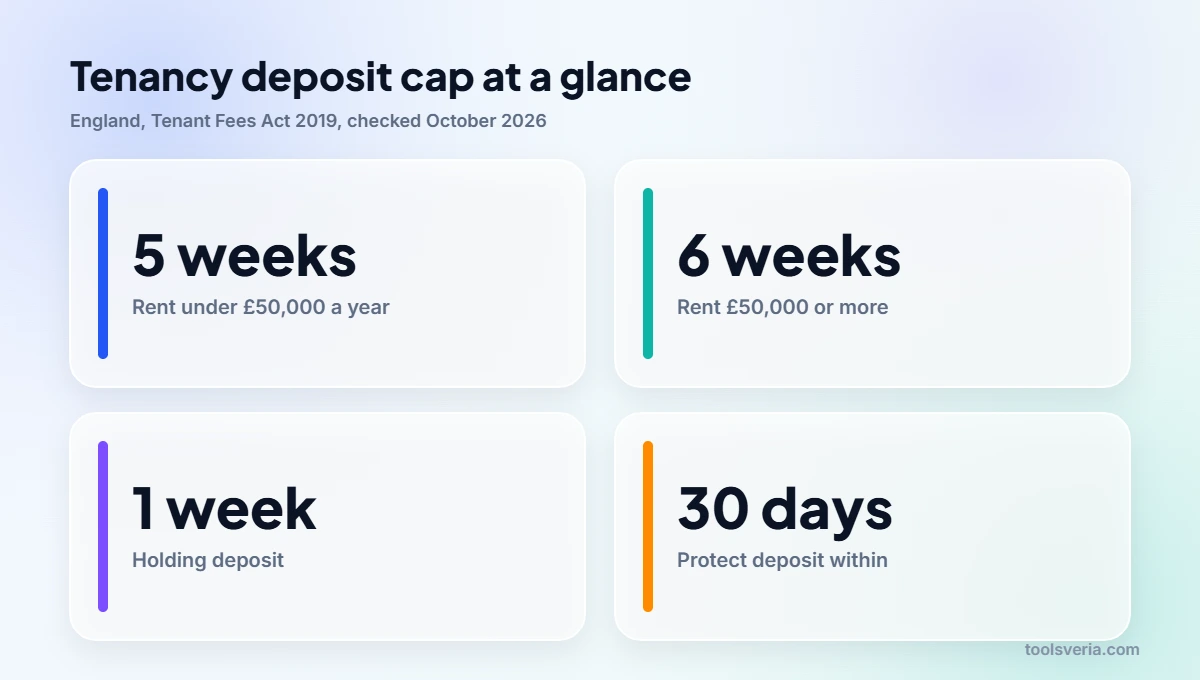
Quick answer: In England, the Tenant Fees Act 2019 caps a tenancy deposit at 5 weeks’ rent when the annual rent is under £50,000, and 6 weeks’ rent at £50,000 or more, as GOV.UK confirms for 2026. One week’s rent is the annual rent divided by 52, so £1,200 a month allows up to £1,384.61.
In This Guide
What is the tenancy deposit cap in England?
The tenancy deposit cap in England is the most a landlord or letting agent can take as a refundable deposit: 5 weeks’ rent if the yearly rent is below £50,000, or 6 weeks’ rent if it is £50,000 or more. It has applied to most private tenancies since 1 June 2019, and anything above it counts as a prohibited payment.
In plain words, the sum has three steps. Turn the rent into a yearly figure, divide that by 52 to get one week’s rent, then multiply by 5, or by 6 for the most expensive homes. Round the answer down to the penny, because rounding up by even a fraction takes the deposit over the limit.
The cap belongs to the tenancy, not to each person on it. Four friends sharing a house at £2,400 a month face one limit of £2,769.23 between them, which is about £692 each, not £2,769.23 per sharer. A landlord also cannot add a separate pet deposit on top, because the Act only allows the payments it lists and an extra deposit is not one of them.
How do you work out 5 weeks’ rent?
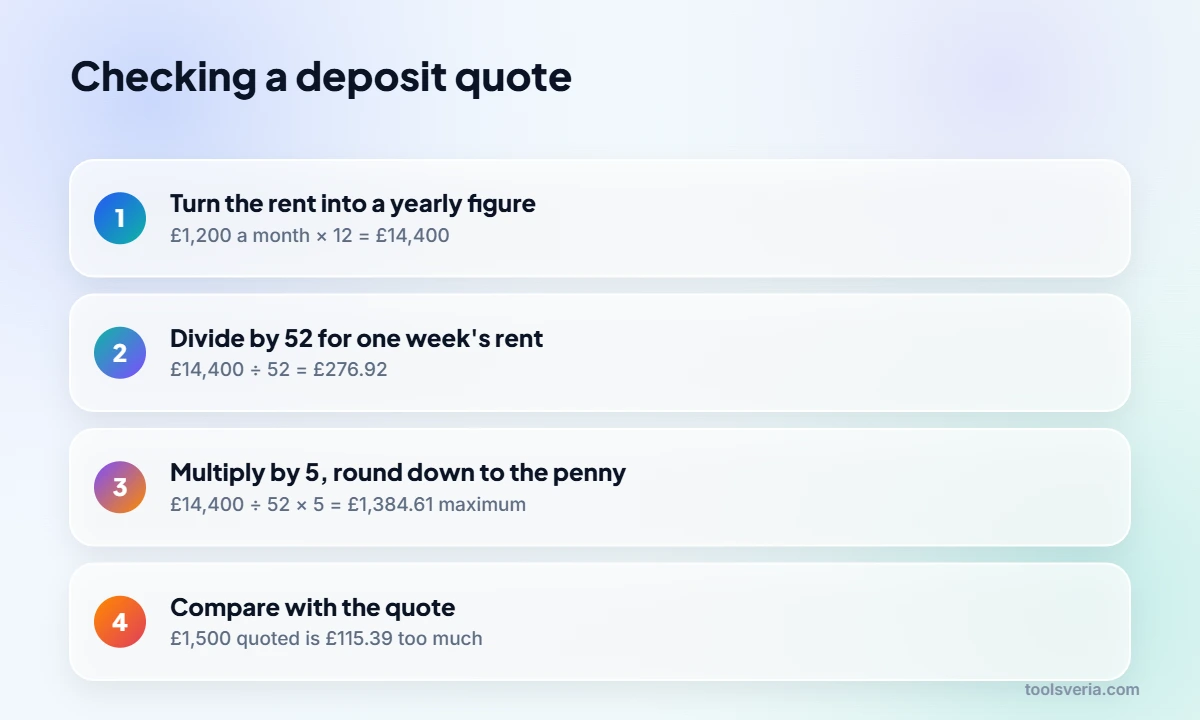
To work out 5 weeks’ rent, multiply the monthly rent by 12, divide by 52 and multiply by 5. That method is not a rule of thumb: the Tenant Fees Act 2019, Schedule 1 defines a week’s rent as the annual rent divided by 52, so every calculation has to pass through a yearly figure first.
For Hannah and Leo, £1,200 a month is £14,400 a year. Divided by 52 that gives £276.92 a week, and five weeks comes to £1,384.61. Their agent had divided £1,200 by 4 to get £300 a week, then multiplied by 5. A month is about 4.33 weeks, not 4, so that shortcut inflates weekly rent by roughly 8% every time.
The 4 weekly rent trap
Some landlords collect rent every 4 weeks, which means 13 payments a year rather than 12. Aisha pays £1,100 every 4 weeks in Leeds, so her annual rent is £14,300 and one week’s rent is exactly £275. Her cap is £1,375. Had she wrongly treated £1,100 as a monthly figure, she would have expected only £1,057.69 and challenged a deposit that was in fact lawful.
| Monthly rent | Annual rent | One week’s rent | Weeks allowed | Maximum deposit |
|---|---|---|---|---|
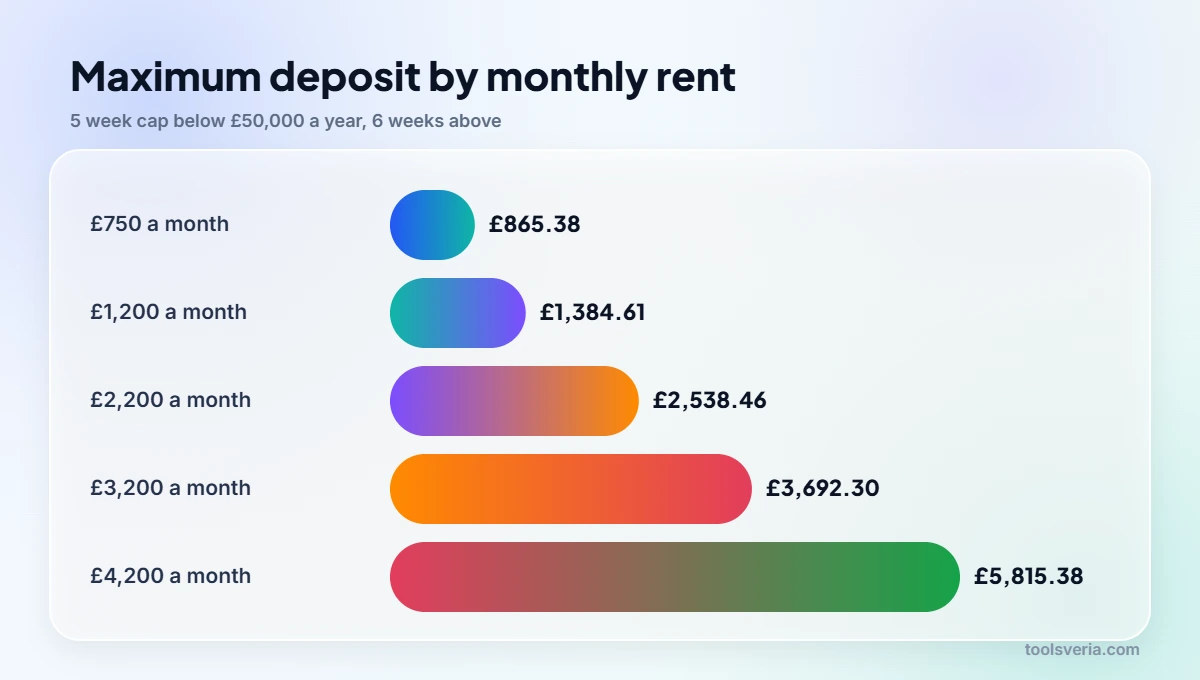
| £750 | £9,000 | £173.07 | 5 | £865.38 |
| £950 | £11,400 | £219.23 | 5 | £1,096.15 |
| £1,200 | £14,400 | £276.92 | 5 | £1,384.61 |
| £1,500 | £18,000 | £346.15 | 5 | £1,730.76 |
| £2,200 | £26,400 | £507.69 | 5 | £2,538.46 |
| £3,200 | £38,400 | £738.46 | 5 | £3,692.30 |
| £4,200 | £50,400 | £969.23 | 6 | £5,815.38 |
If the rent goes up at renewal, the cap moves with it, but only a top up to the new limit is allowed. Our percentage increase calculator shows how big a proposed rise really is, and the deposit cap on the new rent tells you whether any top up request is lawful.
When does the 6 week deposit cap apply?
The 6 week deposit cap applies only when the annual rent is £50,000 or more, which is about £4,166.67 a month. GOV.UK guidance for tenants describes the 6 week band as covering annual rents from £50,000 to £100,000, the range where most high end lettings sit.
The jump at the boundary is sharp. A Kensington flat at £4,100 a month has an annual rent of £49,200, so the 5 week cap of £4,730.76 applies. At £4,200 a month the yearly rent reaches £50,400, the 6 week rule kicks in and the cap becomes £5,815.38. A £100 rise in monthly rent lifts the maximum deposit by £1,084.62, so anyone renting near that line should check which side of it the agreement falls.
How much can you be asked to pay before moving in?
Before signing, you can be asked for a holding deposit of up to one week’s rent and the tenancy deposit; after signing but before the tenancy starts, the landlord can add the first month’s rent, or 28 days’ rent if you do not pay monthly. Since 1 May 2026, no rent at all can be requested before the agreement is signed.
These limits arrived with the Renters’ Rights Act changes for new tenancies, and the government’s rent payments and deposits guidance for landlords spells them out. In practice it means the old practice of demanding six or twelve months up front is no longer allowed for new assured tenancies in the private rented sector, with narrow exceptions for council placements and social or supported housing.
| Payment for Hannah and Leo | Legal limit | When it can be asked for |
|---|---|---|
| Holding deposit | £276.92 | Before signing, to reserve the flat |
| Tenancy deposit | £1,384.61 | Before or at signing |
| Rent in advance | £1,200.00 | After signing, before the start date |
| Total before moving in | £2,584.61 | Holding deposit usually credited against these |
A holding deposit has its own clock. The landlord normally has 15 days to agree the tenancy unless you both agree a different deadline in writing, and if the let does not go ahead for reasons that are not your fault, the money must come back within 7 days. Our days between dates calculator counts those deadlines from the day you paid, which is useful evidence if you later need to chase a refund.
What if your landlord takes too much or does not protect it?
If your landlord takes more than the tenancy deposit cap, the excess is a prohibited payment that must be repaid, and you can ask for it back in writing, report it to your local council or apply to the First tier Tribunal for an order. Keep the advert, the payment receipt and any emails, because they show exactly what was demanded.
Protection is a separate duty. The deposit must go into one of the three approved schemes within 30 days, and the GOV.UK page on deposit protection schemes names them as the Deposit Protection Service, MyDeposits and the Tenancy Deposit Scheme. If a court finds a deposit was not protected, it can order the landlord to pay the tenant up to 3 times the deposit, which on Hannah and Leo’s £1,384.61 would reach £4,153.83.
At the end of the tenancy, the landlord must return the deposit within 10 days of you both agreeing how much you get back. A deposit is money you may not see for a year or more, so if you are weighing up renting against buying, our rent vs buy calculator puts the deposit, rent and mortgage costs side by side. The cap rules in this article cover England only, as Wales, Scotland and Northern Ireland have their own systems.
Key points
- In England the tenancy deposit cap is 5 weeks’ rent below £50,000 a year and 6 weeks’ rent at £50,000 or more.
- One week’s rent is the annual rent divided by 52, so £1,200 a month allows a deposit of £1,384.61.
- Rent paid every 4 weeks means 13 payments a year, which raises the cap compared with the same monthly figure.
- A holding deposit is capped at one week’s rent and must normally be refunded within 7 days if the let falls through.
- Since 1 May 2026 no rent can be taken before signing, and afterwards only one month or 28 days’ rent in advance.
Tenancy Deposit Cap Terms You Should Know
These definitions explain the legislation and payment types behind the tenancy deposit cap so renters in England can spot an unlawful request before paying.
- Tenant Fees Act 2019
- Legislation banning most letting fees in England and restricting what landlords and agents may charge tenants to a closed list of permitted payments. Its Schedule 1 also fixes how a week’s rent is calculated for deposit purposes.
- Prohibited payment
- Any charge a landlord or agent requires in connection with a tenancy that does not appear on the Act’s permitted list. A deposit above the cap falls into this category, and the tenant is entitled to recover the excess.
- Tenancy deposit protection
- The legal duty on landlords in England to place a tenant’s deposit in a government approved scheme within a set time and tell the tenant where it is held. It keeps the money safe and gives access to free dispute resolution at the end.
- Joint tenancy
- A single tenancy agreement shared by two or more people who are jointly responsible for the rent and conditions. The deposit cap applies to the whole tenancy, so sharers split one capped sum rather than each paying the maximum.
- Rent in advance
- Rent paid before a tenancy begins or ahead of the normal payment date. The rules in England changed on 1 May 2026, limiting how much rent landlords may demand upfront on top of the capped deposit.
- Annual rent
- The total rent payable over a year, which the law uses as the starting point for every deposit calculation. Dividing it by 52 gives one week’s rent and avoids the common error of treating a month as exactly four weeks.
Frequently Asked Questions
My agent wants £1,500 on £1,200 a month. Is that legal?
No, it is £115.39 over the limit. Rent of £1,200 a month is £14,400 a year, or £276.92 a week, so the deposit cannot exceed £1,384.61. Ask the agent in writing to reduce it before you pay.
There are three of us on one tenancy. Can each of us be charged 5 weeks?
No, the cap covers the whole tenancy, not each tenant. On a £2,400 a month house the total deposit is capped at £2,769.23, and the sharers split that single amount between them however they agree.
Can my landlord ask for six months’ rent up front because I am self employed?
Not for a new private assured tenancy in England since 1 May 2026. After signing, the most that can be asked for in advance is one month’s rent, or 28 days’ rent if you pay weekly or 4 weekly, alongside the capped deposit.
My deposit was never put in a scheme. What can I claim?
You can apply to the county court, which can order the landlord to protect or repay the deposit and to pay you up to 3 times its amount. Landlords must protect a deposit within 30 days of receiving it.
Hannah and Leo sent the agent the £1,384.61 figure with the working shown, and the deposit was corrected the same afternoon. Run your own rent through the calculator before you transfer any money, and keep the receipt and the scheme certificate together. Figures checked October 2026.