85% of registered childcare costs, capped per assessment period, 2026/27.
Enter what you actually pay after any free hours. Weekly costs are converted at 52 weeks ÷ 12.
Estimate only, check with DWP or your work coach. Caps from 6 April 2026: £1,071.09 for one child, £1,836.16 for two or more, per monthly assessment period. Your overall award can still be reduced by the 55p earnings taper. Figures checked October 2026.
This Universal Credit childcare calculator shows working parents in England, Scotland and Wales how much of their childcare bill Universal Credit pays back in the 2026/27 year, applying the 85% rate and the monthly cap for one child or two or more. Enter what you pay per child, weekly or monthly, and it shows the refund, the amount left for you, the yearly total and how Tax-Free Childcare would compare.
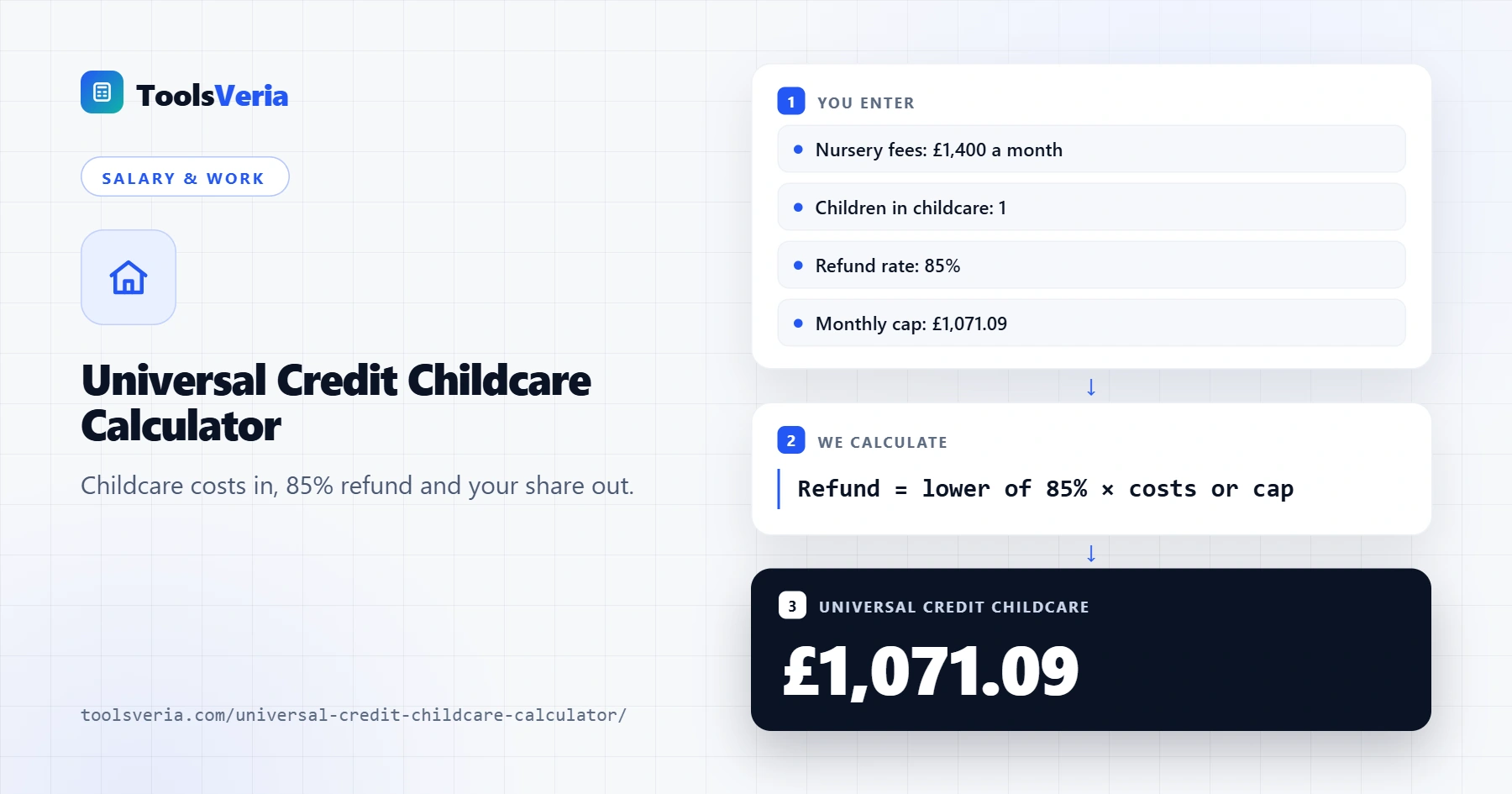
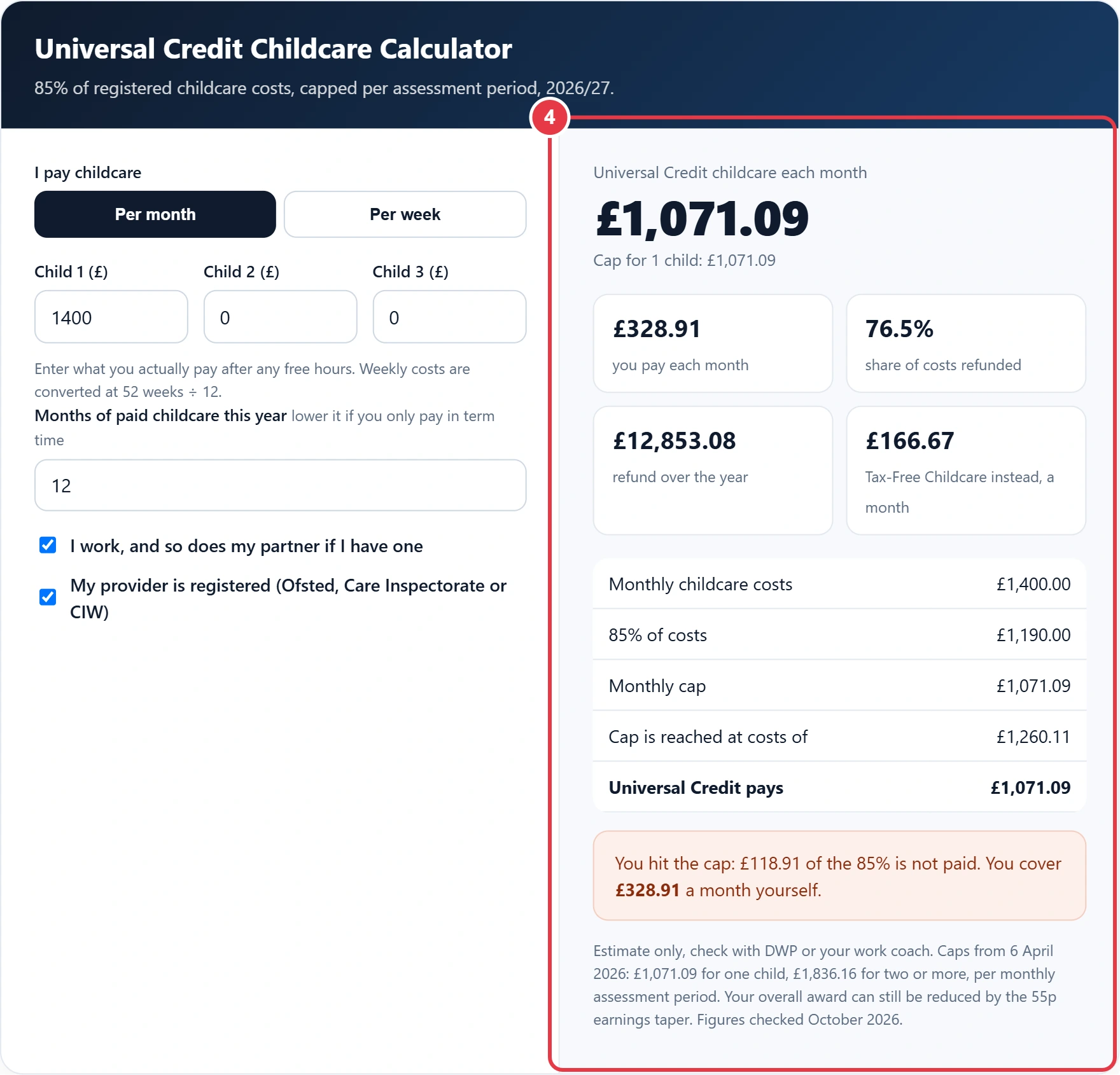
Quick answer: Universal Credit pays back 85% of registered childcare costs, up to £1,071.09 a month for one child or £1,836.16 for two or more from April 2026. On a £1,400 nursery bill the Universal Credit childcare calculator gives £1,071.09, because the cap applies once one child's costs pass £1,260.11.
In This Guide
What Is the Universal Credit Childcare Element?
The childcare element is an extra amount added to a Universal Credit award to repay most of what a working parent spends on registered childcare. It covers nurseries, childminders, registered nannies, breakfast and after school clubs and holiday clubs, for every child until the 31 August after their 16th birthday.
The formula in plain words: add up the childcare you paid in the monthly assessment period, take 85% of it, and compare that with the cap for the number of children in paid childcare. You get whichever is lower. The two figures are the most you can receive, not the most you can spend: the GOV.UK Universal Credit rates page lists £1,071.09 and £1,836.16 as the most you can get each month, so a few guides that take 85% of the cap again understate what parents receive.
How to Use the Universal Credit Childcare Calculator
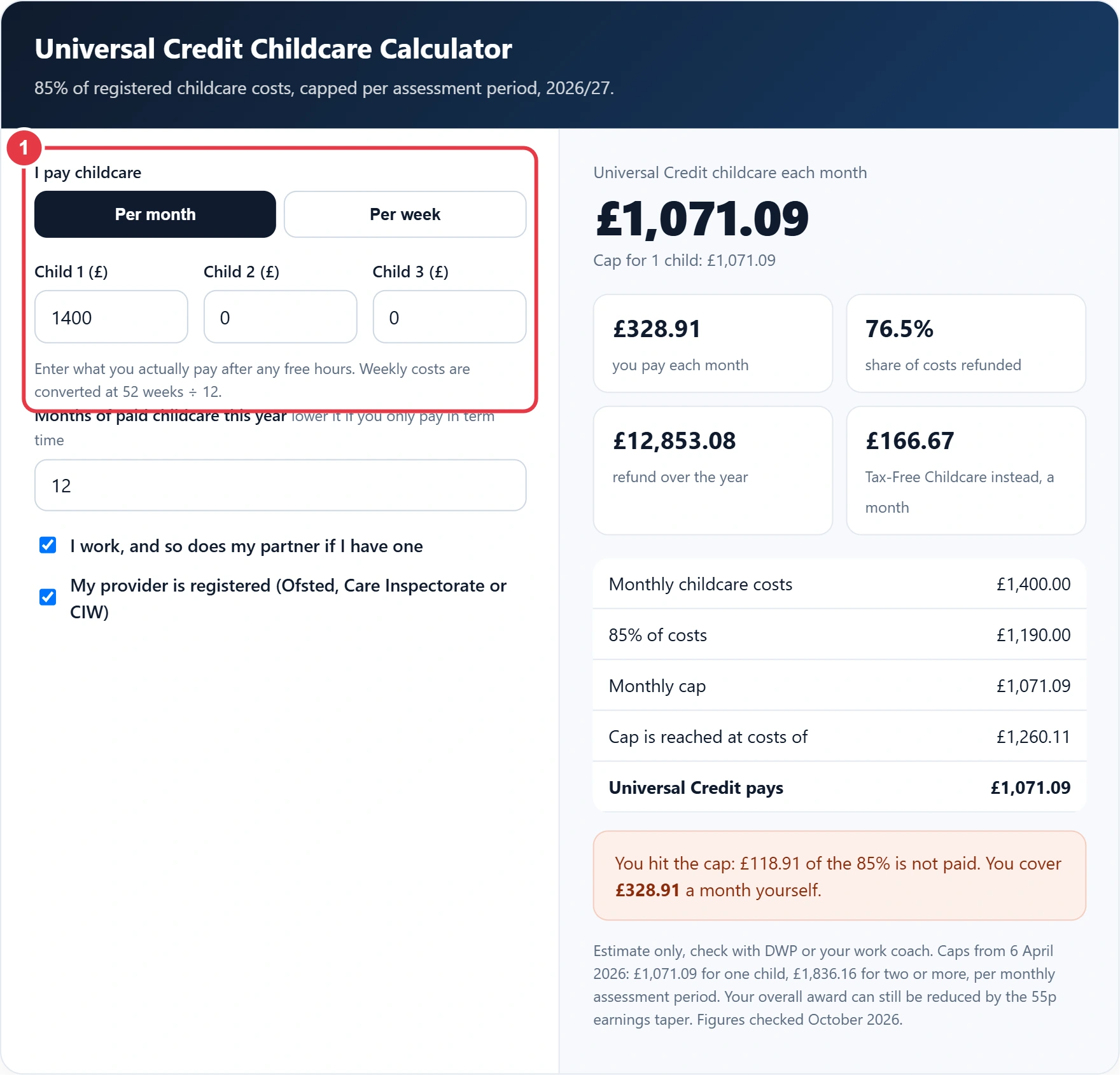
Step 1: Enter What You Pay per Child
Choose monthly or weekly in the Universal Credit childcare calculator, then enter the cost for each child in paid childcare. Use the amount you actually pay after any free hours, because funded hours are not something you pay and cannot be claimed. A child with £0 does not count towards the higher two child cap.
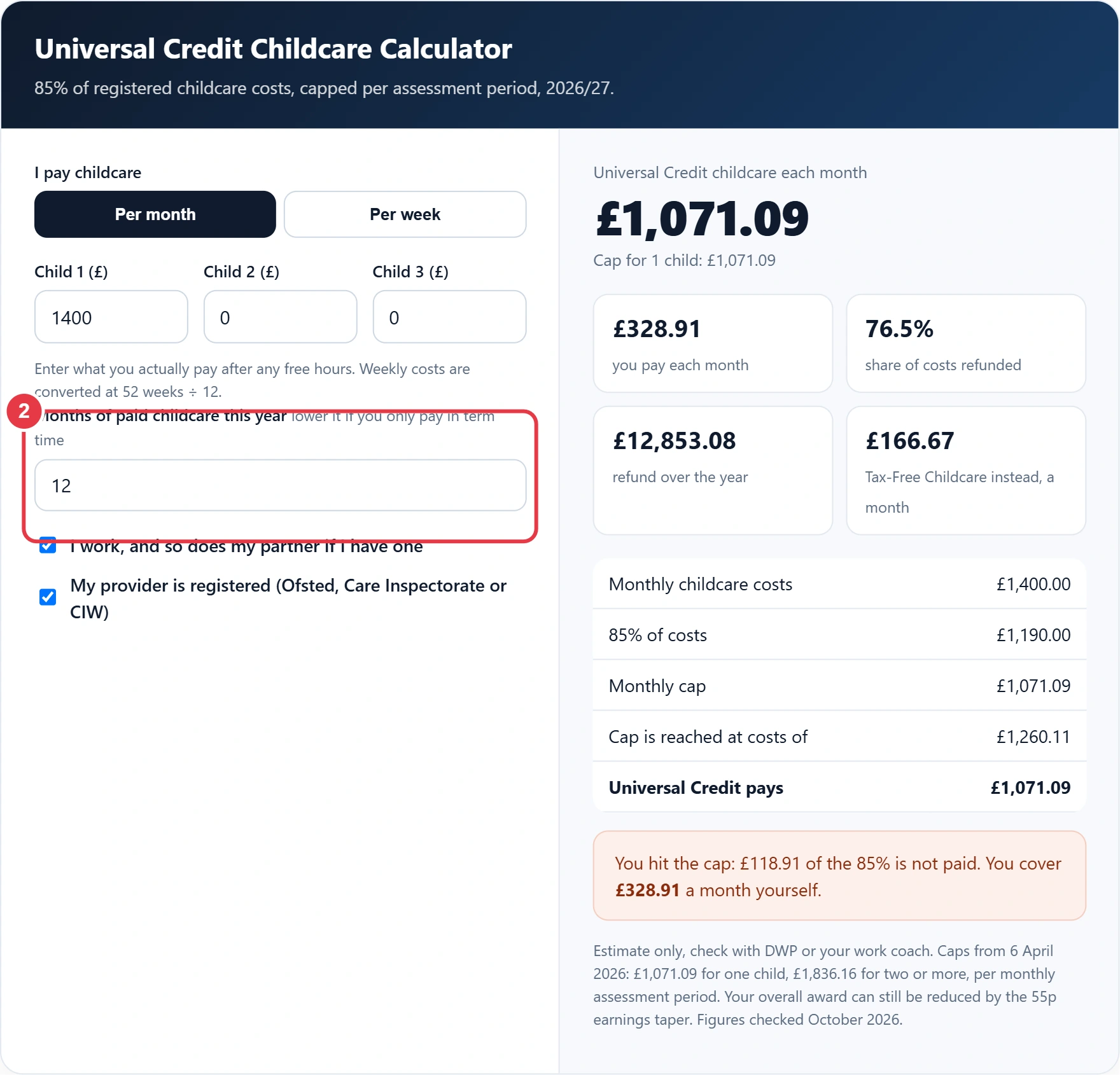
Step 2: Set the Months of Childcare
Keep 12 for year round nursery. Lower it if you only pay during term time or for a summer holiday club, so the yearly refund reflects the months you will actually claim.
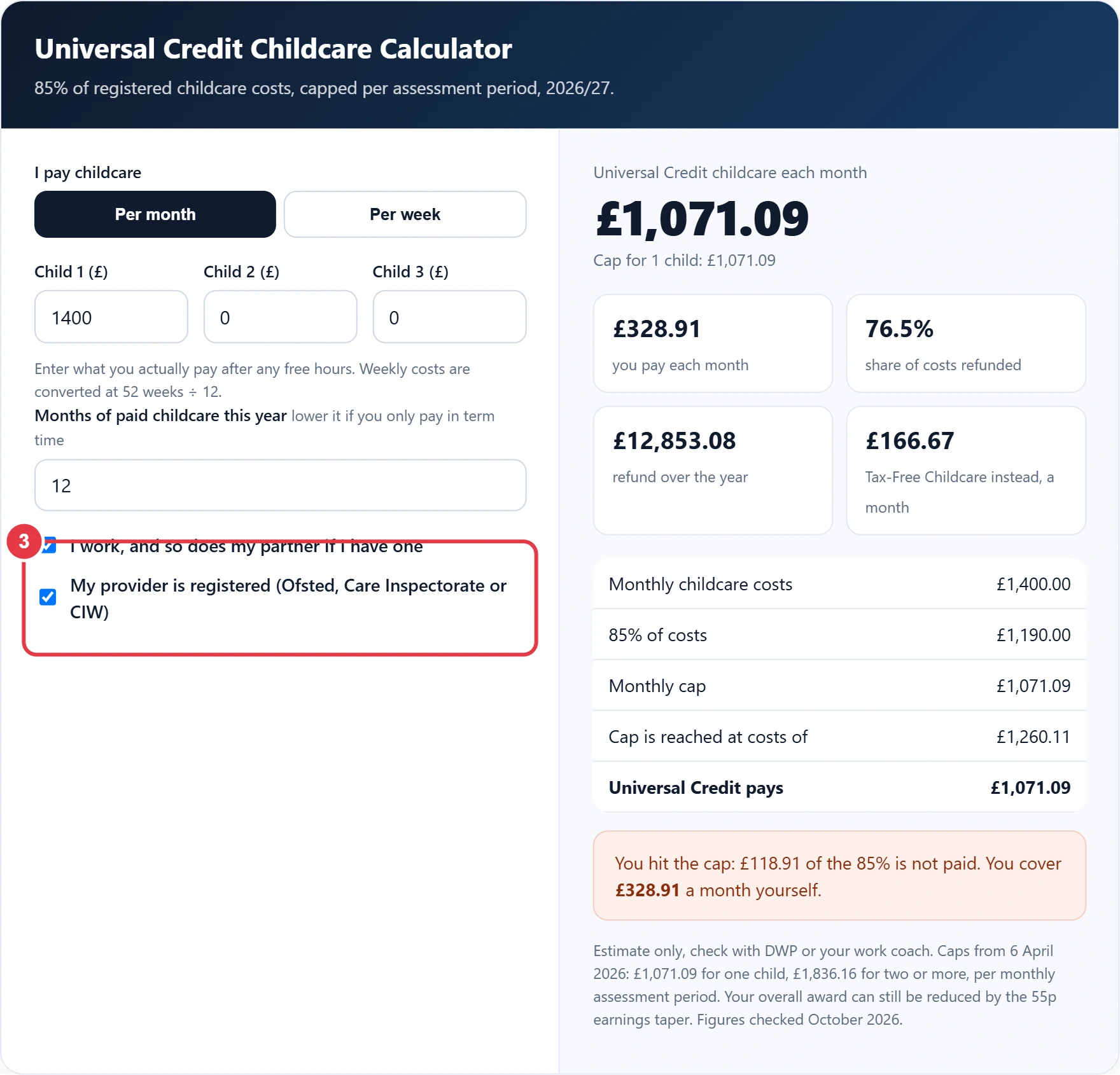
Step 3: Confirm Work and a Registered Provider
Tick both boxes if they apply. There is no minimum number of hours, so a few paid hours a week count as work. Couples both need to be working unless one partner cannot work because of a disability or health condition. Unregistered relatives and informal babysitters do not qualify.
Step 4: Read Your Result
The headline in the Universal Credit childcare calculator is the childcare amount added to your award each month. The table shows 85% of your costs next to the cap, and the cost level at which the cap starts to bite. The stats give what you pay yourself, the true percentage refunded and a Tax-Free Childcare comparison.
How Much Childcare Does Universal Credit Pay?
Universal Credit pays 85% of eligible childcare costs, so you pay 15%, until the refund reaches £1,071.09 a month for one child or £1,836.16 for two or more. The cap is reached when monthly costs pass £1,260.11 for one child or £2,160.19 for two or more.
Worked example: Leanne is a single parent in Leeds who works 24 hours a week as a care assistant. Her 2 year old is at nursery four days a week for £1,400 a month after funded hours. 85% of £1,400 is £1,190, which is above the one child cap, so Universal Credit adds £1,071.09 and Leanne pays £328.91, an effective refund of 76.5%. If her 7 year old also used an after school club costing £300 a month, total costs of £1,700 would give 85% of £1,445, now under the two child cap, so she would receive £1,445.
| Monthly childcare costs | 1 child: Universal Credit pays | 2 or more children: Universal Credit pays |
|---|---|---|
| £500 | £425.00 | £425.00 |
| £1,000 | £850.00 | £850.00 |
| £1,500 | £1,071.09 (capped) | £1,275.00 |
| £2,000 | £1,071.09 (capped) | £1,700.00 |
| £2,500 | £1,071.09 (capped) | £1,836.16 (capped) |
When Do You Get Universal Credit Childcare Costs Back?
You get the money with your next Universal Credit payment after you report the cost, which means paying first and claiming back. Report each payment with proof, such as an invoice and bank statement, in the assessment period you paid it or the following one, or you can lose it.
Many nurseries invoice a month or a term in advance, which suits the rules better than you might expect. If you pay ahead, the DWP guidance on Universal Credit childcare costs lets you claim up to 3 assessment periods of future costs at once, and parents starting a new job may get the first month paid up front, so ask your work coach before the start date. If you are moving into work after maternity leave, the maternity pay calculator helps you plan the gap between your last maternity payment and the first refund.
Is Universal Credit or Tax-Free Childcare Better?
Universal Credit is usually better for lower earners because it repays 85% of costs against 20% through Tax-Free Childcare, where the government adds £2 for every £8 you pay, up to £500 every 3 months per child. You cannot have both: GOV.UK states that you cannot get Tax-Free Childcare while claiming Universal Credit, and it advises waiting for a Tax-Free Childcare decision before ending a claim.
The catch is the earnings taper, which most comparison pages skip. Your whole award, including the childcare element, falls by 55p for every £1 of earnings above any work allowance, so a parent on a good salary may see the childcare amount partly or fully tapered away. On Leanne's £1,400 bill, Tax-Free Childcare would add only £166.67 a month, so the Universal Credit childcare calculator result wins unless her earnings wipe out her award. The pro rata salary calculator converts a part time pattern into monthly earnings, so you can see how extra hours change your pay before they change your award.
</>Embed this calculator on your website
Add the free Universal Credit Childcare Calculator to your own site or blog. Copy the code below and paste it into an HTML block. It resizes itself and works on phones.
How we checked this tool: the Tools Veria Editorial Team built this tool by hand, checked it against the official rules or published standards where they apply, and tested it against worked examples. Results are estimates for planning, not personal financial or tax advice. Read our editorial policy and disclaimer, or report an error.
Frequently Asked Questions
How much childcare does Universal Credit pay in 2026/27?
Universal Credit pays 85% of registered childcare costs, up to £1,071.09 a month for one child or £1,836.16 a month for two or more children. These caps apply to each monthly assessment period from 6 April 2026.
Is the £1,071.09 cap the most I can spend or the most I get back?
It is the most you get back. Universal Credit pays 85% of your costs until the payment reaches £1,071.09 for one child, which happens when monthly costs reach £1,260.11. Anything above that you pay in full.
Do I need to work a minimum number of hours to get Universal Credit childcare?
No. There is no minimum number of hours, so any paid work counts. If you claim as a couple, both partners need to be working unless one cannot work because of a disability or health condition.
When do I need to report childcare costs to Universal Credit?
Report each payment in your online journal with proof in the assessment period you paid it or the next one. Costs reported later than that are usually not paid, so upload invoices and receipts straight away.
Can I get Tax-Free Childcare and Universal Credit childcare at the same time?
No. You cannot get Tax-Free Childcare while you claim Universal Credit. Tax-Free Childcare adds 20%, up to £500 every 3 months per child, while Universal Credit repays 85% before any earnings taper.
Does a third child increase the Universal Credit childcare cap?
No. The cap only rises once, from £1,071.09 a month for one child to £1,836.16 for two or more, so three children in paid childcare share the same £1,836.16 maximum as two.