Compare two values to get the percentage difference and the percentage change, with the working shown.
| Worked steps | Result |
|---|
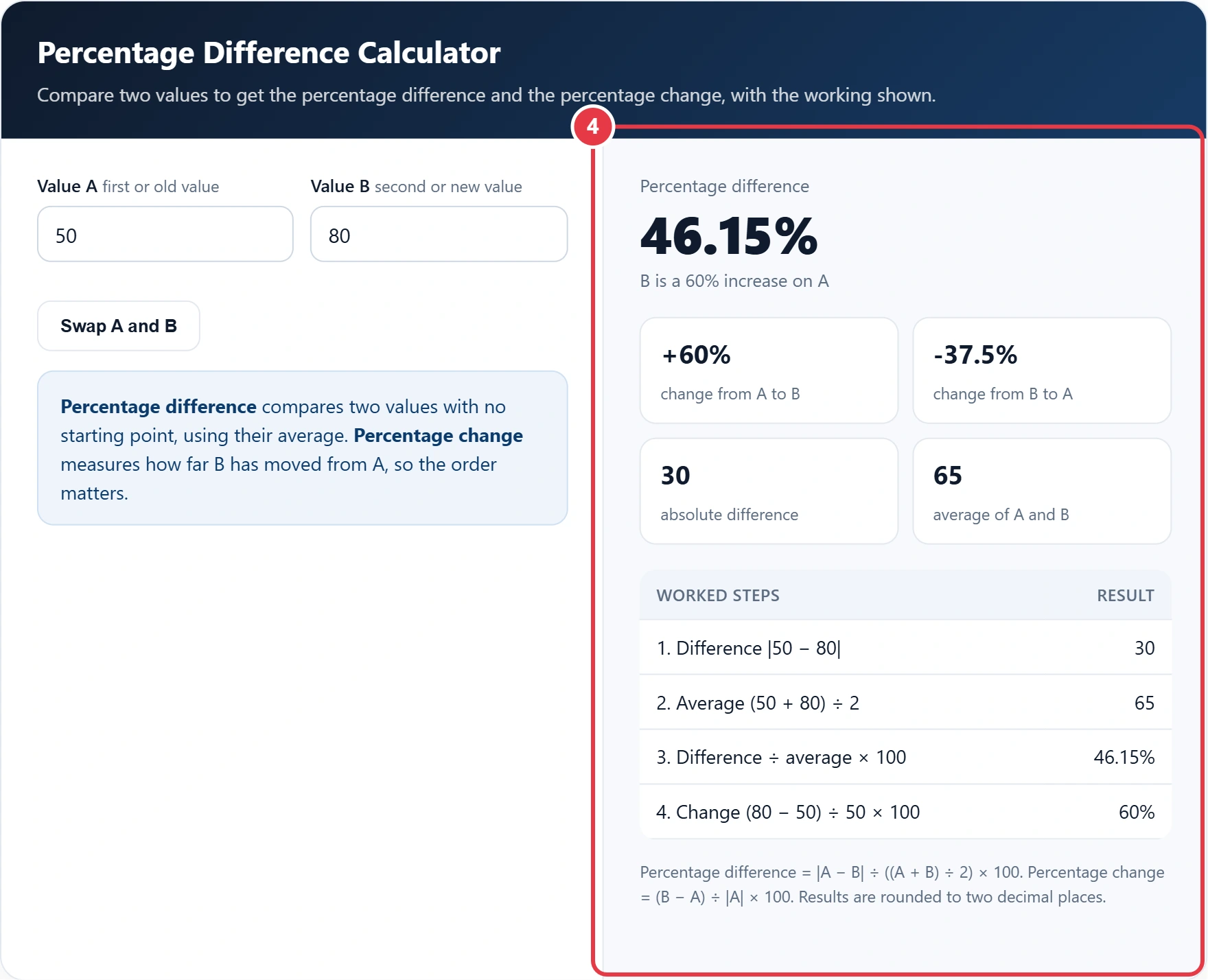
Percentage difference = |A − B| ÷ ((A + B) ÷ 2) × 100. Percentage change = (B − A) ÷ |A| × 100. Results are rounded to two decimal places.
Need to compare two numbers as a percentage? This percentage difference calculator gives you the percentage difference between two values and the percentage change from one to the other, with the formula and each step shown. Knowing which one to use matters, because the two measures, described in detail under relative change and difference, can give very different answers for the same numbers.
What Is Percentage Difference?
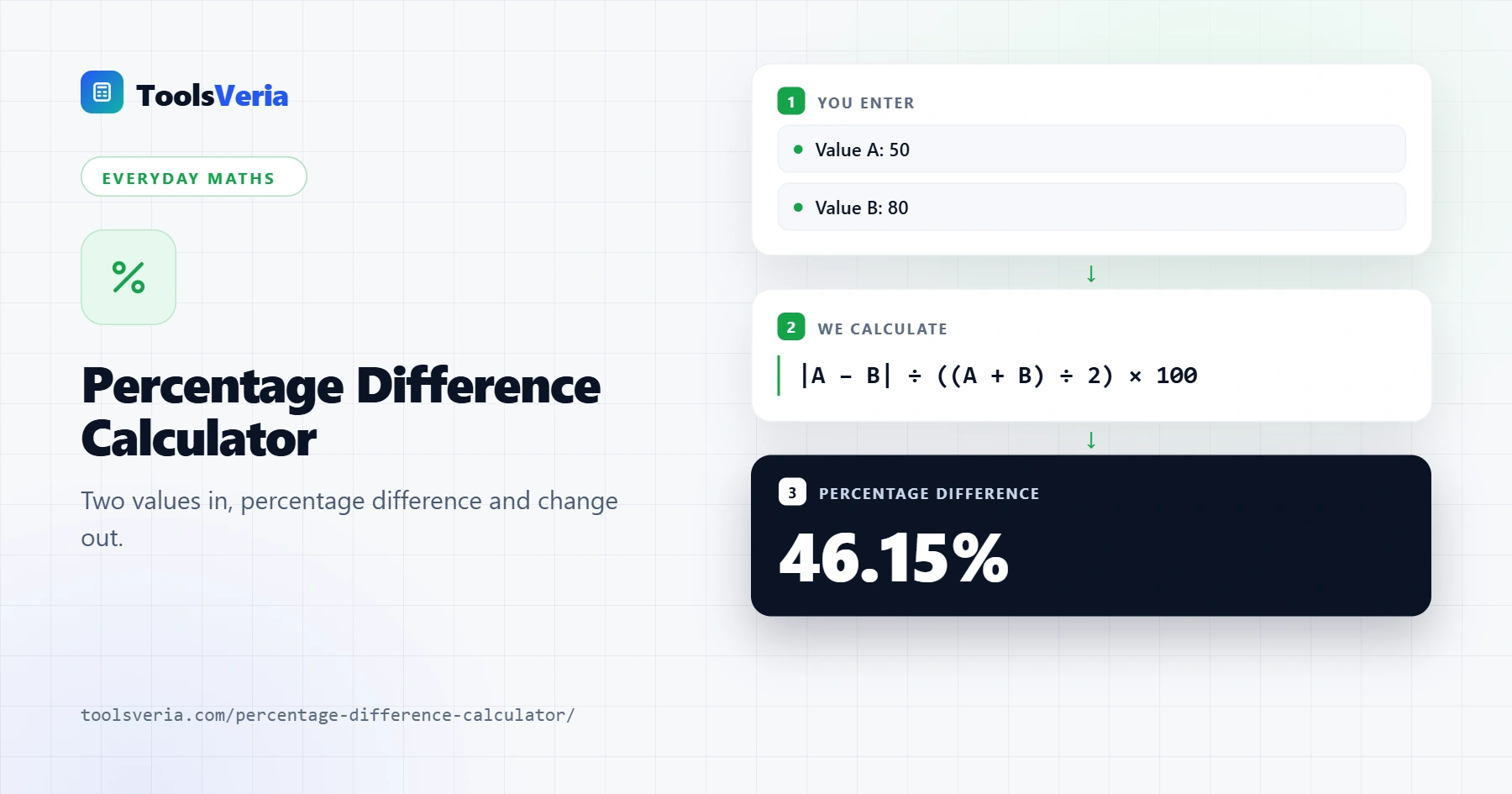
Percentage difference compares two values when neither is the starting point, such as the prices of two similar products or results from two labs. It divides the gap by the average of the two: |A − B| ÷ ((A + B) ÷ 2) × 100. For 50 and 80 the gap is 30, the average is 65, so the percentage difference is 46.15%. Swapping the values gives the same answer.
Percentage change is different. It measures movement from an old value to a new one: (new − old) ÷ old × 100. Going from 50 to 80 is a 60% increase, but going from 80 to 50 is a 37.5% decrease. Use change for prices, salaries or traffic over time, and difference when comparing two things side by side.
How to Use the Percentage Difference Calculator
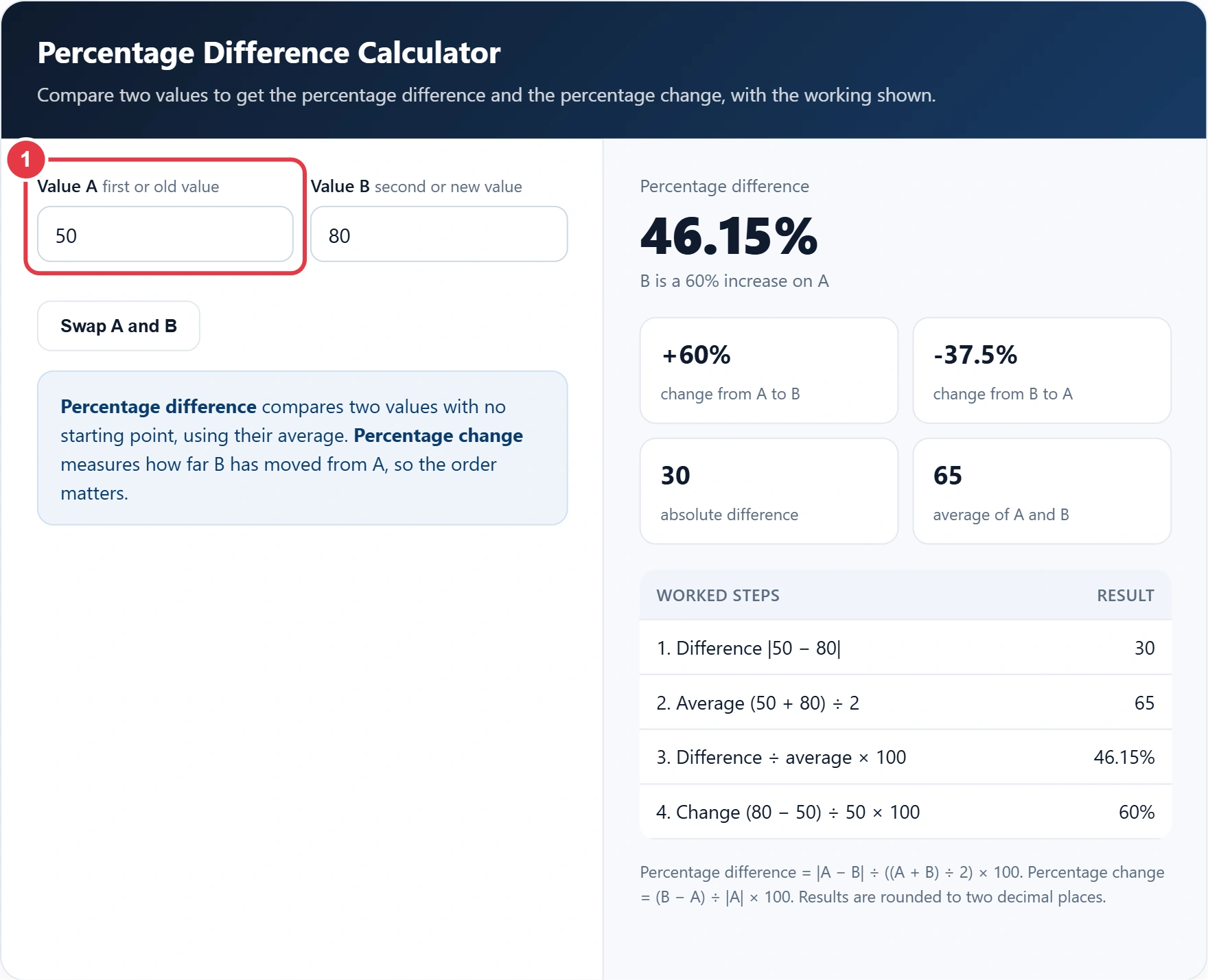
Step 1: Enter Value A
Type the first number. If you are measuring a change over time, this should be the old or starting value.
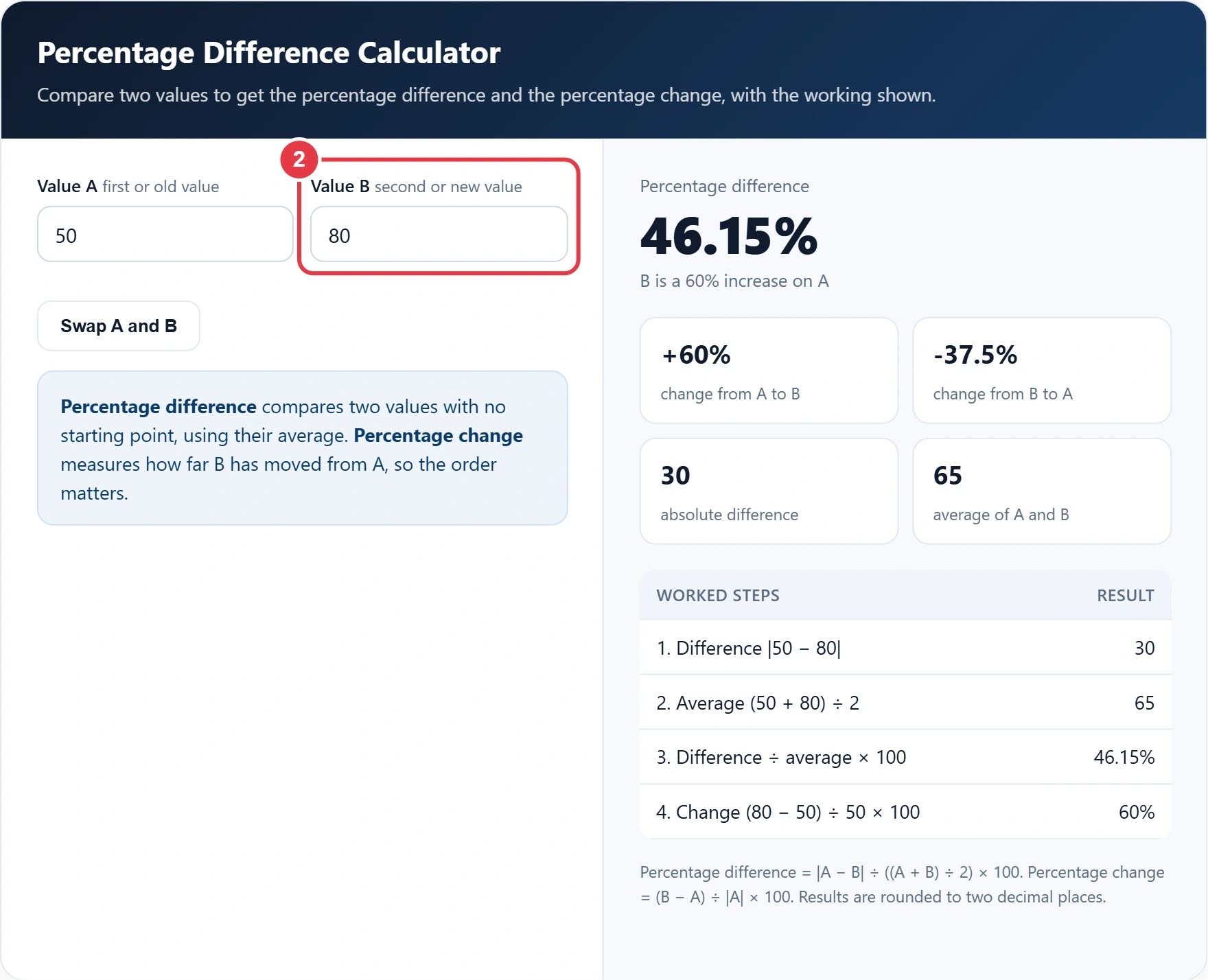
Step 2: Enter Value B
Type the second number, or the new value. Decimals and negative numbers both work.
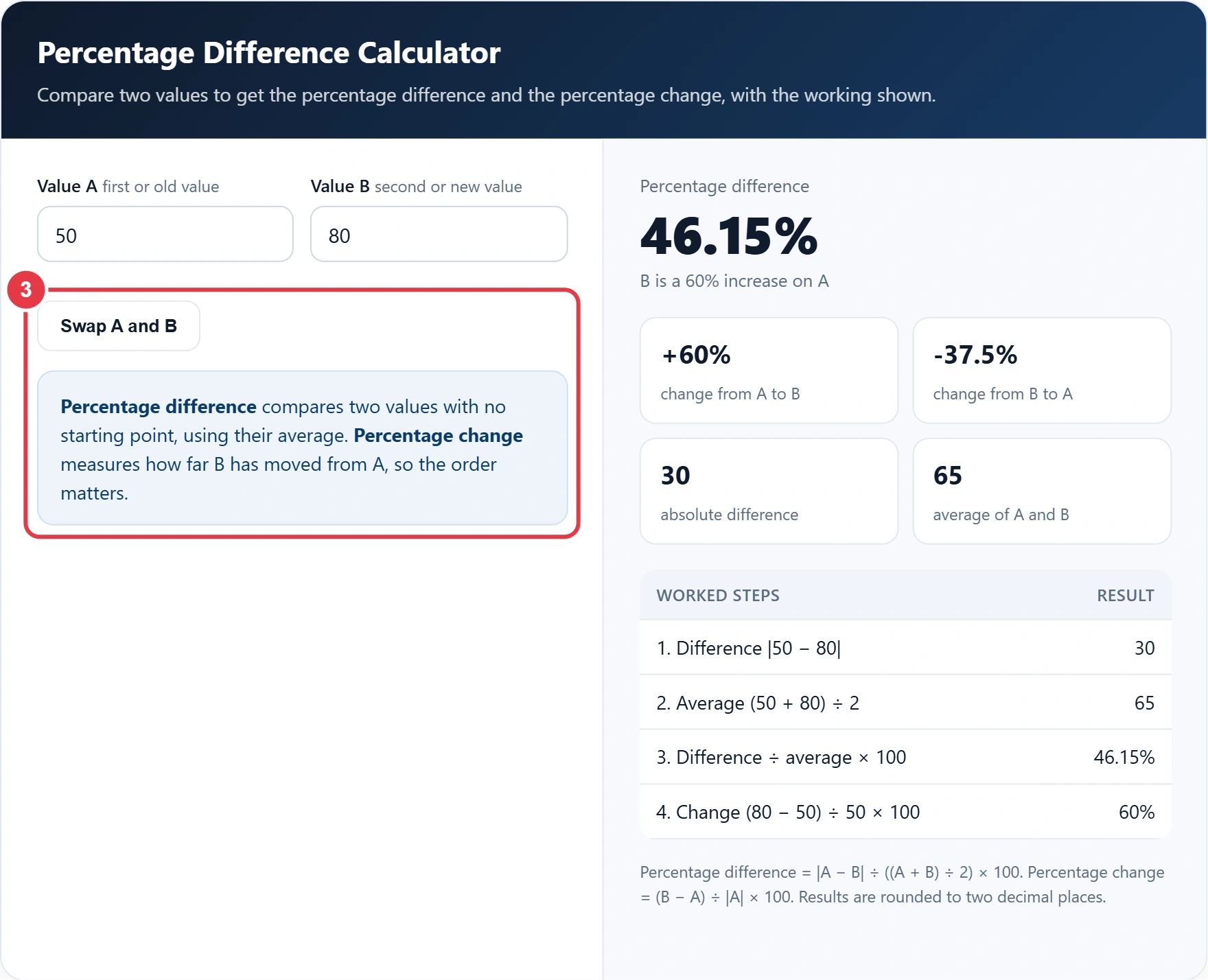
Step 3: Decide Which Result You Need
Use the percentage difference if the order does not matter, or the percentage change if B came after A. For price cuts in a sale, the discount calculator does this in one step. The Swap button flips the values so you can see the change in the other direction.
Step 4: Read the Results and Steps
You will see the percentage difference, the change from A to B and from B to A, and a worked steps table. If you are comparing cost and selling prices, the profit margin calculator gives the business version, and the steps table is easy to copy into homework or a report.
Percentage Difference vs Percentage Change Examples
| A | B | Percentage difference | Change from A to B |
|---|---|---|---|
| 50 | 80 | 46.15% | 60% increase |
| 80 | 50 | 46.15% | 37.5% decrease |
| 100 | 110 | 9.52% | 10% increase |
| 200 | 150 | 28.57% | 25% decrease |
Notice that the percentage difference stays the same when you swap A and B, while the change does not. Official statistics usually report changes, for example the ONS inflation figures show the percentage change in prices compared with a year earlier.
Frequently Asked Questions
What is the formula for percentage difference?
Divide the absolute difference between the two values by their average, then multiply by 100. For 50 and 80 that is 30 ÷ 65 × 100 = 46.15%.
What is the difference between percentage difference and percentage change?
Percentage difference compares two values using their average and ignores order. Percentage change measures movement from an old value to a new one, so order matters.
How do I calculate percentage increase?
Subtract the old value from the new value, divide by the old value and multiply by 100. From 50 to 80 is 30 ÷ 50 × 100 = 60%.
Why is the change from 80 to 50 not 60%?
Percentage change is measured against the starting value. A fall of 30 from 80 is 30 ÷ 80 = 37.5%, even though a rise of 30 from 50 is 60%.
Can percentage difference be more than 100%?
Yes, but only up to 200% for positive numbers. It reaches 200% when one value is zero and the other is positive.
What if one of the values is zero?
Percentage change from zero is undefined because you cannot divide by zero. The percentage difference still works unless both values are zero.