Director salary plus dividends for the 2026/27 tax year, after every company and personal tax.
| Item | Amount |
|---|
2026/27 rates: corporation tax 19% up to £50,000 profit, 25% over £250,000 with marginal relief between; employer NI 15% above £5,000; employee NI 8% from £12,570 to £50,270 and 2% above; dividend allowance £500 then 10.75%, 35.75% and 39.35%. Assumes no associated companies, no other income and rest of UK income tax rates.
Running your own company means your pay passes through two layers of tax: one inside the business and one on you personally. This limited company take home pay calculator follows your money from company profit to your bank account for the 2026/27 tax year, using the current corporation tax rates alongside employer NI, income tax and dividend tax. Enter three figures and you see exactly what you keep and what goes to HMRC.
Quick answer: A limited company take home pay calculator adds salary and dividends, then subtracts income tax, employee NI and dividend tax. For 2026/27, profits up to £50,000 pay 19% corporation tax and profits over £250,000 pay 25%, while a £12,570 director salary uses the whole personal allowance.
In This Guide
What Is Limited Company Take-Home Pay?
Most company directors pay themselves a small salary through PAYE and take the rest of the profit as dividends. The salary is a business expense, so it reduces corporation tax, but salary above £5,000 triggers 15% employer National Insurance and salary above £12,570 triggers income tax and 8% employee NI.
Dividends can only be paid from profit after corporation tax. Small profits up to £50,000 are taxed at 19%, profits over £250,000 at 25%, and marginal relief applies in between. The formula is: take-home pay = salary + dividends minus income tax, employee NI and dividend tax. Dividends carry no National Insurance, which is why this mix is so common.
How Do You Use the Limited Company Take Home Pay Calculator?
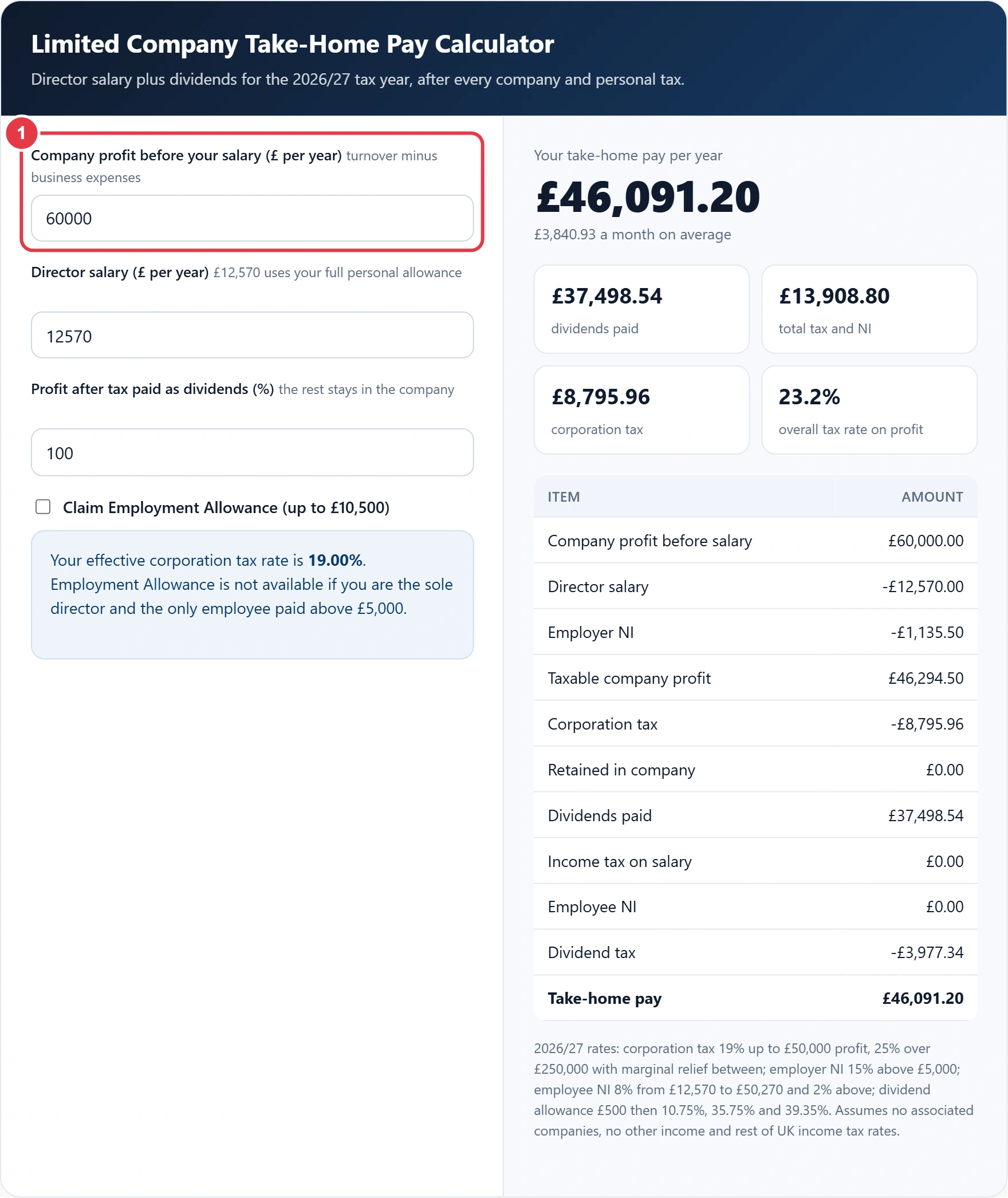
Step 1: Enter the Company Profit
Type the profit for the year before your own salary is taken off, using the profit margin calculator if you only know your sales and costs. Type the profit for the year before your own salary is taken off. If you only know your sales and costs, the profit margin calculator helps you find that figure quickly before you enter it here.
Step 2: Set Your Director Salary
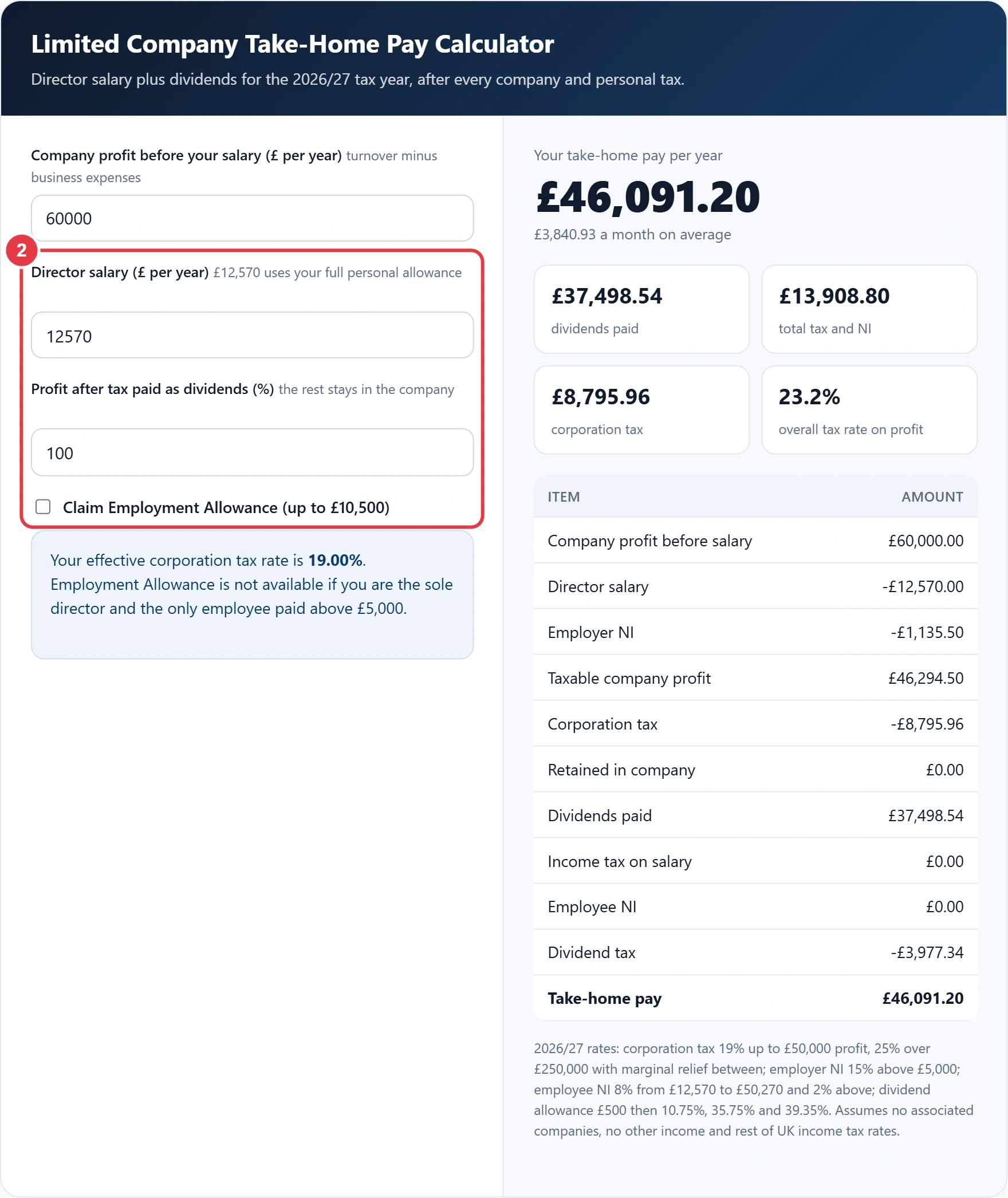
A salary of £12,570 is popular because it uses your whole personal allowance and still counts towards your State Pension. Tick Employment Allowance only if the company has another employee paid above £5,000, as a sole director on the payroll cannot claim it.
Step 3: Choose How Much to Pay as Dividends
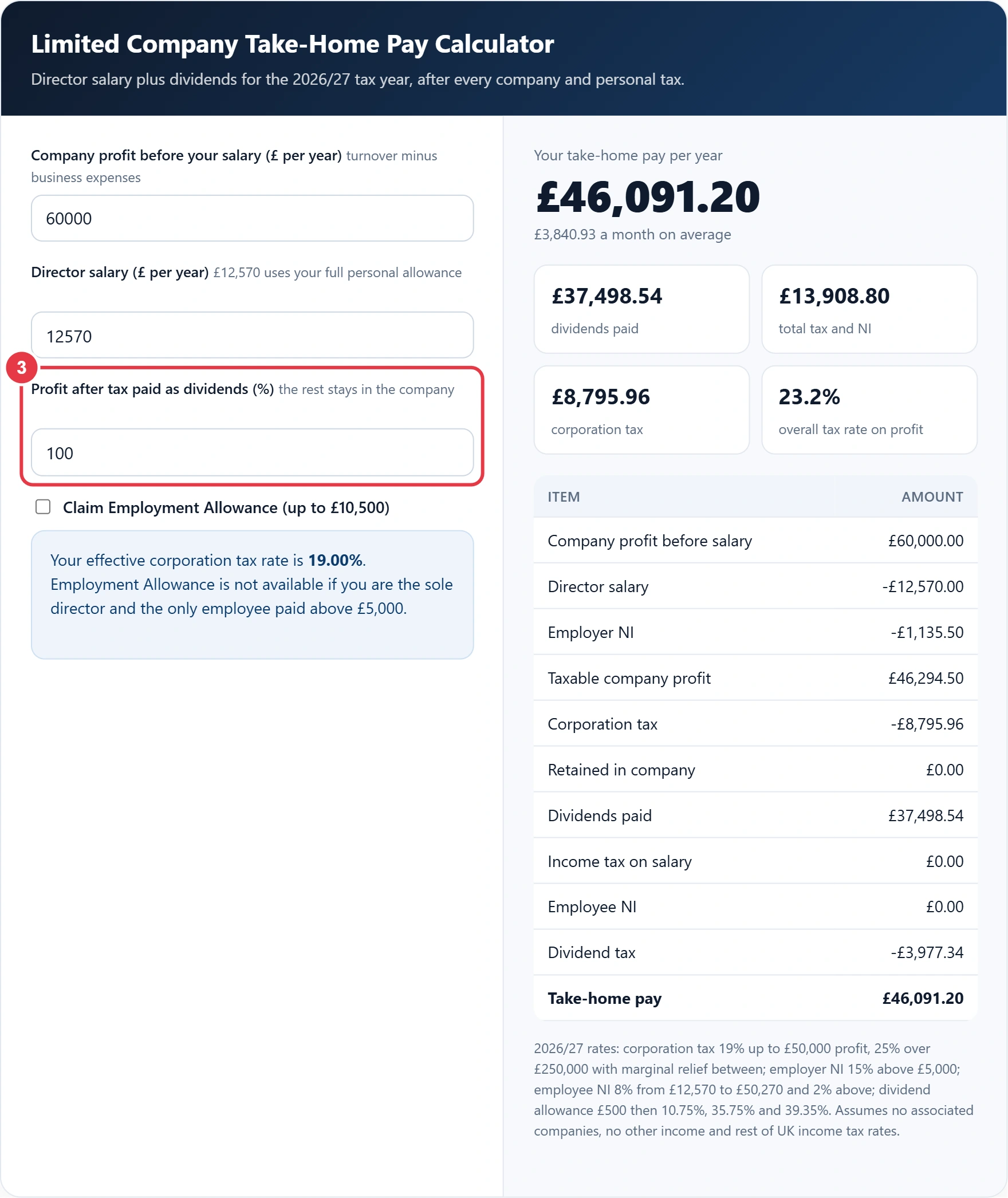
Leave this at 100% to draw all profit after tax, or lower it to keep money in the business. Retained profit is not taxed again until you take it out.
Step 4: Read Your Results
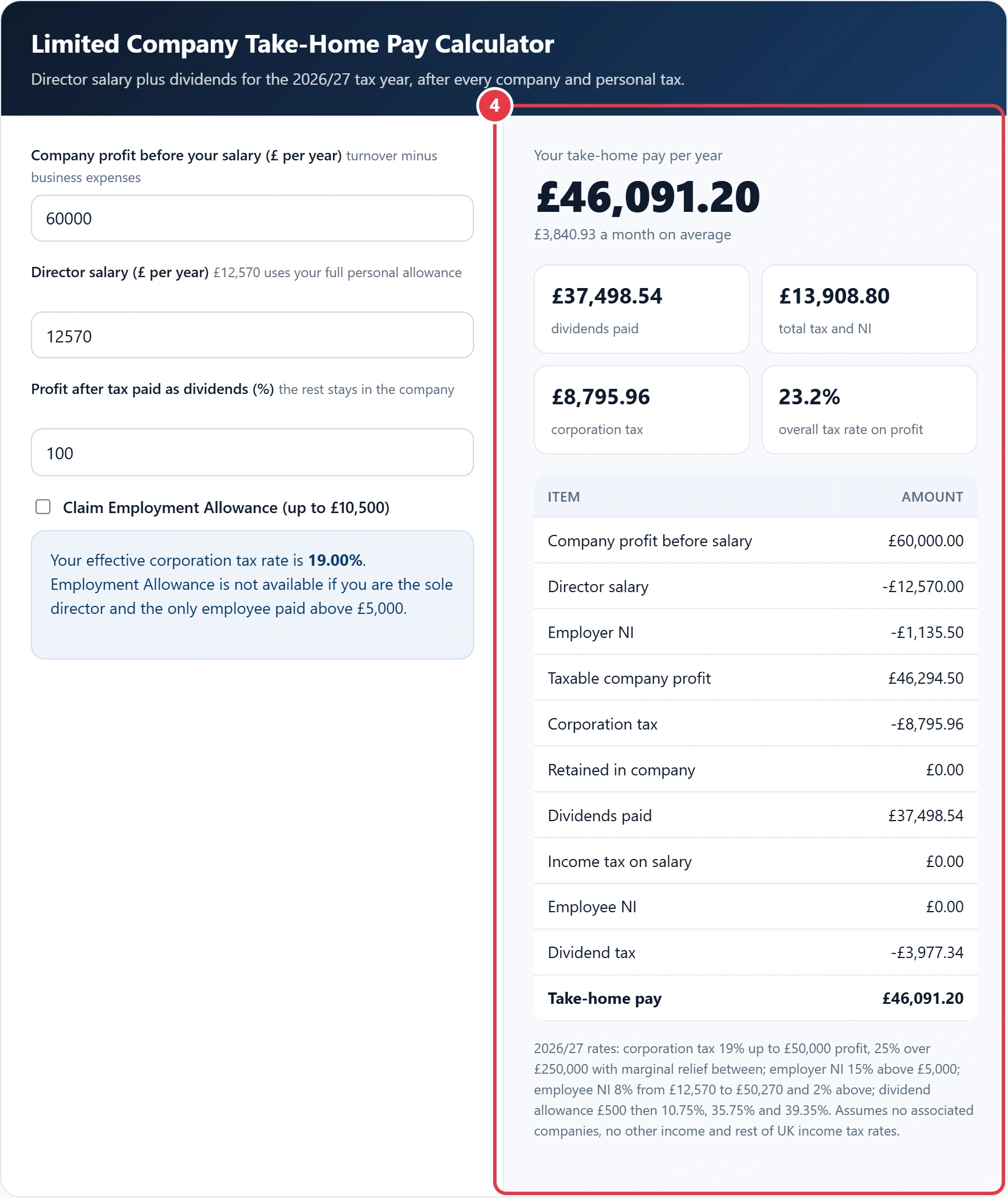
You will see your take-home pay, the total tax paid, corporation tax and your overall tax rate on profit. For a closer look at the personal side, our dividend tax calculator shows how each slice of your dividends is taxed band by band.
What Is Limited Company Take-Home Pay at Different Profits in 2026/27?
| Company profit | Salary | Dividends | Take-home pay |
|---|---|---|---|
| £40,000 | £12,570 | £21,298.54 | £31,632.70 |
| £60,000 | £12,570 | £37,498.54 | £46,091.20 |
| £80,000 | £12,570 | £52,476.46 | £55,764.88 |
| £100,000 | £12,570 | £67,176.46 | £65,209.63 |
With a £12,570 salary and the rest taken as dividends, a single director takes home £31,632.70 from £40,000 of company profit and £65,209.63 from £100,000 in 2026/27. These examples assume a single director with no other income and no associated companies. Dividends above £10,000 must be reported on a tax return, and the GOV.UK guide to tax on dividends explains how the allowance and bands work, so check it before you plan a large payment. If you are comparing a company with working as a sole trader, run the same profit through the self employed tax calculator and compare the two totals side by side, as the gap is often smaller than people expect.
</>Embed this calculator on your website
Add the free Limited Company Take-Home Pay Calculator to your own site or blog. Copy the code below and paste it into an HTML block. It resizes itself and works on phones.
How we checked this tool: the Tools Veria Editorial Team built this tool by hand, checked it against the official rules or published standards where they apply, and tested it against worked examples. Results are estimates for planning, not personal financial or tax advice. Read our editorial policy and disclaimer, or report an error.
Frequently Asked Questions
What is the best salary for a limited company director in 2026/27?
Many directors take £12,570, which uses the personal allowance with no income tax or employee NI. If you cannot claim Employment Allowance, £5,000 avoids employer NI, but £12,570 often still wins because the salary saves corporation tax.
How much corporation tax will my company pay?
For 2026/27 profits up to £50,000 are taxed at 19% and profits over £250,000 at 25%. Between the two, marginal relief gives an effective rate that rises gradually.
Do I pay National Insurance on dividends?
No. Dividends have no employee or employer National Insurance, only dividend tax at 10.75%, 35.75% or 39.35% after the £500 allowance.
Can I claim Employment Allowance as a sole director?
No. If the director is the only employee paid above the secondary threshold of £5,000, the company cannot claim Employment Allowance.
Is this calculator right for Scotland?
Dividend tax and NI are the same across the UK, but a salary above £12,570 would be taxed at Scottish income tax rates, so results differ slightly for higher salaries.
Do I have to take all the profit as dividends?
No. You can leave profit in the company for future use. Corporation tax is still due on it, but there is no personal tax until it is paid out.