Grace works in an office in Leeds and keeps a 2 litre bottle on her desk because an app told her to finish it every day. Most afternoons she forces the last half down. Asking how much water should I drink has a simpler answer than the app suggests: the NHS recommends 6 to 8 glasses of fluid a day for most adults, about 1.5 to 2 litres, and tea, coffee and milk all count towards it.
This guide compares the UK, European and US guidance in litres, glasses and ounces, explains how exercise, heat, pregnancy and age change your needs, and lists the signs that you need more or less. It is general information for healthy adults, not medical advice.
Quick answer: Most healthy adults should drink about 6 to 8 glasses of fluid a day, roughly 1.5 to 2 litres (50 to 68 US fl oz), according to the NHS. The European Food Safety Authority sets total water from drinks and food at 2.0 litres for women and 2.5 litres for men. Drink more in heat or during exercise.
In This Guide
How much water should I drink a day?
Most healthy adults should drink around 1.5 to 2 litres of fluid a day, which is the NHS guidance of 6 to 8 glasses, with more needed in hot weather, during exercise, or when pregnant or breastfeeding. That figure covers drinks only, because food supplies a fair share of water too.
Official bodies express the target in slightly different ways, which is why online figures seem to disagree:
| Source | Women | Men | What the figure covers |
|---|---|---|---|
| NHS (UK) | 6 to 8 glasses, about 1.5 to 2 L | 6 to 8 glasses, about 1.5 to 2 L | Drinks only |
| EFSA (Europe) | 2.0 L | 2.5 L | Total water from drinks and food |
| NASEM (US) | 2.7 L | 3.7 L | Total water from drinks and food |
The US National Academies of Sciences, Engineering, and Medicine (NASEM) figures look much higher, but they are adequate intakes based on what healthy Americans typically consume, and they include the water in food. Fruit, vegetables, soups and yoghurt supply a meaningful share; on European guidance, drinks provide around four fifths of the total, so 2.0 litres of total water works out at about 1.6 litres from drinks for a woman and 2.0 litres for a man.
For Grace, that means her 2 litre bottle is a reasonable upper target on a normal office day, not a minimum she must force down. The NHS guidance on water, drinks and your health sets out the 6 to 8 glasses figure and which drinks are better choices.

What counts towards your daily water intake?
Almost every drink counts towards your daily water intake, including tea, coffee, milk, sugar free squash and fruit juice, along with the water in food. Plain water is the best everyday choice because it has no calories or sugar, but it is not the only thing that hydrates you.
Caffeine has a mild diuretic effect, yet the fluid in a normal mug of tea or coffee more than makes up for it, which is why the NHS counts both. Fruit juice and smoothies also count, but the NHS suggests keeping them to a combined 150 ml a day because of their free sugars. Alcohol is the exception: it is best not counted, since it increases fluid loss.
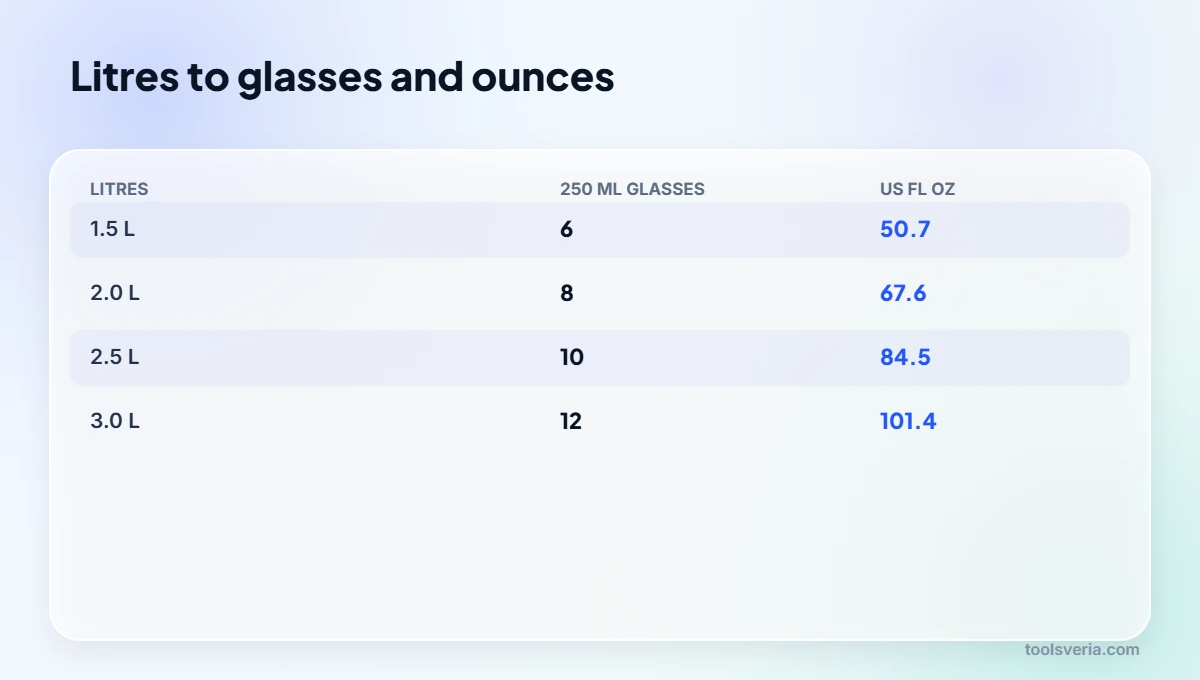
Units cause plenty of confusion when advice crosses the Atlantic. A US cup is about 237 ml, a UK pint is 568 ml and a US fluid ounce is 29.57 ml. The table converts common daily totals, and the ml to oz converter handles any other bottle size.
| Litres a day | 250 ml glasses | US fl oz | UK pints |
|---|---|---|---|
| 1.5 L | 6 | 50.7 | 2.6 |
| 2.0 L | 8 | 67.6 | 3.5 |
| 2.5 L | 10 | 84.5 | 4.4 |
| 3.0 L | 12 | 101.4 | 5.3 |
How much more water do you need when exercising or in hot weather?
You need roughly an extra litre for every kilogram of body weight lost through sweat, which during hard exercise or in hot weather can mean an additional 0.5 to 1.5 litres a day or more. Sweat rates vary hugely, so measuring your own loss is far better than guessing.
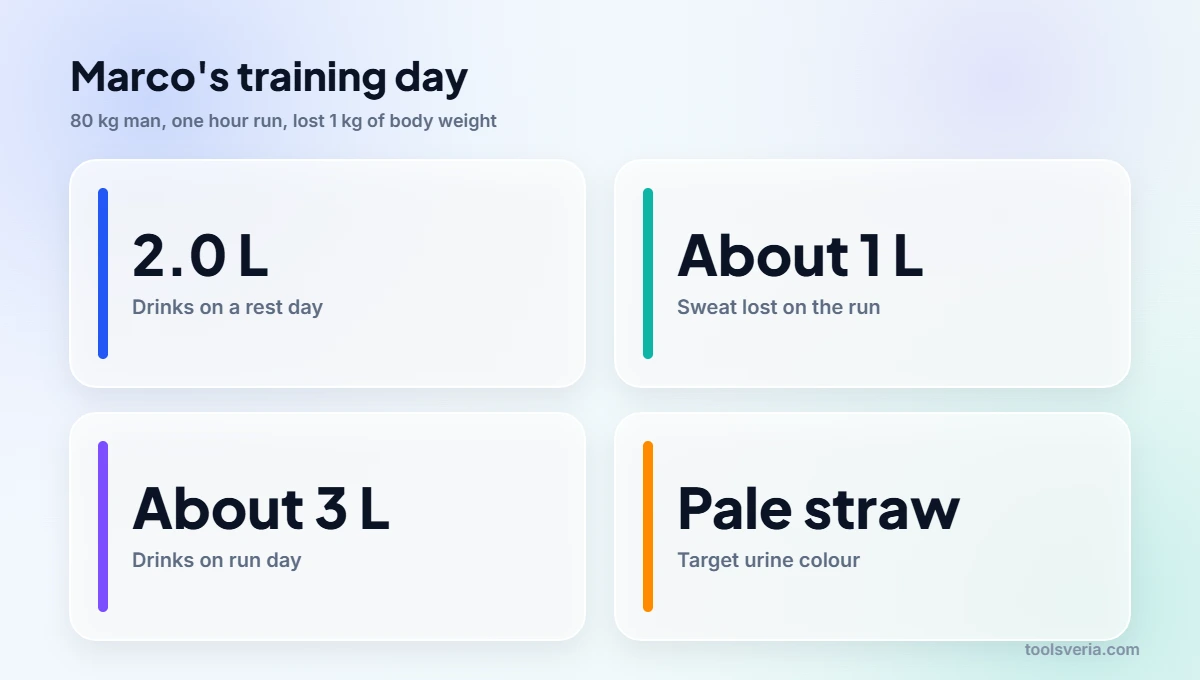
Marco weighs 80 kg and normally drinks about 2 litres a day. On a warm Saturday he weighs himself before and after a one hour run and finds he has lost 1 kg. That kilogram is almost entirely fluid, so he aims to drink about 1 extra litre over the rest of the day, bringing his total to roughly 3 litres. Sipping steadily works better than downing it all at once.
Hot weather raises needs even without exercise, as do air conditioned offices, long flights and high altitude, which all dry the air. Illness with fever, vomiting or diarrhoea increases losses sharply. For long sessions in the heat, a drink containing some sodium helps replace what sweat removes. If you also track training, the calories burned calculator gives a sense of how hard a session was, and harder sessions usually mean more sweat.
Does age, pregnancy or body size change how much water you need?
Yes: larger and more active people need more water, pregnant and breastfeeding women need more, and older adults need to drink regularly because the sense of thirst weakens with age. The European Food Safety Authority adds about 300 ml a day during pregnancy and about 700 ml a day while breastfeeding.
Body size matters because a bigger body loses more water through breathing, skin and urine. A common rule of thumb is about 30 to 35 ml per kg of body weight for total water, which gives 1.95 to 2.28 litres for Grace at 65 kg. Treat it as a rough cross check rather than an official target. The daily water intake calculator combines weight, activity and climate in metric or imperial units.
Older people often feel less thirsty even when they need fluid, so regular drinks at meals and between them are a useful habit. Children’s needs depend on age and size, and parents should follow the guidance of a health visitor or GP. Anyone with heart failure, kidney disease or another condition that needs a fluid limit should follow their doctor’s advice, not general targets like these. Protein needs also rise with body size and activity, as our guide on how much protein you need explains.
How can you tell if you are drinking enough water?
The simplest test is urine colour: pale straw yellow usually means you are drinking enough, while dark yellow, strong smelling urine is an early sign of dehydration. Thirst, a dry mouth, headaches, tiredness and peeing fewer than 4 times a day are other warning signs.
Drinking too much is possible too, although it is rare in everyday life. Downing very large volumes in a short time, typically during long endurance events, can dilute the sodium in the blood, a condition called hyponatraemia. Early symptoms include headache, nausea and confusion. Spreading drinks through the day and following thirst avoids it for nearly everyone.
See a GP or call NHS 111 (or your local equivalent outside the UK) if dehydration symptoms do not improve after drinking, if you feel confused or very dizzy, or if you have had diarrhoea or vomiting for more than a day or two. The NHS page on dehydration lists the symptoms that need urgent help, including in babies and older people.
Key points
- The NHS recommends 6 to 8 glasses of fluid a day, about 1.5 to 2 litres, for most adults.
- EFSA sets total water from drinks and food at 2.0 litres for women and 2.5 litres for men.
- Tea, coffee, milk and sugar free drinks count; alcohol does not.
- Replace about 1 litre of fluid for each kilogram lost during exercise.
- Pale straw coloured urine is a good sign that you are drinking enough.
Key Hydration Terms Explained
These terms come up whenever you ask how much water should I drink, from the official intake figures to the warning signs of drinking too little or too much.
- Total water intake
- Total water intake counts water from drinks and from food together. European guidance sets it at 2.0 litres a day for women and 2.5 litres for men, with drinks typically supplying around four fifths.
- Adequate intake
- An adequate intake is a reference amount judged enough for nearly all healthy people when a precise requirement cannot be set. The US values of 2.7 and 3.7 litres are adequate intakes based on typical consumption.
- Dehydration
- Dehydration means the body is losing more fluid than it takes in. Early signs include thirst, dark yellow strong smelling urine, a dry mouth, tiredness and peeing fewer than 4 times a day.
- Hyponatraemia
- Hyponatraemia is an abnormally low level of sodium in the blood. Drinking very large volumes quickly, often during long endurance events, can dilute sodium and cause headache, nausea and confusion.
- Fluid ounce
- A fluid ounce is an imperial and US unit of volume. One US fluid ounce is 29.57 ml and one UK fluid ounce is 28.41 ml, so 2 litres equals about 67.6 US fluid ounces.
Frequently Asked Questions
Do I really need to drink 8 glasses of plain water every day?
No. The NHS figure of 6 to 8 glasses covers all fluids, including tea, coffee and milk, and food provides extra water too. Plain water is the healthiest choice, but there is no need to force down 8 extra glasses on top of other drinks.
I drink four mugs of coffee a day. Does that count?
Yes. Coffee and tea count towards your daily fluid, because the water in them outweighs caffeine’s mild diuretic effect. Four mugs of around 250 ml each provide about 1 litre, though spreading some plain water or other drinks across the day is sensible.
How much extra should I drink after a sweaty gym session?
Weigh yourself before and after, then drink about 1 litre for every kilogram lost, sipping it over the next few hours. If you lost 0.5 kg, around 500 ml is a fair target. Add a salty snack or electrolyte drink after long, hot sessions.
Is 3 litres a day too much water?
For most healthy adults 3 litres a day is safe, and it may be right on hot or active days. Problems arise from drinking very large amounts quickly, not steady intake. People told to limit fluids for heart or kidney conditions should follow their doctor’s figure instead.
How much water should I drink when pregnant?
European guidance suggests about 300 ml a day more than usual during pregnancy, so around 2.3 litres of total water, and about 700 ml more while breastfeeding. Your midwife can advise if you have sickness, swelling or any condition affecting fluids.
Why is the US recommendation so much higher than the NHS one?
The US figures of 2.7 litres for women and 3.7 litres for men measure total water, including food, and are based on typical intakes. The NHS figure of 1.5 to 2 litres covers drinks only, so the two are closer than they first appear.
Grace now fills her bottle once in the morning, counts her tea, and stops worrying if a little is left at five o’clock. The honest answer to how much water should I drink is about 1.5 to 2 litres of fluid on a normal day, more when it is hot or you exercise, guided by thirst and urine colour. Guidance checked October 2026.