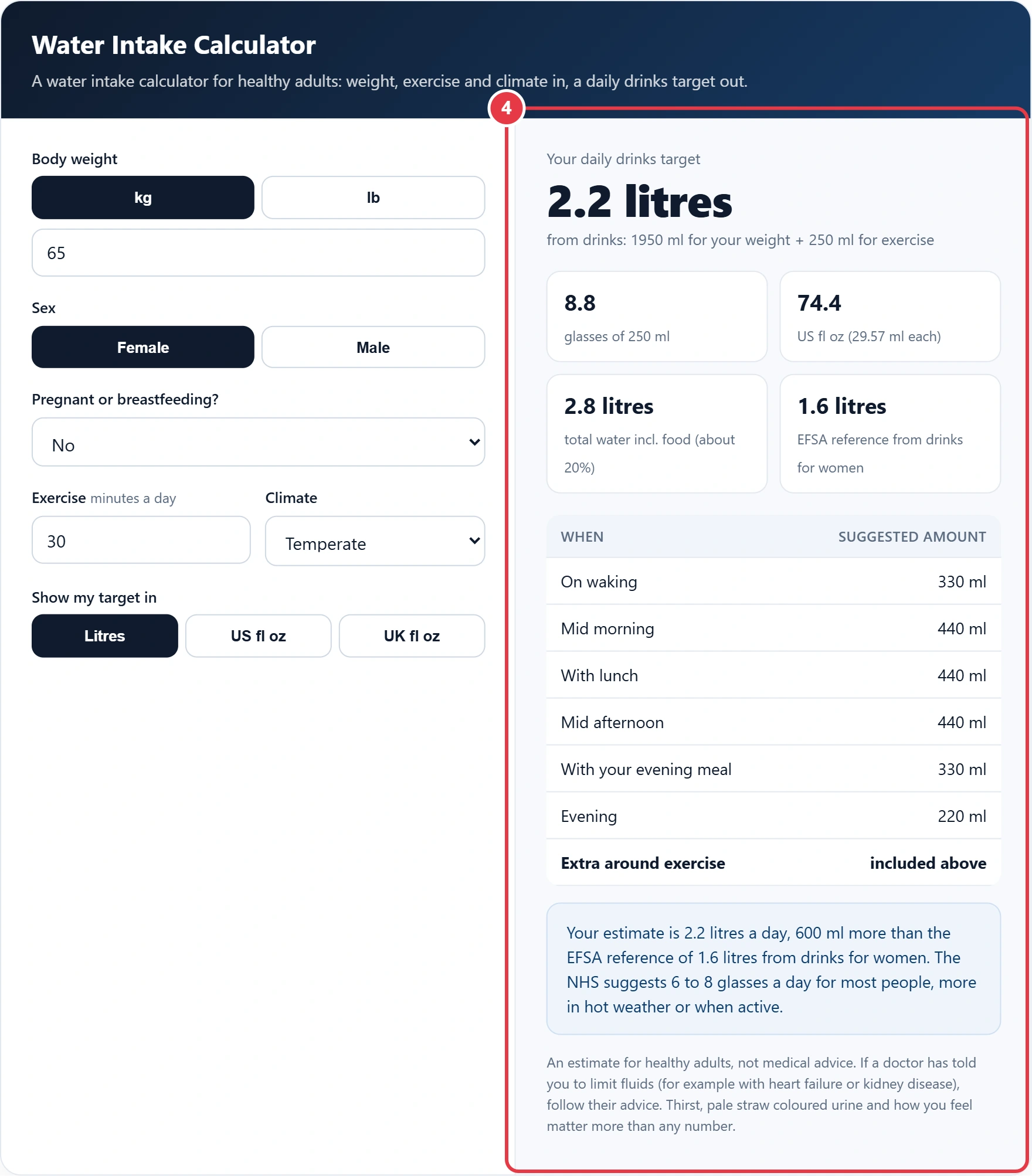
A water intake calculator for healthy adults: weight, exercise and climate in, a daily drinks target out.
| When | Suggested amount |
|---|
An estimate for healthy adults, not medical advice. If a doctor has told you to limit fluids (for example with heart failure or kidney disease), follow their advice. Thirst, pale straw coloured urine and how you feel matter more than any number.
This water intake calculator estimates how much water and other drinks a healthy adult needs each day, using body weight, exercise, climate and pregnancy or breastfeeding. It shows the result in litres, 250 ml glasses and US or UK fluid ounces, and sets it beside the NHS advice on water and drinks and the European reference values, so you can see where your personal number sits.
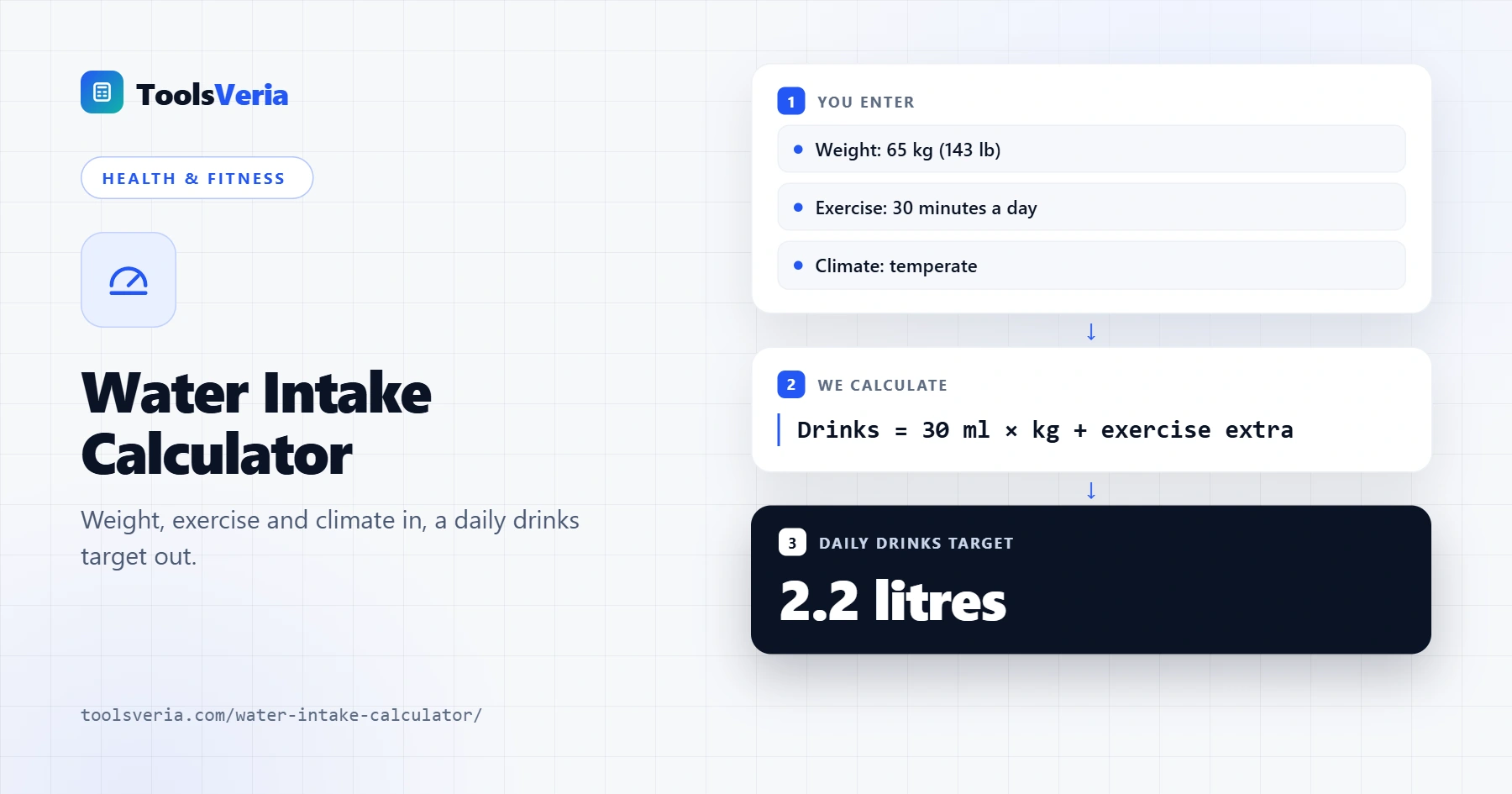
Quick answer: Most healthy adults need about 1.6 to 2.0 litres of drinks a day, roughly 6 to 8 glasses. A water intake calculator refines this with a rule of 30 ml per kg of body weight plus extra for exercise and heat, so a 65 kg adult who exercises for 30 minutes needs about 2.2 litres.
In This Guide
What Is a Water Intake Calculator?
A water intake calculator is a tool that turns your weight and daily routine into a personal target for fluids, so you have a number to aim for instead of a vague "drink more". This one shows every part of the sum, which most hydration tools keep hidden.
The formula is 30 ml × body weight in kg + 250 ml for every 30 minutes of exercise + 500 ml or 1 litre for hot weather, with 300 ml added in pregnancy and 700 ml when breastfeeding, the extra amounts used by the European Food Safety Authority (EFSA). The result is your daily water intake from drinks alone. Food supplies roughly another 20%, which is why the tool also shows a total water figure.
How to Use the Water Intake Calculator
Step 1: Enter Your Body Weight
Pick kg or lb and type your weight. Switching units converts the number for you, and the kg to stone converter helps if your scales only show stone and pounds. Weight drives most of the result, because a larger body holds and loses more water.

Step 2: Choose Sex and Pregnancy Status
Sex sets which EFSA reference the tool compares you with: 1.6 litres from drinks for women and 2.0 litres for men. Women can add pregnancy (300 ml extra) or breastfeeding (700 ml extra).

Step 3: Add Exercise and Climate
Enter the minutes you spend exercising on a typical day and pick your climate. Choose hot for a heatwave, a summer holiday or a warm workplace, and very hot for tropical heat or heavy outdoor work.

Step 4: Read Your Target and Drinking Plan
The water intake calculator shows your daily drinks target in litres, US fl oz or UK fl oz, with the number of 250 ml glasses and a simple plan that spreads the amount across six points of the day. The green or blue box compares your figure with the EFSA reference and the NHS guide of 6 to 8 glasses.
How Much Water Should I Drink a Day?
Most adults should drink about 1.5 to 2.5 litres of fluid a day, depending mainly on body size, with more on active or hot days. If you use this page as a how much water should I drink calculator, start with the table: it shows the weight rule before any exercise or heat is added, in metric and US units.
| Body weight | Drinks a day (30 ml per kg) | US fl oz | 250 ml glasses |
|---|---|---|---|
| 50 kg (110 lb) | 1.5 litres | 50.7 | 6 |
| 60 kg (132 lb) | 1.8 litres | 60.9 | 7.2 |
| 70 kg (154 lb) | 2.1 litres | 71.0 | 8.4 |
| 80 kg (176 lb) | 2.4 litres | 81.2 | 9.6 |
| 90 kg (198 lb) | 2.7 litres | 91.3 | 10.8 |
| 100 kg (220 lb) | 3.0 litres | 101.4 | 12 |
Official advice gives single figures for everyone. EFSA sets an adequate total water intake of 2.0 litres a day for women and 2.5 litres for men from food and drink together, which leaves about 1.6 and 2.0 litres to drink. The NHS Eatwell Guide suggests 6 to 8 cups or glasses. Treat the water intake calculator result as a starting point for your daily water intake and adjust it to your thirst.
Does Exercise or Hot Weather Change How Much Water I Need?
Yes, exercise and heat both raise your daily water intake, because sweat can remove half a litre or more every hour. The calculator adds 250 ml for each 30 minutes of activity and 500 ml or 1 litre for hot climates. Heavy sweaters, long events and physical jobs outdoors can need more than this.
Worked example: Amira weighs 72 kg, runs for 45 minutes most days and lives somewhere hot in summer. Her weight gives 72 × 30 = 2,160 ml, the run adds 45 ÷ 30 × 250 = 375 ml and the heat adds 500 ml, so her target is 3,035 ml, about 3.0 litres, 102.6 US fl oz or 12 glasses. On a cool rest day her target drops back to 2.2 litres.
Do Tea, Coffee and Food Count Towards Water Intake?
Yes, tea, coffee, milk, sugar free squash and other drinks all count towards your daily water intake, not just plain water. Caffeine has a mild effect at normal amounts, so a few mugs of tea still add to your total. Sugary and fizzy drinks also hydrate you, but the NHS advises limiting them for your teeth and weight.
Food matters too: fruit, vegetables, soup and yoghurt are mostly water and supply around a fifth of the daily total. If you are counting energy as well, the TDEE calculator estimates the calories you burn each day, and many people find a regular glass with each meal the easiest way to reach their target.
Can You Drink Too Much Water?
Yes, drinking far more than your body can pass, usually many litres in a few hours, can dilute the sodium in your blood and cause hyponatraemia. It is rare in healthy adults but has affected endurance runners who drank too much during long races. Spread your drinks through the day rather than forcing large amounts at once.
Signs of not drinking enough include thirst, dark yellow urine, headaches and feeling dizzy, and the NHS guide to dehydration explains when to get help. See a GP or call NHS 111 if symptoms last, and follow your doctor or midwife if you have kidney or heart problems or have been told to limit fluids. Figures on this page were checked October 2026.
Key Water Intake Terms Explained
These terms explain the reference values and units behind this water intake calculator, so you can read your daily target and the official figures with confidence.
- Adequate intake
- A reference value set when there is not enough evidence for an exact requirement. EFSA's adequate total water intake is 2.0 litres a day for women and 2.5 litres for men, counting water from both food and drink.
- Total water intake
- All the water your body takes in during a day, from drinks plus the water inside food. Food typically supplies about 20%, which is why a 2.0 litre total leaves around 1.6 litres to drink.
- Fluid ounce
- A unit of liquid volume with two sizes. One US fluid ounce is 29.57 ml and one UK imperial fluid ounce is 28.41 ml, so the same litre target gives a slightly higher number in UK ounces.
- Dehydration
- A state where the body loses more water than it takes in. Early signs include thirst, dark yellow urine, headaches and dizziness, and exercise or hot weather make it more likely.
- Hyponatraemia
- A low level of sodium in the blood. Drinking many litres in a few hours can dilute sodium and cause it, which is why drinks are best spread across the day rather than forced at once.
</>Embed this calculator on your website
Add the free Water Intake Calculator to your own site or blog. Copy the code below and paste it into an HTML block. It resizes itself and works on phones.
How we checked this tool: the Tools Veria Editorial Team built this tool by hand, checked it against the official rules or published standards where they apply, and tested it against worked examples. Results are estimates for planning, not personal financial or tax advice. Read our editorial policy and disclaimer, or report an error.
Frequently Asked Questions
How much water should I drink based on my weight?
A common rule is 30 ml of fluid per kg of body weight each day. That means 1.8 litres at 60 kg, 2.1 litres at 70 kg and 2.4 litres at 80 kg, before adding extra for exercise or hot weather.
Is 2 litres of water a day enough?
For many adults, yes. Two litres of drinks a day matches the EFSA reference for men and is above the 1.6 litres suggested for women. Larger, very active people or anyone in a hot climate may need 2.5 to 3 litres.
How many glasses of water a day is that?
The NHS suggests 6 to 8 glasses of fluid a day. With 250 ml glasses that is 1.5 to 2 litres. The calculator shows your own target as a number of 250 ml glasses so you can count them easily.
How much water is 64 ounces?
64 US fluid ounces is about 1.9 litres, close to eight 8 oz glasses. In UK fluid ounces the same 64 oz is 1.82 litres, because a UK fluid ounce is 28.41 ml and a US one is 29.57 ml.
Does pregnancy increase how much water I need?
Yes. EFSA advises an extra 300 ml a day in pregnancy and about 700 ml while breastfeeding. Your midwife or GP can give personal advice, especially if you have swelling, sickness or high blood pressure.
How can I tell if I am drinking enough?
Pale straw coloured urine and rarely feeling thirsty are good everyday signs that you are drinking enough. Dark yellow urine, headaches and dizziness suggest you need more fluids, and lasting symptoms are a reason to speak to a pharmacist or GP.