Check a reading against UK limits and the target for your age group.
| Age | High (clinic) | High (home) | Aim below |
|---|
For adults 18 and over. An estimate, not a diagnosis or medical advice: high blood pressure is only diagnosed after repeat or 24 hour readings. Children's readings are judged on centiles for age, sex and height, so ask your GP.
This blood pressure chart by age lets UK adults check a reading from a GP surgery, pharmacy or home monitor against the thresholds used by the NHS and the NICE hypertension guideline, and see the target that applies to their age group. Type in one or two readings and you get the category, which number is driving it and what to do next, in plain English.
Quick answer: In a UK blood pressure chart by age, the ideal for every adult is between 90/60 and 120/80 mmHg. A clinic reading of 140/90 or more, or 135/85 or more at home, counts as high at any age. Only the treatment target changes: below 140/90 under 80, and below 150/90 from 80.

In This Guide
What Is a Blood Pressure Chart by Age?
A blood pressure chart by age is a table that shows which readings count as low, healthy or high for adults at different stages of life. Blood pressure is written as two numbers in millimetres of mercury (mmHg). The top number, systolic, is the pressure when your heart beats. The bottom number, diastolic, is the pressure as the heart relaxes between beats.
The rule for reading any chart is simple: your category is set by whichever number falls in the higher band. A reading of 128/92 is high even though 128 looks fine, because 92 is over the 90 diastolic limit. Many charts online list "average" readings by age from US surveys, which tell you what is common, not what is healthy. Average systolic pressure does rise with age as arteries stiffen, but UK guidance does not move the high threshold up for older adults until the age of 80.
How to Use the Blood Pressure Chart by Age Checker
Step 1: Pick Your Age and Where the Reading Was Taken
Choose your age band and say whether the reading came from a GP, nurse or pharmacy, or from your own home monitor. Home readings are usually lower than clinic ones because there is no "white coat" effect, so the high threshold at home is 135/85 rather than 140/90.

Step 2: Enter Your First Reading
Type the systolic (top) and diastolic (bottom) numbers exactly as the monitor shows them. Ignore the pulse figure for now, it is your heart rate, not part of your blood pressure.
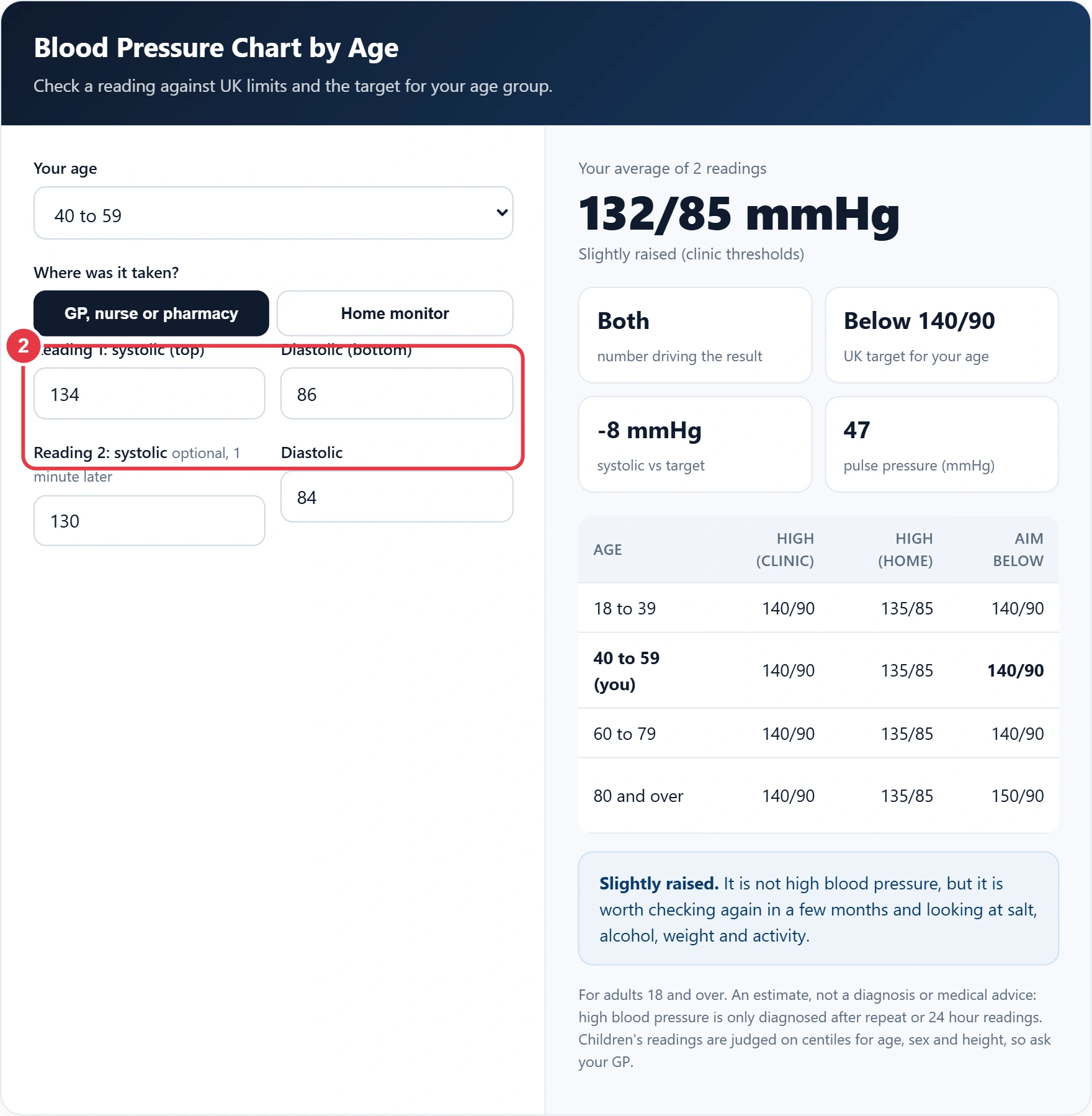
Step 3: Add a Second Reading
Take a second reading a minute after the first and enter it. The checker works out the average for you in the same way an average calculator would, which smooths out the natural jump that many people see on the first squeeze of the cuff. Leave the boxes blank if you only have one reading.

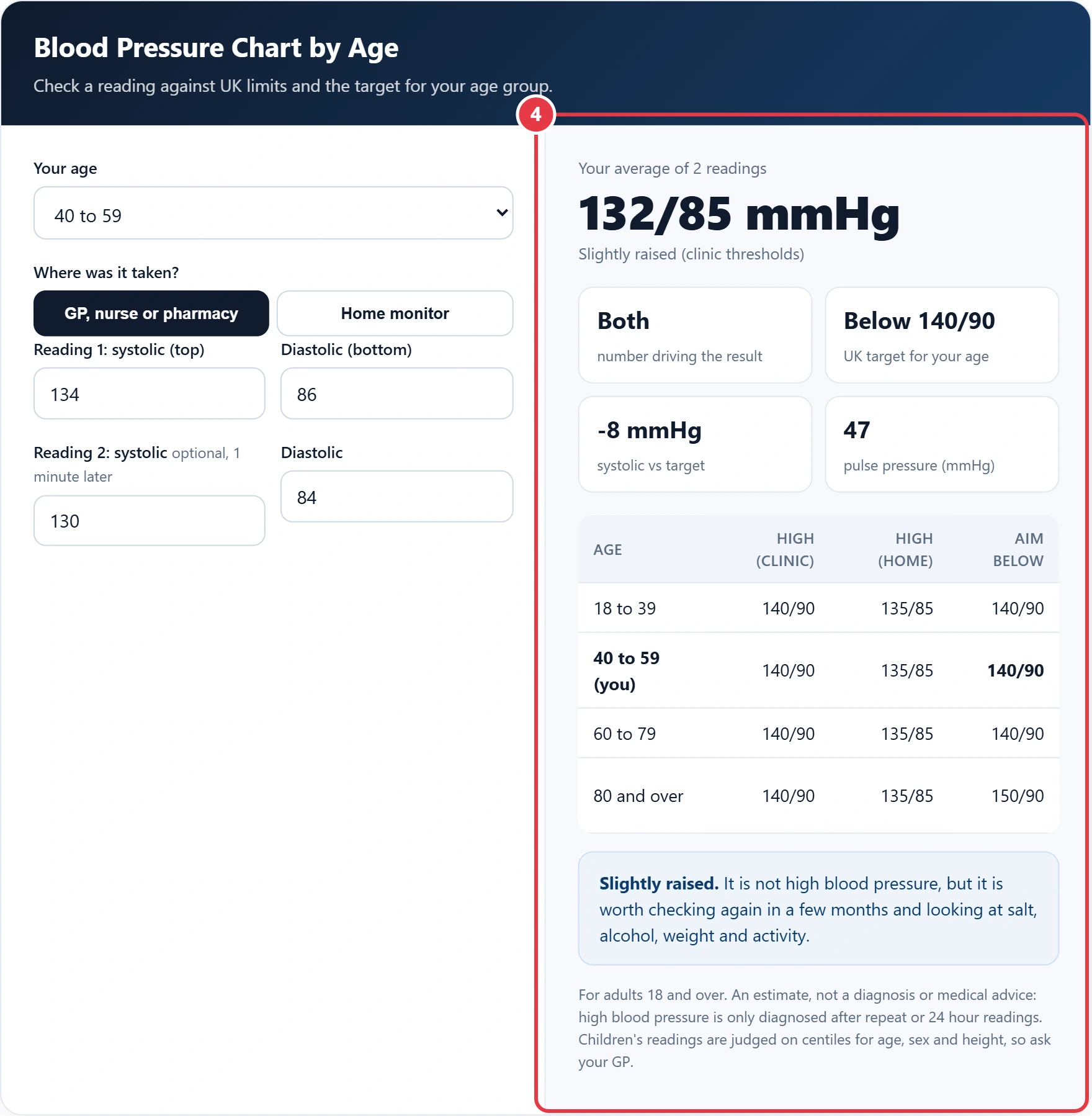
Step 4: Read Your Result
You see your average, its category, whether systolic or diastolic is driving it, your age target, how far systolic sits from that target, and your pulse pressure (the gap between the two numbers). The chart underneath highlights your age group and the box explains what to do next.
UK Blood Pressure Chart for Adults by Age
| Age | Ideal | High at clinic | High at home | Treatment target (clinic / home) | What changes |
|---|---|---|---|---|---|
| 18 to 39 | 90/60 to 120/80 | 140/90+ | 135/85+ | below 140/90 / 135/85 | Often never checked, so high readings go unnoticed |
| 40 to 59 | 90/60 to 120/80 | 140/90+ | 135/85+ | below 140/90 / 135/85 | Free NHS Health Check every 5 years from 40 to 74 |
| 60 to 79 | 90/60 to 120/80 | 140/90+ | 135/85+ | below 140/90 / 135/85 | Systolic tends to rise as arteries stiffen |
| 80 and over | 90/60 to 120/80 | 140/90+ | 135/85+ | below 150/90 / 145/85 | Gentler target; watch for dizziness on standing |
Within the high range, NICE splits clinic readings into stage 1 (140/90 to 159/99), stage 2 (160/100 to 179/119) and severe (180/120 or higher). Between 120/80 and 140/90 is a grey zone: the British Heart Foundation calls 130/85 to 139/89 slightly raised. Low blood pressure, below 90/60, is only a concern if it causes symptoms such as dizziness or fainting.
What Is a Normal Blood Pressure for My Age?
For any adult, a normal blood pressure is between 90/60 and 120/80 mmHg, and anything under 140/90 at a clinic is below the high threshold until you reach 80. After 80, NICE allows a treatment target of below 150/90 because pushing pressure lower can cause falls. So "normal for your age" never means 150/95 is fine at 60.
Take David, 52, who had 134/86 at a pharmacy and 130/84 a minute later. His average of 132/85 is slightly raised: not high, but above the ideal. His mother Margaret, 83, averages 142/80 on her home monitor. That is over the 135/85 home limit for younger adults, but below the 145/85 home target that applies over 80, so her GP is likely to be content with it.
What Raises Blood Pressure and What Brings It Down
The NHS lists being over 40, having Black African, Black Caribbean or South Asian heritage, a family history of high blood pressure, smoking, too much salt or alcohol, little exercise and carrying extra weight as the main risks. Most of those can be changed. Losing even a few kilos tends to lower readings, so a calorie deficit calculator is a sensible way to set a daily target that you can keep up for months rather than weeks.
Cutting salt towards the 6 g a day adult limit, keeping alcohol within 14 units a week, and building up to 150 minutes of brisk walking or similar activity each week all help, and they add together. If lifestyle changes are not enough, your GP may suggest medicine, which is usually taken long term and reviewed with regular checks.
How to Take an Accurate Reading at Home
- Avoid caffeine, smoking and exercise for 30 minutes before.
- Sit with your back supported and feet flat for 5 minutes, arm resting at heart height.
- Use an upper arm cuff of the right size, on bare skin, and do not talk.
- Take two readings a minute apart, morning and evening, for 4 to 7 days, and average them, ignoring the first day.
High blood pressure rarely causes any symptoms at all, which is why regular checks matter so much for adults of every age. The NHS high blood pressure guide explains the causes, the tests your GP may arrange and the treatments available. This blood pressure chart by age gives an estimate for adults and cannot diagnose anything: speak to a GP or pharmacist about any reading in the high range, and call 999 if a very high reading comes with chest pain or breathlessness.
Blood Pressure Chart by Age Terms Explained
These definitions explain the measurements and thresholds in this blood pressure chart by age, so you can understand your reading before speaking to a clinician.
- Systolic pressure
- The peak pressure in the arteries as the heart contracts and pushes blood out, recorded as the upper figure in a reading. It tends to rise with age as large arteries lose elasticity.
- Diastolic pressure
- The lowest pressure in the arteries while the heart rests and refills between beats, recorded as the lower figure. A raised value can put a reading in the high category even when the upper figure looks normal.
- Millimetres of mercury (mmHg)
- The traditional unit for blood pressure, based on the height a column of mercury would be pushed in a manometer. Digital monitors still report in this unit so readings can be compared with clinical thresholds.
- Hypertension
- Persistently raised blood pressure, confirmed in the UK by repeat clinic readings or by ambulatory or home monitoring. It often causes no symptoms yet raises the risk of stroke, heart attack and kidney disease.
- White coat effect
- A temporary rise in blood pressure caused by the stress of being measured in a clinical setting. It is why UK guidance uses a lower high threshold for home readings, 135/85, than for clinic readings.
- Pulse pressure
- The difference between systolic and diastolic values, such as the gap between 120 and 80 in a reading of 120/80. A persistently wide gap can indicate stiffening arteries, particularly in older adults.
</>Embed this calculator on your website
Add the free Blood Pressure Chart by Age to your own site or blog. Copy the code below and paste it into an HTML block. It resizes itself and works on phones.
How we checked this tool: the Tools Veria Editorial Team built this tool by hand, checked it against the official rules or published standards where they apply, and tested it against worked examples. Results are estimates for planning, not personal financial or tax advice. Read our editorial policy and disclaimer, or report an error.
Frequently Asked Questions
Does blood pressure go up with age?
Yes, systolic pressure usually rises with age because arteries become stiffer, while diastolic often levels off or falls after about 60. UK guidance still treats 140/90 at a clinic as high for every adult, and only relaxes the treatment target to below 150/90 from age 80.
Is 140/90 high blood pressure?
Yes. A clinic reading of 140/90 mmHg or higher is the NHS and NICE threshold for high blood pressure at any adult age. At home the threshold is lower, 135/85 mmHg, because home readings avoid the stress of a surgery visit.
What is a good blood pressure for a 60 year old?
A good reading at 60 is the same as at any adult age: between 90/60 and 120/80 mmHg is ideal. Under 140/90 at a clinic, or 135/85 at home, is below the high threshold, so 128/78 would be healthy.
Which number is more important, top or bottom?
Both count, and your category is set by whichever is higher. After 50, the top (systolic) number is usually the stronger predictor of heart attack and stroke risk, which is why a high systolic with a normal diastolic still needs a check.
What should I do if my reading is 180/120?
Rest quietly for 5 minutes and measure again. If it is still 180/120 mmHg or above, contact your GP the same day or call NHS 111, and call 999 straight away if you have chest pain, breathlessness, weakness or vision changes.
Why is my blood pressure higher at the doctor's?
Many people have white coat hypertension, where the stress of an appointment can push readings noticeably higher than at home. That is why NICE asks for home or 24 hour ambulatory readings, judged against 135/85, before high blood pressure is diagnosed.