Estimate blood alcohol from UK drinks and see when it falls to zero. Never use it to decide whether to drive.
| Time from now | BAC | mg per 100 ml |
|---|
A rough estimate for healthy adults, not medical or legal advice. Food, medicines, health and drinking speed change real levels a lot. The only safe amount before driving is none. If someone is very drunk, cannot be woken or is breathing slowly, call 999.
This BAC calculator estimates the blood alcohol of an adult from the drinks they have had, entered the way people actually drink in the UK: pints, glasses of wine and single measures. It counts your units with the formula used by the NHS, compares the result with the UK drink drive limits on GOV.UK and shows, hour by hour, how long the alcohol takes to clear. It is for understanding alcohol, never for deciding whether you are fit to drive.
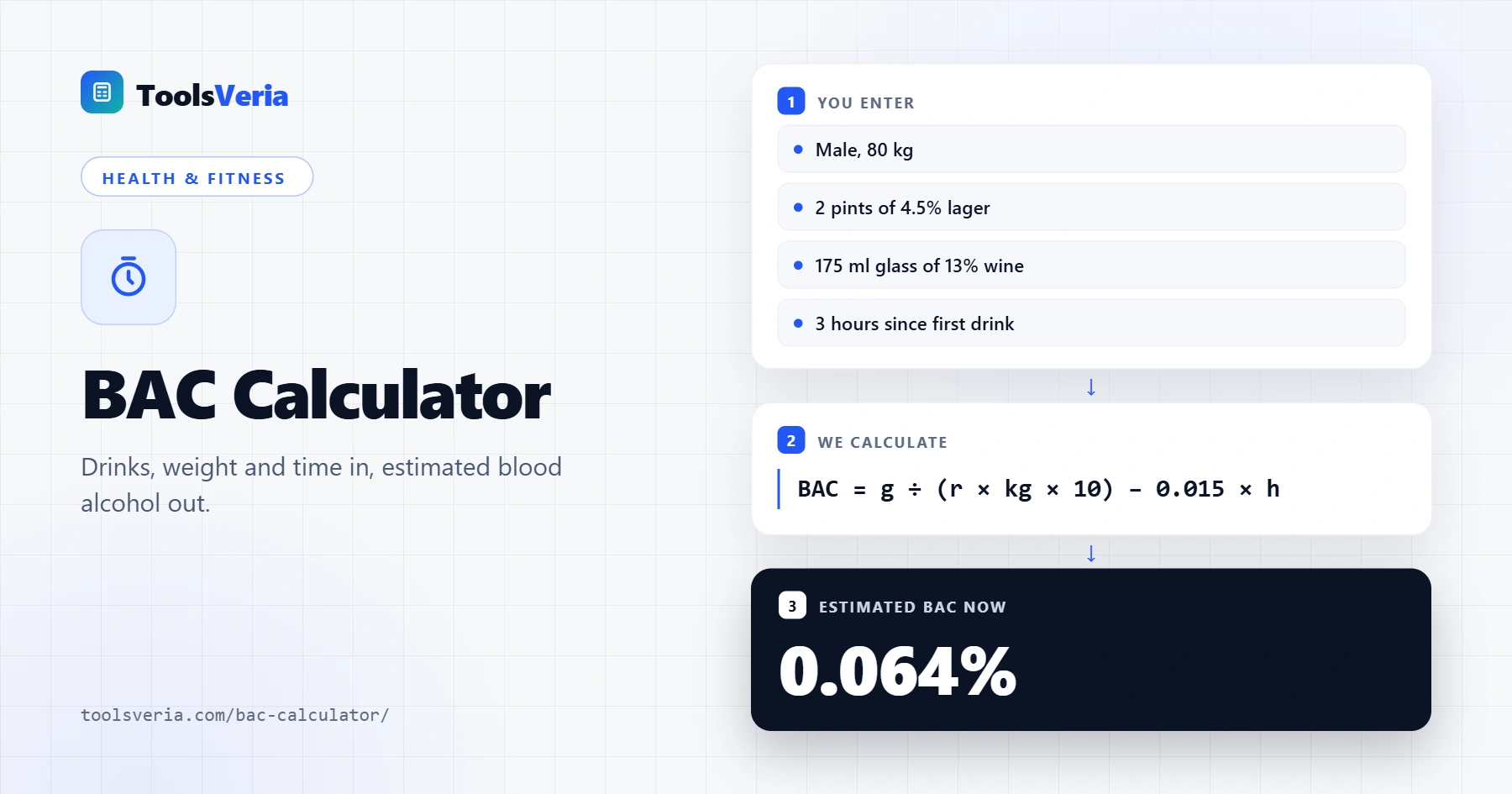
Quick answer: A BAC calculator divides the grams of alcohol you drank by your weight times a body water factor (0.68 for men, 0.55 for women), then takes off about 0.015% for every hour since your first drink. An 80 kg man who has had 7.4 units over 3 hours is near 0.064%.
In This Guide
What Is BAC?
BAC, or blood alcohol concentration, is the amount of alcohol in your blood, shown as a percentage or as milligrams of alcohol per 100 millilitres of blood. A BAC of 0.08% is the same as 80 mg per 100 ml, which is the legal driving limit in England, Wales and Northern Ireland. Scotland's limit is lower at 50 mg.
The calculator uses the Widmark formula. In plain words: BAC % = grams of alcohol ÷ (body water factor × weight in kg × 10), minus the clearance rate × hours. Grams come from UK units: ABV × ml ÷ 1,000 gives units, and each unit is 8 g of pure alcohol. Women usually reach a higher BAC than men of the same weight because a smaller share of their body is water.
How to Use the BAC Calculator
Step 1: Enter Your Sex and Weight
Choose male or female and enter your weight in kilograms, pounds, or stone and pounds. A lighter person has less body water to dilute the alcohol, so the same drinks give a higher reading.

Step 2: Add Your Drinks
Enter pints of beer or cider, glasses of wine with the glass size, single 25 ml spirits and any other drink by its volume. Check the ABV on the can, bottle or pump clip, because a 6.5% craft IPA has nearly half as much alcohol again as a 4.5% lager.

Step 3: Set the Time and Limit
Enter the hours since your first drink. Leave clearance on average unless you want to see the slow case, which is the safer assumption. Then pick the limit to compare against; if you are timing a long evening, the time duration calculator works out the gap between two clock times for you.

Step 4: Read the Estimate
You see your BAC as a percentage and in mg per 100 ml, your total units, an approximate breath figure, the time until the estimate reaches zero and an hour by hour table. The breath figure uses the ratio between the UK legal limits of 35 µg and 80 mg, so treat it as a guide only.

How Long Does It Take to Sober Up?
Most adults clear roughly one UK unit an hour, which lowers BAC by about 0.015% an hour, and nothing speeds it up: not coffee, water, a cold shower or sleep. Take Tom, who weighs 80 kg and drinks two pints of 4.5% lager and a 175 ml glass of 13% wine. That is 7.4 units, or 59 g of alcohol, and an estimated peak of 0.109%. Three hours after his first drink he is still near 0.064%, and he needs about 4 more hours to reach zero.
Sarah weighs 62 kg and drinks two 250 ml glasses of 12% wine, 6 units in all. Her estimated peak is 0.141%, and two hours after her first glass she is still around 0.111%, over the limit in every part of the UK. This is why people are caught the morning after a late night.
| Drink | Size and strength | UK units | Pure alcohol |
|---|---|---|---|
| Pint of lager | 568 ml at 4.5% | 2.6 | 20 g |
| Pint of strong cider | 568 ml at 6% | 3.4 | 27 g |
| Medium glass of wine | 175 ml at 13% | 2.3 | 18 g |
| Large glass of wine | 250 ml at 13% | 3.3 | 26 g |
| Single spirit | 25 ml at 40% | 1.0 | 8 g |
| Bottle of wine | 750 ml at 13.5% | 10.1 | 81 g |
Why a BAC Calculator Can Be Wrong
Every BAC calculator, including this one, assumes all the alcohol has been absorbed. In reality food in your stomach slows absorption, so readings rise later and lower, while drinking fast on an empty stomach pushes them up sooner. Medicines, liver health, age and tiredness all change how you clear alcohol, and you can be impaired well below any legal limit.
For your long term health, the UK Chief Medical Officers advise no more than 14 units a week, spread over three or more days, and the NHS guide to alcohol units shows the units in common drinks so you can keep track week to week. Regular heavy drinking also raises blood pressure, which you can check against UK thresholds with our blood pressure chart by age tool, and if you are worried about how much you drink, speak to your GP.
Key Terms for Using the BAC Calculator
These definitions explain the science and legal limits behind the BAC calculator, so you understand what the estimate shows and why it is only a guide.
- Blood alcohol concentration
- The quantity of ethanol in the bloodstream, given as a percentage or in milligrams per 100 millilitres. A reading of 0.08% equals 80 mg per 100 ml, the measure used to set drink driving limits.
- Widmark formula
- An equation from the Swedish chemist Erik Widmark that estimates blood alcohol from grams of alcohol, body weight and a body water factor, then subtracts elimination over time. It remains the basis of most BAC estimators.
- UK alcohol unit
- A measure of 10 ml or 8 g of pure alcohol. Multiplying a drink's ABV by its volume in millilitres and dividing by 1,000 gives its units, which convert directly into grams for the Widmark calculation.
- Alcohol by volume (ABV)
- The percentage of a drink's volume that is pure ethanol, printed on cans, bottles and pump clips. A small difference matters: a 6.5% beer carries far more alcohol than a 4.5% lager of the same size.
- Alcohol elimination rate
- The speed at which the liver clears alcohol from the blood, typically about 0.015% BAC an hour. It cannot be accelerated by coffee, water or sleep, so only time lowers the level.
- Drink driving limit
- The legal maximum alcohol level for drivers: 80 mg per 100 ml of blood or 35 micrograms per 100 ml of breath in England, Wales and Northern Ireland, and 50 mg in Scotland.
</>Embed this calculator on your website
Add the free BAC Calculator to your own site or blog. Copy the code below and paste it into an HTML block. It resizes itself and works on phones.
How we checked this tool: the Tools Veria Editorial Team built this tool by hand, checked it against the official rules or published standards where they apply, and tested it against worked examples. Results are estimates for planning, not personal financial or tax advice. Read our editorial policy and disclaimer, or report an error.
Frequently Asked Questions
How accurate is a BAC calculator?
A BAC calculator gives a rough estimate that can be well above or below a real breath or blood test. It assumes full absorption and an average clearance rate, while food, medicines, health and drinking speed all change real levels, so never use it to decide whether to drive.
What BAC is the UK drink drive limit?
In England, Wales and Northern Ireland the limit is 80 mg of alcohol per 100 ml of blood, which is a BAC of 0.08%, or 35 µg per 100 ml of breath. In Scotland it is 50 mg per 100 ml of blood, a BAC of 0.05%, or 22 µg of breath.
How long does one unit of alcohol take to leave the body?
About one hour for an average adult, according to the NHS, which lowers BAC by roughly 0.015%. A pint of 4.5% lager has 2.6 units, so it takes around 2 and a half hours to clear, and longer for some people.
Can I drive the morning after drinking?
Possibly not. Ten units drunk by midnight can still be in your blood at breakfast, because the body clears only about one unit an hour. Work out when your last drink should be, and if in doubt, do not drive.
Why do women get a higher BAC than men?
On average women have a lower share of body water than men of the same weight, so the same alcohol is less diluted. The Widmark formula reflects this with a factor of about 0.55 for women and 0.68 for men.
Does eating food lower my BAC?
Eating before or while drinking slows how fast alcohol is absorbed, so your peak BAC is lower and later. It does not speed up how quickly your liver clears alcohol, so the total time to reach zero barely changes.