Predict adult height from both parents, see the likely range and track progress.
| Outcome | cm | ft and in |
|---|
An estimate for healthy children, not medical advice. If your child crosses centile lines on their red book chart, seems much shorter or taller than the family, or starts puberty very early or late, speak to your GP or health visitor.
This child height predictor gives parents and carers a quick estimate of how tall a son or daughter is likely to be as an adult, using the same mid parental method that sits on the RCPCH UK growth charts used by health visitors and GPs across the UK. Enter both parents' heights in centimetres or feet and inches, and you get a target height, the range four in five children land in, and an optional check on how far your child has grown so far.
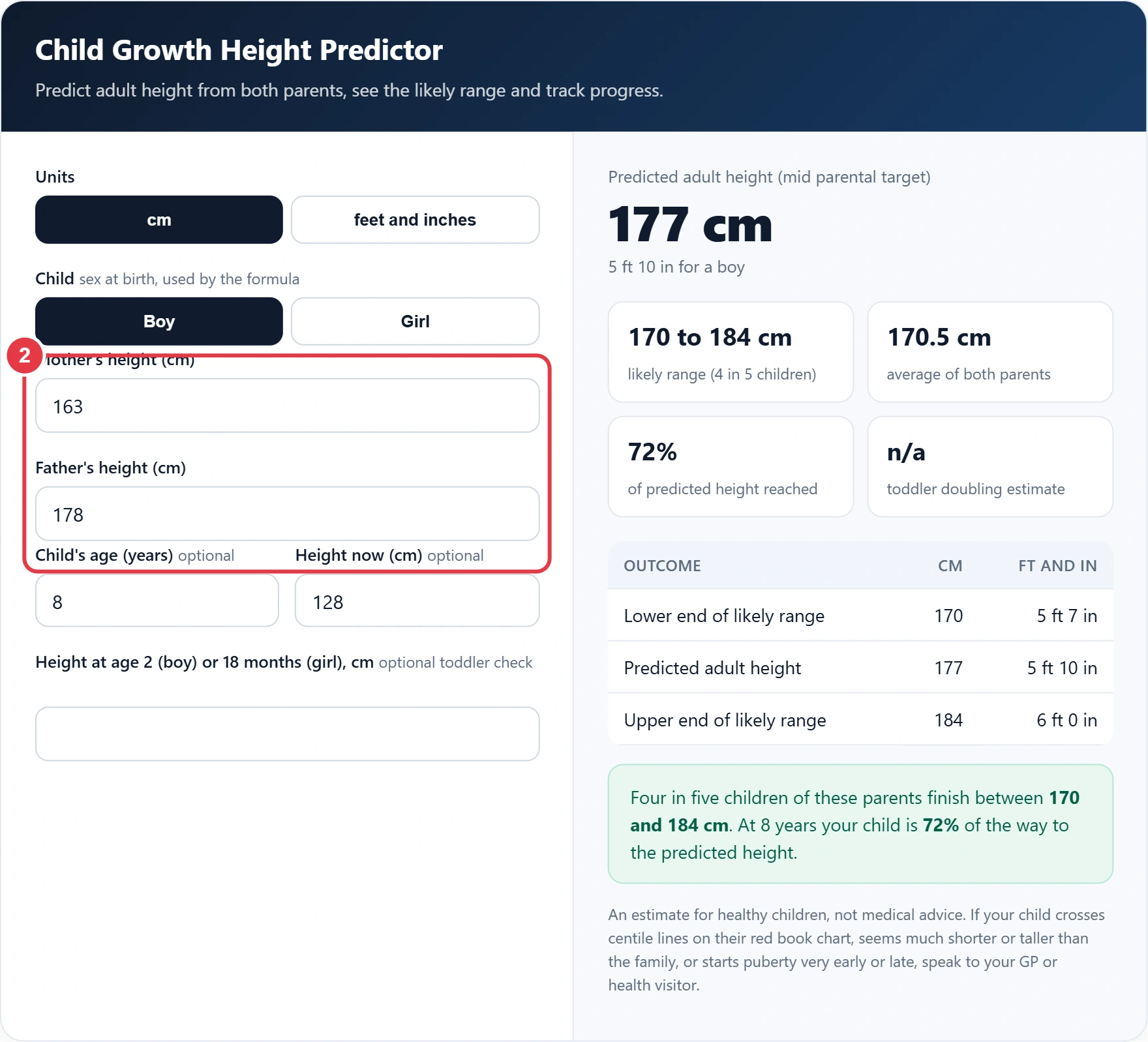
Quick answer: A child height predictor adds the parents' heights, adds 13 cm for a boy or takes away 13 cm for a girl, then halves the total. A mother of 163 cm and father of 178 cm give a son a target of 177 cm, and four in five sons finish within 7 cm of it.

In This Guide
What Is a Child Height Predictor?
A child height predictor is a calculator that estimates a child's final adult height from the heights of their biological parents. It works because height is strongly inherited: children of tall parents tend to be tall, and children of shorter parents tend to be shorter, although each child can land anywhere in a fairly wide band.
The method is called the mid parental height, first set out by the paediatrician James Tanner. In plain words: add the mother's and father's heights, add 13 cm for a boy or subtract 13 cm for a girl, then divide by 2. The 13 cm reflects the average gap between adult men and women. In inches the adjustment is 5 inches. Take Amira, whose mother is 160 cm and father 183 cm. Her target is (160 + 183 − 13) ÷ 2 = 165 cm, or about 5 ft 5 in, and her likely range runs from 158 cm to 172 cm.
How to Use the Child Growth Height Predictor
Step 1: Choose Units and Your Child's Sex
Pick centimetres or feet and inches. The calculator converts everything for you, and the results table always shows both. Then select boy or girl, because the formula adds or subtracts the 13 cm sex adjustment based on sex at birth.

Step 2: Enter Both Parents' Heights
Use measured heights, not the number on an old passport. Stand without shoes, heels against a wall, and mark the top of the head with a book held flat. People are often 1 cm taller in the morning than the evening, so measure both parents at the same time of day for a fair average.
Step 3: Add Your Child's Details (Optional)
Enter your child's age and height now to see what share of the predicted height they have already reached. If you have a measurement from age 2 for a boy or 18 months for a girl, add it as a toddler check. You will find it in the red book, and if you only know the date of that check, the days between dates calculator shows exactly how old your child was when it was taken.

Step 4: Read the Prediction and Range
The big figure is the target height. Underneath you see the range that four in five children of the same parents finish within, the plain parental average, the progress figure and, if entered, the toddler estimate. The summary box tells you whether the two methods agree.

How Tall Will My Child Be?
Most children end up within 7 cm either side of their mid parental target: the RCPCH chart notes say four out of five do. So treat the target as the middle of a 14 cm window rather than a promise. A son of a 165 cm mother and a 180 cm father has a target of 179 cm (about 5 ft 10 in), and he will most likely finish somewhere between 172 cm and 186 cm.
The table shows targets for some common parent pairings. The parental average in the second column is a simple mean of two numbers, the same sum an average calculator would give you, before the 13 cm sex adjustment is applied to it.
| Mother and father | Parental average | Son target | Daughter target |
|---|---|---|---|
| 155 cm and 170 cm | 162.5 cm | 169 cm (5 ft 7 in) | 156 cm (5 ft 1 in) |
| 160 cm and 175 cm | 167.5 cm | 174 cm (5 ft 9 in) | 161 cm (5 ft 3 in) |
| 165 cm and 180 cm | 172.5 cm | 179 cm (5 ft 10 in) | 166 cm (5 ft 5 in) |
| 170 cm and 185 cm | 177.5 cm | 184 cm (6 ft 0 in) | 171 cm (5 ft 7 in) |
Other Ways to Predict Adult Height
The mid parental formula is the simplest method and the one used in UK child health checks, but there are others, each with trade offs.
- Current centile: a child who has followed one centile line on the UK growth chart for years will usually stay near it. The RCPCH chart notes that this is often closer to final height than the parents' target, and four in five children finish within 6 cm of it.
- Toddler doubling: double a boy's height at 2 or a girl's height at 18 months. It is a rough rule with little research behind it, so use it only as a cross check.
- Khamis Roche: a US formula that adds the child's current height and weight. It was built on white American children, so it is less reliable for other groups.
- Bone age: a hand X ray read by a specialist shows how much growing is left. It is only done when a doctor has a medical reason.
What Affects How Tall a Child Grows
Genes set the range, but nutrition, sleep, long term illness and some medicines decide where in that range a child lands. Puberty timing matters too. Early developers often look tall for their age and then stop sooner, while late developers can seem small at 12 and catch up by 17. Girls usually finish growing in their mid teens, a year or two after periods start, and boys usually finish later, often between 16 and 18.
Any child height predictor needs both biological parents' heights. If your child is adopted or donor conceived, or you do not know one parent's height, the target will be unreliable, and the current centile on the growth chart is the better guide.
When to Speak to Your GP or Health Visitor
This child height predictor is an estimate for healthy children and cannot diagnose a growth problem. Book a check if your child's height drops or climbs across two or more centile lines, is far below the range for your family, or if puberty starts before 8 in girls or 9 in boys. The RCPCH has a clear guide to growth charts for parents that explains centiles, so you can ask the right questions at the appointment.
Child Growth Height Predictor Terms You Should Know
These terms explain the growth science behind the child growth height predictor, helping parents read the target height, likely range and progress figures sensibly.
- Mid parental height
- An estimate of a child's adult height based on the average of both biological parents' heights, adjusted for the typical difference between men and women. It gives a target, not a guarantee, because many genes and environmental factors affect growth.
- Growth centile
- A line on a growth chart showing the height or weight below which a given percentage of children of the same age and sex fall. A child tracking the middle centile line is exactly average for their age.
- Target height range
- The band around the predicted adult height within which most children of the same parents are expected to finish. Health professionals use it to judge whether a child's growth pattern matches the family's genetic potential.
- Heritability
- The share of variation in a trait across a population that is explained by genetic differences between individuals. Height is one of the most heritable human traits, which is why parental heights give a useful prediction.
- Personal Child Health Record
- The record book, commonly called the red book, given to parents of every newborn in the UK. Health visitors and GPs plot measurements on its growth charts, making it the best source of past height readings.
- Puberty growth spurt
- The rapid increase in height that occurs during adolescence before the long bones stop growing. Its timing varies widely between children, so early or late developers can sit temporarily above or below their predicted path.
</>Embed this calculator on your website
Add the free Child Height Predictor to your own site or blog. Copy the code below and paste it into an HTML block. It resizes itself and works on phones.
How we checked this tool: the Tools Veria Editorial Team built this tool by hand, checked it against the official rules or published standards where they apply, and tested it against worked examples. Results are estimates for planning, not personal financial or tax advice. Read our editorial policy and disclaimer, or report an error.
Frequently Asked Questions
How accurate is a child height predictor?
The mid parental method puts four in five children within 7 cm of the predicted height, according to the RCPCH UK growth chart notes. That leaves one in five outside that window, so read the result as a likely range rather than an exact final height.
What is the formula for mid parental height?
Add the mother's and father's heights, add 13 cm for a boy or subtract 13 cm for a girl, then divide by 2. In inches use 5 instead of 13. Parents of 160 cm and 175 cm give a son 174 cm.
Can a child be taller than both parents?
Yes. A son's target already sits 6.5 cm above the parental average, and the likely range spans another 7 cm either side, so many boys outgrow both parents. Better nutrition than the parents had can add a little more.
At what age do girls and boys stop growing?
Most girls reach adult height in their mid teens, usually a year or two after their periods start. Boys start puberty later and usually stop growing between about 16 and 18, with a few still adding small amounts at 19 or 20.
Is doubling a child's height at age 2 accurate?
It is a rough rule of thumb, not a tested method. Double a boy's height at 2 years or a girl's at 18 months, then compare it with the parents method; if they differ by more than 7 cm, trust the parents method.
Does this work if my child is adopted?
No. The formula relies on the heights of both biological parents, so it gives a misleading figure for adopted or donor conceived children. Use their position on the UK growth chart instead and ask your health visitor or GP to plot it.