Your likely ovulation day, fertile window and test date for the next six cycles.
| Period starts | Fertile window | Ovulation |
|---|
Calendar estimates only. Ovulation can shift from cycle to cycle, so this is not a reliable method of contraception. Not medical advice: speak to a GP or pharmacist about fertility or contraception.
This ovulation calculator estimates when you are likely to ovulate, your fertile window and the best days to try for a baby, for anyone with a menstrual cycle who wants to plan or understand it. It follows the NHS explanation of fertility in the menstrual cycle, so it allows for ovulation falling 10 to 16 days before your next period rather than always on day 14. It also handles irregular cycles, shows your next six cycles and tells you the earliest day a pregnancy test is likely to work.
Quick answer: An ovulation calculator subtracts your luteal phase, usually 14 days, from your next period date. With a 28 day cycle you ovulate about 14 days after your period starts, and your fertile window is the 5 days before ovulation plus ovulation day. With a 32 day cycle, ovulation moves to about day 18.
In This Guide
What Is an Ovulation Calculator?
An ovulation calculator is a calendar tool that predicts the day an ovary releases an egg from the length of your cycle. The formula is ovulation date = first day of last period + cycle length − luteal phase. The luteal phase is the stretch between ovulation and your next period, and it is far more stable than the first half of the cycle. That is why a long cycle means later ovulation rather than a later period after a normal ovulation.
The fertile window is wider than ovulation day because sperm can survive in the body for up to 7 days, while an egg lives for about a day once released. In practice the 5 days before ovulation and the day itself carry nearly all the chance of conception, and the 3 days up to ovulation carry the most. If your cycles vary, the calculator switches to the calendar method: your first fertile day is your shortest cycle minus 18, and your last is your longest cycle minus 11.
How to Use the Ovulation Calculator
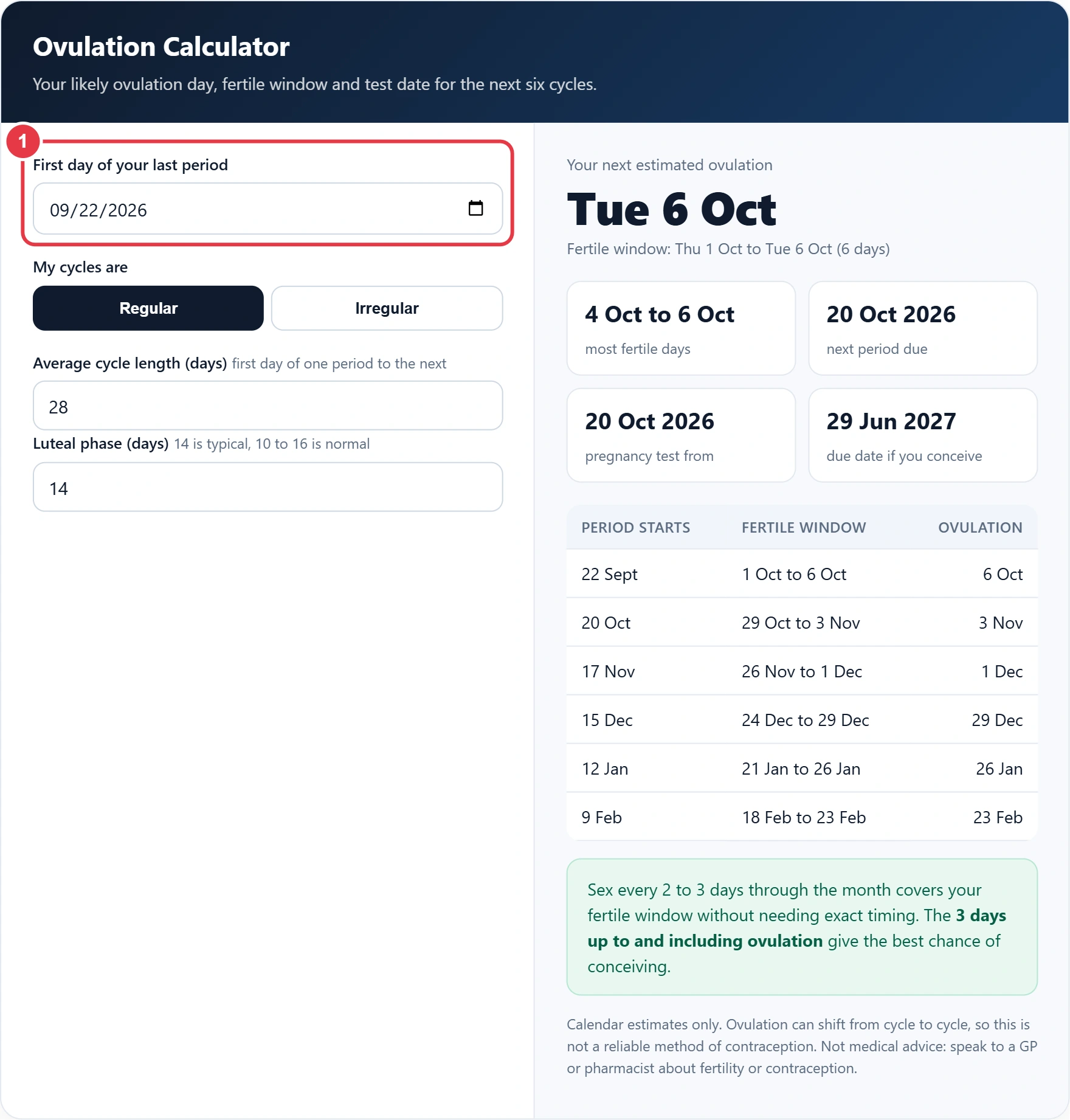
Step 1: Enter Your Last Period
Pick the first day of proper bleeding from your most recent period, not a day of light spotting. If you do not remember it exactly, the nearest date you are confident about still gives a useful estimate.
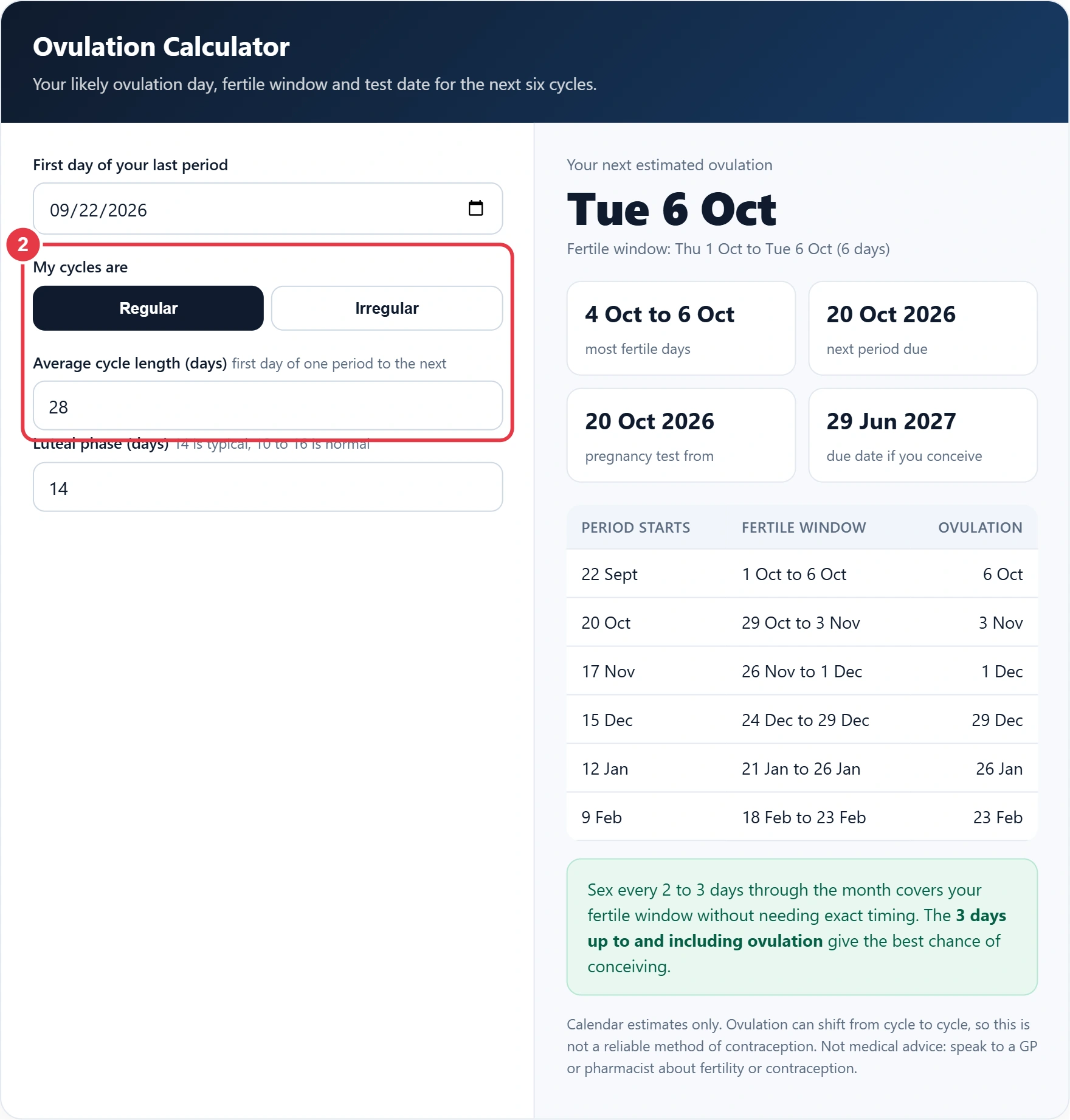
Step 2: Add Your Cycle Length
Choose Regular and enter your average cycle if it rarely changes by more than a day or two. Choose Irregular and enter your shortest and longest cycle from the last six months if it does. Counting from one period to the next is quicker with the days between dates calculator, because it gives the exact number of days without any finger counting.
Step 3: Adjust the Luteal Phase
Leave this at 14 days unless you know your own figure. If you have used ovulation tests, count the days from a positive test to your next period and enter that number, as it personalises every date the tool gives.

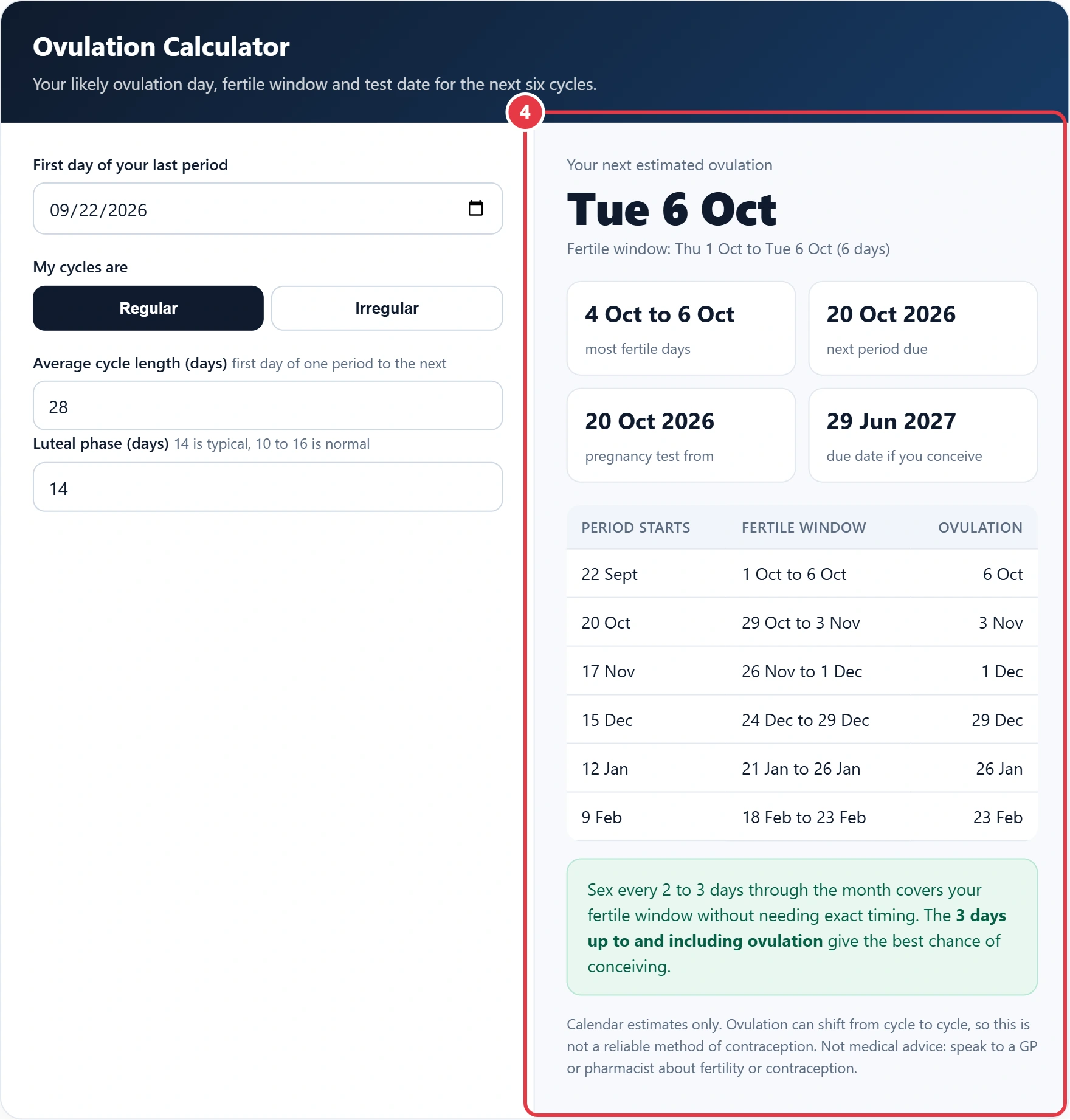
Step 4: Read Your Dates
The headline is your next likely ovulation, with the fertile window underneath. You also get your most fertile days, your next period, the earliest pregnancy test date and the due date if you conceive this cycle. The table lists the next six cycles so you can plan around work or travel.
When Do I Ovulate?
Most people ovulate about 14 days before their next period, so subtract 14 from your cycle length: that is 14 days after your period starts in a 28 day cycle, 16 days after in a 30 day cycle and 21 days after in a 35 day cycle.
| Cycle length | Ovulation (days after period starts) | Fertile window (days after period starts) |
|---|---|---|
| 24 days | 10 | 5 to 10 |
| 28 days | 14 | 9 to 14 |
| 30 days | 16 | 11 to 16 |
| 32 days | 18 | 13 to 18 |
| 35 days | 21 | 16 to 21 |
Take Hannah, whose period started on Thursday 1 October 2026 and whose cycle is usually 30 days. The ovulation calculator puts ovulation 16 days later, on Saturday 17 October, with a fertile window from 12 to 17 October and the best days from 15 to 17 October. Her next period is due on 31 October, which is also the first day a standard pregnancy test is likely to be accurate, and if she conceives this cycle her estimated due date is 10 July 2027. Had her cycles ranged from 26 to 33 days, the calendar method would widen her window to 8 to 22 October.
Signs of Ovulation That Confirm the Dates
- Cervical mucus becomes clear, slippery and stretchy, a little like raw egg white, in the days before ovulation.
- Ovulation predictor kits detect the surge in luteinising hormone that comes 24 to 36 hours before the egg is released.
- Basal body temperature rises slightly, by about 0.2 to 0.5°C, after ovulation. It confirms ovulation has happened, so it is most useful for learning your pattern over a few months.
- Some people feel a one sided twinge low in the tummy. It is common but not reliable enough to time sex around on its own.
These dates are estimates and are not medical advice, and a single late ovulation can move your fertile days, so never rely on an ovulation calculator as contraception. Once a test is positive, the pregnancy week by week calculator shows your weeks, due date and NHS appointments. The NHS advice on trying to get pregnant suggests seeing a GP after a year of trying, or sooner if you are over 36 or know of a fertility problem. A GP can arrange simple checks for both partners, so there is no need to wait longer than that.
Key Ovulation Calculator Terms Explained
These fertility terms explain how cycle dates are estimated, helping you read the ovulation calculator results and understand why your own timing may vary.
- Ovulation
- The release of a mature egg from one of the ovaries, usually once in each menstrual cycle. After release the egg travels into a fallopian tube, where fertilisation can occur if sperm are present.
- Fertile window
- The span of days in each cycle when intercourse can lead to pregnancy, covering the days before ovulation and ovulation day itself. It exists because sperm can survive in the reproductive tract much longer than an egg remains viable.
- Luteal phase
- The second part of the menstrual cycle, from ovulation until the next period begins. It is fairly consistent for each person, which is why calculators count backwards from the expected period to estimate ovulation.
- Follicular phase
- The first part of the menstrual cycle, from the first day of a period until ovulation, during which an egg matures inside a follicle. Its length varies the most, so it explains most differences in overall cycle length.
- Calendar method
- A fertility awareness approach that estimates fertile days from the lengths of past cycles. For irregular cycles it uses the shortest and longest recent cycles, giving a wider window that reflects the extra uncertainty.
- Luteinising hormone surge
- A sharp rise in luteinising hormone that triggers the release of an egg, typically within a day or two. Home ovulation tests detect this rise in urine, giving a more personal signal than calendar estimates alone.
</>Embed this calculator on your website
Add the free Ovulation Calculator to your own site or blog. Copy the code below and paste it into an HTML block. It resizes itself and works on phones.
How we checked this tool: the Tools Veria Editorial Team built this tool by hand, checked it against the official rules or published standards where they apply, and tested it against worked examples. Results are estimates for planning, not personal financial or tax advice. Read our editorial policy and disclaimer, or report an error.
Frequently Asked Questions
How many days after my period do I ovulate?
Ovulation usually happens about 14 days before your next period, not a set number of days after the last one. With a 28 day cycle that is around 14 days after your period starts, and with a 32 day cycle around 18 days.
How long is the fertile window?
The fertile window is about 6 days: the 5 days before ovulation plus ovulation day. Sperm can survive for up to 7 days and an egg for about a day, so sex in the 3 days up to ovulation gives the best chance.
Can I use an ovulation calculator with irregular periods?
Yes, but expect a wider window. Enter your shortest and longest cycles and the calculator uses the calendar method, shortest cycle minus 18 to longest cycle minus 11, which covers the days you could ovulate.
When should I take a pregnancy test?
Most pregnancy tests work from the first day of your missed period, according to the NHS. If you do not know when your period is due, test at least 21 days after you last had unprotected sex.
Is an ovulation calculator accurate?
It is a reasonable estimate for regular cycles, but ovulation can shift by several days in any month because of stress, illness or travel. Ovulation test kits or cervical mucus checks make the timing more precise.
Can I use an ovulation calculator to avoid pregnancy?
No. Calendar predictions alone are not reliable contraception, because ovulation can come earlier or later than expected. Speak to a GP, pharmacist or sexual health clinic about contraception that suits you.