How many weeks pregnant you are, your due date and your NHS appointment dates.
| Week | NHS care | Your dates |
|---|
Dates are estimates. Your 12 week scan gives the most reliable due date. NHS schedule shown for a first baby, your local trust may differ. Not medical advice: contact your midwife or GP with any concerns.
This pregnancy week by week calculator tells you how many weeks and days pregnant you are, your estimated due date and your trimester, and it is built for parents to be in the UK and anywhere else. It also turns the NHS antenatal appointment schedule into real dates for your pregnancy, so you can see which scans and check ups are done and what comes next. You can start from your last period, a conception date, a known due date or an IVF transfer.
Quick answer: A pregnancy week by week calculator counts from the first day of your last period. Your due date is that day plus 280 days (40 weeks), moved later by one day for each day your cycle runs over 28 days. Full term is 37 to 42 weeks, so your baby may arrive up to three weeks either side.

In This Guide
What Is a Pregnancy Week by Week Calculator?
It is a date tool that works out your gestational age, the number of weeks and days since the start of your pregnancy, and the date you reach each stage. Pregnancy is counted from the first day of your last period rather than from conception, which is why you are already "2 weeks pregnant" around the time you conceive. The formula is gestational age = today minus the first day of your last period, and due date = last period + 280 days, a method known as Naegele's rule.
That rule assumes a 28 day cycle with ovulation on day 14. If your cycle is usually 32 days you probably ovulated about four days later, so the calculator moves everything four days later. From a conception date it subtracts 14 days to find the equivalent start date. For IVF it uses the transfer date and the embryo's age, so a day 5 transfer gives a due date 261 days later and a day 3 transfer 263 days later.
How to Use the Pregnancy Week by Week Calculator
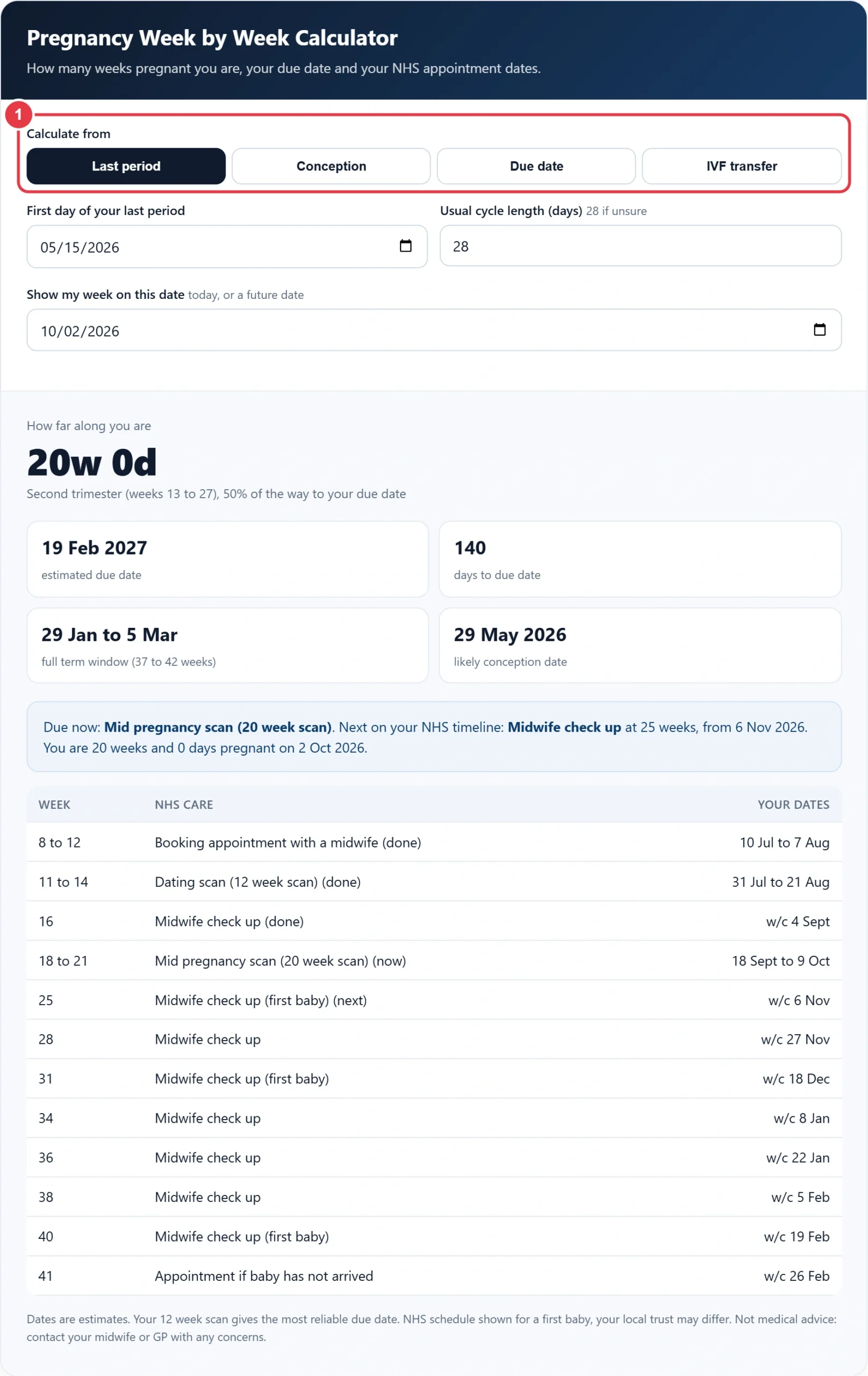
Step 1: Choose Your Starting Point
Pick Last period if you know when your last period began. Choose Due date once you have had your dating scan, because the scan date is more accurate and replaces any estimate based on your period. Use Conception if you tracked ovulation, or IVF transfer after fertility treatment.
Step 2: Enter the Date and Your Cycle
Type or pick the date. For the last period method, enter your usual cycle length, counted from the first day of one period to the first day of the next. Leave it at 28 if your cycles vary a lot or you have recently stopped hormonal contraception.

Step 3: Choose the Date to Check
The calculator shows your week for today by default. Change the date to see how far along you will be for a wedding, a flight or the day you plan to tell work. To count the exact days between two dates for leave planning, the days between dates calculator is handy, and it pairs well with the timeline here.

Step 4: Read Your Week and Timeline
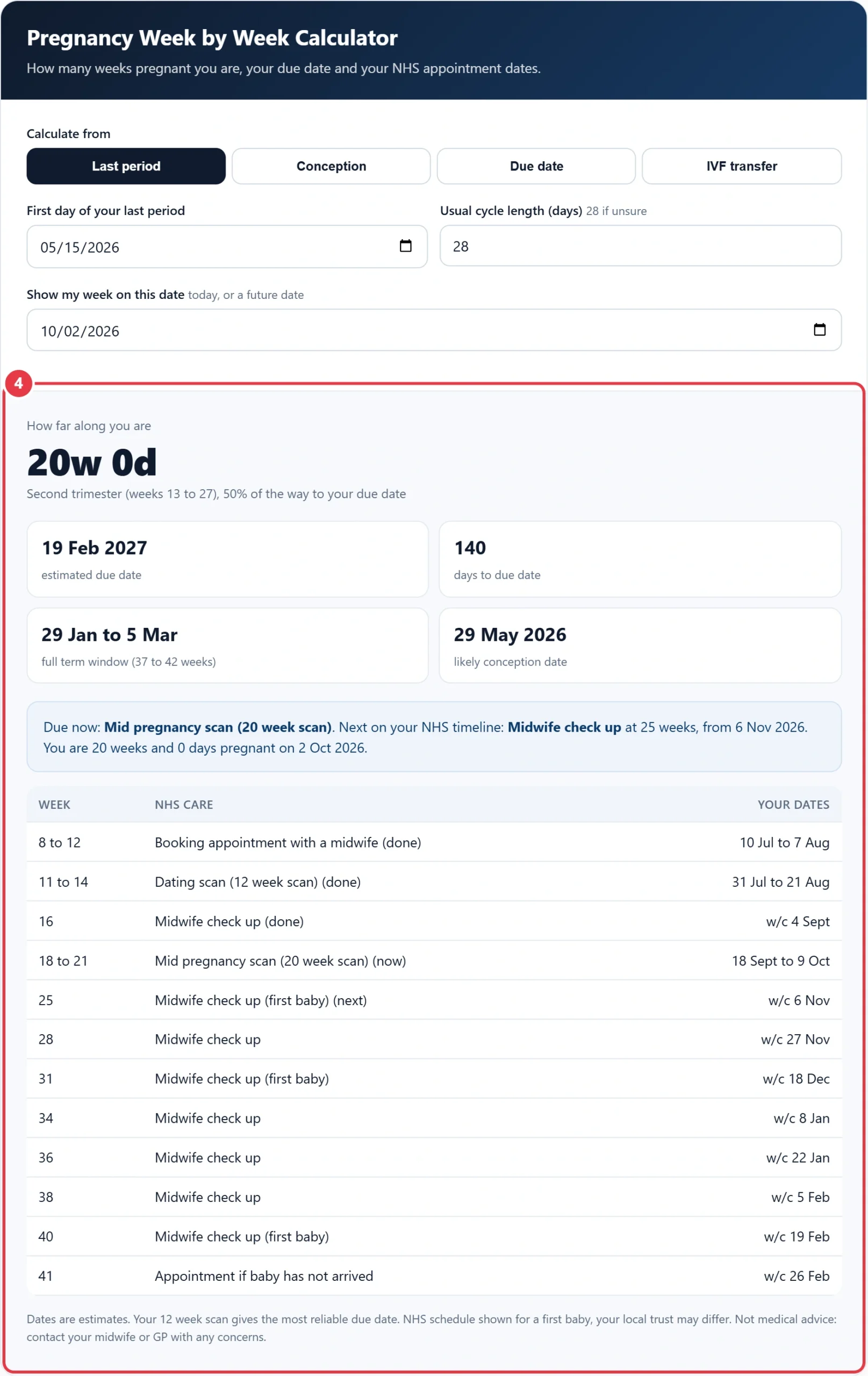
You will see your weeks and days, trimester, due date, days to go, the full term window and a likely conception date. Underneath, every routine NHS appointment for a first pregnancy has its own date range marked done, now or next.
How Many Weeks Pregnant Am I?
Count the days from the first day of your last period to today and divide by 7: the whole number is your weeks and the remainder is your days. If your period started 150 days ago, you are 21 weeks and 3 days pregnant.
Take Emma, whose last period began on 3 March 2026 and whose cycle is usually 31 days. The pregnancy week by week calculator moves her start date three days later, to 6 March, and adds 280 days to give a due date of 11 December 2026. On 2 October 2026 she is exactly 30 weeks pregnant, in her third trimester. Her full term window runs from 20 November to 25 December, and her dating scan window was 22 May to 12 June. Once that scan confirms a date, she switches the calculator to Due date and every result updates to match.
Pregnancy Trimesters and NHS Appointments
The NHS groups pregnancy into weeks 1 to 12, 13 to 27 and 28 to 40 or beyond. The table shows the routine care a first pregnancy usually includes, and the NHS guide to ultrasound scans confirms the two standard scans fall at 11 to 14 weeks and 18 to 21 weeks, so you can plan time off around them.
| Trimester | Weeks | Routine NHS care |
|---|---|---|
| First | 1 to 12 | Booking appointment at 8 to 12 weeks, dating scan from 11 weeks |
| Second | 13 to 27 | Dating scan up to 14 weeks, check up at 16 weeks, 20 week scan at 18 to 21 weeks, check up at 25 weeks (first baby) |
| Third | 28 to 40+ | Check ups at 28, 31 (first baby), 34, 36, 38 and 40 (first baby) weeks, plus 41 weeks if the baby has not arrived |
- Second and later pregnancies usually have fewer routine check ups, so the 25, 31 and 40 week appointments may not apply.
- Your due date is an estimate. Most babies arrive in the five week full term window rather than on the day itself.
- Planning leave and money early helps. The maternity pay calculator works from the same due date, so you can see your Statutory Maternity Pay weeks alongside this timeline.
This tool gives estimates and is not medical advice. Contact your midwife, GP or maternity unit straight away if you have bleeding, severe tummy pain, fluid leaking, a bad headache with blurred vision, or notice your baby moving less than usual. A pregnancy week by week calculator cannot replace your scan dates or your midwife's advice.
Pregnancy Week by Week Calculator Terms Explained
These medical terms explain how the pregnancy week by week calculator counts your pregnancy, helping you read your due date, trimester and appointment timeline with confidence.
- Gestational age
- The length of a pregnancy measured from the first day of the last menstrual period and written in weeks and days. Midwives and doctors use it to time scans, screening tests and checks on the baby's growth throughout pregnancy.
- Naegele's rule
- A traditional method for estimating the due date by adding 280 days to the first day of the last period. It assumes a regular 28 day cycle, so the date needs moving when cycles are reliably longer or shorter.
- Trimester
- One of three broad stages a pregnancy is divided into, each linked to different developmental milestones and antenatal checks. The calculator shows which one you are currently in alongside your weeks and days of gestation.
- Dating scan
- An early ultrasound examination, offered around 12 weeks in the NHS schedule, that measures the baby to give a more accurate due date. Once it has been done, its result replaces any estimate based on the last period.
- Blastocyst
- An embryo about five days after fertilisation, with an inner cell mass that becomes the baby and an outer layer that helps form the placenta. In IVF, a day 5 transfer uses a blastocyst, which alters the due date count.
</>Embed this calculator on your website
Add the free Pregnancy Week by Week Calculator to your own site or blog. Copy the code below and paste it into an HTML block. It resizes itself and works on phones.
How we checked this tool: the Tools Veria Editorial Team built this tool by hand, checked it against the official rules or published standards where they apply, and tested it against worked examples. Results are estimates for planning, not personal financial or tax advice. Read our editorial policy and disclaimer, or report an error.
Frequently Asked Questions
How is my due date calculated?
Your due date is the first day of your last period plus 280 days, which is 40 weeks. The calculator adjusts for cycles longer or shorter than 28 days, and your 12 week dating scan then gives a more accurate date.
Why am I 2 weeks pregnant at conception?
Pregnancy is counted from the first day of your last period, about two weeks before you ovulate and conceive. So at conception you are already counted as roughly 2 weeks pregnant, even though the embryo is newly formed.
What are the trimester weeks on the NHS?
The NHS splits pregnancy into the first trimester (weeks 1 to 12), the second trimester (weeks 13 to 27) and the third trimester (week 28 until birth, usually around 40 weeks).
How accurate is a due date calculator?
It is a good estimate if your cycle is regular, but only a small share of babies are born on their due date. Most arrive between 37 and 42 weeks, and a dating scan at 11 to 14 weeks narrows the estimate.
When is the 20 week scan?
The NHS mid pregnancy scan, often called the 20 week scan, is offered between 18 and 21 weeks. It checks how your baby is developing and looks for 11 specific physical conditions.
Can I use this calculator after IVF?
Yes. Choose IVF transfer, enter the transfer date and pick day 3 or day 5 embryo. A day 5 transfer gives a due date 261 days later and a day 3 transfer gives one 263 days later.